From Straw-Figures to Lasers: What’s the Best Method to Scare Birds from Sweet Corn?

human-like figure with plaid shirt and straw hands, red bow tie, cloth face smiling, and straw hat

Image by Jacques Gaimard from Pixabay

by Julie Kikkert, Cornell Cooperative Extension, Cornell Vegetable Program

(Reprinted with permission from Cornell VegEdge Newsletter Vol. 17 (14), July 14, 2021, CCE Cornell Vegetable Program, CanandaiguaNY.)

Scaring birds out of sweet corn and other crops is not new, based on the centuries-old placement of scarecrows dressed in old clothes (oftentimes filled with straw) in fields. However, there are many newer methods from chemical control to loud noises, to laser beams. There are pros and cons to each method and varied costs as well. [Read more…]

Allium leaf miner update: 04/21/21

Allium Leaf Miner

Allium leaf miner (ALM) feeding/egg laying scars continue to increase in chive plantings near Milford, Hunterdon County and Lawrenceville, Mercer County as of this Tuesday.  Chives in home gardens in central Morris County and southern Cape May County were also found to be infested this past weekend, with adults actively flying in plants.  The first (spring) flight of these flies appears well underway.  Yellow sticky cards have captured low, but consistent (range 1-5/card/week) numbers of adults in Hunterdon and Mercer County plantings.  Foliar insecticide applications temporarily suppress catches on the cards.  Growers throughout the state should assume there is egg laying activity in their area currently.

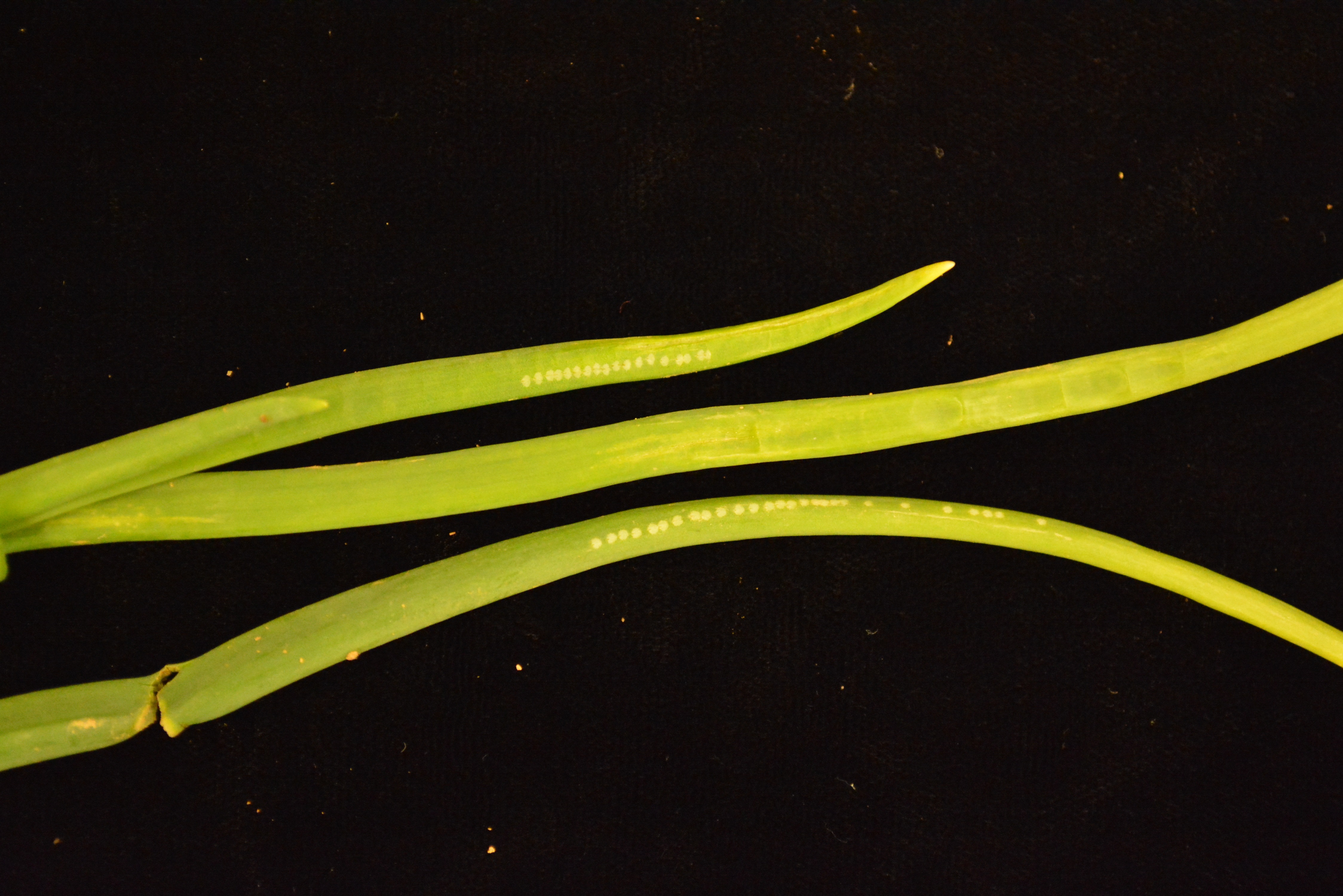
Damaged plantGrowers should consider initiating (continuing) the control method of their choice at this time.  Affected crops include chives, scallions, garlic, onions and leeks.  Look for neat rows of white spots descending from the upper tips of allium leaves (see photo at left).  Initial injury often occurs on the tallest leaves.  Under warmer, less breezy conditions, adults may be seen near the tips of leaves (see photo of adults at lower right).  Click on photos to enlarge the images.

Floating row covers, kept on until this flight ends will help minimize access to plants.  Insecticide applications targeting adults may be helpful as well, although weekly sprays have not stopped foliar injury.  Spinosyn materials (Radiant, Entrust (OMRI approved)), pyrethroids (Mustang Maxx, Warrior), neonicotinoids (Scorpion, Venom), the diamide Exirel (section 2ee recommendation) and the insect growth regulator Trigard are labeled for  leaf miner control.Damaged plant

Adult activity and observations of feeding will be reported on in the IPM Update as they occur.  At this time, all growers should continue to respond to the first adult generation.  We will attempt to identify the end of the first flight so that growers know when the risk of infestation has abated.


Allium leaf miner update: 04/06/21

Allium Leaf Miner

Allium leaf miner (ALM) feeding/egg laying scars were detected in a large chive planting near Milford, Hunterdon County on Tuesday of this week.  Feeding was very low (<0.5% of chive clusters), but several adults were observed in the planting.  This indicates that the first (spring) flight of these flies has now begun and damage will increase.  No injury or adults were found in a similar inspection of a commercial chive planting near Lawrenceville (Mercer Co.) on the same day.  Yellow sticky cards were deployed in both locations and will be checked weekly.  We look to identify the peak of the flight in central and northern NJ, as well as the period when the adult population is in decline.  Growers in southern counties should assume there is egg laying activity in their area currently.

Photo: Sabrina Tirpak. Allium leafminer oviposition scars on onion

The Milford and Princeton NJ weather stations that are closest to these farms both surpassed 250 growing degree days (GDD) base 39˚F on Monday (4/5).  This GDD base is close to that (38.3˚ F) which our colleagues at Penn State recommend for predicting the first emergence of ALM adults.

Growers should consider initiating the control method of their choice at this time.  Affected crops include chives, scallions, garlic, onions and leeks.  Look for neat rows of white spots descending from the upper tips of allium leaves (see photo at left).  Initial injury often occurs on the tallest leaves.  Under warmer, less breezy conditions, adults may be seen near the tips of leaves (see photo of adult at lower right).

Floating row covers, kept on until this flight ends will help minimize access to plants.  Insecticide applications targeting adults may be helpful as well, although frequency of applications is uncertain.  Spinosyn materials (Radiant, Entrust (OMRI approved)), pyrethroids (Mustang Maxx, Warrior), neonicotinoids (Scorpion, Venom) and the insect growth regulator Trigard are labeled for miner control.

Adult activity and observations of feeding will be reported on in the IPM Update as they occur.  At this time, all growers should respond to the first adult generation.  We will attempt to identify the end of the first flight so that growers know when the risk of infestation has abated.


Assistance Needed: Sweet Corn Bird Damage Survey

This applies to all sweet corn producers. Researchers at the University of Rhode Island are currently distributing an online survey about fresh market sweet corn. If you grow fresh market sweet corn you are eligible to take this short 5-minute online survey.

Your participation and feedback are extremely valuable to the success of this research. The survey will gather information on growers’ bird damage levels to sweet corn and prevention methods used to deter bird damage.

To take this survey, please click here or paste the following link into your URL, https://uri.co1.qualtrics.com/jfe/form/SV_8qBBeU2HAIwcKYl.

We thank you in advance for taking this survey. If you have further questions or interested in this study please see the contact information bQR codeelow.

For More Information contact:

Dr. Rebecca Brown at brownreb@uri.edu
Department of Plant Science and Entomology

Natalie Meyer at natalie_meyer@uri.edu
Department of Environmental and Natural Resource Economics

Allium leaf miner update: 04/09/20

Allium Leaf Miner

Allium leaf miner (ALM) adults were captured in higher numbers (16/week) on yellow cards in Princeton (Mercer Co.), NJ on Tuesday of this week, while lower numbers (2) were found near Milford, Hunterdon County.  Additionally, a garlic field near Asbury on the Warren/Hunterdon border was found to have 64% of plants exhibiting feeding/egglaying scars.  This indicates that the first (spring) flight of these flies is now in full swing, and damage is ongoing.  ALM flies were observed on foliage in all fields that were inspected this week.

Oviposition scars on onion

Photo: Sabrina Tirpak. Allium leafminer oviposition scars on onion

Growers should consider implementing the control method of their choice at this time.  Affected crops include chives, scallions, garlic, onions and leeks.

Floating row covers, kept on until this flight ends will help minimize access to plants.  Insecticide applications targeting adults may be helpful as well, although frequency of applications is uncertain.  Spinosyn materials (Radiant, Entrust (OMRI approved)), pyrethroids (Mustang Maxx, Warrior),  neonicotinoids (Scorpion, Venom) and the insect growth regulator Trigard are labeled for miner control.  The diamide, Exirel, is permitted in NJ under a 2ee label as well.

Adult activity and observations of feeding will be reported on in the IPM Update as they occur.  At this time, all growers should respond to the first adult generation.  We will attempt to identify the end of the first flight so that growers know when the risk of infestation has abated.



Allium leaf miner update: 03/24/20

Allium Leaf Miner

Allium leaf miner (ALM) feeding/egglaying scars were detected in chives near Princeton (Mercer Co.), NJ on Tuesday of this week.  This indicates that the first (spring) flight of these flies has now begun and damage will increase.  Additionally, extension personnel at Penn State have reported finding the first feeding scars in several southeastern PA sites within the past few days.  It is believed that all of these occurrences are very recent.

Allium leafminer oviposition scars on onion

Photo: Sabrina Tirpak. Allium leafminer oviposition scars on onion

Growers should consider initiating the control method of their choice at this time.  Affected crops include chives, scallions, garlic, onions and leeks.

Floating row covers, kept on until this flight ends will help minimize access to plants.  Insecticide applications targeting adults may be helpful as well, although frequency of applications is uncertain.  Spinosyn materials (Radiant, Entrust (OMRI approved)), pyrethroids (Mustang Maxx, Warrior),  neonicotinoids (Scorpion, Venom) and the insect growth regulator Trigard are labeled for miner control.

Adult activity and observations of feeding will be reported on in the IPM Update as they occur.  At this time, all growers should respond to the first adult generation.  We will attempt to identify the end of the first flight so that growers know when the risk of infestation has abated.