Vegetable IPM Update 5/30/25

Greetings from the Veg IPM team! The program welcomes Martina Lavender and Coco Lin as the first two scouts of the season, servicing North and Central Jersey respectively.

Sweet Corn

We’ve put out corn earworm pheromone traps throughout the state. While silking corn is the main target of CEW activity, we set the traps early to detect overwintering moths. So far, we haven’t spotted any serious corn pests through visual inspection.

Cole Crops 
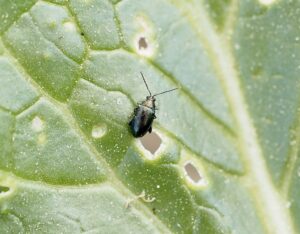
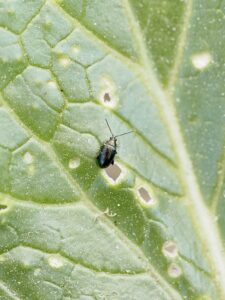
A shiny black beetle with straight antennae stands on a leaf surrounded by circular feeding holes.

Flea beetle surrounded by feeding damage. Picture by Maria Cramer.

Flea beetle remain active in various cole crops. This year, they have been especially prevalent in lacinato kale, Napa cabbage and bok choy. Young plants are especially vulnerable to attack from flea beetles. The treatment threshold for flea beetles in heading cole crops is 50% infestation.
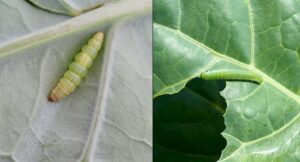
 

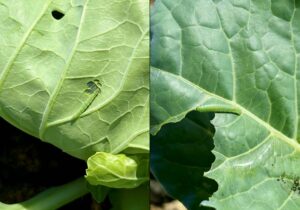
Left: Smooth caterpillar, tapered at each end. Right: fuzzy caterpillar. Both are on brassica leaves.

Left: Diamondback moth caterpillar, showing characteristic tapering at each end. Right: Imported cabbageworm caterpillar showing characteristic fuzziness. Pictures by Maria Cramer.

We’re seeing caterpillar activity (imported cabbageworm in the North and diamondback moth in the South) in cabbage and other cole crops. Treatment thresholds vary between crops and growth stage, but for heading cole crops between early vegetative and cupping, the treatment threshold is 30%. At this stage, sprayable Bt products (IRAC 11A) such as Dipel, Xentari, or Javelin can be effective on young imported cabbage worm caterpillars. Other materials approved for caterpillar control include Entrust/Radiant (IRAC 5), Proclaim (IRAC 6), Torac (IRAC 21A), and Exirel (IRAC 28). Diamondback moth has resistance to many insecticide groups, and pyrethroids (IRAC 3A) are not effective for their management. For Bt products and contact insecticides, coverage on the undersides the leaves is essential.

Tomatoes

In high tunnels and the first field plantings of tomatoes, we’re seeing limited aphid, thrips, and spider mite activity. If dealing with primarily aphids, products such as Beleaf (IRAC 29) are recommended, especially if plants have reached the flowering stage. We have seen aphid populations decline over the last couple of weeks without spray, probably due to lady beetle predation and parasitism from wasps. For thrips, Entrust, Radiant (IRAC 5) and Torac (IRAC 21A) can be used. For spider mites, Nealta (IRAC 25) is an effective material that is more friendly to beneficial insects, but Portal (IRAC 21A) and other materials can be used to manage populations. We’ve seen very few Colorado potato beetles, so while no controls are needed yet, we’ll keep an eye out for increasing populations.
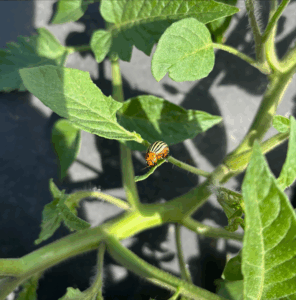
Colorado potato beetle adult in tomato

Diseases

With little break in the rainy weather, we’re seeing plants stressed by flooding and some bacterial and fungal diseases popping up in tomatoes, peppers, and cole crops. If you’re seeing disease symptoms and need a diagnosis, samples can be sent to Rutgers Plant Diagnostic Laboratory.

We’ve detected bacterial leaf spot of tomatoes and peppers on a few farms in the central and northern parts of the state (see photos below). Copper may help mitigate symptoms, but some strains have developed resistance due to continued copper use. Other products that may help include Actigard and Quintec. Otherwise, properly managing nutrients and growing conditions for the plant will be crucial for reducing the severity of this disease.
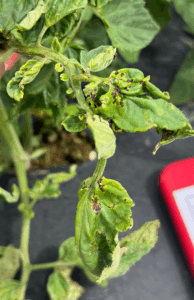
Bacterial leaf spot on tomato
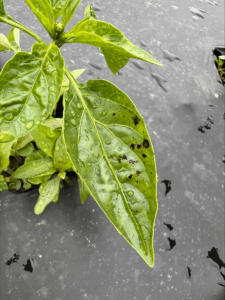
Bacterial leaf spot on pepper


Despite the rain, we also saw some rhizoctonia in cole crops, which shows up when transplant plugs dry out. For more information on this disease, check out the recent update in the PPA.

Please consult the Mid-Atlantic Commercial Vegetable Production Guide for a more comprehensive list of materials that are labeled for specific crops and pests. As always, be sure to follow label rates and application instructions.

Authors: Amanda Quadrel (Northern NJ Veg IPM coordinator) and Maria Cramer (Southern NJ Veg IPM coordinator)
Vegetable IPM Update 5/15/25

Greetings from the Veg IPM team! No major changes have taken place between last week and this week, and with the rainy weather, scouting has been limited.

Sweet Corn

We’ve put out corn earworm pheromone traps throughout the state. While silking corn is the main target of CEW activity, we set the traps early to detect overwintering moths, which have become more common with warmer winters. As a reminder, we’re no longer using blacklight traps as of this year, and we’ll be reporting pheromone trap counts in the Plant Pest Advisory as the season progresses. So far, we haven’t spotted any corn pests through visual inspection.

Cole Crops 

A shiny black beetle with straight antennae stands on a leaf surrounded by circular feeding holes.

Flea beetle surrounded by feeding damage. Picture by Maria Cramer.

Flea beetle are active in various cole crops. This year, they have been especially prevalent in Napa cabbage and bok choy. Young plants are especially vulnerable to attack from flea beetles. The treatment threshold for flea beetles in heading cole crops is 50% infestation.


Two picture, the picture on the left shows a smooth caterpillar that tapers at both ends. The picture on the right shows a caterpillar that is fuzzy all over and does not taper at either end.

Left: Diamondback moth caterpillar, showing characteristic tapering at each end. Right: Imported cabbageworm caterpillar showing characteristic fuzziness. Pictures by Maria Cramer.

We’re seeing caterpillar activity (imported cabbageworm and diamondback moth) in cabbage and other cole crops. Treatment thresholds vary between crops and growth stage, but for heading cole crops between early vegetative and cupping, the treatment threshold is 30%. At this stage, sprayable Bt products (IRAC 11A) such as Dipel, Xentari, or Javelin can be effective on young caterpillars. Other materials approved for caterpillar control include Entrust/Radiant (IRAC 5), Proclaim (IRAC 6), Torac (IRAC 21A), and Exirel (IRAC 28). For Bt products and contact insecticides, coverage on the undersides the leaves is essential.


Tomatoes

In high tunnels and the first field plantings of tomatoes, we’re seeing limited aphid, thrips, and spider mite activity. If dealing with primarily aphids, products such as Beleaf (IRAC 29) are recommended, especially if plants have reached the flowering stage. For thrips, Entrust, Radiant (IRAC 5) and Torac (IRAC 21A) can be used. For spider mites, Nealta (IRAC 25) is an effective material that is more friendly to beneficial insects, but Portal (IRAC 21A) and other materials can be used to manage populations.


Please consult the Mid-Atlantic Commercial Vegetable Production Guide for a more comprehensive list of materials that are labeled for specific crops and pests. As always, be sure to follow label rates and application instructions.

Authors: Amanda Quadrel (Northern NJ Veg IPM coordinator) and Maria Cramer (Southern NJ Veg IPM coordinator)
 

Vegetable IPM Update 5/08/25

Sweet Corn

We’ve put out corn earworm pheromone traps throughout the state. While silking corn is the main target of CEW activity, we set the traps early to detect overwintering moths, which have become more common with warmer winters. As a reminder, we’re no longer using blacklight traps as of this year, and we’ll be reporting pheromone trap counts in the Plant Pest Advisory as the season progresses.

Cole Crops 

A shiny black beetle with straight antennae stands on a leaf surrounded by circular feeding holes.

Flea beetle surrounded by feeding damage. Picture by Maria Cramer.

Flea beetle are active in various cole crops. This year, they have been especially prevalent in Napa cabbage and bok choy. Young plants are especially vulnerable to attack from flea beetles. The treatment threshold for flea beetles in heading cole crops is 50% infestation.


Two picture, the picture on the left shows a smooth caterpillar that tapers at both ends. The picture on the right shows a caterpillar that is fuzzy all over and does not taper at either end.

Left: Diamondback moth caterpillar, showing characteristic tapering at each end. Right: Imported cabbageworm caterpillar showing characteristic fuzziness. Pictures by Maria Cramer.

We’re seeing caterpillar activity (imported cabbageworm and diamondback moth) in cabbage and other cole crops. Treatment thresholds vary between crops and growth stage, but for heading cole crops between early vegetative and cupping, the treatment threshold is 30%. At this stage, sprayable Bt products (IRAC 11A) such as Dipel, Xentari, or Javelin can be effective on young caterpillars. Other materials approved for caterpillar control include Entrust/Radiant (IRAC 5), Proclaim (IRAC 6), Torac (IRAC 21A), and Exirel (IRAC 28). For Bt products and contact insecticides, coverage on the undersides the leaves is essential.


Tomatoes

In high tunnel tomatoes, we’re seeing limited aphid, thrips, and spider mite activity. If dealing with primarily aphids, products such as Beleaf (IRAC 29) are recommended, especially if plants have reached the flowering stage. For thrips, Entrust, Radiant (IRAC 5) and Torac (IRAC 21A) can be used. For spider mites, Nealta (IRAC 25) is an effective material that is more friendly to beneficial insects, but Portal (IRAC 21A) and other materials can be used to manage populations.


Please consult the Mid-Atlantic Commercial Vegetable Production Guide for a more comprehensive list of materials that are labeled for specific crops and pests. As always, be sure to follow label rates and application instructions.

Authors: Amanda Quadrel (Northern NJ Veg IPM coordinator) and Maria Cramer (Southern NJ Veg IPM coordinator)


Allium leaf miner update: 04/29/24

Allium Leaf Miner (ALM)

As of last week, allium leaf miner (ALM) adults were still being captured on sticky cards placed in chive plantings in Mercer and Hunterdon counties, and in a garlic planting in Morris County.  Numbers had declined somewhat from catches the week of 4/15.  There is a possibility that damaging levels of ALM adults remain.  Once we cease to capture adults, another update will follow.

Deceased tree branch

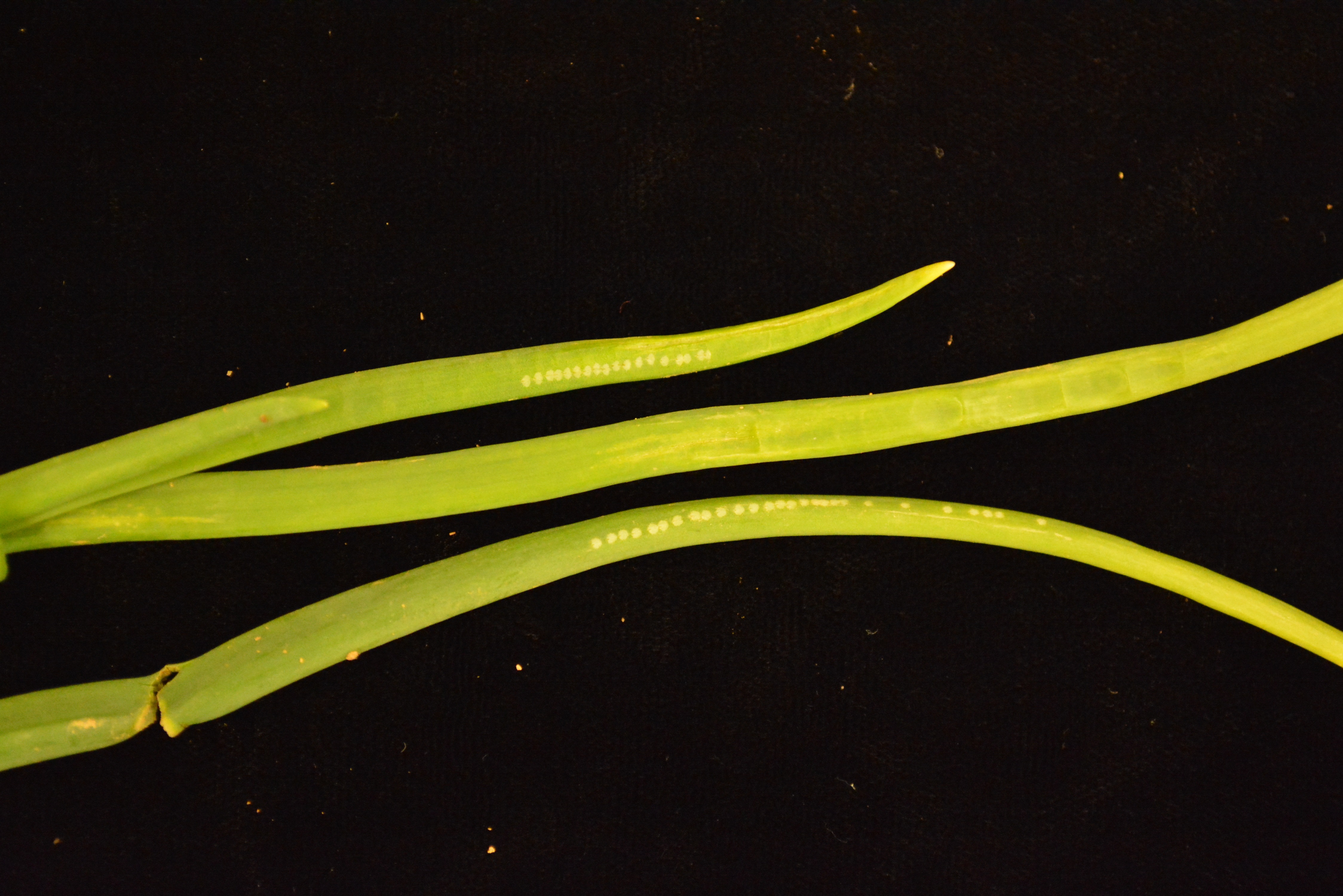
Photo: Sabrina Tirpak. Allium leaf miner oviposition scars on onion

Growers should consider initiating the control method of their choice at this time, if any allium crops are in the field.  Affected crops include chives, scallions, garlic, onions and leeks.  Look for neat rows of white spots descending from the upper tips of allium leaves (see photo at left).  Initial injury often occurs on the tallest leaves.  Under warmer, less breezy conditions, adults may be seen near the tips of leaves (see photo of adult at lower right).  Perennial chive beds are often the first, and most heavily infested alliums of the spring season, so this makes chives an ideal crop to confirm ALM adult activity.

Floating row covers, kept on until this flight ends will help minimize access to plants.  Insecticide applications targeting adults may be helpful as well, although frequency of applications is uncertain.  Spinosyn materials (Radiant, Entrust (OMRI approved)), pyrethroids (Mustang Maxx, Spider on leafWarrior), neonicotinoids (Scorpion, Venom), the diamide Exirel (section 2ee recommendation) and the insect growth regulator Trigard are labeled for miner control.


Allium leaf miner update: 03/25/24

Allium Leaf Miner (ALM)

Many weather stations on the NEWA network except for typical colder sites in northern New Jersey have surpassed 250 growing degree days (GDD) base 39˚F.  39˚F is close to the lower developmental temperature (38.3˚ F) which our colleagues at Penn State recommend for predicting the first emergence of ALM adults.    In recent years, initial feeding/egg laying scars have been detected within a few days of local weather stations recording the 250 GDD threshold.  Growers who feel they may be impacted by this pest should check the accumulated GDD from local weather stations.   Growers in southern counties may reasonably assume there will be ALM activity in their area soon, if not already happening.  To determine GDD from local weather stations, the NEWA website https://newa.cornell.edu/ is very helpful.  From the NEWA home screen, select the nearest weather station from drop down menu at the center of the page.  Next, scroll down to “Weather Tools” on the right side of the page, and select “DD Calculator”.  Select your start date (1/01/24) and end date as well as Degree Day Type (39 F) from the menu at the left of the page.  The site will automatically generate the accumulated GDD base 39F to the last day of your requested sample, and then offer a forecast of accumulated GDD for the next week.   If you should select 1˚C, then the DD accumulation should be 350.

Deceased tree branch

Photo: Sabrina Tirpak. Allium leaf miner oviposition scars on onion

Growers should consider initiating the control method of their choice at this time, if any allium crops are in the field.  Affected crops include chives, scallions, garlic, onions and leeks.  Look for neat rows of white spots descending from the upper tips of allium leaves (see photo at left).  Initial injury often occurs on the tallest leaves.  Under warmer, less breezy conditions, adults may be seen near the tips of leaves (see photo of adult at lower right).  Perennial chive beds are often the first, and most heavily infested alliums of the spring season, so this makes chives an ideal crop to confirm ALM adult activity.

Floating row covers, kept on until this flight ends will help minimize access to plants.  Insecticide applications targeting adults may be helpful as well, although frequency of applications is uncertain.  Spinosyn materials (Radiant, Entrust (OMRI approved)), pyrethroids (Mustang Maxx, Spider on leafWarrior), neonicotinoids (Scorpion, Venom), the diamide Exirel (section 2ee recommendation) and the insect growth regulator Trigard are labeled for miner control.

Adult activity and observations of feeding will be reported on in the IPM Update as they occur.


Allium leaf miner update: 04/06/23

Allium Leaf Miner (ALM)

Allium leaf miner feeding and egg laying injury was discovered on chives and garlic near Milford in Hunterdon County on Wednesday.  All weather stations on the NEWA network except for a few in the highest elevation sites in northern New Jersey have surpassed 250 growing degree days (GDD) base 39˚F.  39˚F is close to the lower developmental temperature (38.3˚ F) which our colleagues at Penn State recommend for predicting the first emergence of ALM adults.    In recent years, initial feeding/egg laying scars have been detected within a few days of local weather stations recording the 250 GDD threshold.  Growers who feel they may be impacted by this pest should check the accumulated GDD from local weather stations.   Growers in southern counties may reasonably assume there will be ALM activity in their area soon, if not already happening.  To determine GDD from local weather stations, the NEWA website https://newa.cornell.edu/ is very helpful.  From the NEWA home screen, select the nearest weather station from drop down menu at the center of the page.  Next, scroll down to “Weather Tools” on the right side of the page, and select “DD Calculator”.  Select your start date (1/01/23) and end date as well as Degree Day Type (39 F) from the menu at the left of the page.  The site will automatically generate the accumulated GDD base 39F to the last day of your requested sample, and then offer a forecast of accumulated GDD for the next week.

Deceased tree branch

Photo: Sabrina Tirpak. Allium leafminer oviposition scars on onion

Growers should consider initiating the control method of their choice at this time.  Affected crops include chives, scallions, garlic, onions and leeks.  Look for neat rows of white spots descending from the upper tips of allium leaves (see photo at left).  Initial injury often occurs on the tallest leaves.  Under warmer, less breezy conditions, adults may be seen near the tips of leaves (see photo of adult at lower right).  Perennial chive beds are often the first, and most heavily infested alliums of the spring season, so this makes chives an ideal crop to confirm ALM adult activity.  At the Milford site this week, chives had feeding/egg laying scars on nearly 30% of leaves.  The garlic field, which was approximately a half mile away, exhibited only 2% infested plants.  A primary reason for this lower infestation rate in the garlic is that allium crops had not been grown in that field for several years.

Floating row covers, kept on until this flight ends will help minimize access to plants.  Insecticide applications targeting adults may be helpful as well, although frequency of applications is uncertain.  Spinosyn materials (Radiant, Entrust (OMRI approved)), pyrethroids (Mustang Maxx, Spider on leafWarrior), neonicotinoids (Scorpion, Venom), the diamide Exirel (section 2ee recommendation) and the insect growth regulator Trigard are labeled for miner control.

Adult activity and observations of feeding will be reported on in the IPM Update as they occur.