Nursery – Pest Scouting Guide for July – BWB and RHFB Reminders

NURSERY PEST SCOUTING GUIDE – JULY (1300-2200 GDD50)

Please download and print the pest scouting guide resources (printable version of the information below for your desk or truck) –(click on the link and then print)

To determine your local growing degree-days, please review this postObtaining your local growing degree-day information”

Projected GDD50 accumulation as of 7/1/2021
Region Location 1-Jul 1-Aug 1-Sep 1-Oct 1-Nov
Southern Upper Deerfield (NJ50) 1303 2145 2931 3477 3682
Central Howell / Freehold (NJ10) 1102 1896 2630 3109 3249
Northern High Point (NJ59) 884 1490 2045 2352 2384
Forecast: NOAA NCEP Coupled Forecast System model version 2 (CFSv2) forecast system (3.5 months) (USPEST.ORG)


(Same material as downloads)

Nursery Pest Scouting – Growing Degree-day Ranges  (1300-2200 GDD50) 
CROP TYPE Common Name Scientific Name GDD Min (50F) GDD Max (95F) Reference Developmental / Target Stage
Many Japanese beetle  Popillia japonica 950 2150 5 Adults emerge and feed
Turf Bluegrass billbug Sphenophorus parvulus 1094 1217 RU Larvae (40%)
Many Indian wax scale Ceroplastes ceriferus 1145 6 Crawlers (1st generation)
Many Oriental Beetle Anomala orientalis 1147 6 Adult emergence
Euonymus Euonymus Scale Unaspis euonymil 1150 1388 5 2nd generation targeted treatments
Dogwood Dogwood sawfly Macremphytus tarsatus 1151 1500 RU Larvae Treatment
Tulip Tuliptree aphid Illinoia liriodendri 1151 1514 RU Nymphs / adults
Boxwood Boxwood leafminer  Monoarthropalpus flavus 1200 1400 5 Larvae Treatment
Conifer Northern pine weevil Pissodes nemorensis 1200 1400 4 2nd generation adults active
Conifer Pales weevil Hylobius pales 1200 1400 4 Adults 2nd generation
Conifer Pine root collar weevil  Hylobius radicis 1200 1400 4 2nd generation adults active
Conifer White pine weevil Pissodes strobi 1200 1400 4 2nd generation adults active
Rhododendron Azalea whitefly Pealius azaleae 1250 1500 5 Adults/nymphs (2nd generation)
Turf Bluegrass sod webworm Parapediasia teterrella 1250 1920 RU Larvae
Birch Birch Skeletonizer Bucculatrix canadensisella 1266 1580 5 Typical treatment window
Shade trees European fruit lecanium Parthenolecanium corni 1266 1645 5 Crawlers
Many Fall webworm Hyphantria cunea 1266 1795 2 Caterpillars present – larvae treatment
Many Lacebugs ( on hawthorn) Corythucha cydoniae 1266 1544 RU Nymphs / adults
Many Leafhoppers Species within Cicadellidae  1266 1544 RU Nymphs / adults
Privet Privet rust mite Aculus ligustri 1266 1515 5 Second typical treatment window
Conifer Pine Needle Scale Chionaspis pinifoliae 1290 1917 3 Crawlers emerge (2nd generation)
Many Two spotted spider mite  Tetranychus urticae 1300 2000 RU Nymphs / adults
Turf N. Masked chafer Cyclocephala borealis 1377 1579 RU Adults (90%)
Conifer Hemlock scale Abgrallaspis ithacae 1388 2154 5 Typical treatment window
Lilac Lilac leafminer  Caloptilia syringella 1388 1644 5 Typical treatment window
Conifer Cooley spruce gall adelgid Adelges cooleyi 1500 1775 RU Adults/nymphs (Douglas Fir)
Malus, Prunus, many Peachtree borer Synanthedon sp. 1500 1800 RU Larvae Treatment
Conifer Pine Needle Scale Chionaspis pinifoliae 1500 4 Hyaline crawlers = treatment timing
Conifer Nantucket tip moth Rhyacionia frustrana 1514 1917 RU Adults 2nd generation
Many Roundheaded apple tree borer Saperda candida 1514 1798 5 Typical treatment window
Many Redheaded flea beetle Systena frontalis 1570 1860 Udel. 2nd generation egg hatch
Many Japanese beetle  Popillia japonica 1590 1925 RU Adults (90%)
Many White prunicola scale Pseudaulacaspis prunicola 1637 6 Egg hatch / crawler (2nd generation)
Conifer Rust-mites  Nalepella and Setoptus spp. 1644 2030 RU Nymphs / adults
Many Two-banded Japanese weevil Pseudocneorhinus bifasciatus 1644 2271 RU Adults
Willow Willow twig aphids Lachnus spp. 1644 2271 5 Typical treatment window
Conifer Juniper webworm Dichomeris marginella 1645 1917 RU Larvae Treatment
Euonymus Euonymus Scale Unaspis euonymil 1700 RU Continued 2nd generation treatments
Conifer Cryptomeria scale Aspidiotus cryptomeriae 1750 2130 RU, 4 Crawlers emerge (2nd generation)
Many Obscure scale Melanaspis obscura 1774 6 Egg hatch / crawler
Oaks Oak skeletonizer Bucculatrix ainsliella 1798 2155 RU Larvae
Conifer Arborvitae leafminer Argyresthia thuiella 1800 2200 RU Larvae Treatment (3rd generation)
Mimosa, Honeylocust Mimosa webworm Homadaula anisocentra  1800 2100 RU Larvae (2nd generation)
Conifer Cooley spruce gall adelgid Adelges cooleyi 1850 1950 RU Galls open (Spruce)
Turf Hairy chinch bug  Blissus leucopterus 1903 2160 RU Second generation- 50%- 2nd instars
Tulip Tuliptree aphid Illinoia liriodendri 1917 2033 RU Nymphs
Conifer Zimmerman pine moth Dioryctria zimmermani 1917 2154 5 Treatment window (adult flight-1700 GDD)
Mainly Oaks Orangestriped oakworm Anisota senatoria 1917 6 Egg hatch – early instars
Conifer White pine aphid Cinara strobi 1991 2271 RU Adults
Rhododendron Azalea whitefly Pealius azaleae 2032 2150 5 Adults/nymphs (3rd generation)
Maple Sugar maple borer Glycobius speciosus 2032 2375 5 Typical treatment window
Conifer Maskell scale lepidosaphes pallia 2035 6 Egg hatch / crawler (2nd generation)
Mainly Tulip Tulip tree scale Toumeyella liriodendri  2037 2629 RU Crawlers (1st generation)
Mainly Magnolia Magnolia scale Neolecanium cornuparvum 2155 2800 RU Crawlers (1st generation)
Locust Locust borer Magacyllene robiniae 2271 2805 5 Typical treatment window
Poplar and Willow Poplar and willow borer  Crytorhynchus lapathi 2271 2806 5 Typical treatment window
Conifer Spruce spider mite  Oligonychus ununguis 2375 2806 5 Typical treatment window
Note: Growing degree-day values utilize daily average air temperatures with a minimum temperature threshold (a.k.a. ‘base’) of 50F = GDD50 (max. temp. threshold set at 95F). These values are accumulated from a biofix date, such as January or March 1st in the NE USA. Provided GDD50 are scouting ranges and should be truthed. References RU Rutgers Cooperative Extension – Landscape IPM Notes
2 http://ccetompkins.org/resources/using-growing-degree-days-for-insect-management
3 https://extension.psu.edu/ipm-basics-for-christmas-trees#section-2
4 https://www.canr.msu.edu/ipm/agriculture/christmas_trees/gdd_of_conifer_insects
5 https://www.agriculture.nh.gov/publications-forms/documents/landscape-pests.pdf
Daily GDD50 =                                                                                                  (Max + Min temp.) / 2 – 50 (min temp. threshold) 6 https://extension.umd.edu/ipm/pest-predictive-calendar-landscapenursery
7 https://www.canr.msu.edu/ipm/agriculture/christmas_trees/gdd_of_landscape_insects
Unv. Del. Coorespondance with Dr. Kunkel (University of Delaware)-evolving GDD ranges
Compiled 7-6-2021 – Timothy J. Waller, Ph.D. – Rutgers Cooperative Extension, Cumberland County Nursery Crops – twaller@njaes.rutgers.edu  

Redheaded flea beetle considerations:

Adults are mating and laying eggs in southern NJ. Contact material applications are still viable to target adults now (if found scouting) but will also be useful when treating larvae prior to emergence from the soil/growing media in a few weeks time. The use of systemics should also be considered to protect foliage from the next generations adults and again late season to guard from first generation adults in the 2022 spring season.

NOTE: The majority of RHFB I have personally observed have been seen later in the evening, especially if the foliage is wet. I have also isolated an anthracnose pathogen (Colletotrichum sp.) from what appeared to be damaged leaves. Thus a complete fungicide – insecticide program needs to be in place if this is a high value crop for your business.


Boxwood blight considerations: 

Preventative applications should continue in high value plantings. As with the vast majority of foliar diseases, overhead irrigation plays a major role in reducing the staying power and efficacy of fungicides. Overhead irrigation or rain events also play a critical role in pathogen dispersal and ease of entry by these pathogens into plant tissues. Anything you can do to reduce/limit overhead irrigation in virtually all crops will aid in reducing the overall disease pressure that your plants experience.

Boxwood Blight Risk Model (CLICK HERE) – In 30 seconds you can have a better idea of boxwood blight (and other pathogen) activity in your immediate area!

    • (click on the link – input area code – select closest weather station – check 7-14 prediction – click on graph / table) 

Great new resources by Steve Rettke

Mimosa Webworm Activity Begins

Some Key Soft Scale Pests in the Landscape


SURVEY REQUESTS

Please answer a few questions if you would like to be included in a statewide Phytophthora in Conifer Nurseries sampling project 

Please fill out this brief survey if you are experiencing damages due to Redheaded flea beetle (RHFB)

Contact – Timothy J. Waller – twaller@njaes.rutgers.edu for more information
Nursery – Pest Scouting Guide for June, Boxwood blight advisory, survey requests

BOXWOOD BLIGHT

There is an immediate potential for boxwood blight June 4/5th throughout NJ.

Preventative / protective fungicide applications should be initiated and continued in high value crops

Boxwood Blight risk-model information, considerations, and links:

Boxwood Blight Risk Assessment as of 6/1/2021
Region Location CODE 1-Jun 2-Jun 3-Jun 4-Jun 5-Jun 6-Jun
Southern Upper Deerfield NJ50 Very Low  Very Low  Low  Infection Risk Infection Risk Low 
Central Howell / Freehold NJ10 Low  Very Low  Low  Infection Risk Infection Risk Low 
Northern High Point NJ59 Very Low  Very Low  Low  Infection Risk High Risk Low 
Please check your local boxwood blight risk here (click here and type in your area code – select closest station)


Wednesday 5/4/21 -PPA Post regarding boxwood blight activity (click here)

  • These advisories are general in nature and change rapidly so someone from your business should be using this risk model (CLICK HERE) daily if boxwood is important to your financial stability – In 30 seconds you can have a better idea of boxwood blight (and other pathogen) activity in your immediate area!
    • (click on the link – input area code – select closest weather station – check 7-14 prediction – click on graph / table) 


NURSERY PEST SCOUTING GUIDE – JUNE

To determine your local growing degree-days, please review this postObtaining your local growing degree-day information”

Projected GDD50 accumulation as of 6/1/2021
Region Location 1-Jun 1-Jul 1-Aug 1-Sep 1-Oct
Southern Upper Deerfield (NJ50) 590 1283 2125 2910 3456
Central Howell / Freehold (NJ10) 438 1078 1873 2607 3085
Northern High Point (NJ59) 353 837 1444 1999 2305
Forecast: NOAA NCEP Coupled Forecast System model version 2 (CFSv2) forecast system (3.5 months) (USPEST.ORG)


Nursery Pest Scouting – Growing Degree-day Ranges (500-1300 GDD50)
CROP TYPE Common Name Scientific Name GDD Min (50F) GDD Max (95F) Reference Developmental / Target Stage
Many Spotted Lantern Fly Lycorma delicatula 250 1000 PA Dept. Ag 1st-4th Instar (nymphs) – control target
Conifer European pine shoot moth Rhyacionia buoliana 480 710 5 Larvae Treatment
Malus, Prunus, many Peach Tree Borer Synanthedon sp. 500 600 RU Adults – emerge (1st treatment both types)
Rhododendron Rhododendron Borer Synanthedon rhododendri 509 696 RU Adults emerge
Many Redheaded flea beetle Systena frontalis 517 1028 Unv. Del Adults – feeding / laying eggs
Many Cottony camellia / taxus scale Pulvinaria floccifera 520 6 Crawlers (1st generation)
Birch Birch Leafminer Fenusa pusilla 530 700 RU Larvae (2nd generation)
Oak Oak blotch leafminers Cameraria spp. ; Tisheria spp. 533 912 5 Typical treatment window
Maple Greenstriped mapleworm Dryocampa rubicunda 533 1645 5 Control target
Conifer Arborvitae Leafminer Argyresthia thuiella 533 700 RU Adults (egg laying) – larvae treatments
Euonymus Euonymus Scale Unaspis euonymil 533 820 RU Crawlers (1st generation)
Conifer Balsam gall midge Paradiplosis tumifex 550 700 4 Galls apparent
Conifer Juniper scale Carulaspis juniperi 550 700 7 Egg hatch
Malus, Prunus, many Greater peach tree borer Synanthedon exitiosa 575 710 4 Adult emergence
Conifer Cryptomeria scale Aspidiotus cryptomeriae 600 800 3 First crawler emergence
Conifer Cooley spruce gall adelgid Adelges cooleyi 600 1000 7 Nymphs active – Douglas fir (control target)
Conifer Bagworm Thyridopteryx ephemeraeformis 600 900 RU Larvae (early instars) – ONLY CONTROL WINDOW
Conifer Cryptomeria scale Aspidiotus cryptomeriae 600 800 RU Crawlers (1st generation)
Elm Elm leaf beetle Xanthogaleruca luteola 600 1300 7 Larvae (2nd generation)
Conifer Spruce budscale Physokermes hemicryphus 700 1150 4 Crawlers (1st generation)
Many White prunicola scale Psedaulacaspis prunicola 707 1151 RU Crawlers (1st generation)
Conifer Juniper scale Carulaspis juniperi 707 1260 RU Crawlers (1st generation)
Many Calico scale Eulecanium cerasorum 714 6 Crawlers (1st generation)
Conifer Striped pine scale Toumeyella pini 750 800 4 Egg hatch
Turf Hairy cinch bug Blissus leucopterus 765 870 RU 1st generation (50% – 2nd instar)
Oak, hickory, birch, many Oak leacanium scale Parthenolecanium quercifex 789 6 Crawlers (1st generation)
Rhododendron Azalea Lacebug Stephanitis pyrioides 802 1029 RU Eggs / Nymphs 3rd Generation
Many, shadetrees Cottony maple scale Pulvinaria innumerabilis 802 1265 RU Crawlers (1st generation) – control target
Oaks Oak spider mites Oligonychus bicolor 802 1265 RU All Stages
Many Roundheaded appletree borer Saperda candida 802 1129 RU Adults
Oaks Golden oak scale Asterolecanium variolosum 802 1266 5 Egg hatch
Acer Cottony maple leaf scale Pulvinaria acericola 802 1265 5 Crawlers (1st generation)
Maples Japanese maple scale Lopholeucaspis japonica 829 6 Crawlers (1st generation)
Elm European elm scale Gossyparia spuria 831 1388 6,2 Crawlers (1st generation)
Mimosa, Honeylocust Mimosa webworm Homadaula anisocentra 880 RU Larvae (1st generation)
Turf Bluegrass billbug Sphenophorus parvulus 884 1003 RU Larvae 20%
Turf N. Masked chafer Cyclocephala borealis 898 905 RU 1st adults
Honeylocust Honeylocust mite Eotetranychus multidigituli 912 1514 2 All Stages
Honeylocust Honeylocust spider mite Platytetranychus multidigituli 912 1514 5 Typical treatment window
Shade trees European fruit lecanium Parthenolecanium corni 932 1645 6,RU Crawlers  – control target
Many Japanese beetle Popillia japonica 950 2150 7 Adult emergence and feeding
Conifer Pine tortoise scale Toumeyella parvicornis 1000 1200 4 Egg hatch ends, last of crawlers
Ash Emerald ash borer Agrilus planipennis 1000 1200 4 Peak adult activity
Many Redheaded flea beetle Systena frontalis 1028 1570 Unv. Del 2nd generation of un-hatched eggs
Yew, many conifers Fletcher Scale (Yew) Parthenolecanium fletcheri 1029 1388 RU Crawlers (1st generation) – control target
Locust Locust leafminer Odontota dorsalis 1029 1388 RU Adults
Juglandaceae Walnut Caterpillar Datana integerrima 1029 1514 2 Larvae Treatment
Many Indian wax scale Ceroplastes ceriferus 1145 6 Crawlers (1st generation)
Many Oriental Beetle Anomala orientalis 1147 6 Adult emergence
Euonymus Euonymus Scale Unaspis euonymil 1150 1388 5 2nd generation targeted treatments
Dogwood Dogwood sawfly Macremphytus tarsatus 1151 1500 RU Larvae Treatment
Tulip Tuliptree aphid Illinoia liriodendri 1151 1514 RU Nymphs / adults
Conifer Northern pine weevil Pissodes nemorensis 1200 1400 4 2nd generation adults active
Conifer Pine root collar weevil Hylobius radicis 1200 1400 4 2nd generation adults active
Conifer White pine weevil Pissodes strobi 1200 1400 4 2nd generation adults active
Boxwood Boxwood leafminer Monoarthropalpus flavus 1200 1400 5 Larvae Treatment
Conifer Pine Needle Scale Chionaspis pinifoliae 1250 1350 7 Crawlers (2nd generation)
Rhododendron Azalea whitefly Pealius azaleae 1250 1500 5 Adults/nymphs
Many Lacebugs ( on hawthorn) Corythucha cydoniae 1266 1544 RU Nymphs / adults
Many Leafhoppers Species within Cicadellidae 1266 1544 RU Nymphs / adults
Many Fall webworm Hyphantria cunea 1266 1795 2 Caterpillars present – larvae treatment
Privet Privet rust mite Aculus ligustri 1266 1515 5 Second typical treatment window
Many Two spotted spider mite Tetranychus urticae 1300 2000 RU Nymphs / adults
Conifer Cooley spruce gall adelgid Adelges cooleyi 600 1000 7 Nymphs active – Douglas fir (control target)
RU Rutgers Cooperative Extension – Landscape IPM Notes
2 http://ccetompkins.org/resources/using-growing-degree-days-for-insect-management
3 https://extension.psu.edu/ipm-basics-for-christmas-trees#section-2
4 https://www.canr.msu.edu/ipm/agriculture/christmas_trees/gdd_of_conifer_insects
5 https://www.agriculture.nh.gov/publications-forms/documents/landscape-pests.pdf
6 https://extension.umd.edu/ipm/pest-predictive-calendar-landscapenursery
7 https://www.canr.msu.edu/ipm/agriculture/christmas_trees/gdd_of_landscape_insects
Unv. Del. Coorespondance with Dr. Kunkel (University of Delaware)
Compiled 6-1-2021 – Timothy J. Waller, Ph.D. – Rutgers Cooperative Extension, Cumberland County Nursery Crops – twaller@njaes.rutgers.edu


SURVEY REQUESTS

Phytophthora sampling project – grower collaborators wanted 

Please answer a few questions if you would like to be included in a statewide Phytophthora in Conifer Nurseries sampling project 

Redheaded Flea beetle NJ specific survey: 

Please fill out this brief survey if you are experiencing damages due to Redheaded flea beetle (RHFB)

Contact – Timothy J. Waller – twaller@njaes.rutgers.edu for more information

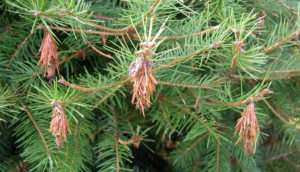
It is time to put Bagworms on your radar in Southern NJ

Bagworms

Photo: Rich Buckley

Bagworms should begin hatching in the next 2-6 weeks throughout NJ, starting in the southern regions. Now is an optimal time to get this pest on your radar and prepare materials or approaches to attack first/second instar caterpillars. The control window for this pest is typically between 600-900 GDD50 (growing degree-days) and treatments should be in use prior to their mobile, airborne, “ballooning” phase. Check that the eggs have hatched prior to application of pesticides – as most compounds will not be effective at all if the first instar caterpillars are not present. Lethal pesticide doses are important, as sub-lethal doses can trigger early pupation, making the pest all but invincible to chemical or biological treatments.


Bagworm management – mechanical: If eggs have not hatched: hand-remove sacs/bags. Typically female/egg filled sacs are higher in the canopy so keep that in mind while scouting.

Treatment options for Lepidoptera (caterpillars) to have at the ready – containing: B.t. (Bacillus thuringiensis)(Dipel), spinosad (Entrust SC), bifenthrin (Talstar, UP-Star), cyfluthrin (Decathlon 20WP), carbaryl (Sevin SL), chlorantraniliprole (Acelepryn), cyclaniliprole (Sarisa), cyclaniliprole + flonicamid  (Pradia), Lambda-cyhalothrin (Scimitar GC), cyantraniliprole (Mainspring), Indoxacarb(Provaunt)

IT IS CRITICAL TO ROTATE AS MUCH AS POSSIBLE BETWEEN IRAC GROUPS DUE TO THE NUMBER OF POTENTIAL APPLICATIONS

DISCLAIMER: The label is the law, always refer to it for allowable host crops, use-restrictions, application rates, reapplication intervals, re-entry intervals (REI), and mix compatibility information. Production and pesticide information on this site are for private/commercial pesticide applicators and landscape professionals only, and are NOT for home gardener use. Provided materials represent examples and do not cover all possible control scenarios. Trade-names listed do not imply endorsement and are used as examples only. Please contact your local agent or chemical sales representative for more information or to discuss additional pest management options.

More information on Bagworms:

Steve Rettke’s 2020 PPA Post – Bagworm caterpillars have hatched throughout most of NJ

RU Bagworm FactSheet 

Bagworms on Ornamental Landscape Plants


Photo Credits: Rich Buckley (Plant Diagnostics Laboratory) https://njaes.rutgers.edu/plant-diagnostic-lab/


IMPORTANT NOTICE – Considerations for systemic and contact material control of Redheaded Flea Beetle – now

If you are unfamiliar with this pest

*****Please take this 5-minute survey pertaining to your concerns with Redheaded flea beetles in NJ (click here)***** 

If you are interested in donating infested plant material or conducting on-farm RHFB research. Please contact twaller@njaes.rutger.edu (856-451-2800 ext.1)


Redheaded Flea Beetle (RHFB) Considerations

Ideally when controlling high-density populations of RHFB, fall applications of long-lasting systemic materials can provide a strong knock-down of larvae populations destined to emerge in the following spring. Establishing a reserve of systemic materials in the soil and root zone late-season or early this season will greatly increase control efforts made later and can reduce the number of overall applications made specifically for RHFB.  A two-pronged approach of systemic and contact insecticides can manage active adults and larvae throughout the season.  For current season control: systemic insecticide drench or ‘sprench’ (*consider backpack units) near planting / potting-up, or a month prior to adult emergence (now for southern NJ), will provide the reserve of systemic activity required to reduce larvae and adult populations later. Contact material applications should also be considered for adult and larval treatments but must be made at sufficient volumes to guarantee ‘contact’. Contact-only driven spray regimes can provide good results, however the need to protect new growth will be ever present. When choosing materials, also consider the other pests targeted by that compound to maximize the value of your investment. Targeting the larval stage will reduce the number of adults present to lay the next generation of eggs.

Timeline for New Jersey growers and landscape professionals 

  • NOTE: Calendar date predictions based on USPEST.ORG using weather-stations for Upper Deerfield (NJ50), Howell/Freehold (NJ10), and High Point (NJ59). These are predictions and scouting should commence at least 2 weeks prior to listed dates
Projected GDD50 accumulation as of 4/26/2021
Region Location 26-Apr 1-May 1-Jun 1-Jul Aug. 1st
Southern Upper Deerfield (NJ50) 163 231 638 1315 2158
Central Howell / Freehold (NJ10) 110 166 514 1135 1929
Northern High Point (NJ59) 61 99 313 765 1327
Forecast: NOAA NCEP Coupled Forecast System model version 2 (CFSv2) forecast system (3.5 months) (USPEST.ORG)


Redheaded flea beetle – life stage predictions for South, Central, and Northern New Jersey with material considerations
TARGET RANGE TARGET RANGE Upper Deerfield (NJ50) Howell (NJ10) High Point (NJ59)
Growth Stage Gen. GDD50 LOW GDD50 HIGH LOW (DATE) HIGH (DATE) LOW (DATE) HIGH (DATE) LOW (DATE) HIGH (DATE)
Egg hatch – larvae 1st 242 600 2-May 29-May 10-May 6-Jun 24-May 21-Jun
Adults                            (feeding / laying eggs) 1st 517 1028 24-May 20-Jun 1-Jun 27-Jun 16-Jun 14-Jul
POTENTIAL OVERLAP OF GENERATIONS / STAGES
Egg hatch – larvae 2nd 1570 1860 10-Jul 21-Jul 17-Jul 29-Jul 11-Aug 27-Aug
Adults                            (feeding / laying eggs) 2nd 1878 2318 22-Jul 7-Aug 30-Jul 16-Aug 28-Aug 1-Oct

Note: Updated 4/26/2021 – Estimated using USPEST.org, 3.5-month CFSv2 based seasonal climate forecast, simple average growing degree-days, min temp: 50F, max temp: 95F. Growing degree-day ranges based on Dr. Kunkel’s work out of the University of Delaware. 

  • 1st generation larvae: 242-600 GDD50 
    • Observation of larval activity on the outside of root balls occurs during this timeframe, meaning they may be active earlier
    • Systemic treatments should be initiated late fall or immediately on susceptible hosts (southern NJ)to guard plants from adult feeding later this season.
      • Materials containing neonicotinoids [4A] and cyantraniliprole [28] (Mainspring) are considered particularly fast and effective, however lack the staying power of similar chemistries such as Chlorantraniliprole [28] (Acelepryn) that takes longer to translocate from soil reserves.
      • Organophosphates (1B) Acephate (Orthene, Acephate 97UP) are also a systemic options.
    • During larval development contact materials containing bifenthrin, azadirachtin, tolfenpyrad, cyclaniliprole + flonicamid, entomopathogenic fungi (Beauveria bassiana) or beneficial nematodes should be seriously considered when attempting to knock-down forthcoming adult populations.
  • 1st generation adults: 517-1028 GDD50 
    • Feeding damages will be apparent on susceptible hosts, scout to determine best time of day for applications, materials such as Captiva Prime or another agitator may be useful in driving the beetles out of hiding (which they do EXTREMELY well).
    • Continuation of systemic materials, use contact materials to directly target the adults.
    • Keep weed populations to a minimum, adults may feed on nearby weed species such as dog fennel, pigweed, and knotweed, thus avoiding pest control efforts on susceptible crops
  • 2nd gen. larvae: 1570-1860 GDD50
    • Potential for considerable overlap of larval-adult developmental stages
    • Continuation of systemic materials, use contact materials to directly target the larvae and adults.
  • 2nd gen. adults: 1878-2318 GDD50
    • Continuation of systemic materials, use contact materials to directly target the larvae and adults.
    • Keep weed populations to a minimum
  • A third generation is suspected to be possible in the southern and central regions of New Jersey

IT IS CRITICAL TO ROTATE AS MUCH AS POSSIBLE BETWEEN IRAC GROUPS DUE TO THE NUMBER OF POTENTIAL APPLICATIONS

DISCLAIMER: The label is the law, always refer to it for allowable host crops, use-restrictions, application rates, reapplication intervals, re-entry intervals (REI), and mix compatibility information. Production and pesticide information on this site are for private/commercial pesticide applicators and landscape professionals only, and are NOT for home gardener use. Provided materials represent examples and do not cover all possible control scenarios. Trade-names listed do not imply endorsement and are used as examples only. Please contact your local agent or chemical sales representative for more information or to discuss additional pest management options.

Boxwood Blight risk model update (4/26 – 5/1) 

Boxwood Blight Risk Assessment as of 4/26/2021
Region Location CODE 26-Apr 27-Apr 28-Apr 29-Apr 30-Apr 1-May
Southern Upper Deerfield NJ50 Very Low  Very Low  Very Low  Very Low  Very Low  Very Low 
Central Howell / Freehold NJ10 Very Low  Very Low  Very Low  Very Low  Low  Very Low 
Northern High Point NJ59 Very Low  Very Low  Very Low  Low  Low  Very Low 
Please check your local boxwood blight risk here (click here)  


*****Please take this 5-minute survey pertaining to your concerns with Redheaded flea beetles in NJ (click here)***** 

Please contact Tim Waller – Cumberland Co. – RCE for more information – twaller@njaes.rutgers.edu – 856-451-2800 ext. 1

Nursery and Landscape Pest Scouting Guide: 150-250 Growing Degree-days and Boxwood Blight Risk ( currently = low risk )

Nursery and Landscape Pest Scouting Guide 150-250 GDD50:

Please print or download these resources (click on them)

Remember:

  • To determine your local growing degree-days, please review this postObtaining your local growing degree-day information”
  • The information provided in the downloads gives scouting GDD50 ranges (in growing degree days, base 50F) for specific insect pests harming nursery crop production and maintenance. It is important to note that these GDD50 are not exact, rather provide a range of GDD and subsequent calendar dates that can be used to scout for, and treat for, insect pests.
  • This document supports scouting, it does not replace it. Keeping good notes on pest development will help dial in scouting and treatment efforts at your local level.
  • Forecasting predictions (GDD50 accumulation) for calendar dates of multiple regions of New Jersey (S,N,C) are provided.
  • If you need more information, OR you are regularly seeing specific pest development stages at growing degree-days different than those listed here, please contact Tim Waller at twaller@njaes.rutgers.edu

GREAT RESOURCE from Steve Rettke:Landscape Pest Notes: Some Early Spring Insects/Mites”


Projected GDD50 accumulation as of 4/15/2021
Region Location 4/15/21 1-Apr 1-May 1-Jun 1-Jul Aug. 1st
Southern Upper Deerfield (NJ50) 141 75 230 636 1314 2156
Central Howell / Freehold (NJ10) 94 67 165 513 1135 1929
Northern High Point (NJ59) 50 21 56 268 721 1327
Forecast: NOAA NCEP Coupled Forecast System model version 2 (CFSv2) forecast system (3.5 months) (USPEST.ORG)


Pest Scouting – Growing Degree-day Ranges (150-250 GDD50)
CROP TYPE Common Name Scientific Name GDD Min (50F) GDD Max (95F) Reference Developmental / Target Stage
Malus, Prunus, many Eastern tent caterpillar Malacosoma americanum 90 190 2 Larvae treatment before tents apparent (near 150-GDD50)
Elm, Service berry Woolly elm aphid Eriosoma americana 121 246 2 (6) Control target
Conifer Hemlock woolly adelgid Adelges tsugae 150 150 RU Eggs and 10% hatch
Conifer Spruce spider mite Oligonychus ununguis 150 175 4 1st egg hatch
Conifer Spruce needleminer Endothenia albolineana 150 200 4 1st larvae active
Conifer Balsam gall midge Paradiplosis tumifex 150 300 4 Adults laying eggs
Witchhazel, River birch Spiny witchhazel gall aphid Hamamelistes spinosus 171 6 Control target
Birch Birch leafminer Fenusa pusilla  190 290 RU Larvae (1st generation)
Conifer Spruce spider mite Oligonychus ununguis 190 363 RU Immatures/Adults
Honeylocust Honeylocust pod gall midge Dasineura gleditchiae 192 229 RU Larvae
Holly Holly leafminer Phytomyza ilicis 192 290 RU Egg hatch
Holly *Native holly leafminer Phytomyza ilicicola 192 298 2 Egg hatch
Rhododendron Rhododendron borer Synanthedon rhododendri 192 298 2 Typical treatment window
Larch Larch sawfly Pristophora erichsonii 192 299 2 Typical treatment window
Andromeda Andromeda lacebug Stephanitis takeyai 192 303 RU Adults
Rhododendron Rhododendron gall midge Clinodiplosis rhododendri 192 363 RU Larvae
Willows, Cottonwood, Poplar Imported willow leaf beetle Plagiodera versicolora 192 448 RU Larvae/Adults
Privet Privet thrips Dendrothrips ornatus 192 618 2 Typical treatment window
Lilac, ash, privet, many Lilac / Ash Borer Podosesia syringae 200 299 RU Adults – 1st Treatment
Spruce Spruce budworm Choristoneura fumiferana 200 300 5 Larvae
Elm Elm leafminer Fenusa ulmi 215 240 5 Adult emergence
Wild and cultivated roses Roseslug sawfly Endelomyia aethiops 230 6 Egg hatch / early instars
Deciduous, many Hawthorn lacebug Corythucha cydoniae 239 363 RU Nymphs/Adults
Conifer Arborvitae leafminer Argyresthia thuiella 245 360 RU Larvae Treatments
Prunus American plum borer Euzophera semifuneralis 245 440 5 Adult flight, egg laying
Boxwood Boxwood mites Eurytetranychus buxi 245 600 RU All Stages
Lilac Lilac leafminer Caloptilia syringella 246 363 5 Larvae Treatments
Holly Holly leafminer Phytomyza ilicis 246 448 RU Larvae Treatment
Yew Taxus mealybug Dysmicoccus wistariae 246 618 RU Adults/Crawlers
Conifer Pine sawflies (Red-headed) Neodiprion lecontei 246 1388 RU Larvae (1st generation)
Boxwood Boxwood leafminer Monarthropalpusi flavus 249 6 Adult emergence
Conifer Eastern spruce gall adelgid Adelges abietis 250 310 5 egg hatch, galls begin forming (not a control target)
References RU Rutgers Cooperative Extension – IPM Notes
2 http://ccetompkins.org/resources/using-growing-degree-days-for-insect-management
3 https://extension.psu.edu/ipm-basics-for-christmas-trees#section-2
4 https://www.canr.msu.edu/ipm/agriculture/christmas_trees/gdd_of_conifer_insects
5 https://www.agriculture.nh.gov/publications-forms/documents/landscape-pests.pdf
6 https://extension.umd.edu/ipm/pest-predictive-calendar-landscapenursery
7 https://www.canr.msu.edu/ipm/agriculture/christmas_trees/gdd_of_landscape_insects


Boxwood Blight risk-model information, considerations, and links:

Boxwood Blight Risk Assessment as of 4/15/2021
Region Location CODE 15-April 16-April 17- April 18-April 19-April
Southern Upper Deerfield NJ50 Low  Very Low  Very Low  Very Low  Very Low 
Central Howell / Freehold NJ10 Low  Very Low  Very Low  Very Low  Very Low 
Northern High Point NJ59 Very Low  Very Low  Very Low  Very Low  Very Low 
Please check your local boxwood blight risk at (https://uspest.org/risk/boxwood_app)


Considerations:

Become a Boxwood Blight Advocate to receive quarterly updates (through the Horticultural Research Institution)

Early Season Conifer and Christmas Tree Pest Scouting List Using Growing Degree-days (base 50F)

Please print or download the two resources of this post (click on them)

The information provided in the downloads gives early season scouting ranges (in growing degree days, base 50F) for specific insect pests harming conifer and Christmas tree production and maintenance. Additionally, forecasting predictions (GDD50 accumulation) for calendar dates of multiple regions of New Jersey (S,N,C) are provided.

To determine your local growing degree-days, please review this postObtaining your local growing degree-day information”

Scouting Ranges:

  • This document supports scouting, it does not replace it. Keeping good notes on pest development will help dial in scouting and treatment efforts at your local level.
  • It is important to note that these GDD50 are not exact, rather provide a range of GDD and subsequent calendar dates that can be used to scout for, and treat for, insect pests.
  • The pests listed here will be listed again in future scouting range announcements as they undergo further developmental life stages or are vulnerable to management options.
  • If you need more information, OR you are regularly seeing specific pest development stages at growing degree-days different than those listed here, please contact Tim Waller at twaller@njaes.rutgers.edu


Projected GDD50 accumulation as of
NJ Region Location March 1st April 1st May 1st June 1st July 1st
Southern Upper Deerfield (NJ50) 0 24 133 540 1217
Central Howell / Freehold (NJ10) 0 14 95 443 1064
Northern High Point (NJ59) 0 1 7 220 672
Forecast: NOAA NCEP Coupled Forecast System model version 2 (CFSv2) forecast system (3.5 months) (USPEST.ORG)


Early Season Conifer Pest Scouting – Growing Degree-day Ranges Starting (0-300 GDD50)
Common Name Scientific Name GDD Min (50F) GDD Max (95F) Reference Developmental / Target Stage
Conifer rust mites Eriophyidae 7 22 4 Overwintering eggs hatch
Eastern pine weevil Pissodes nemorensis 7 58 RU Overwintering adults become active / prevent egg laying
Taxus mealybug Dysmicoccus wistariae 7 91 2 Spring control of overwintering stage
Cottony taxus scale Pulvinaria floccifera 7 91 6 Spring control of overwintering stage
Elongate hemlock scale Fiorinia externa 7 120 2 Spring control of overwintering stage
Spruce spider mite Oligonychus ununguis 7 121 RU Overwintering eggs hatch
Pales weevil Hylobius pales 7 121 RU Overwintering adults become active / prevent egg laying
White pine aphid Cinara strobi 22 91 RU Spring control of overwintering stage
Pine bark adelgid Pineus strobi 22 58 2 Spring control of overwintering stage
Spruce bud scale Physokermes piceae 22 120 2 Spring control of overwintering stage
Juniper scale Carulaspis juniperi 22 148 2 Spring control of overwintering stage
Eastern spruce gall adelgid Adelges abietis 25 100 3 spring control of overwintering stage
Northern pine weevil Pissodes approximatus 25 100 4 1st adults active
Zimmerman pine moth Dioryctria zimmermani 25 100 3 1st larvae active
Cooley spruce gall adelgid Adelges cooleyi 25 120 3 Spring control of overwintering stage
White pine weevil Pissodes strobi 25 220 4 1st adults active
European pine sawfly Neodiprion sertifer 35 145 1 Spring control of overwintering stage
Fletcher scale Parthenolecanium fletcheri 35 148 2 Spring control of overwintering stage
European pine shoot moth / borer Rhyacionia buoiana 50 220 4 1st larvae active
Pine tortoise scale Toumeyela parvicornis 58 148 2 Cralwer activity
Pine bark adelgid Pineus strobi 58 618 2 Spring control of overwintering stage
Balsam twig aphid Mindarus abietinus 60 100 4 Egg hatch
Eastern pine shoot borer Eucosma gloriola 75 200 4 1st adults active
Cooley spruce gall adelgid Adelges cooleyi 90 180 4 1st adults active – Douglas fir
Balsam twig aphid Mindarus abietinus 100 150 4 Stem mothers present (control target)
Pine engraver (Ips bark beetle) Ips spp. 100 150 4 1st adults active
European pine sawfly Neodiprion sertifer 100 195 4 1st larvae active
Larch casebearer Coleophora laricella 120 150 4 Egg hatch
Nantucket pine tip moth Rhyacionia frustrana 121 448 RU 1st generation egg hatch
Gypsy moth Lymantria dispar 145 200 4 Egg hatch, 1st larvae
Spruce spider mite Oligonychus ununguis 150 175 4 1st egg hatch
Spruce needleminer Endothenia albolineana 150 200 4 1st larvae active
Balsam gall midge Paradiplosis tumifex 150 300 4 Adults laying eggs
Spruce budworm Choristoneura fumiferana 200 300 4 1st larvae active
Cooley spruce gall adelgid Adelges cooleyi 200 310 4 1st galls visible – Spruce
Arborvitae leafminer Argyresthia thuiella 245 360 4 Larvae in mines; 1st generation
Eastern spruce gall adelgid Adelges abietis 250 310 4 Egg hatch, galls begin forming
Pine needle scale Chionaspis pinifoliae 298 448 4 1st generation egg hatch
Pine root collar weevil Hylobius radicis 300 350 4 1st adults active
Turpentine beetle Dendroctonus terebrans 300 350 4 Parent beetles colonizing brood material
References RU Rutgers Cooperative Extension – IPM Notes
2 http://ccetompkins.org/resources/using-growing-degree-days-for-insect-management
3 https://www.canr.msu.edu/ipm/agriculture/christmas_trees/gdd_of_conifer_insects
4 https://extension.psu.edu/ipm-basics-for-christmas-trees#section-2
5 https://www.agriculture.nh.gov/publications-forms/documents/landscape-pests.pdf
6 https://extension.umd.edu/ipm/pest-predictive-calendar-landscapenursery

(Please note: we will be providing pest GDD ranges regularly throughout the season for our green industries)


Important notes about growing degree-day models:

  1. These models do not replace scoutingThey should guide scouting efforts and pest management programs, once the vulnerable life stage or economic threshold of a pest is recorded. Observations at a local level for specific pests is critical to IPM efforts and further refinement of degree-day-based predictions.
  2. GDD50 values for pest development are not exact, rather they should be viewed as a range. 
  3. The growing degree-day model (GDD50) is general by design. Some insect pests have specific formulas for their growth and development (some examples here). However, the GDD50 model is useful for many pests and plant species.
  4. Many GDD50 target values were developed in other parts of the country and should be ‘ground truthed’ at a local level. Blind applications of pesticides, without truthing pest development, may not deliver desired outcomes.