RCE Seeks Input Regarding COVID-19 Resources For 2022 Season

Rutgers Cooperative Extension’s EXCITE team is requesting NJ farmers input via a short five-minute survey about COVID-19-related resources for the upcoming growing season.  

Please click here to go to the survey: https:/go.rutgers.edu/mcgr9pzt 

This survey is totally anonymous, you do not have to answer any questions you do not want to, and you can stop at any time.  

After taking the survey, please take a minute to forward this post to other NJ farmers who may not see this message. You can copy the link or just forward this message.  

Thank you. 
On-line Ordering of Free COVID-19 At-Home Test Kits Now Open

Per the National Association of Community Health Workers <https://nachw.org/>,

“The COVID-19 pandemic shows no signs of slowing down, especially given the rise of the Omicron variant. … It is more important than ever … to have the necessary tools to safeguard … against the disease. As a result, NACHW [is] be supporting the Biden-Harris Administration’s rapid test distribution [program] … to equitably distribut[e] over 500 million tests, with the end goal of the initiative being the proliferation of testing and vaccine resources to our hardest-hit and highest-risk communities.

Ordering for free at-home COVID-19 tests is now open. When you click on the order link below, you will be asked for your zip code. Ordering today will be available to zip codes with the highest vulnerability to COVID-19. Starting this Wednesday (January 19), ordering for free at-home COVID-19 tests through this program will be open to everyone. There is a limit of 4 tests per household address and kits will be shipped by the end of January via the US Postal Service.

Use this link to order – https://nachw.org/covidtests/


COVID-19 Vaccines Still Available For Farmworkers

At the request of the New Jersey Departments of Health and Agriculture, please read the following message:

Our offices are working diligently to ensure that all farmworkers are protected against COVID-19 for the fall season – to that end, we have developed a new survey to assess the migrant and seasonal farm worker population for the fall and to identify focus areas for COVID-19 vaccination support. We would greatly appreciate if you could please fill out the survey here (even if all your workers are already vaccinated for COVID-19): http://healthsurveys.nj.gov/NoviSurvey/n/zz2q2.aspx. Any information you provide will be confidential and used solely for supporting COVID-19 vaccination efforts.

Additionally, if any of your workers are not yet vaccinated for COVID-19 and are interested in receiving a vaccine, please feel free to contact Omolola Taiwo, Ph.D,  MPA, Executive Director, Office of Primary Care and Rural Health, Division of Community Health Services, New Jersey Department of Health, at njmsfw@doh.nj.gov.  Our team will ensure that you are connected with the appropriate resources to keep your workforce healthy.

Thank you for your support in keeping our farm communities safe and healthy!

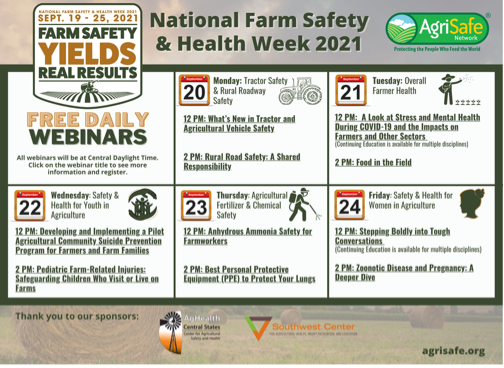
National Farm Safety and Health Week: September 19-25, 2021

Flyer for NFSHW 2021 Webinars

NFSHW webinars to be held 9/20-9/24/2021. Click here to register.

September precedes one of the busiest and most dangerous seasons of the year in agriculture – fall harvest time. For this reason, National Farm Safety and Health Week (NFSHW) is recognized annually during the third week of September. The theme this year is “Farm Safety Yields Real Results”.

AgriSafe will host two FREE webinars each day during NFSHW to highlight new technology, discuss incident prevention, and inform your decision-making and conversations. The webinars will feature discussion on each of the daily topics. Visit The National Education Center for Agricultural Safety website to register (scroll down to ‘Webinars’). Note that the webinar times are posted for Central Daylight Time.

Take an active role in keeping yourself and others safe this harvest season. Plan to join in on a webinar, encourage others to do the same, and take to social media to spread the message: “Farm Safety Yields Real Results”. Stay tuned to the Rutgers Agriculture and Natural Resources Facebook page for content to share each day during NFSHW!


Sun Exposure and Skin Cancer Precautions in Agriculture

We all want to be healthy and it is important to take measures to prevent illness and injuries. Everyone, especially farmers need to be cautious about their exposure to the ultraviolet rays (UV) of the sun. Skin cancer is the most common type of cancer in the United States and is related to repeated exposure to the sun which causes damaging changes to a person’s skin. The two types of ultraviolet rays most likely to damage a person’s skin and increase the risk for developing skin cancer are Ultraviolet A (UVA) and Ultraviolet B (UVB).


No one is immune to the sun’s UV rays; however, some skin types are more susceptible than others. People with blonde or red hair, fair skin, or freckles tend to get sunburned more quickly than others and should be even more vigilant about protecting themselves from the sun.
Skin damage builds up over the years, and once the damage has occurred, it cannot be reversed.


Risks of Sun Exposure:
One of the main health concerns of sun exposure is skin cancer. In the United States, one in five people will develop skin cancer. Contact your physician if you notice a difference in your skin or changes in moles regarding asymmetry, border, irregularities, color, or size.
The three main types of skin cancer are basal, squamous, and melanoma. Basal and squamous cancers are typically associated with long-term exposure to the sun but are seldom fatal. Melanoma can be fatal if not diagnosed and treated early and can affect people of all ages. When examining your skin for melanoma, look for changes in the size, shape, and color of existing moles and discolored patches of skin that may start small and grow.


Recommendations:
The following recommendations can reduce an agricultural producer’s risk of sun exposure, skin cancer, and other sun-induced conditions:


Sun Intensity – Exposure to harmful ultraviolet rays is most intense between 10:00 a.m. and 4:00 p.m. When possible, avoid working in direct sunlight during this time. If you must be in the sun during these hours, take shade breaks to reduce exposure, drink plenty of water, and reapply sunscreen at least every two hours.


Sunscreen – Sunscreens have one or more chemicals that absorb or disperse ultraviolet rays. Sun protection factor (SPF) is a numerical rating that indicates a specific amount of protection. You should wear a sunscreen with a minimum SPF of 15, but those with fair skin should use an SPF of 30 or higher. Due to exposure to water, weather, and perspiration, you should reapply sunscreen at least every two hours.


Clothing – Long-sleeved shirts and long pants provide protection from the sun’s rays. Darker clothing with a tight weave provides more protection from the sun than light-colored, loose-fitting clothing. Special SPF or UV-resistant clothing is available to reduce exposing your skin to the UV rays.


Hats – When it comes to sun protection, not all hats are created equal. You should wear a wide-brimmed (minimum of three inches wide) hat with flaps or drapes to provide sun protection for your eyes, ears, and neck.


Information adapted from: Sun exposure and agriculture. (2012) Farm and Ranch eXtension in Safety and Health (FReSH) Community of Practice. Retrieved from http://www.extension.org/pages/63042/sun-exposure-and-agriculture.