Search Results for: corn borer

Vegetable IPM Update 9/18/19

Sweet Corn

European corn borer (ECB) moth captures remain scattered and very low, and no map will appear in this addition.  There are very few plantings not yet silking.  Silk sprays for corn earworm (CEW) control will serve to manage ECB larvae as well.  Reminder:  Useful insecticides for worm control in the silk stage include  spinosyns (including OMRI approved Entrust) IRAC Grp 5), and diamides such as Coragen (IRAC Grp 28) or materials such as Besiege which include the active ingredient in Coragen.  Synthetic pyrethroids alone should NOT be used for corn earworm (CEW) protection on silking corn.  Control with these materials is very inconsistent.


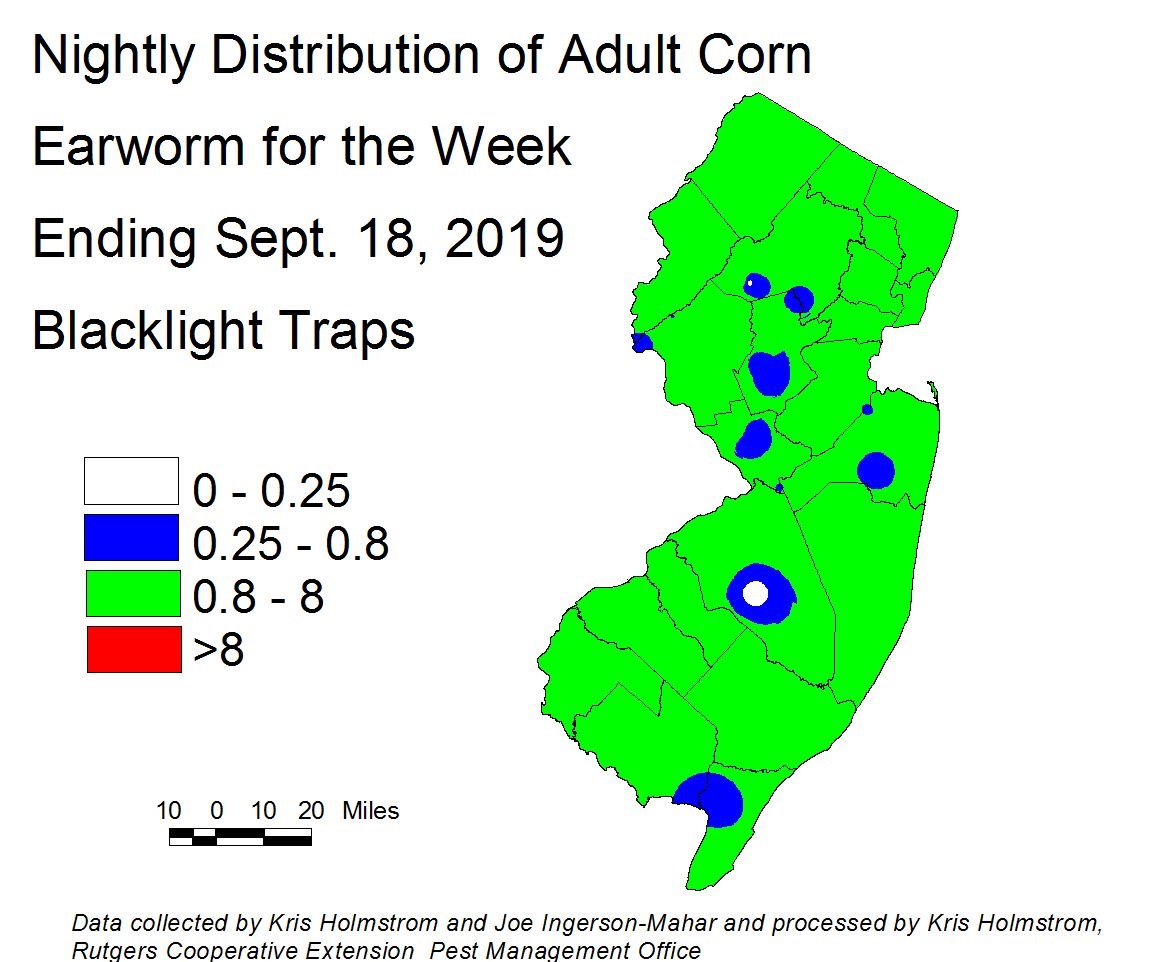
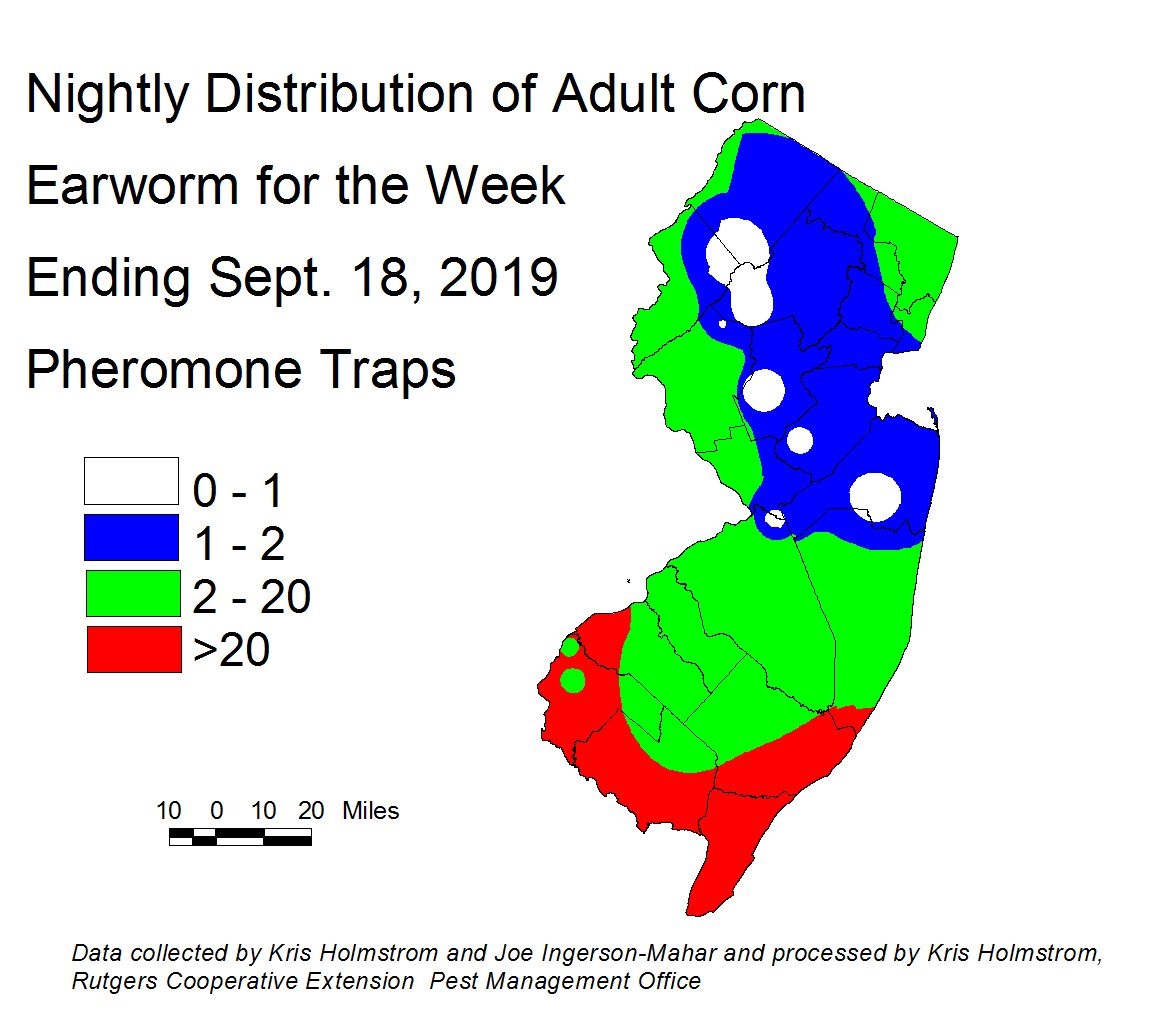
Corn earworm (CEW) moth catches have changed little in NJ this past week.  Overall, CEW numbers represent a normal late summer population.  While moth counts will decline somewhat with cool night temperatures, look for strong rebounds when nighttime temperatures exceed 60F.  The green area on the blacklight map (left) represents a 3-day silk spray schedule zone.  Blue and white areas within the overall green zone are outliers, and corn growers in or near those areas should also adhere to 3-day silk spray schedules.     Economically damaging populations of this pest are present throughout the state, and all areas are at extreme risk of crop injury if strict silk spray schedules are not observed.   Red areas on the on the pheromone trap map (below at right) indicate a 3-day silk spray schedule, while green indicates a 4-5 day silk spray schedule.  Currently, the black light network is indicating a more conservative spray regime statewide, than is the pheromone network.  Taken together, blacklight and pheromone traps are indicating 3-day silk spray schedules throughout the state.  There are far fewer CEW pheromone traps than blacklights, and the resulting map has much broader color bands as a result.  It should also be noted that the pheromone traps are much more sensitive than blacklights.  Therefore, the number of moths caught in pheromone traps required to generate a specific spray interval is much higher than the number caught in blacklight traps.   It must be stressed that there is high variability in these catches, and growers should consult with their IPM practitioner on recommended spray schedules.


[Read more…]

Vegetable IPM Update 9/11/19

Sweet Corn

European corn borer (ECB) moth captures remain scattered and very low, and no map will appear in this addition.  Feeding in late season pre-tassel corn in northern NJ continues, with some plantings exceeding the 12% threshold.   In combination with fall armyworm (FAW) feeding, action thresholds have been exceeded in all areas of the state.

Growers should continue to scout whorl and pre-tassel stage plantings weekly and consider treating when infested plants exceed 12% in a 50 plant sample.  As plantings proceed to the pre-tassel stage, ECB larvae may be found in emerging tassels.  It is a good idea to treat individual plantings as they move into the full tassel/first silk stage one time.  This eliminates any ECB larvae that have emerged with the tassels as they begin to move down the stalk to re-enter near developing ears.

Useful insecticides for this particular application include synthetic pyrethroids (IRAC Grp 3), spinosyns (including OMRI approved Entrust) IRAC Grp 5), and diamides such as Coragen (IRAC Grp 28) or materials such as Besiege which include the active ingredient in Coragen.  Synthetic pyrethroids alone should NOT be used for corn earworm (CEW) protection on silking corn.  Control with these materials is very inconsistent.

The highest nightly black light trap catches of ECB for the week ending 9/11/19 are as follows:

Allamuchy   1 Jones Island   1
Chester   1 Monroeville   1
Elm   1 Oldwick   1


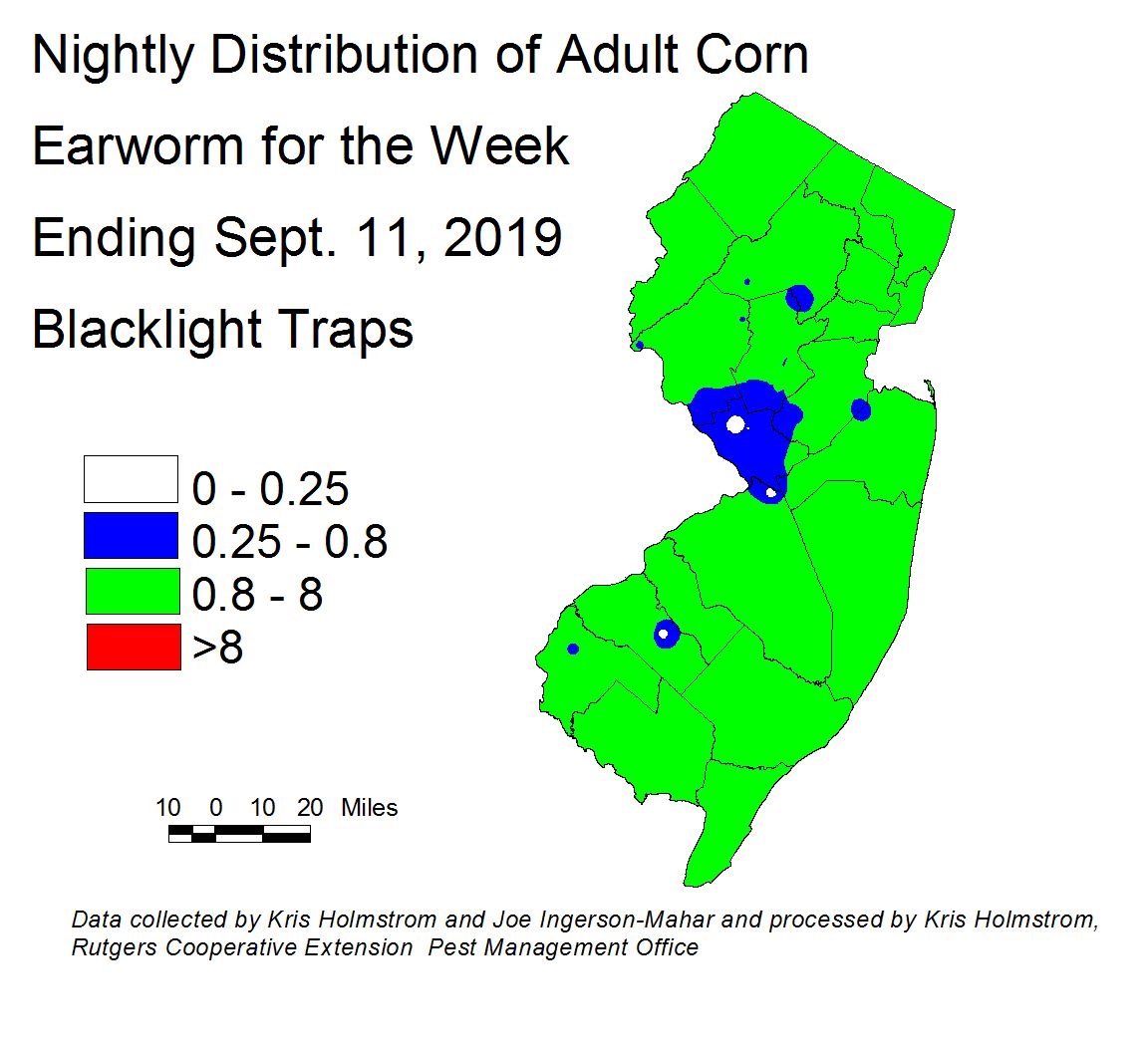
Corn earworm (CEW) moth catches have remained fairly stable in NJ this past week.  Blacklight catches are steady, while there was a slight decline in pheromone trap catches.  However, the effect on spray schedules is unchanged.  Overall, CEW numbers now represent a sizeable late summer migratory influx.  While moth counts will decline somewhat with cool night temperatures, look for strong rebounds when nighttime temperatures exceed 60F.  The green area on the blacklight map (left) represents a 3-day silk spray schedule zone.  Blue and white areas within the overall green zone are outliers, and corn growers in or near those areas should also adhere to 3-day silk spray schedules.     Economically damaging populations of this pest are present throughout the state, and all areas are at extreme risk of crop injury if strict silk spray schedules are not observed.   Red areas on the on the pheromone trap map (below at right) indicate a 3-day silk spray schedule, while green indicates a 4-5 day silk spray schedule.  Currently, the black light network is indicating a more conservative spray regime statewide, than is the pheromone network.  Taken together, blacklight and pheromone traps are indicating 3-day silk spray schedules throughout the state.  There are far fewer CEW pheromone traps than blacklights, and the resulting map has much broader color bands as a result.  It should also be noted that the pheromone traps are much more sensitive than blacklights.  Therefore, the number of moths caught in pheromone traps required to generate a specific spray interval is much higher than the number caught in blacklight traps.   It must be stressed that there is high variability in these catches, and growers should consult with their IPM practitioner on recommended spray schedules.


[Read more…]

Vegetable IPM Update 9/04/19

Sweet Corn

European corn borer (ECB) moth captures remain very low, and no map will appear in this addition.  Feeding in late season pre-tassel corn in northern NJ continues, with some plantings exceeding the 12% threshold.   In combination with fall armyworm (FAW) feeding, action thresholds have been exceeded in all areas of the state.

Growers should continue to scout whorl and pre-tassel stage plantings weekly and consider treating when infested plants exceed 12% in a 50 plant sample.  As plantings proceed to the pre-tassel stage, ECB larvae may be found in emerging tassels.  It is a good idea to treat individual plantings as they move into the full tassel/first silk stage one time.  This eliminates any ECB larvae that have emerged with the tassels as they begin to move down the stalk to re-enter near developing ears.

Useful insecticides for this particular application include synthetic pyrethroids (IRAC Grp 3), spinosyns (including OMRI approved Entrust) IRAC Grp 5), and diamides such as Coragen (IRAC Grp 28) or materials such as Besiege which include the active ingredient in Coragen.  Synthetic pyrethroids alone should NOT be used for corn earworm (CEW) protection on silking corn.  Control with these materials is very inconsistent.

The highest nightly black light trap catches of ECB for the week ending 9/04/19 are as follows:

Medford   2 Jobstown   1
Califon   1 Jones Island   1
Cinnaminson   1


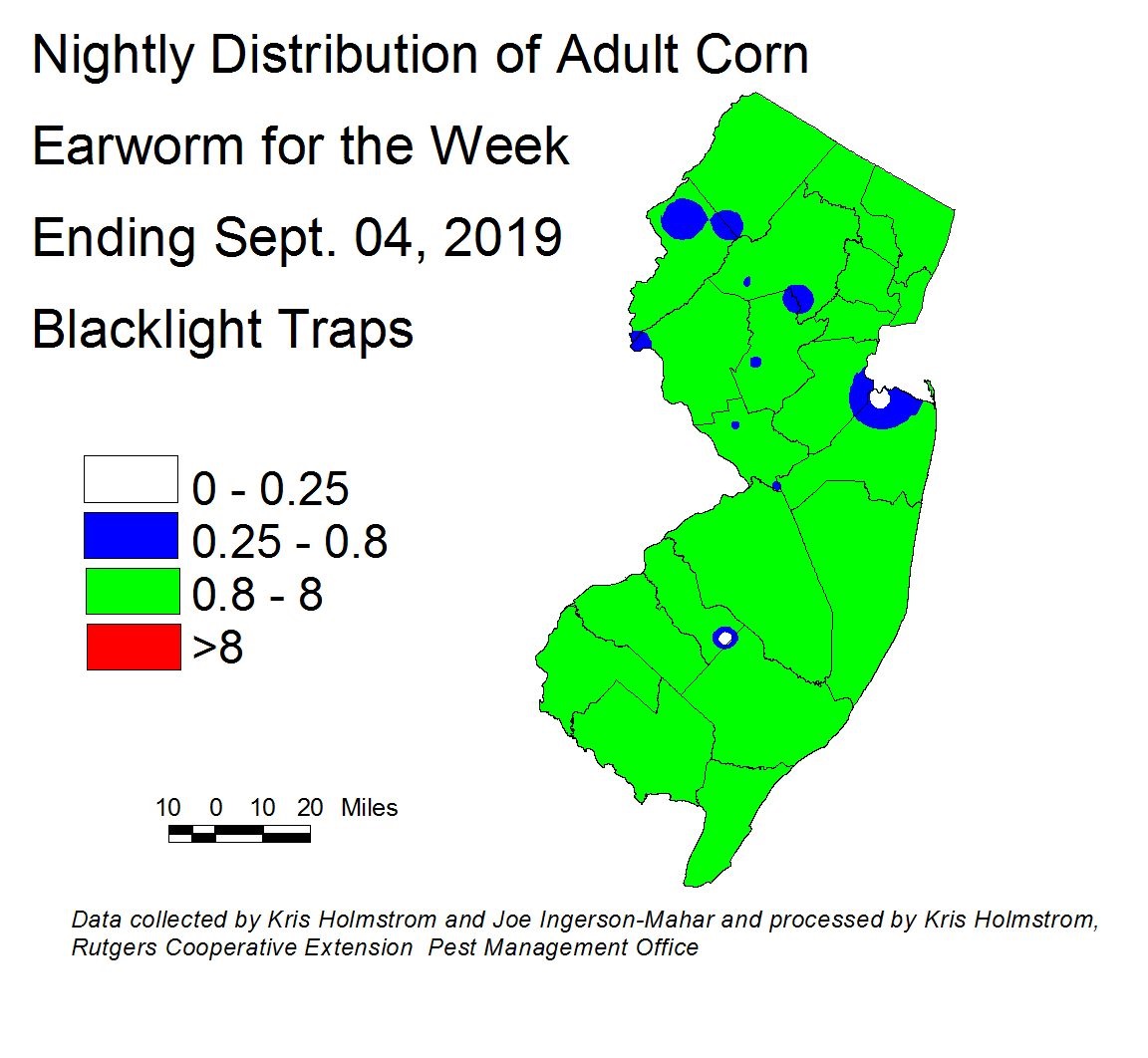
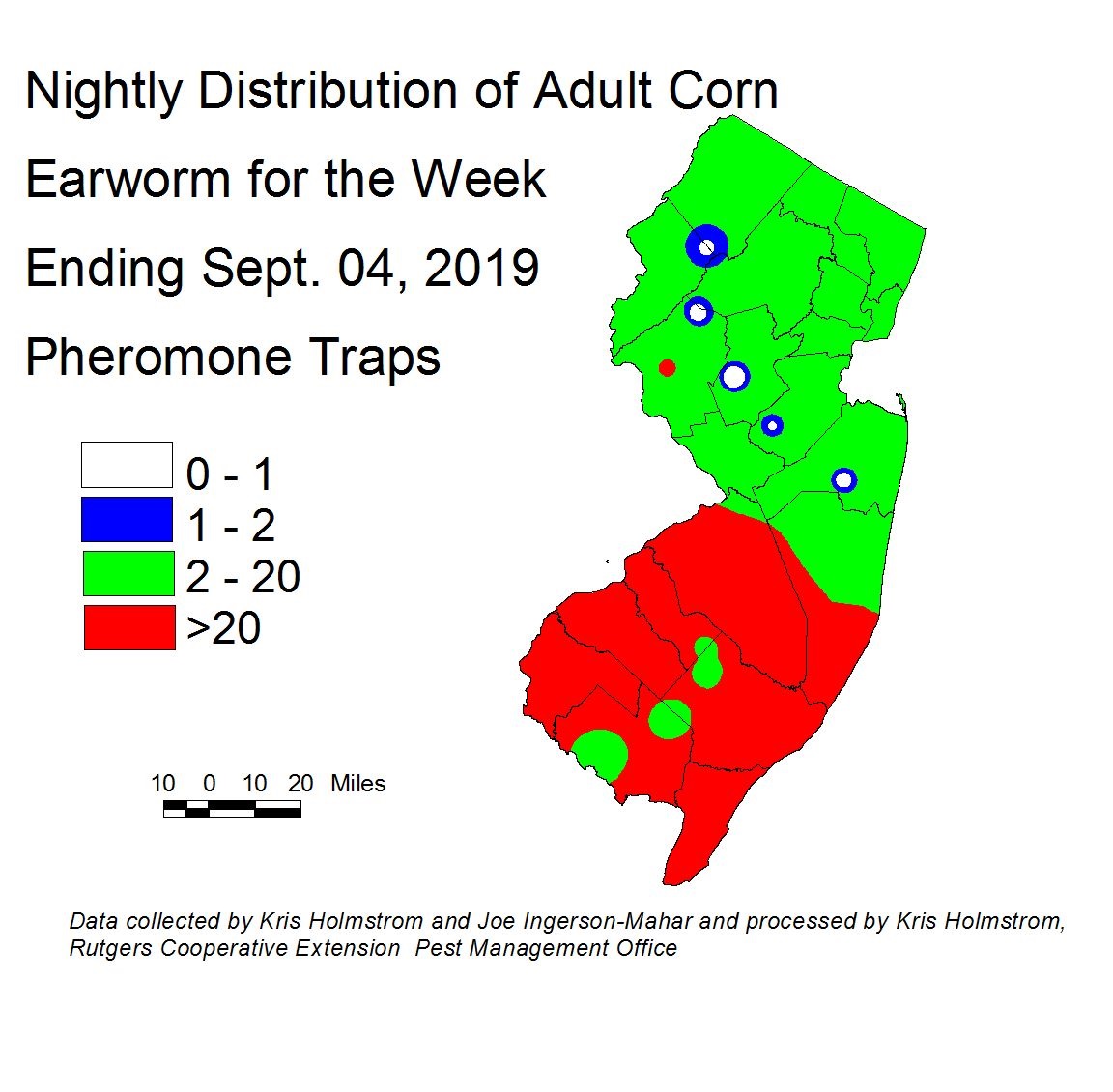
Corn earworm (CEW) moth catches increased in southern NJ this past week, while remaining stable in northern counties.  Overall, CEW numbers now represent a sizeable late summer migratory influx.  While moth counts will decline somewhat with cool night temperatures, look for strong rebounds when nighttime temperatures exceed 60F.  The green area on the blacklight map (left) represents a 3-day silk spray schedule zone.  Blue and white areas within the overall green zone are outliers, and corn growers in or near those areas should also adhere to 3-day silk spray schedules.  There continue to be some exceptionally high catches in southern NJ pheromone traps this past week (see pheromone trap map below at right).    Economically damaging populations of this pest are present throughout the state, and all areas are at extreme risk of crop injury if strict silk spray schedules are not observed.   Red areas on the on the pheromone trap map indicate a 3-day silk spray schedule, while green indicates a 4-5 day silk spray schedule.  Currently, the black light network is indicating a more conservative spray regime statewide, than is the pheromone network.  Taken together, blacklight and pheromone traps are indicating 3-day silk spray schedules throughout the state.  There are far fewer CEW pheromone traps than blacklights, and the resulting map has much broader color bands as a result.  It should also be noted that the pheromone traps are much more sensitive than blacklights.  Therefore, the number of moths caught in pheromone traps required to generate a specific spray interval is much higher than the number caught in blacklight traps.   It must be stressed that there is high variability in these catches, and growers should consult with their IPM practitioner on recommended spray schedules.


[Read more…]

Vegetable IPM Update 8/28/19

Sweet Corn

Note:  Traps in some portions of southern New Jersey were not serviced over the past week.  The impact of this will be addressed in individual sweet corn pest sections.

European corn borer (ECB) moth captures have decreased generally over the past week and no map will appear in this addition.  Feeding in late season whorl and pretassel corn in northern NJ has increased, with some plantings exceeding the 12% threshold.  This week, unsprayed sweet corn in the sentinel plots (Providence) at Snyder Farm in Hunterdon County had 47% ECB infested ears, despite little indication of adult activity in the area.  Most of these larvae were in the tips of ears, which underscores the importance of the silk spray schedule in not only controlling CEW, but ECB that move from tassel to ear during the silk period.   In combination with fall armyworm (FAW) feeding, action thresholds have been exceeded in all areas of the state.

Growers should continue to scout whorl and pre-tassel stage plantings weekly and consider treating when infested plants exceed 12% in a 50 plant sample.  As plantings proceed to the pre-tassel stage, ECB larvae may be found in emerging tassels.  It is a good idea to treat individual plantings as they move into the full tassel/first silk stage one time.  This eliminates any ECB larvae that have emerged with the tassels as they begin to move down the stalk to re-enter near developing ears.

Useful insecticides for this particular application include synthetic pyrethroids (IRAC Grp 3), spinosyns (including OMRI approved Entrust) IRAC Grp 5), and diamides such as Coragen (IRAC Grp 28) or materials such as Besiege which include the active ingredient in Coragen.  Synthetic pyrethroids alone should NOT be used for corn earworm (CEW) protection on silking corn.  Control with these materials is very inconsistent.

The highest nightly black light trap catches of ECB for the week ending 8/28/19 are as follows:

Downer   3 Hillsborough   1 South Branch   1
Califon   1 Milltown   1
Denville   1 Sergeantsville   1


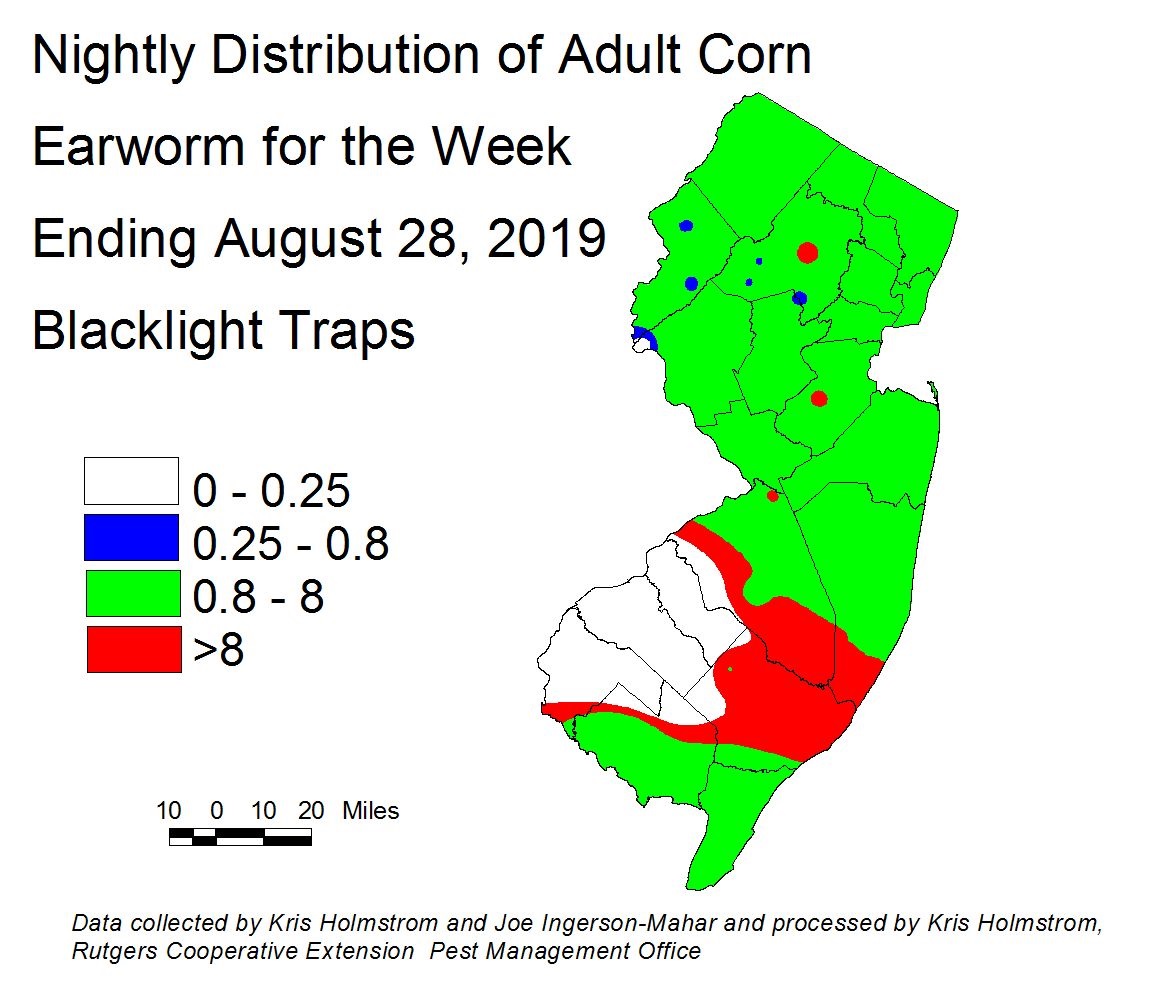
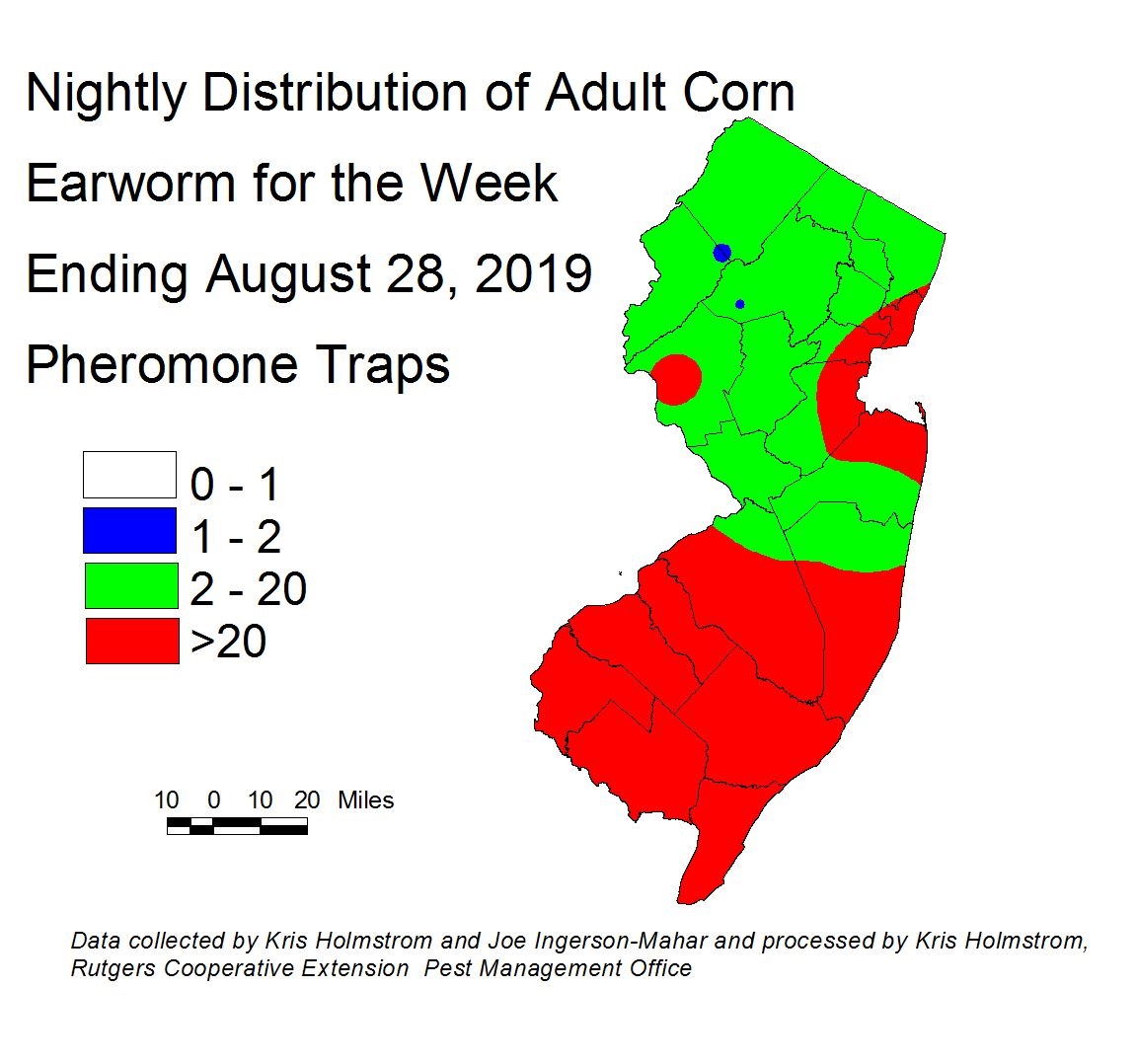
Corn earworm (CEW) moth catches increased dramatically beginning late last week in all traps.  Overall, CEW numbers now represent a sizeable late summer migratory influx.  While moth counts declined somewhat with cool night temperatures since the weekend, we are still experiencing high activity.  The white area in southwestern NJ on the blacklight map (left) should be considered to be solidly in the 3-day silk spray schedule zone.  We are missing trap data in that area, but activity should be similar to surrounding areas.  There continue to be some exceptionally high catches in southern NJ pheromone traps this past week (see pheromone trap map below at right).    There are now economically damaging populations of this pest throughout the state, and all areas are at extreme risk of crop injury if strict silk spray schedules are not observed.   Red areas on the on the pheromone trap map indicate a 3-day silk spray schedule, while green indicates a 4-5 day silk spray schedule. Blue areas represent a 5-6 day schedule, and white areas are 6-7 day.  Taken together, blacklight and pheromone traps are indicating 3-day silk spray schedules throughout the state.  There are far fewer CEW pheromone traps than blacklights, and the resulting map has much broader color bands as a result.  It should also be noted that the pheromone traps are much more sensitive than blacklights.  Therefore, the number of moths caught in pheromone traps required to generate a specific spray interval is much higher than the number caught in blacklight traps.   It must be stressed that there is high variability in these catches, and growers should consult with their IPM practitioner on recommended spray schedules.


[Read more…]

Vegetable IPM Update 8/21/19

Sweet Corn

European corn borer (ECB) moth captures have increased in some areas over the past week (see map at left), although catches are very inconsistent.  Late summer activity is overall low and scattered.  Minor feeding has appeared in whorl and pre-tassel corn, but rarely rises to the 12% threshold by itself.  In combination with fall armyworm (FAW) feeding, action thresholds have been exceeded in all areas of the state.

Growers should continue to scout whorl and pre-tassel stage plantings weekly and consider treating when infested plants exceed 12% in a 50 plant sample.  As plantings proceed to the pre-tassel stage, ECB larvae may be found in emerging tassels.  It is a good idea to treat individual plantings as they move into the full tassel/first silk stage one time.  This eliminates any ECB larvae that have emerged with the tassels as they begin to move down the stalk to re-enter near developing ears.

Useful insecticides for this particular application include synthetic pyrethroids (IRAC Grp 3), spinosyns (including OMRI approved Entrust) IRAC Grp 5), and diamides such as Coragen (IRAC Grp 28) or materials such as Besiege which include the active ingredient in Coragen.  Synthetic pyrethroids alone should NOT be used for corn earworm (CEW) protection on silking corn.  Control with these materials is very inconsistent.

The highest nightly black light trap catches of ECB for the week ending 8/21/19 are as follows:

Downer   2 Clinton   1 Elm   1 Milford   1
Asbury   1 Dayton   1 Hillsborough   1 Milltown   1
Califon   1 Eldora   1 Jobstown   1 Sergeantsville   1


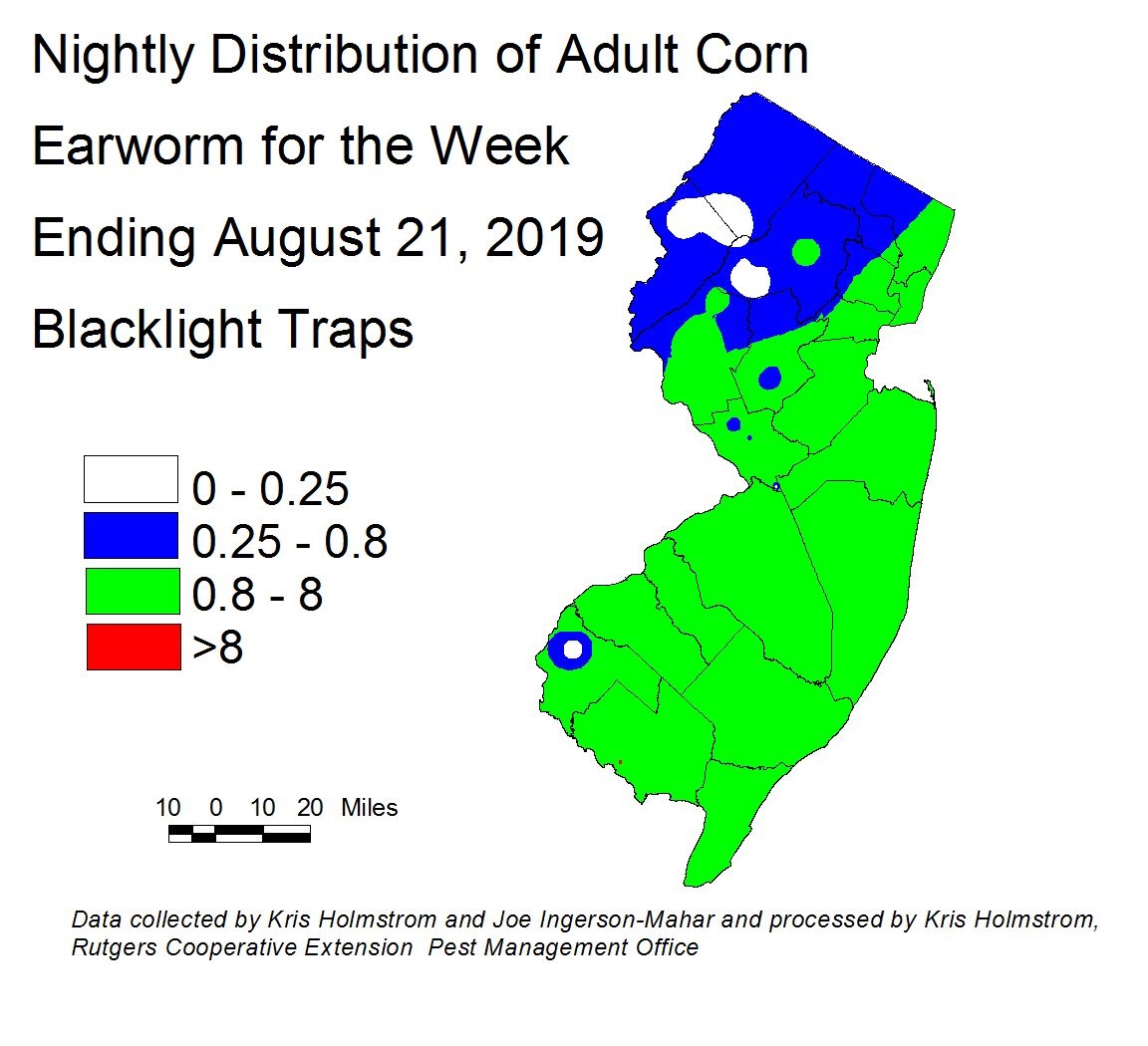
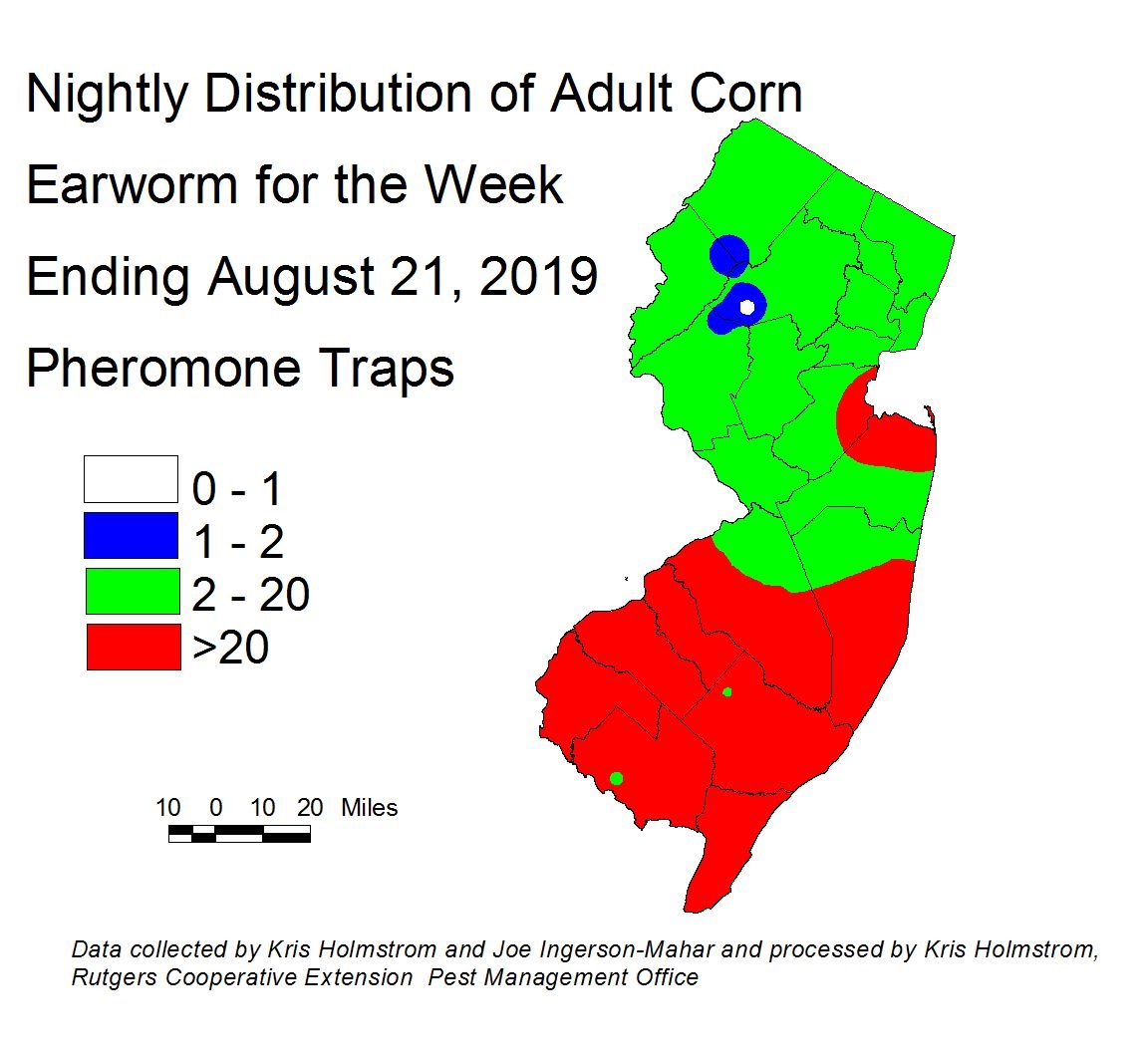
Corn earworm (CEW) moth catches have remained fairly steady over the past week in both trap types.  Overall, CEW numbers are moderately high, but not unusual for this time of year.  There continue to be some very high catches in southern NJ pheromone traps this past week (see blacklight map at left, and pheromone trap map below at right).    There are now economically important populations of this pest throughout the state, and most areas are at extreme risk of crop injury if strict silk spray schedules are not observed.   Red areas on the on the pheromone trap map indicate a 3-day silk spray schedule, while green indicates a 4-5 day silk spray schedule. Blue areas represent a 5-6 day schedule, and white areas are 6-7 day.  There are far fewer CEW pheromone traps than blacklights, and the resulting map has much broader color bands as a result.  It should also be noted that the pheromone traps are much more sensitive than blacklights.  Therefore, the number of moths caught in pheromone traps required to generate a specific spray interval is much higher than the number caught in blacklight traps.   It must be stressed that there is high variability in these catches, and growers should consult with their IPM practitioner on recommended spray schedules.


[Read more…]

Vegetable Twilight Research Tour Tomorrow

Wes, Michelle and I invite you to our annual open house plot tour tomorrow evening at RAREC!

Wednesday, August 21, 2019, 4:00pm
Rutgers Agricultural Research & Extension Center
(meet at the shelter near the parking lot)
121 Northville Rd., Bridgeton, NJ (Upper Deerfield)

  • Specialty Crop Evaluations – Albert Ayeni, PhD, Ethnic Crop Research Specialist, Rutgers University and Tom Orton, PhD, Specialist in Vegetables
    • Exotic peppers (Habaneros, Superhots, Poblano types, Jalapenos, Sweet minibells and African Birdeyes)
    • Tropical Spinach
    • Tigernuts (Conventional vs. Organic plots)
    • Roselle (Conventional vs. Organic)
    • Asian Cucurbits (Trellised vs. Non-trellised)
    • Elephant Ear Demo
    • Sweetpotatoes for Leaf Production (Vine vs. tuber propagule)
    • Fluted pumpkin (Conventional vs. Organic)
  • Evaluation of Yacon as a Potential New Specialty Crop for New Jersey Farmers – Rick VanVranken, Rutgers Cooperative Extension of Atlantic County and Peter Nitzsche, Rutgers Cooperative Extension of Morris County
  • Evaluation of Bell Pepper Varieties and Breeding Lines for Bacterial Leaf Spot and Phytophthora Blight Management – Wes Kline, PhD, Rutgers Cooperative Extension of Cumberland County
  • Weed Control Options for Cucurbits – Thierry Besancon, PhD, Extension Weed Specialist for Specialty Crops
  • Basil Downy Mildew Fungicide Control Trial – Andy Wyenandt, PhD, Specialist in Vegetable Pathology
  • Cucurbit Powdery Mildew Control with Fungicides – Andy Wyenandt, PhD, Specialist in Vegetable Pathology
  • Basil Downy Mildew Variety Evaluations – Andy Wyenandt, PhD, Specialist in Vegetable Pathology
  • Organic and Conventional Basil Downy Mildew Control Programs Comparing New Rutgers DMR Lines and Downy Mildew Susceptible Lines. – Andy Wyenandt, PhD, Specialist in Vegetable Pathology
  • Managing Phytophthora Blight in Peppers With Fungicides – Andy Wyenandt, PhD, Specialist in Vegetable Pathology
  • Evaluation of Five Sweet Corn Varieties: non-Bt, Bt, and Bt+VIP for Resistance to Corn Earworm, Fall Armyworm and European Corn Borer – Joe Ingerson-Mahar, PhD, Vegetable IPM Coordinator

Pesticide credits have been requested.