Search Results for: corn borer

IPM Update 5/20/20

Sweet Corn

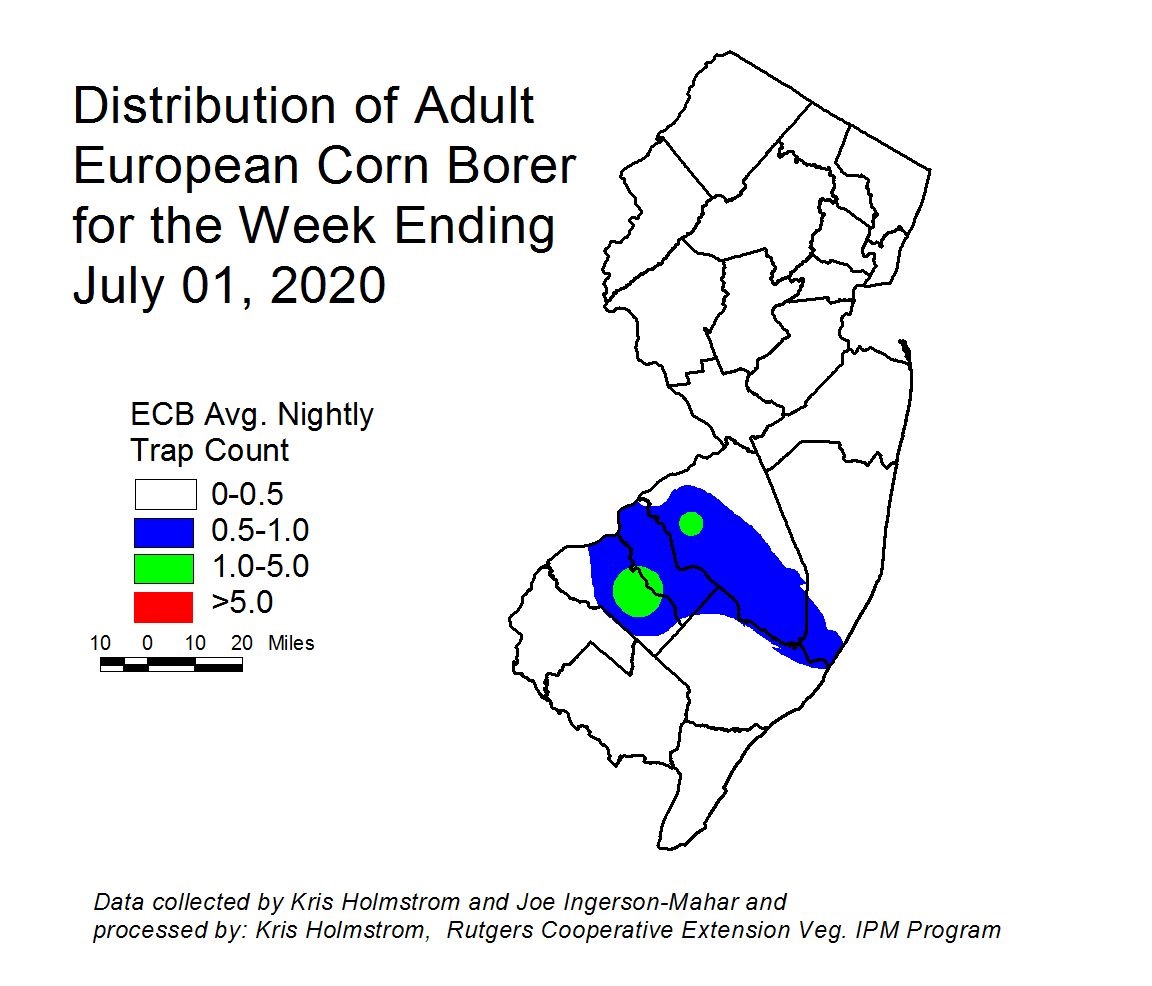
The black light trap network is  complete at this time.  To date, one corn earworm (CEW) was captured at Eldora, Cape May County.  A very few European corn borer (ECB) moths have been captured this past week, indicating that as warmer weather begins to arrive, we should see increasing numbers over the next several weeks.   This pest poses little threat at this time, as they are few in number and the earliest sweet corn plants are only just reaching suitable size to support larvae.

The highest nightly trap catches of ECB for the week ending 5/20/20 are as follows:

Downer   1
Hackettstown   1
Medford   1

[Read more…]

IPM Update 5/13/20

Sweet Corn

IPM Program personnel have re-established the black light trap network in New Jersey.  With continued below normal temperatures, no corn earworm (CEW) or European corn borer (ECB) moths have been captured.  As numbers increase, look for population maps of ECB, CEW, brown marmorated stink bug (BMSB) and CEW catches from pheromone traps in this weekly publication.  The resulting full-state maps will include interpretive information.

Sweet corn rootWith cold, damp conditions dramatically slowing down the growth of seedling corn, wire worms (see photo at left) have the potential to be more of a nuisance than usual.  While we don’t often see this problem in sweet corn, it does occasionally happen when wire worms are present and the corn cannot grow quickly enough to become less susceptible to injury.  Look for clusters of seedlings that exhibit wilted inner leaves.  Wire worms often are discovered by digging up these affected seedlings.  The incidence of this damage may be minor, but if growers determine that a field must be replanted, it may be necessary to include an in-furrow soil insecticide targeting this pest.

[Read more…]

IPM Update 5/06/20

Sweet Corn

IPM Program personnel are currently finishing deployment of the black light trap network in New Jersey.  At present, we are approximately 70% operational and have begun to monitor traps.  With below normal temperatures, no corn earworm (CEW) or  European corn borer (ECB) moths have been captured.  As numbers increase, look for population maps of ECB, CEW, brown marmorated stink bug (BMSB) and CEW catches from pheromone traps in this weekly publication.  The resulting full-state maps will include interpretive information.

[Read more…]

Vegetable IPM Update 9/25/2019

Joe Ingerson-Mahar and Kris Holmstrom

This is an abbreviated edition of the IPM Update.  The final IPM Update for the 2019 season will appear next week.  Pest alerts will appear as needed.


Sweet Corn

European corn borer (ECB) remains at very low levels across most of the state, with a few moths (1 per night) being found in the Hillsborough and Milltown areas this past week.  Late-season plantings are still at risk from ECB feeding but are likely to be minimal at this point.  In the late-season corn borers tend to lay eggs on many different crops, including apples and eggplant, so do not be surprised that you find ECB on unexpected crops.

Corn earworm (CEW) numbers have fallen somewhat across the state with the generally cooler night-time temperatures of the past week.  Counts in both blacklights and pheromone traps are highly variable across the state.

Blacklights – counts statewide range from 0 to 5 moths per night with larger numbers in the southern half of the state.  Spray schedules range from 4 to 5-day to 3-day.

Pheromone traps – counts have also declined somewhat, due both to cooler weather and aging sweet corn.  Plantings that are tasseling now will be the most attractive to CEW moths and these plantings should be on 3-day schedules, especially in South Jersey where despite declining numbers there is still a large reservoir of moths in the area.  Highest counts seen are at Eldora with 58 moths per night and Beckett with 48 moths per night.  The pheromone traps are showing a 4-day or 3-day schedule.

Fall armyworm pressure has been light in at least the southern part of the state.  Infestations of less than 10% are the norm.

Peppers

Corn earworm numbers have been high in pheromone traps placed at pepper fields.  Some injury has been found from these pests where insecticide applications have been backed off.

Beet armyworm continues to be a significant pest in the southernmost part of the state with counts at 73 per night at Jones Island and 32 per night at Pedricktown.  Traps in Hammonton record less than 10 per night.  Plant injury has occurred at counts under 5 per night.

Pepper weevil has become a widespread pest with now at least 8 farms infested in the Swedesboro, Glassboro, Hammonton and East V

Adult weevil on pepper

ineland areas.  It is hard to estimate yield loss to weevils but most of these farms probably have light to moderate loss.  Two of the farms had severe losses from weevils this year.  Farms that are located near, or do business with, processors should routinely have yellow pheromone traps placed in high traffic areas on the farm and in fields.  Weevils are most likely to be transported to the farm by hitchhiking on vehicles or on produce bins, though they are capable of spreading on their own to adjacent fields of solanaceous crops.

Other insect pests

Brown marmorated stinkbug has nearly become absent in blacklight trap catches.  At this time of year, they are seeking ov

Hawaiian beet webworm on spinach

erwintering sites and do not present much of a problem for vegetable crops.  Centerton had the highest nightly count of 2 for the past week.

Hawaiian beet webworm (HBWW) moths have been trapped in blacklights in South Jersey – Jones Island and Eldora.  Though the numbers are light, farmers with spinach, beets, and chard should check their fields for the presence of webbing and feeding injury.  These are small migratory moths usually occurring in mid-to-late summer.  Their favored host is the pigweed, Amaranthus sp., but they are capable of causing defoliation and contamination to crops.  Since they are migratory and have a short life cycle they can rapidly appear and cause extensive damage to crops unnoticed.  There were isolated highly-infested weedy areas last year on vegetable farms in South Jersey.

Vegetable IPM Update 9/18/19

Sweet Corn

European corn borer (ECB) moth captures remain scattered and very low, and no map will appear in this addition.  There are very few plantings not yet silking.  Silk sprays for corn earworm (CEW) control will serve to manage ECB larvae as well.  Reminder:  Useful insecticides for worm control in the silk stage include  spinosyns (including OMRI approved Entrust) IRAC Grp 5), and diamides such as Coragen (IRAC Grp 28) or materials such as Besiege which include the active ingredient in Coragen.  Synthetic pyrethroids alone should NOT be used for corn earworm (CEW) protection on silking corn.  Control with these materials is very inconsistent.


Corn earworm (CEW) moth catches have changed little in NJ this past week.  Overall, CEW numbers represent a normal late summer population.  While moth counts will decline somewhat with cool night temperatures, look for strong rebounds when nighttime temperatures exceed 60F.  The green area on the blacklight map (left) represents a 3-day silk spray schedule zone.  Blue and white areas within the overall green zone are outliers, and corn growers in or near those areas should also adhere to 3-day silk spray schedules.     Economically damaging populations of this pest are present throughout the state, and all areas are at extreme risk of crop injury if strict silk spray schedules are not observed.   Red areas on the on the pheromone trap map (below at right) indicate a 3-day silk spray schedule, while green indicates a 4-5 day silk spray schedule.  Currently, the black light network is indicating a more conservative spray regime statewide, than is the pheromone network.  Taken together, blacklight and pheromone traps are indicating 3-day silk spray schedules throughout the state.  There are far fewer CEW pheromone traps than blacklights, and the resulting map has much broader color bands as a result.  It should also be noted that the pheromone traps are much more sensitive than blacklights.  Therefore, the number of moths caught in pheromone traps required to generate a specific spray interval is much higher than the number caught in blacklight traps.   It must be stressed that there is high variability in these catches, and growers should consult with their IPM practitioner on recommended spray schedules.


[Read more…]

Vegetable IPM Update 9/11/19

Sweet Corn

European corn borer (ECB) moth captures remain scattered and very low, and no map will appear in this addition.  Feeding in late season pre-tassel corn in northern NJ continues, with some plantings exceeding the 12% threshold.   In combination with fall armyworm (FAW) feeding, action thresholds have been exceeded in all areas of the state.

Growers should continue to scout whorl and pre-tassel stage plantings weekly and consider treating when infested plants exceed 12% in a 50 plant sample.  As plantings proceed to the pre-tassel stage, ECB larvae may be found in emerging tassels.  It is a good idea to treat individual plantings as they move into the full tassel/first silk stage one time.  This eliminates any ECB larvae that have emerged with the tassels as they begin to move down the stalk to re-enter near developing ears.

Useful insecticides for this particular application include synthetic pyrethroids (IRAC Grp 3), spinosyns (including OMRI approved Entrust) IRAC Grp 5), and diamides such as Coragen (IRAC Grp 28) or materials such as Besiege which include the active ingredient in Coragen.  Synthetic pyrethroids alone should NOT be used for corn earworm (CEW) protection on silking corn.  Control with these materials is very inconsistent.

The highest nightly black light trap catches of ECB for the week ending 9/11/19 are as follows:

Allamuchy   1 Jones Island   1
Chester   1 Monroeville   1
Elm   1 Oldwick   1


Corn earworm (CEW) moth catches have remained fairly stable in NJ this past week.  Blacklight catches are steady, while there was a slight decline in pheromone trap catches.  However, the effect on spray schedules is unchanged.  Overall, CEW numbers now represent a sizeable late summer migratory influx.  While moth counts will decline somewhat with cool night temperatures, look for strong rebounds when nighttime temperatures exceed 60F.  The green area on the blacklight map (left) represents a 3-day silk spray schedule zone.  Blue and white areas within the overall green zone are outliers, and corn growers in or near those areas should also adhere to 3-day silk spray schedules.     Economically damaging populations of this pest are present throughout the state, and all areas are at extreme risk of crop injury if strict silk spray schedules are not observed.   Red areas on the on the pheromone trap map (below at right) indicate a 3-day silk spray schedule, while green indicates a 4-5 day silk spray schedule.  Currently, the black light network is indicating a more conservative spray regime statewide, than is the pheromone network.  Taken together, blacklight and pheromone traps are indicating 3-day silk spray schedules throughout the state.  There are far fewer CEW pheromone traps than blacklights, and the resulting map has much broader color bands as a result.  It should also be noted that the pheromone traps are much more sensitive than blacklights.  Therefore, the number of moths caught in pheromone traps required to generate a specific spray interval is much higher than the number caught in blacklight traps.   It must be stressed that there is high variability in these catches, and growers should consult with their IPM practitioner on recommended spray schedules.


[Read more…]