Organic Farm Advisory

The Plant & Pest Advisory serves NJ growers by reporting on important pests and recommending responses that are grounded in reproducible trials.

Articles in this section contain information helpful to the NJ commercial organic grower.
Sharing organic practice trial results between land-grant universities is a cost effective way to create a common knowledge base built on the strengths of individual programs. In the sidebar, find institutions with programs in organic agriculture which augment knowledge developed at the Rutgers New Jersey Ag Experiment Station.

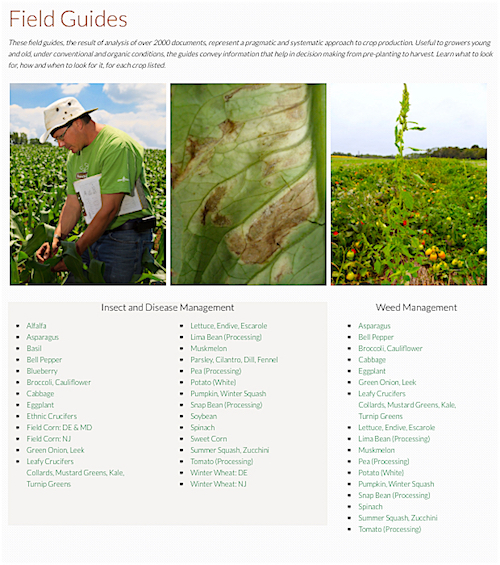
Rutgers Cooperative Extension Field Guides: These concise guides help with decision making from pre-planting to harvest. For each crop listed, learn what pests to proactively look for as the season progresses, how to look for them, and when to take action.

Field Guide List

Vegetable IPM Update 09/14/22

Note:  Insect trap data are unavailable from much of southern New Jersey this past week due to staff shortages.  No maps will appear in this edition.  Maps will resume later in September as conditions permit.  Interpretations from available data will continue in the absence of maps.

Sweet Corn

European corn borer (ECB) moth catches are nearly non-existent now.   At this time, no feeding has been detected.

[Read more…]

Vegetable IPM Update 09/07/22

Sweet Corn

European corn borer (ECB) moth catches have declined, and are at very low levels throughout the state.   At this time, no feeding has been detected.

The highest nightly trap catches of ECB for the week ending 09/07/22 are as follows:

Allentown   2 Lawrenceville   1
New Egypt   2 Pennington   1
Crosswicks   1
Georgetown   1

[Read more…]

Survey of cole crops and leafy green growers – novel weed control technology

Tractor

Several university weed scientists from around the U.S. (Clemson, Cornell, UC Davis, Florida, Michigan State, Rutgers, Arkansas) have developed a survey as part of a Specialty Crop Research Initiative (SCRI) planning grant (SC-2021-07806 DEVELOPING A NATIONAL TEAM TO OPTIMIZE NON-HERBICIDE WEED MANAGEMENT TECHNIQUES IN COLE AND LEAFY GREEN CROPS).

We would appreciate if you could share it with your constituents and cooperators (growers, crop consultants, extension personnel, industry partners) via newsletters, email blasts or other outreach efforts.

 ** WE NEED YOUR INPUT! **


Tractor for extracting weedsWeed management in vegetables can be difficult due to a shrinking labor pool, which is becoming more costly to source, and a lack of effective herbicides. Research and extension efforts must focus on integrating novel weed technology into current crop production systems. Autonomous and semi-autonomous robotic weed control technology has been implemented by some vegetable growers, mainly in the Western US, but is not universally available to or adapted by many producers. This survey is designed to new tools of interest (e.g. precision sprayers or cultivators, electrical weeders, drones, etc.) for managing weeds in cole crop and leafy green systems as well as the environmental, physical and economic barriers to adoption. The results of this survey will benefit vegetable growers by enabling the research team to develop relevant and realistic research efforts informed by the needs of and constraints faced by our local stakeholders. Specifically, we will use survey data to develop a multi-regional USDA grant proposal to bring grower-specified technology to each our states for evaluation and demonstration under a variety of commercial conditions and provide growers with an economic assessment of their performance relative to current best management practices.

The survey is voluntary and anonymous. All replies will be de-identified. It should take less than 10-15 minutes to complete. The link is below.

https://clemson.ca1.qualtrics.com/jfe/form/SV_1IfwcgkAXC9i6h0


If you have questions, please feel free to contact Thierry Besançon, Associate Professor and Extension Weed Science Specialist for Specialty Crops, New Jersey Agricultural Experiment Station, thierry.besancon@rutgers.edu.

Tractors


Vegetable IPM Update 08/31/22

Sweet Corn

European corn borer (ECB) moth catches have increased slightly in central counties but remain at low levels generally throughout the state.   At this time, no feeding has been detected.

The highest nightly trap catches of ECB for the week ending 08/31/22 are as follows:

Pennington   2 Dayton   1 Jones Island   1
Allentown   1 Downer   1 Matawan   1
Centerton   1 East Vineland   1 Oldwick   1
Crosswicks   1 Georgetown   1 Princeton   1

[Read more…]

Non-herbicide Management Options for Large Crabgrass in Specialty Crops

Large crabgrass can form robust root systems thanks to its numerous tillers and capacity to root at stem nodes, allowing it to out-compete crops for moisture and nutrients.  Understanding the life cycle and biology of large crabgrass is key to figuring out the best options for its control on your farm. Learn more about non-herbicide life cycle disruptions that can be used in the development of a short and long term management plan through the large crabgrass decision tool fact sheet and an informational video. These resources are one of a five-part weed management series created by Extension Specialist Thierry Besancon and County Agricultural Agent Meredith Melendez, funded by USDA Specialty Crop Block Grant AM190100Crabgrass. Provide feedback on these resources through an online survey.

Vegetable IPM Update 08/24/22

Sweet Corn

European corn borer (ECB) moth catches are largely unchanged; remaining at low levels throughout the state.    Only occasional feeding in sweet corn has been detected by field personnel.

The highest nightly trap catches of ECB for the week ending 08/24/22 are as follows:

Dayton   1 Matawan   1
East Vineland   1 New Egypt   1
Farmingdale   1 Pennington   1
Folsom   1 Princeton   1

[Read more…]