Early August Nursery Update (2nd generation scale hatch and boxwood blight considerations)

This PPA has four updates:

  1. Growing Degree-day Update GDD50
  2. 2nd generation scale insect hatch / crawler growing degree-day targets
  3. Tuliptree and Magnolia scale insect activity and notes on treatment
  4. Late summer boxwood blight considerations

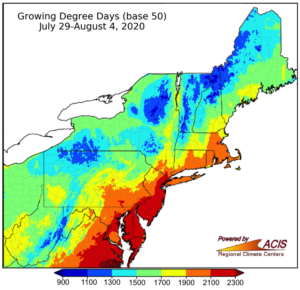
(1) Growing Degree-days as of 8/5/2020

(Weather station selected for each location. Ex: NJ50 = Upper Deerfield)

Upper Deerfield (NJ50)= 2242 GDD50 Howell/Freehold (NJ10) = 1946 GDD50 Pequest (NJ58) = 1901 GDD50

Growth by date

Cornell ForeCast Map

If you need help getting your Growing Degree-day models set up, please contact (twaller@njaes.rutgers.edu) 

(2) 2nd generation scale insect hatch / crawler GDD50 targets

A second generation of scale insects will be hatching soon. Scout for crawlers and treat as needed.

format: scale insect species – (growing degree day GDD50 targets)

  • Maskell scale – (2035)
  • Euonymus scale – (2235)
  • Japanese maple scale – (2508)

Please refer to Tim Waller’s summer scale insect treatments PPA for additional information.

(3) Tuliptree and Magnolia scale egg hatch and crawler activity

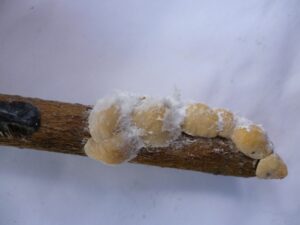
Magnolia Scale

Magnolia Scale & Maturing Females Photo- Steven Rettke of RCE

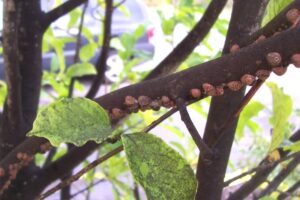
Tuliptree Scale

Tuliptree Scale With Honeydew & Sooty Mold Photo- Steven Rettke of RCE

Tuliptree scale and Magnolia scale insects begin hatching around ~2000 GDD50 but continue to emerge through the month of September (+6 week period). Therefor scouting for 1st and 2nd instar nymphs (crawlers) is critical to controlling these pests. Treatments will be ineffective if made too early in the season, as many of the un-hatched eggs will still be viable and lead to infestation and damages later.

Given this wide window of emergence, three treatment strategies can be deployed

  1. Delay pesticide applications for these pests until mid-October as the females will be dead and not harming the trees, all of the eggs will have hatched, and all of the crawlers will be vulnerable to appropriate materials (best approach)
  2. Apply multiple suppressive sprays at the first sign of emergence (time consuming, labor intensive, costly)
  3. Root or trunk applied systemic insecticides (often for very large trees)

Please refer to Steve Rettke’s Magnolia and Tuliptree scale insect PPA for additional information.

(4) Late summer boxwood blight considerations

As we enter into a period of cooler nighttime temperatures (< 77F) and frequent rain events, boxwood blight preventative sprays should be considered if you have not been making regularly scheduled applications. Boxwood blight is typically not as active during the heat of the summer, however, when cooler temperatures are coupled with prolonged periods of leaf-wetness the pathogen can infect.

Please refer to Tim Waller’s boxwood blight post for additional information and links to many other resources including numerous post from Rich Buckley of the Plant Diagnostic Lab.


Please take the 2020 Nursery Industry Survey: https://forms.gle/dUjLxaiu6qDQYYsRA

Don’t Let Your Guard Down With Farm Worker Health

The COVID-19 pandemic has highlighted the critical, indeed essential, role of farm labor in getting food from farm to plate. However, health concerns should not stop with a negative COVID test, especially if an employee or family member is exhibiting any of the ‘flu-like’ symptoms that are associated with corona virus.

A recent farm call was a reminder that working outside, especially during this July heat wave, exposes workers to a number of potential health risks that may present very similar symptoms and can be equally health, and even life, threatening. Recently published studies from the Rutgers Institute of Earth, Ocean, and Atmospheric Sciences suggest growing numbers of people worldwide are at risk of heat stress and related complications, including farmers and ag laborers working in high heat and humid conditions.

Harvesting and other activities along field edges, including going into the woods instead of using a portable bathroom facilities, also lead to a high risk of tick bites, which can also carry a number of diseases, many as or more debilitating than Lyme disease that most are now aware of. A recent story at Today.com suggested that the COVID-19 pandemic might lead to more tick-borne disease this year, quoting Rutgers entomologist and assistant professor Alvaro Toledo at the Center for Vector Biology with suggestions how to prevent tick bites.

It is critical for your employees’ health and well-being to get proper diagnosis and treatment for all of these ailments. This table illustrates how many tick-born diseases, as well as heat stress, all have potential symptoms very similar to those of COVID-19. Each is linked to additional resources at the CDC. In many cases, it may be the ‘other symptoms’ that may be unique to each disease and assist a medical practitioner with correct identification and lead to better verification with further testing.

   Disease    >

Symptoms  v

COVID-19 Heat Stress Lyme Disease Ehrlichiosis Babe- biosis Powas-san Rocky Mtn Spotted Fever
Vector* Human Black-legged Tick (a.k.a. Deer Tick) (I. scapularis) Lone Star Tick (A. americanum) & Black-legged Black-legged Tick Ground hog(I. cookei), Squirrel (I. marxi) & Black-legged Ticks American Dog Tick (D. variabilis)
Fever or chills X X X X X X X
Cough X X
Shortness of breath/difficulty breathing X
Fatigue X X X X
Muscle/body aches X X X X X X
Headache X X X X X X X
New loss of taste or smell X
Sore throat X
Congestion or runny nose X
Nausea/vomiting X X X X X X X
Diarrhea X X
Rash X X X
Other symptoms X X X X X X
Potentially Deadly/Disabling
X X X X X X X

*NOTE – main vector listed, but many tick born diseases may be vectored by other species of ticks, or different species causing same disease may be carried by different tick species.

Make Sure Your Farm or Ranch Counts – And is Counted!

Did you know that according to the 2019 State Agriculture Overview for NJ, 3,900 acres of peaches yielded 5/tons per acre at a value of over $25.6 million dollars? Or that 3,500 acres of peppers were harvested in 2019, with a value of $45.8 million dollars?  Or that 9,300 acres of harvested blueberries were valued at $85.3 million dollars in 2019?  And in 2018, NJ ranked 4th nationwide in cranberry and peach production, and third in bell peppers?

[Read more…]

Participants Wanted for a Redheaded Flea Beetle Survey

The Southern Nursery Flea Beetle Working-Group has put out a survey under the auspices of University of Georgia. The Universities of Maryland and Delaware recently joined forces with that working group with the goal of gathering information aimed at suppressing this continually destructive pest. If you have seen redheaded flea beetle in your containerized nursery stock please take this short survey. Ultimately the goal is to gather as much information as possible about this pest in an effort to come up with better recommendations for all of us in the industry.

Click here to take the survey

Please contact Tim Waller (twaller@njaes.rutgers.edu) with any questions, severely damaged plant varieties, or personal observations pertaining to pest control and biology.

Thank you

NJ Ag & Health Urge Use of Free COVID-19 Testing For Farm Workers

Earlier this week, NJ Secretary of Ag Douglas Fisher released this attached letter, co-signed by Dept of Health Commissioner Judith Persichilli, urging all growers with farm labor to take advantage of opportunities to help protect your employees from COVID-19.

As the letter states,

“One program that is being implemented FREE OF CHARGE for all farms is a COVID-19 testing and education program through Federally Qualified Health Centers (FQHCs) and local health departments. Along with free testing, the program provides education and other related support services. [Read more…]

Tropical Storm Brings Rain But What About Gray Leaf Spot?

The passing of tropical storm, Fay brought some needed precipitation to the region, albeit too much at once in many places. Relatively dry soils (assumes not being over-irrigated) and the long, warm days of summer should allow turfs to dry out reasonably fast. But what about gray leaf spot? Spores of the pathogen are thought […]

Fungicide plots