Vegetable Crops Edition
Seasonal updates and alerts on insects, diseases, and weeds impacting vegetable crops. New Jersey Commercial Vegetable Production Recommendations updates between annual publication issues are included.
Subscriptions are available via EMAIL and RSS.
Quick Links:
 NJ Commercial Vegetable Production Recommendations
Rutgers Weather Forecasting - Meteorological Information important to commercial agriculture.
How to Prepare a Pesticide Container for Recycling or Reconditioning – What “Empty” Means Legally
Locations for NJ Pesticide Recycling Containers – 2024
Below are the locations and dates for recycling pesticide containers in New Jersey. Individuals dropping off containers (triple rinsed, holes drilled in bottom of container or slit with a knife & sans paper booklet on container) may do so during business hours and can pick up the form with a stamped self-addressed envelope to mail NJDA to confirm participation. Completed form must be returned to NJDA. Individuals with a valid NJ DEP Pesticide Applicators Licenses will receive 1 CORE point PER CALENDAR YEAR when confirming participation in this program.
More information can be found at www.nj.gov/agriculture/divisions/anr/nrc/processingsteps.html
Salem County
Helena Chemical, 440 N. Main St., Woodstown, NJ
Friday, April 19
Friday, May 17
Friday, June 21
Friday, August 23
Friday, September 20
Friday, October 18
Atlantic County
Helena Chemical, 66 Route 206 (North of the Route 30/206 intersection) Hammonton, NJ
Friday, April 12
Friday, May 10
Friday, June 14
Thursday, July 12
Friday, August 16
Friday, September 13
Friday, October 11
Monmouth County
Rutgers Fruit and Ornamental Research Extension Center
283 Route 539, Cream Ridge, NJ 08514-9634
Friday, April 26
Friday, May 24
Friday, June 28
Friday, July 26
Friday, August 30
Friday, September 27
Friday, October 25
Items that Will Not Be Accepted and Will Be Returned to the Participant:
• Pesticide containers with dried formulation on the container, pour spout or the spout threads
• Pesticide containers with any liquid residue
• Pesticide containers where the insides are caked with dried residue
• Mini-bulk, saddle tanks and nurse tanks, which can be made of fiberglass
• Pesticide containers with lids
• Containers that held any type of petroleum oil product or antifreeze
Non-Waxy Cardboard:
Helena Chemical will also be accepting non-waxy cardboard 1 p.m. to 3 p.m and during the scheduled pesticide container collection times. The clean non-waxy cardboard must be broken down and flattened. Cardboard delivered to the Atlantic County site must be tied.
Clean Non-waxy cardboard will also be accepted year-round at the Cumberland County Solid Waste Complex’s Convenience Center.
More information can be found at: www.nj.gov/agriculture/divisions/anr/nrc/processingsteps.html
South Jersey Tree Fruit Twilight Meeting – I
When: April 9th (Tue) @ 5:45 pm
Where: Gloucester County Govt. Services Building: 1200 N. Delsea Drive, Bldg. # A, Clayton, NJ 08312
Pesticide credits requested: CORE (#1), 1A (#3), PP2 (#3), 10 (#3)
5: 45 pm Light Fare (Pizza, Donuts and Coffee)
6:00 pm Welcome and Updates.
Hemant Gohil, Extension Agent, RCE of Gloucester County, Rutgers NJAES
6:05 pm Field Observations from the IPM Program
Dave Schmitt, Fruit IPM Program Associate, Rutgers NJAES
6:35 pm RIMpro, a New Climate Monitoring Tool to Access Accurate Disease Prediction Models.
Janine Spies, Statewide Fruit IPM Extension Agent, Rutgers NJAES.
7:05 pm Water Testing Requirements Under the Food Safety Modernization Act for 2024
Wesley Kline, Extension Agent, RCE of Cumberland County.
7:35 pm: An Udate on the Rutgers Hazelnut Breeding Program and Eastern Fire Blight Resistance.
Thomas Molnar, Professor, Plant Biology, Rutgers University.
8:05 pm Peach Market Updates
Hemant Gohil, Extension Agent, RCE of Gloucester County.
8:20 pm Pesticide re-certification credits application.
Meeting Adjourn
Light fare will be provided. If you plan to attend, please call Joan Medany at jmedany@co.gloucester.nj.us or 856-224-8030. If you have any questions, please get in touch with Hemant Gohil at 856-224-8029 before the meeting.
Allium leaf miner update: 03/25/24
Allium Leaf Miner (ALM)
Many weather stations on the NEWA network except for typical colder sites in northern New Jersey have surpassed 250 growing degree days (GDD) base 39˚F. 39˚F is close to the lower developmental temperature (38.3˚ F) which our colleagues at Penn State recommend for predicting the first emergence of ALM adults. In recent years, initial feeding/egg laying scars have been detected within a few days of local weather stations recording the 250 GDD threshold. Growers who feel they may be impacted by this pest should check the accumulated GDD from local weather stations. Growers in southern counties may reasonably assume there will be ALM activity in their area soon, if not already happening. To determine GDD from local weather stations, the NEWA website https://newa.cornell.edu/ is very helpful. From the NEWA home screen, select the nearest weather station from drop down menu at the center of the page. Next, scroll down to “Weather Tools” on the right side of the page, and select “DD Calculator”. Select your start date (1/01/24) and end date as well as Degree Day Type (39 F) from the menu at the left of the page. The site will automatically generate the accumulated GDD base 39F to the last day of your requested sample, and then offer a forecast of accumulated GDD for the next week. If you should select 1˚C, then the DD accumulation should be 350.
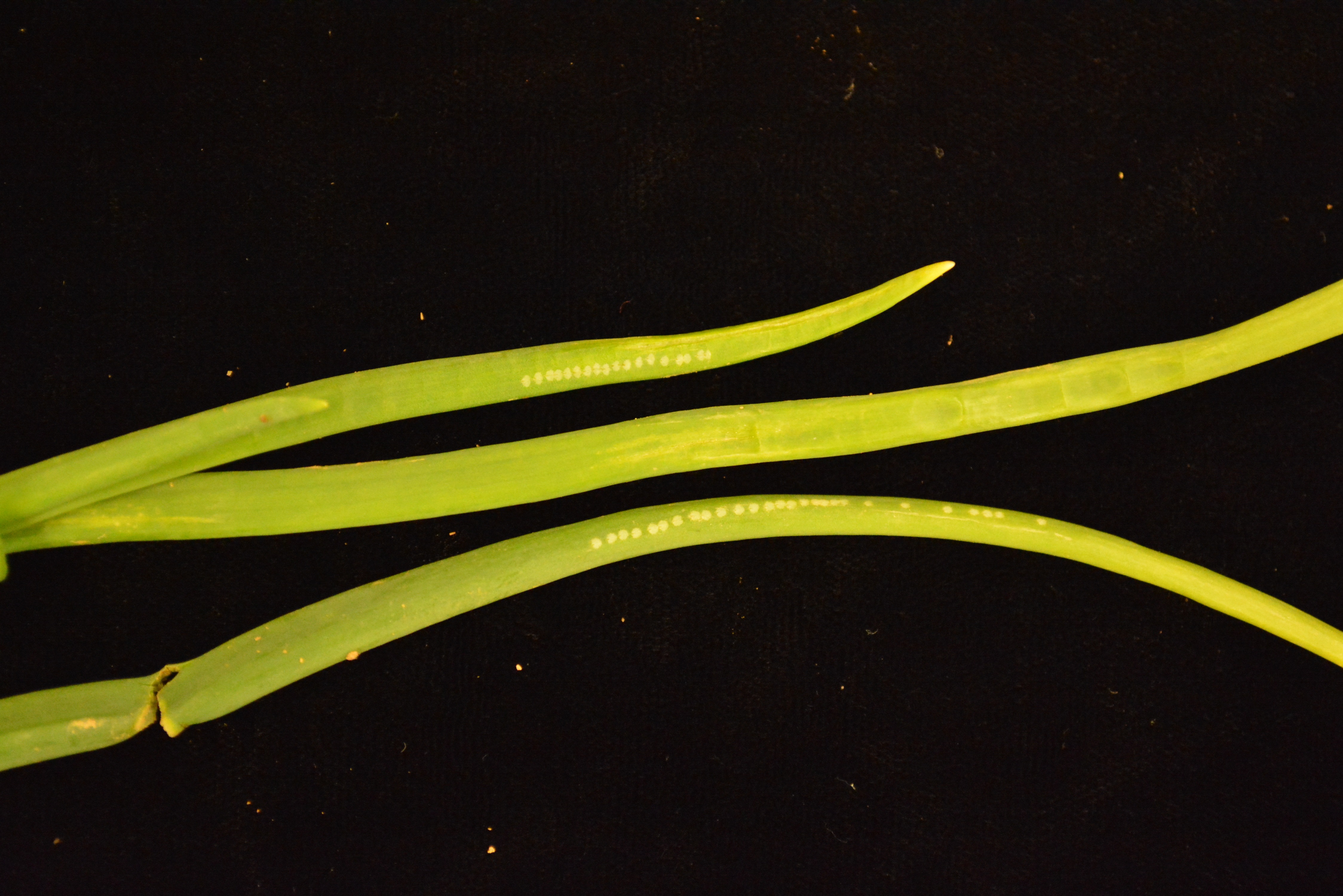
Photo: Sabrina Tirpak. Allium leaf miner oviposition scars on onion
Growers should consider initiating the control method of their choice at this time, if any allium crops are in the field. Affected crops include chives, scallions, garlic, onions and leeks. Look for neat rows of white spots descending from the upper tips of allium leaves (see photo at left). Initial injury often occurs on the tallest leaves. Under warmer, less breezy conditions, adults may be seen near the tips of leaves (see photo of adult at lower right). Perennial chive beds are often the first, and most heavily infested alliums of the spring season, so this makes chives an ideal crop to confirm ALM adult activity.
Floating row covers, kept on until this flight ends will help minimize access to plants. Insecticide applications targeting adults may be helpful as well, although frequency of applications is uncertain. Spinosyn materials (Radiant, Entrust (OMRI approved)), pyrethroids (Mustang Maxx,  Warrior), neonicotinoids (Scorpion, Venom), the diamide Exirel (section 2ee recommendation) and the insect growth regulator Trigard are labeled for miner control.
Adult activity and observations of feeding will be reported on in the IPM Update as they occur.
2024 National Agritourism Survey
The 2024 National Agritourism Survey is now collecting responses, and you are invited to participate! All agricultural operations that welcome visitors – whether for on-farm education, direct sales, entertainment, recreation, special events, and more – are invited to complete the survey. So, if you offer education or rent event space on your farm, have a farm stand, a petting zoo, offer pick-your-own, farm stays, or other on-farm experiences, your insights are crucial.
By participating in this survey, you’ll help us pinpoint the types of support farmers like you require – whether it’s business assistance, developing networks, applying for grants, or navigating zoning and liability issues. Our goal is to help build the resources you need, improve your access to critical information and opportunities, and shape policy decisions that impact your industry.
This survey is part of a collaborative project led by Penn State with the University of Vermont, Oklahoma State University, the University of Maine, Northeast Regional Center for Rural Development, and other partners across the country.
We recognize that your time is valuable, which is why the survey will take approximately 15 minutes to complete. Your insights are invaluable to us, and we sincerely appreciate your willingness to participate.
To take part in the survey, please visit: National Agritourism Support System Survey | Qualtrics Survey |
If you have questions about the survey, please contact Claudia Schmidt from Penn State Extension at cschmidt@psu.edu

