Organic Farm Advisory

The Plant & Pest Advisory serves NJ growers by reporting on important pests and recommending responses that are grounded in reproducible trials.

Articles in this section contain information helpful to the NJ commercial organic grower.
Sharing organic practice trial results between land-grant universities is a cost effective way to create a common knowledge base built on the strengths of individual programs. In the sidebar, find institutions with programs in organic agriculture which augment knowledge developed at the Rutgers New Jersey Ag Experiment Station.

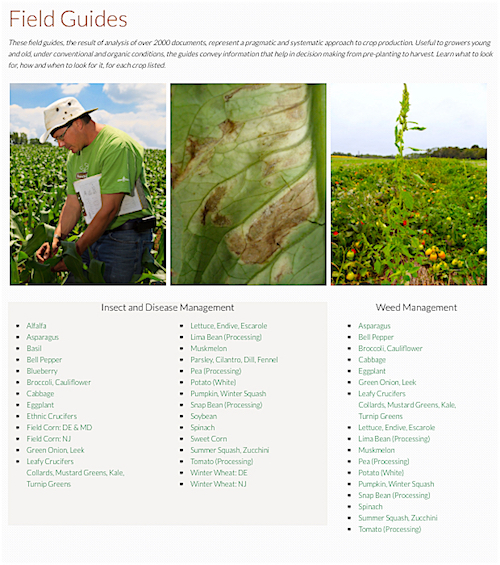
Rutgers Cooperative Extension Field Guides: These concise guides help with decision making from pre-planting to harvest. For each crop listed, learn what pests to proactively look for as the season progresses, how to look for them, and when to take action.

Field Guide List

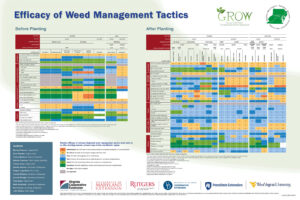
Comparing the Efficacy of Various Integrated Weed Management Tactics

Efficacy of Weed Management Tactics

Integrated weed management (IWM) combines various methods to reduce or eliminate the effect of weeds on crop production over time, using a combination of practices that are most effective for solving specific weed issues. These weed management techniques form a “toolbox” in which each “tool” can be integrated into a weed management plan catered to the particular farm and problem. The toolbox includes preventative, biological, chemical, cultural, and mechanical strategies. IWM also considers the weed species present and tailors strategies for these species.

A collaborative effort led by Dr. Michael Flessner with Virginia Tec has been developed to compare the efficacy of various integrated weed management tactics before and after planting at reducing the impact of common troublesome weed species. Other universities of the Mid-Atlantic Region (Rutgers, West Virginia University, Penn State, University of Delaware, and University of Maryland) have also participated to this project.

A poster providing relative effectiveness of various integrated weed management tactics for summer annual crops is now available (https://agweedsci.spes.vt.edu/extension/publications/iwm.html) and will help growers identify the most effective tactics to manage weeds.
Cultivating a Farm State of Mind About Mental Health

American Farm Bureau Federation’s 2021 Ag Safety Awareness Program (ASAP) Week, which is taking place from February 28 to March 6, was created to bring awareness to safety and health issues facing the agriculture industry.

For farmers and ranchers, stress is a way of life. They depend on many factors that are out of their control, like weather, commodity prices, availability of labor, trade markets and a lot more. With the impacts of the COVID-19 pandemic, their stress levels have gone even higher and in many cases are reaching the breaking point.AG Safety Awareness

A new survey from the American Farm Bureau found that more than half of rural adults and farmers/farmworkers say they are personally experiencing more mental health challenges than they were a year ago. Two in three farmers/farmworkers say the COVID-19 pandemic has impacted their mental health, and two in three have experienced feeling nervous, anxious or on edge during the pandemic. The percentage of farmers/farmworkers who say social isolation impacts farmers’ mental health increased 22% since April 2019, a significant finding given the long hours many farmers work alone.

This should be a wake-up call for everyone in the agriculture community, and we should all be doing our part to help.

As part of Agricultural Safety Awareness Week (Feb. 28 – March 6), Farm Bureau encourages everyone to learn to recognize the warning signs of chronic stress, engage in conversations and lend a helping hand.

When loved ones, neighbors or others we care about are experiencing mental health challenges, they may not even realize it, so it’s important to look for signs that they may be at risk. These include things like changes in routines or social activities, decline in appearance of
the farm or the care of domestic animals, increase in farm accidents, increase in illnesses or other chronic conditions, or decreased interest in activities or events.

If you see any of these signs, it’s time to show you care. It may feel like it’s out of your comfort zone, but there are simple ways to start a conversation. Remind them of something they’ve said about what’s concerning them, and express interest. Acknowledge what they’re going through. Share a habit you’ve seen change. And if you’re concerned, don’t wait for them to ask for help. Offer to help connect them to the many resources that are available for support. What matters most is showing genuine care and empathy, and listening.

It’s time we all took a stand to help those around us who may be experiencing the effects of chronic stress. Visit the Farm State of Mind website for more information about the warning signs of stress, tips for helping someone in emotional pain, ways to start a conversation, crisis hotlines, treatment locators and additional resources for managing stress, anxiety or depression. If we all do our part to help, we can strengthen our rural and farming communities and shine a ray of hope on those we care about.

Register for a Free Asparagus Webinar – March 17th 10:00AM

Asparagus

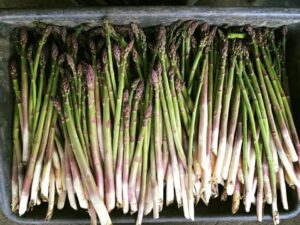
Penn State announced an upcoming free Zoom Meeting on Asparagus Production, Management, and Marketing. The presentation will be given by Carl Cantaluppi, Retired Area Extension Agent, North Carolina Cooperative Extension. Registration required to obtain Zoom link. 

The Meeting will be on Wednesday, March 17 from 10 A.M. to 12 Noon. It will be free and open to all that are interested. The publication entitled, “Growing Asparagus from A to Z” will be available for sale but is not required to attend the meeting.

Click on the link below to register for the meeting:

https://nam02.safelinks.protection.outlook.com/?url=https%3A%2F%2Fextension.psu.edu%2Fasparagus-production-management-and-marketing&data=04%7C01%7Cminfante%40njaes.rutgers.edu%7C6c4ad96b99884d60da8308d8d424f5e0%7Cb92d2b234d35447093ff69aca6632ffe%7C1%7C0%7C637492602501485088%7CUnknown%7CTWFpbGZsb3d8eyJWIjoiMC4wLjAwMDAiLCJQIjoiV2luMzIiLCJBTiI6Ik1haWwiLCJXVCI6Mn0%3D%7C1000&sdata=dwjiC0F1OFulJPA2AXvCRZEzpwmxht7JYQWtnGHnsNk%3D&reserved=0

Energy Efficiency Incentives for Indoor Agriculture – Webinar

New Jersey offers a variety of statewide energy efficiency programs that are designed to offer full project development assistance from information on best practices to rebate payments and financing tools.

“Incentives for Indoor Agriculture” webinar will be presented by New Jersey’s Clean Energy Program on Thursday, March 4, 2021 from 11:00am to 12:00pmEDT. This webinar will discuss how New Jersey’s Clean Energy Program is helping the indoor agriculture industry with state funded incentives and rebates for highly energy efficient technology and money-saving solutions to maximize plant growth potential while reducing utility costs.

Registrations are accepted online by clicking here.

The New Jersey Board of Public Utilities (BPU) provides oversight for the NJ Clean Energy Program.

As stewards of our environment, farmers can reinforce their pledge to sustainable agriculture by using renewable energy and help reduce pollution, global warming, and our dependence on imported fuels. Installation of energy efficient equipment, adoption of energy-saving practices and renewable energy generation is a viable option for New Jersey farmers seeking to reduce their operating costs.

For additional information, please call the NJ Department of Agriculture’s Division of Agricultural and Natural Resources at (609) 292-5532 or visit their website.

Free Food Safety Webinar Series

The Rutgers On-Farm Food Safety Team will be presenting three free webinars in March from 12:00 pm to 1:00pm.  These will cover issues related to audits and the Food Safety Modernization Act (FSMA) – Produce Safety Rule.  On March 12 we will have an “Introduction to FSMA and Audits” discussing the difference between them, if a grower needs to comply with either and what is involved.  March 19 “Backflow Prevention in the Field and Packinghouse”, types of different devices, how to maintain them and where to place them.  March 26 “On-Farm Record Keeping” for FSMA and audits including the type of records required, what needs to be on the records and now long to maintain them.  To sign up for these free webinars go to RutgersOnFarmFoodSafety.Eventbrite.com.

Second notice: Pepper Weevil Management and Research Priorities

Pepper Weevil Management and Research Priorities

March 3, 2021, 1:00 – 3:00 pm

Online Zoom Meeting

Pepper growers/agribusiness professionals/extension personnel are invited to attend a virtual meeting to discuss current pepper weevil management tactics and to set research priorities.

Since 2006, at least one farm each growing season has been infested with pepper weevil.  So far, timely spraying after detection has occasionally been successful in eliminating weevils.  Otherwise, insecticide applications have only suppressed weevil populations.  Pheromone traps are useful in detecting weevils, but often fields are infested before the weevils are trapped.  What else can be done?  What are the priorities in attempting to manage weevils?

Please join the discussion to help develop tactics to reduce the impact of pepper weevil.

To register please go to https://go.rutgers.edu/3bm2r3xl

The registration deadline is March 1, 2021, and you must pre-register to get the zoom link.
