Dear Fruit Growers,
The 2017 New Jersey Commercial Tree Fruit Production Guide is available electronically for free. Anyone may print paper copies if they choose to. If you already have a copy of 2016 NJ Commercial Tree Fruit Production Guide, you only need to print 10 page addendum (first 10 pages), available at: https://njaes.rutgers.edu/pubs/publication.asp?pid=e002.
Print copies of 2017 NJ Tree Fruit Production Guide available for $25 per copy.
For North Jersey, please contact: Diana Boesch: email – boesch@njaes.rutgers.edu or Phone – 908 -788-1339
For South Jersey, please contact: Joan Medany: email – jmedany@co.gloucester.nj.us or Phone – 856-307-6450 ex. 1
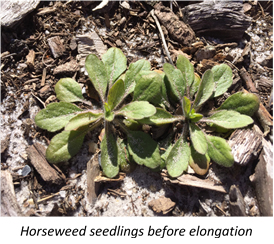 of the first weeds that will break through the residual herbicide coverage provided by preemergence applications is horseweed, aka marestail. Horseweed has two primary periods of emergence, from late March through June and from late summer through late fall. Some of the most problematic horseweed emerges in the fall and over winters as small rosettes. If growers don’t control it with fall-applied residual herbicides, the weed has an excellent head start on the spring growing season, especially after a mild winter. Horseweed plants remain in the rosette stage through mid-April, followed by stem elongation (bolting) and rapid growth to an height of 3 to 6 feet. Plants that emerge the previous fall will bolt earlier than spring-emerging plants. Horseweed is most easily controlled when in the seedling, or rosette stage, and spring postemergence herbicides should be applied before stem elongation.
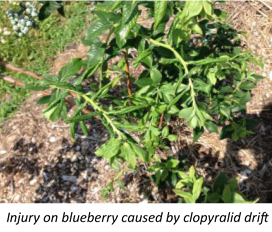 Clopyralid – Use Stinger at 3 to 4 fl oz/A of. Stinger has a 24(c) Special Local Need label for weed control in blueberry since 2013. Stinger acts as both a postemergence foliar absorbed herbicide and a residual herbicide. The initial twisting and curling observed after application to susceptible species is due to the foliar absorption. Do not apply Stinger from one week prior to bloom until one week after bloom. Stinger can eventually be tank-mixed with Gramoxone to increase the spectrum of weeds controlled and defoliate existing foliage of perennial asters, goldenrod species and mugwort. Donot allow spray or drift to contact green bark, leaves, or fruit as crop damage may result as shown on the picture. Time all applications to maintain a 30-day PHI (PreHarvest Interval). Do NOT apply Stinger in a hand-held sprayer used to “spray until wet”. Stinger is a residual herbicide that must be applied on a rate per acre basis with a precisely calibrated sprayer. Read safety precautions on the label.