Fruit Crops Edition

Seasonal updates on diseases, insects, weeds impacting tree fruit and small fruit (blueberry, cranberry, and wine grape). Fruit Pest Alerts are also available via this category feed.
 
Subscriptions are available via EMAIL and RSS.

Grape Root Borer – Do I Need to Treat?

Dean Polk, Statewide Fruit IPM Agent and Dr. Anne Nielsen, Extension Specialist in Fruit Entomology

A number of growers have recently asked about treatments for grape root borer. Grape root borer (Vitacea polistiformis Harris) is a comparatively large clearwing moth. The adults can resemble Polistes wasps, and can often be confused with these insects, especially since it is often easier to see a wasp in a vineyard than an adult grape root borer. See the images that compare the 2 insects below in Figure 1.

Figure 1. Polistes wasp on left, compared to male grape root borer on right. Credits Hermann 2012 and Copeland 2012.

One important difference is that grape root borer (GRB) larvae feed inside grape roots, while wasp larvae do not. Although the grape borer is more of a southern pest, it is present in New Jersey and can be a pest that does significant damage. Adult females lay eggs on the vine surface and on weeds near the crown. Shortly after hatching the larvae enter the crown and central root system, boring into the roots where they can last for 2 years. When the larvae mature, they exit the wood and pupate close to the soil surface where they emerge from early July through August. GRB is not considered an economic pest until about 5% of the vines are infested. This is determined by examining the bases of numerous vines at weekly intervals for signs of adult emergence, or pupal cases (exuvia), throughout the summer, see Figure 2. Pheromone traps can also be used to measure adult emergence, but since they attract moths from both the surrounding woods and vineyards, they are practically useless to tell us what is going on in any specific vineyard. Counting pupal cases is labor intensive, but does tell us if the vineyard is or is not truly infested.

Figure 2. Pupal case from newly emerged adult GRB.


During 2015 -’16 we monitored 2 plantings at each of 9 vineyards. During that time we found 3 vineyards that had populations of GRB that merited treatment, or were above the 5% infestation level. While infestation levels can change over time, this does tell us a few things about GRB in NJ. First, about 33% of the vineyards we sampled had economic populations of GRB. Therefore growers need to determine if they indeed have GRB populations that merit treatment prior to actually doing a GRB treatment. Secondly most GRB adults emerged from the soil a little later than we first thought. Counting the pupal cases over time, we can get an emergence curve as in Figure 3. This vineyard does merit treatment, since the total vines infested is over 5%. Most of the insects that emerged peaked in late July and early August.

Figure 3. GRB exuvia counts over time Farm A, 2015, ’16.

Treatments: If the vineyard has an economic population, then the standard treatment would be using Lorsban at the start of adult emergence, which would be now in most years. The material is applied to the soil around the base of each vine, and forms a barrier that kills young larvae as they burrow into the soil and root system. Growers can use any of several formulations. The rates vary depending on the formulation that is used. Lorsban Advanced: Use 4.5 pt/100 gal, with 2 qt applied to a 15 sq ft area around each vine; Lorsban 4E: Use the same amount as with the ‘Advanced’; Lorsban 75WG: Use 3 lb/100 gal, with 1.5 qt applied to 11 sq ft around each vine. There is a 35 day PHI with Lorsban products for grapes. Do not contact the fruit surface, and apply only to the soil at the base of each vine.

Fruit IPM for July 26, 2017

Peach:

Brown Marmorated Stink Bug (BMSB): Adults are present at two sites in Monmouth and Middlesex Counties. Numbers are very low, and in both cases the orchard consists of weedy ground cover.

[Read more…]

Upcoming Event – ACGA Summer Meeting

Event – American Cranberry Growers Association (ACGA) Summer Meeting

Date – August 17, 2017

Location– Rutgers P.E. Marucci Center, Chatsworth NJ

Agenda

CRANBERRY BOGS:

8:30–8:45 Opening Remarks
Shawn Cutts, President, American Cranberry Growers Association

8:45-9:05 Screening of POST Herbicides for Controlling Carolina Redroot (Lachnanthes caroliana) in New Jersey Cranberry Beds (Bog 6)
Thierry Besancon and Baylee L. Carr, P.E. Marucci Center for Blueberry & Cranberry Research & Extension, Rutgers University, Chatsworth, NJ

9:05–9:25 Breeding for Fruit Rot Resistance: Evaluation of the Next Cycle of Crosses (Bog 8)
Nicholi Vorsa, P.E. Marucci Center for Blueberry & Cranberry Research & Extension, Rutgers University, Chatsworth, NJ

9:25–9:45 Performance of Welker and Haines and other Advanced Selections (Bog 10)
Jennifer Johnson-Cicalese and Nicholi Vorsa, P.E. Marucci Center for Blueberry & Cranberry Research & Extension, Rutgers University, Chatsworth, NJ

9:45-10:10 Research on Diseases of Cranberries (Bog 15)
Peter Oudemans, Department of Plant Biology and Pathology, Rutgers University

10:10-10:30 Is Mycorrhizal Inoculation Efficacious? (Bog 18)
James Polashock, Research Plant Pathologist, USDA-ARS

10:30–10:50 On-going Research on Sucking Insect Pests (Bog 19)
Cesar Rodriguez-Saona, Department of Entomology, Rutgers University; Vera Kyryczenko-Roth, P.E. Marucci Center; and Robert Holdcraft, P.E. Marucci Center, Chatsworth, NJ

10:50–11:10 Show and Tell
Cranberry growers

CONFERENCE ROOM:

11:20–11:30 Cranberry Statistics
Bruce A Eklund, State Statistician, U.S. Department of Agriculture | National Agricultural Statistics Service

11:30–12:00 Root Growth in Cranberries
Amaya Atucha, Assistant Professor, and Beth Workmaster, Department of Horticulture, University of Wisconsin-Madison

12:00–1:00 LUNCH (Pole Barn)

1:00–1:30 Farm Safety
Ray Samulis, Cooperative Extension Agent, Burlington County Extension, Rutgers University

Fruit IPM for 7/21/17

Peach:

Oriental Fruit Moth (OFM): Treatments for the third brood are almost over. The second and final treatments are due in southern counties by this weekend. The first sprays for this brood are due in northern counties by this weekend. As with the previous generations, timing for the third generation depends on the type of material that is used. Application timings are as follows:


OFM 3rd Generation Timing
Insecticide Type
County/Region Degree Days by 7/20 base 45 Conventional

Target – 2100-2200, 2450-2500

Intrepid / IGRs

Target -2050-2100, 2400-2450

Diamides (Altacor, Exirel

Target – 2025-2150, 2375-2450

Gloucester – Southern 2366 1st – past

2nd – 7/22-7/24

1st – past

2nd – 7/21-7/22

1st – past

2nd – 7/20-7/21

Hunterdon – Northern 2047 1st – 7/22-7/24

2nd – 8/3-8/4

1st – 7/21-7/22

2nd – 8/2-8/3

1st – 7/20-7/21

2nd – 8/1-8/2

[Read more…]

The Cranberry Toad Bug – An Update

We are seeing an increase in the number of nymphs of toad bugs in cranberry beds. Growers need to be aware of this insect and treat if numbers reach high levels (there is no current threshold). We are currently conducting studies to estimate the density of toad bugs that can cause economic injury to cranberries.

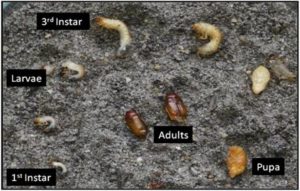
Life cycle. Toad bugs, Phylloscelis atra, feed only on cranberries. This insect has a single generation per year. It overwinters as eggs. The nymphs appear by the end of June through early September, and the adults from end of July through October (harvest). Eggs are laid from end of August through October.

Cranberry toad bug nymphs

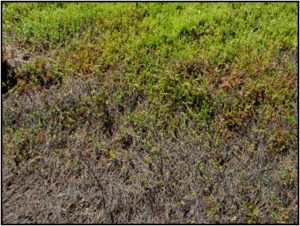
Damage. Feeding damage can be noticed in two stages. First stage feeding damage on vines causes closing in (towards the branch) of the leaves on the new growth. Second stage feeding causes changed in color (reddish to brown) of new growth. The damage can be seen from July until harvest. This damage will cause dying of the branch and the berries to shrivel up. Heavy infestation will result in dwarfed berries.

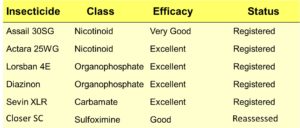
Management. To determine infestation, lightly sweep problematic beds (bugs should be easy to catch in sweep nets as they are very active). Because this is a new pest there is no threshold established yet. Thus, insecticide applications should be based on the relative number of bugs per sweep compared with other sites and previous history of infestation. Currently, growers can use the following control options: Sevin 4F (broad-spectrum carbamate), Diazinon, Imidan 70W (broad-spectrum organophosphates), Actara or Assail 30SG (neonicotinoid insecticides, effective against piercing-sucking insects). If infestation is high, treatments should be applied at this time of the year.

Toad bug life cycle

For more information, please see “The Cranberry Toad-Bug” by F.A. Sirrine and B.B. Fulton. 1914. New York Agricultural Experiment Station. Bulletin No. 377. Department of Agriculture, Geneva, NY.

Fruit IPM for 7/13/17

Peach:

Oriental Fruit Moth (OFM): The 3rd OFM flight is well underway in all counties. These adults produce 3rd brood of larvae, which primarily infest the fruit.

[Read more…]