Fruit Crops Edition - Cranberry Section

Seasonal updates on diseases, insects, weeds impacting small fruit (blueberry, cranberry, and wine grape). Fruit Pest Alerts are also available via this category feed.
 
Subscription is through the general Fruit feed available via EMAIL and RSS.

Wednesday Discussions: Ask the Ag Agent

Last night on “Ask the Ag Agent” we discussed The NJ Department of Health’s “Interim Coronavirus Disease 2019 (COVID-19) Guidance for Migrant and Seasonal Farmworkers, Their Employers, and Housing Providers” guidance document. We will continue to facilitate discussion on “Ask the Ag Agent” forum for this topic and others next week. Please feel free to bring up any ag-related topics for discussion on this forum.

“Ask the Ag Agent” weekly 1-hour sessions for farmers will be hosted weekly and continue each Wednesday until May 27th. The online conferencing/call in events will begin at 7:00PM with an open forum to discuss ag-related questions about production, marketing, regulations and any other topics farmers wish to discuss. All are welcome. Events are hosted by William Bamka, Stephen Komar, Meredith Melendez and Michelle Infante-Casella – Agricultural Agents.

To access via WebEx on a computer go to https://go.rutgers.edu/rc9n3kxt

Or, Join by phone
+1-650-429-3300 USA Toll
Access code: 799 743 872

For additional Rutgers Cooperative Extension educational programs check out https://events.rutgers.edu/njaes/
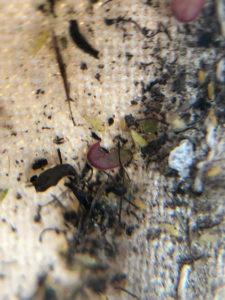

Blunt-nosed Leafhoppers in Cranberries

There is continued concern among New Jersey cranberry growers of increases in blunt-nosed leafhopper populations due to changes in pest management strategies (e.g., adoption of new reduced-risk products and decreased applications of broad-spectrum insecticides). Blunt-nosed leafhopper is of particular concern because they are vectors of false blossom disease.

Blunt-nosed leafhopper nymphs

Blunt-nosed leafhopper nymphs. Photo credit: Lindsay Wells-Hansen.

Life Cycle – The blunt-nosed leafhopper has one generation a year. Blunt-nosed leafhopper eggs overwinter and begin to hatch in early May. The nymphs (see Picture; small yellow-colored insects) will go through five instars in about a month. The adults begin to appear early in July and are most abundant in late July. Numbers of this species start to diminish by the first week in August. The adults have a characteristic blunt head and vary from light yellowish-gray to dark brown. Eggs are laid in August-September.

Damage – Nymphs and adults get their food by sucking the plant juices of the cranberry with their piercing-sucking mouthparts. This direct injury is, however, not noticeable. They are most important as vectors of false blossom disease.

Scouting and Control – The most important point in leafhopper control is locating the infestation. Monitoring for this insect is accomplished best with an insect sweep net. Nymphs can be monitored before bloom using sweep nets. Nymphs before bloom are small; thus, you may need to freeze the samples (to kill them), and then count the number of nymphs under a microscope or using a magnifying lens. Perform sweep sets of 25 sweeps each. The recommended number of sweep sets is: 1 per 1–10 acres, at least 10 sweep sets per 10–20 acres, and 1 sweep set per 2 acres for more than 20 acres. In cases of high blunt-nosed leafhopper numbers, we recommend application of a broad-spectrum insecticide, such as Lorsban. This time of the year (May 20-30) would be the period for pre-bloom applications. The neonicotinoids Actara and Assail are very effective against blunt-nosed leafhoppers and can be used to target the adults after bloom. There is no threshold so decisions should be made based on current numbers and prior infestation history. Broad-spectrum insecticides will disrupt biological control particularly the natural enemies (predators and parasitoids) of Sparganothis fruitworm, so their use should be minimized to areas of high blunt-nosed leafhopper populations.

NJMVC Further Extends Driver License, Registration, and Inspection Expiration Dates Due to COVID-19

The New Jersey Motor Vehicle Commission Chief Administrator Sue Fulton, on Monday, May 18th, announced additional extensions to driver license, registration, and inspection expiration dates in the continuing efforts to mitigate COVID-19 and safeguard public health.

Effective immediately, the following documents, if expiring between March 13 and May 31, have been extended to July 31. Documents expiring June 30 are extended two months to August 31, and those expiring July 31 are extended to September 30.

• All Standard driver licenses (including permits) and standard non-driver IDs
• Privately owned and commercial vehicle registrations (including Farmer and Farm Use registrations)
• Vehicle inspections
• Purple Heart/Disabled Veteran placards
• Temporary tags

“Get it done online now, if you’re able,” Fulton suggests. “We do anticipate that volumes will spike once we reopen and when we reach the end of these extensions. Our job is to serve customers in the most efficient way possible and one way we can do that is by steering people to our expanded list of online services.”

On March 13, the NJMVC initially announced two-month extensions for licenses, registrations, and inspection stickers expiring in March, April, and May, timelines that have now been pushed back.

The NJMVC encourages customers to utilize online services, which have been expanded during the COVID-19 crisis. In most cases, customers can renew a license, replace a lost license, change an address, renew a registration, and complete other transactions through the NJMVC’s Online Services portal.

Customers also should check NJMVC.gov for the latest information and updates.

Exirel®: A New Insecticide Registered in Cranberries

Last year, the insecticide Exirel® (FMC Corporation) was registered for use in cranberries. The Exirel label includes the target pests: cherry fruitworm, cranberry fruitworm, blackheaded fireworm, and Sparganothis fruitworm. The active ingredient (a.i.) is cyantraniliprole. This insecticide belongs to a class of insecticides known as anthranilic diamides (similar to Altacor). This class of insecticides is particularly effective against lepidopteran pests but Exirel has broader insecticidal activity that includes flies, aphids, weevils, etc. After ingestion, anthranilic diamides work by impairing muscle contraction, resulting in feeding cessation, lethargy, and partial paralysis, eventually leading to the death of the insect.

Exirel is considered a reduced-risk insecticide and compatible with biological control and pollination. It should thus be considered as a new alternative when rotating insecticides with different modes of action for preventing the development of resistant populations.

Exirel has a 14-day pre-harvest interval (PHI) and a 12-hour re-entry interval (REI). A maximum of 0.4 lb a.i. can be applied per acre, which equates to three applications at the highest label rate (20.5 fl oz per acre).

Our previous work in laboratory and semi-field experiments has demonstrated that Exirel can provide similar, or sometimes even better, larval control as compared with other registered materials such as Intreprid, Delegate, and Altacor. I encourage growers to consider using Exirel as a pre- or post-bloom application for the control of lepidopteran pests. Because it is a new insecticide, we have limited (large-scale) field data, so I recommend growers to start by using Exirel in a few acreages and share their experiences with me.

Labor Will Be Hot Topic For 7:00PM Wednesday Night Webinar – “Ask the Ag Agent”

This week, the webinar will be concentrated on the topic of farm labor. Since updates are coming to the industry and we have learned of some programs for migrant workers please join us for discussion. Please feel free to bring up other topics.

Ask the Ag Agent – 7:00PM Weekly – Every Wednesday – Farmer Video Conference/Call-In ForumAsk the Ag agent

“Ask the Ag Agent” weekly 1-hour sessions for farmers will be hosted again on Wednesday May 13th and continue each Wednesday until May 27th. The online conferencing/call in events will begin at 7:00PM with an open forum to discuss ag-related questions about production, marketing, regulations and any other topics farmers wish to discuss. All are welcome. Events are hosted by William Bamka, Stephen Komar, Meredith Melendez and Michelle Infante-Casella – Agricultural Agents.

To access via WebEx on a computer go to https://go.rutgers.edu/rc9n3kxt

Or, Join by phone
+1-650-429-3300 USA Toll
Access code: 799 743 872

For additional Rutgers Cooperative Extension educational programs check out https://events.rutgers.edu/njaes/

NJ Statewide Wine Grape Twilight Meeting (online)

Please join the NJ Statewide Wine Grape Twilight Meeting on the Wed, May 20, 2020 4:20 pm using the below link. Also, please see below for the program details.

Meeting Host: Hemant Gohil

https://rutgers.webex.com/rutgers/j.php?MTID=mbdbb2eafedfe9d44f3694adeedf61269

Meeting number: 222 571 928:

Password: MJht93B8Pzx

Join by phone    +1-650-429-3300

Access code: 222 571 928 [Read more…]