Fruit Crops Edition - Cranberry Section

Seasonal updates on diseases, insects, weeds impacting small fruit (blueberry, cranberry, and wine grape). Fruit Pest Alerts are also available via this category feed.
 
Subscription is through the general Fruit feed available via EMAIL and RSS.

Diazinon Shortage and Future Production

This article has been adapted from an article written by Dr. Christelle Guédot, University of Wisconsin-Madison, and published in the Cranberry Crop Management Journal – Volume 36 (August 02).

Every 15 years, the Environmental Protection Agency (EPA) performs registration reviews to reevaluate pesticides to assess environmental and occupational risk. In March 2023, the EPA announced that it would accelerate the review process of Diazinon and other pesticides that were due to conclude in 2026. As part of the review process of Diazinon, EPA reached an agreement with the pesticide registrants to develop voluntary mitigation measures by the registrants several years ahead of the normal registration review process to reduce occupational risk. This has led registrants to start implementing these measures this summer and resulted in the shortages observed this summer. For more information about this agreement between EPA and the registrants reached in April, please see https://www.epa.gov/pesticides/epa-reaches-agreement-early-mitigation-measures-initiative-organophosphate-pesticide.

While there was some uncertainty surrounding the supply and forecast of production of the different formulations of Diazinon from Adama and Loveland Products this summer, an official statement was received from Adama stating that they will continue to produce AG500 into 2024 and that they will cease production of Diazinon 50W. For AG500, new labels that will contain occupational risk mitigation measures and endangered species language are expected to be approved by the end of 2023 and should be in place through 2026 when the EPA will complete the registration review process. As for AG600, Loveland Products have informally indicated to the Cranberry Institute that they do not intend to produce Diazinon AG600 any longer. Once stocks of Diazinon 50W and AG600 run out, Diazinon will only be produced and available from Adama in the AG500 formulation. For more information about use pattern of Diazinon AG500, a link to the label can be found at https://s3-us-west-1.amazonaws.com/agrian-cg-fs1-production/pdfs/Diazinon_AG5001t_Label.pdf. It is expected that EPA will announce the notice of the agreed upon mitigation measures later this year and that an interim or final decision will be reached in 2026 under the regular review process timeline.

New Peach Varieties – ‘Felicia’, ‘Evelynn’ and ‘Anna Rose’

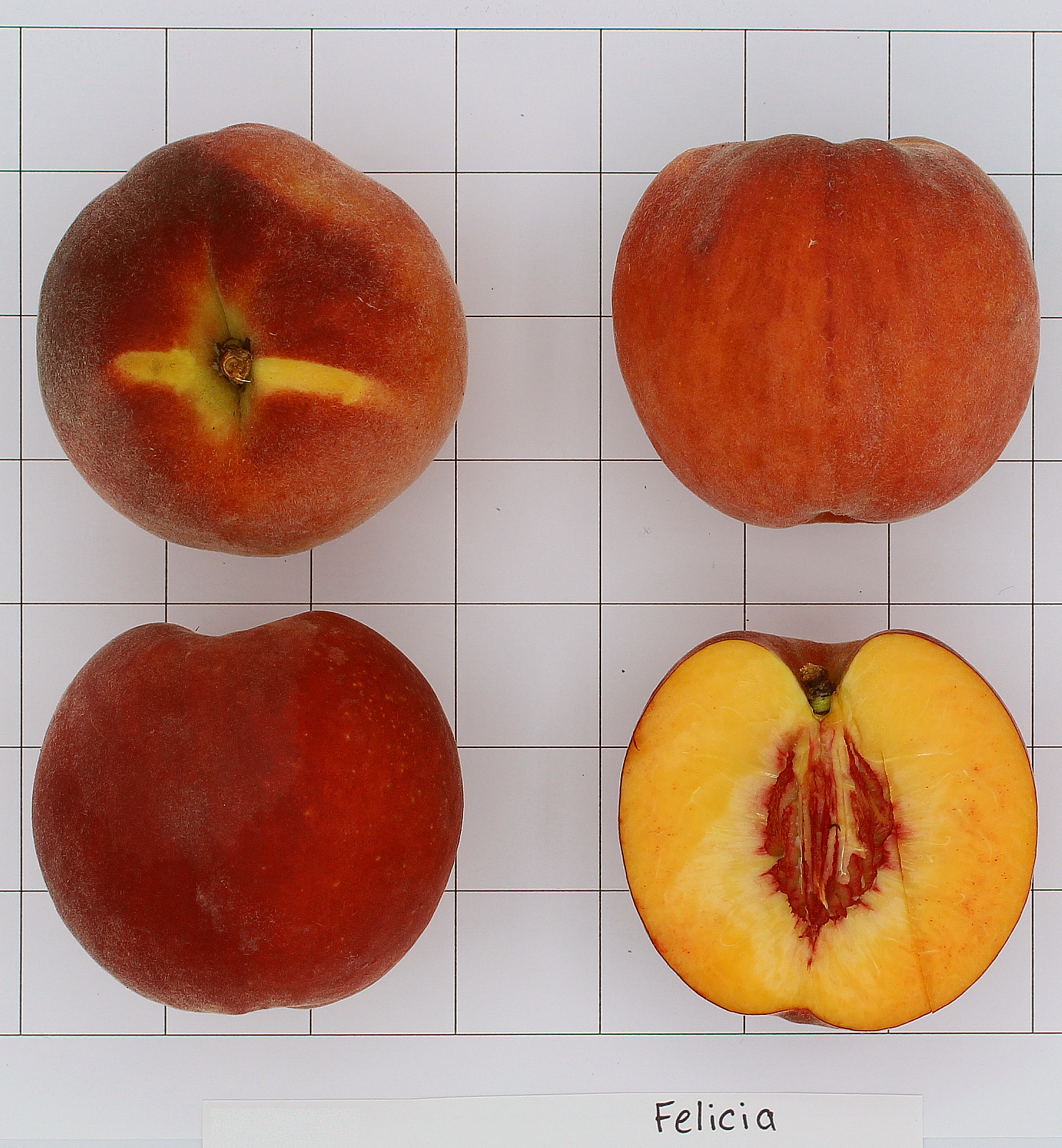
Felicia peach The Rutgers/NJAES stone fruit breeding program, led by Joe Goffreda, continues to create, and release exciting new peach varieties. We, in collaboration with growers, also continue to develop the varieties by evaluating their performance in plantings in commercial orchards and at Rutgers Agricultural Research and Extension Center. During this key time of the season, historically Redhaven season, it is important for our area to capture a substantial market share with premium fresh peaches. We are glad to feature some new and improved peach options for this season.

Felicia is a recent release from Rutgers University. It is a very attractive freestone yellow-fleshed peach variety. It has attractive red to dark red skin, little pubescence, with traces of red in the flesh. It ripens a few days before Redhaven; however, unlike Redhaven, it retains firmness for longer while maintaining the balance of sweetness and acidity (Table 1). Fruit is large and firm-fleshed, which is essential for post-harvest handling. It has low susceptibility to bacterial spot.

Though Redhaven is still the standard, yellow-fleshed, traditional peach in this season, it has a few challenges. For example, fruit can ripen faster than it changes skin color. That means it requires experience to start picking. Felicia is a good choice if one is planning a replacement for Redhaven. [Read more…]

Farm Credit East Report on Grants & Incentives Available for Northeast Agriculture Businesses

One of the most frequent calls over the past few years has been, “I want to start a farm/business/value-added product (etc.).”

That is usually followed up with, “What grants/funding sources are available?”

After rattling off a list of a few common sources of funding for new farmers there’s an added caveat that I don’t know the current status of those programs or what restrictions they have regarding new farming ventures. There are more programs out there with available funding, but there’s no comprehensive list of all grant programs supporting agricultural businesses, until now.

Farm Credit East has just released a report “identifying federal, regional and state grants, loan guarantees, and other incentives available to assist Northeast producers of all types and sizes.”

“Grants can be a great resource to provide additional funds needed to take on larger projects,” said Chris Laughton, Farm Credit East Director of Knowledge Exchange. “Unfortunately, they’re often under-utilized because they can be time consuming and involve quite a bit of paperwork.”

The report, from Farm Credit East Knowledge Exchange, includes funding opportunities available in the eight states served by Farm Credit East. Programs are categorized by their main focus:  beginning farmers; conservation, environment and forestry; energy; fisheries and aquaculture; organic; rural business development; and research, education and promotion.

The report titled Grants and Incentives for Northeast Agriculture is available at FarmCreditEast.com or by contacting Chris Laughton at (800) 562-2235 or Chris.Laughton@farmcrediteast.com for more information.

Farm Credit East also has grant writing assistance services. Information is available on their grant writing page.

[Source:  https://www.farmcrediteast.com/en/about/NewsRoom/press-releases/230717FundingforNortheastAgriculturalProducers]

Sparganothis Fruitworm Degree-Day Update: As of June 22, 2023

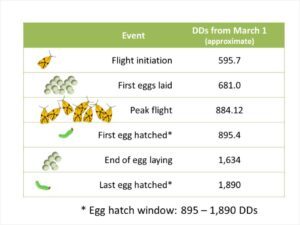
Based on our degree-day (DD) model for Sparganothis fruitworm, peak flight is expected at around 884 DD (see chart). As of June 22, Sparganothis fruitworm has accumulated 827 DD (using April 15 as biofix; a biofix more realistic to New Jersey practices). Based on the April 15 biofix, egg laying should have been initiated. However, I do not expect peak flight and those eggs to start hatching until mid-next week. Larval injury to fruit usually begins after the eggs hatch. If treatment is required (based on pheromone trap counts), sprays should be done 10-14 days after peak moth captures, ca. 7-11 July. If Sparganothis fruitworm pressure has been high, it may be advisable to treat 3 weeks after the moth flight began (i.e., around 1-4 July) and again 10 days later. When bees are present your option is to use an insect growth regulator such as Confirm or Intrepid. Our “standard” recommendation has been, however, to wait until bees are removed to apply an insecticide. Your post-bloom options include Altacor, Delegate, Exirel, or Intrepid. The timing of insecticide application is critical; so, if needed, do not wait too long to manage this pest.

Degree-day model for Sparganothis fruitworm

Degree-day model for Sparganothis fruitworm

2023 Spotted Lanternfly Tracking Survey

Rutgers NJAES Wine Grape Extension, in association with Penn State Extension Grape and Wine Team, is calling on those who own, operate, or manage a farm or vineyard in the New Jersey region to participate in a survey that aims to track the spread and severity of nymph and adult spotted lanternfly populations during the 2023 season. The data collected will provide insights into the distribution patterns of both nymph and adult SLF within and outside vineyards, enabling growers and researchers to better understand this invasive pest’s potential impact on agriculture in the Mid-Atlantic region. [Read more…]

Managing Blunt-nosed Leafhoppers in Cranberries – 2023

Blunt-nosed leafhoppers (BNLH) are important pests of cranberries in NJ because they vector a phytoplasma that causes false blossom disease. BNLH has one generation a year. It overwinters as eggs, which begin to hatch in early May. The nymphs will go through five instars in about a month. The adults begin to appear by the end of June and are most abundant in mid-July. Numbers of this species start to diminish by the end of July. The adults have a characteristic blunt head and vary from light yellowish-gray to dark brown. Eggs are laid in June-July. Nymphs and adults get their food by sucking the plant juices of the cranberry vines with their piercing-sucking mouthparts. At this time of the year, we are observing early-instar nymphs, mostly 1st instars but also 2nd instars (Figure 1).

Blunt-nosed leafhoppers

Figure 1. Blunt-nosed leafhoppers early-instar nymphs. Photo credit: Paolo Salazar-Mendoza.

Here are some guidelines to consider when managing BNLH in cranberries:

  1. The most important point in BNLH control is locating the sites of infestation. Monitoring for this insect is accomplished best with an insect sweep net. Nymphs should be monitored before bloom using sweep nets (this time of year). Nymphs before bloom are small (Figure 1); thus, ideally, you may need to freeze the samples (to kill them), and then count the number of nymphs under a microscope or using a magnifying lens.
  2. To monitor, perform sweep sets of 25 sweeps each. The recommended number of sweep sets is: 1 per 1–10 acres, at least 10 sweep sets per 10–20 acres, and 1 sweep set per 2 acres for more than 20 acres.
  3. A challenge for managing BNLH is the fact that they vector a phytoplasma that causes false blossom disease. For this reason, it is difficult to establish economic thresholds for this pest because we do not know the proportion of individuals that are infected in the population. Moreover, this proportion can vary depending on the variety. For instance, we have observed higher incidence of infection in the newer varieties even when populations of leafhoppers are low.
  4. Control measures should be considered based on the number of BNLH relative to previous years, history of insecticide application, and the variety. If BNLH populations are increasing compared to previous years and the beds have not been treated for BNLH for 2-3 years, growers should consider treatment.
  5. If treatment is necessary, we have a few options to manage BNLH. The best timing for insecticide treatment is before bloom to target the young nymphs. We recommend the use of organophosphates such as Diazinon (diazinon) and Orthene (acephate), carbamates like Sevin (carbaryl), and pyrethroids like Fanfare (bifenthrin) and Danitol (fenpropathrin). Although not proven scientifically, there are claims that Orthene and Sevin can reduce pollinator activity by repelling bees. The neonicotinoids Assail (acetamiprid) and Actara (thiamethoxam) also work well against nymphs, but we do not recommend their use before bloom due to potential negative effects on bees; neonicotinoids are systemic insecticides that can accumulate in the pollen and nectar. Closer (sulfoxaflor) is a new registered insecticide in cranberries with a similar mode of action as the neonicotinoids but that belongs to a different class of insecticides. We have tested Closer in small plot trials at the P.E. Marucci Center and shown that it is effective against BNLH nymphs; however, more data are needed to confirm its efficacy at larger scales in commercial farms.