Fruit Crops Edition - Blueberry Section

Seasonal updates on diseases, insects, weeds impacting small fruit (blueberry, cranberry, and wine grape). Fruit Pest Alerts are also available via this category feed.
 
Subscription is through the general Fruit feed available via EMAIL and RSS.

Where Can I Find the 24(c) Label for Dual Magnum Herbicide in Highbush Blueberry

I’ve been recently asked by a few people if Dual Magnum is really labeled for use on highbush blueberry since they cannot find the label on the CDMS website. Dual Magnum received a 24(c) Special Local Need label for various crops in New Jersey, including highbush blueberry.

The 24(c) label is an indemnified label provided by Syngenta, meaning that this label con only be distributed to users that have agreed in writing to the terms and conditions of the use including a waiver of liability.

Therefore, the label is only available from the Syngenta website: https://www.syngenta-us.com/labels/indemnified-label-login

You’ll have to create an account before being able to login to the website. Once you have logged in, you’ll be redirected to the Indemnified Label Search page where you need to enter the information for State (New Jersey) and Product (Dual Magnum, and select “Blueberries, Highbush” for use on. You’ll then have to read the Waiver of Liability and Indemnification Agreementbefore deciding to accept or decline it. If you accept the Waiver, you’ll be redirected to the actual Dual Magnum 24(c) label for use on highbush blueberry.


Status of U.S. Consular Operations in Mexico in Light of COVID-19

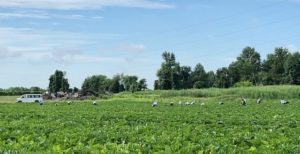
In response to the global pandemic COVID-19, and in line with the Mexican government’s call to increase social distancing, the U.S. Embassy in Mexico City and all U.S. consulates in Mexico will suspend routine immigrant and nonimmigrant visa services starting March 18, 2020, and until further notice. For farmers this means, H-2A workers and others from Mexico may be prevented from entering the U.S. until further notice. NJ Farm Bureau is researching the subject for more clarification. For now to see more information go to the U.S. Embassy’s website at: Field of plantershttps://mx.usembassy.gov/status-of-u-s-consular-operations-in-mexico-in-light-of-covid-19/

2020 Recommendations for Preemergence Weed Control in Established Blueberry

With T3 stage scheduled for late March, it’s really time now to apply your preemergence herbicides before blueberry bud break!

Preemergence herbicides should be applied prior to weed seed germination. If applied to weeds that are already out of the ground, most of these products will not control them. Keep also in mind that these herbicides should receive at least ½” rainfall or irrigation one to seven days after application (depending on herbicides) to incorporate the herbicide in the soil

In order to reduce the potential of selecting for herbicide-resistant weeds, it is highly recommended mixing two residual herbicides with different MOA whenever you apply preemergence herbicides. Make sure the herbicides you plan to apply will be effective at controlling the weed species in your field by checking the herbicide label. Usually, residual herbicides will suppress weed for 6 to 8 weeks depending on irrigation as well as soil and weather conditions. After this period, another residual herbicide can be needed to control weeds through harvest and could be mixed with a postemergence herbicides to control emerged weeds. Roundup (glyphosate), Rely 280 (glufosinate,) and Gramoxone (paraquat) are postemergence herbicides that may be applied with preemergence herbicides before bud break with little risk for crop injury.

  •  MOA 2: Solida (rimsulfuron) and Sandea (halosulfuron) are ALS inhibitors that have both preemergence and postemergence activity. They control most annual broadleaves but are weak on common groundsel, common lambsquarters and eastern black nightshade. Sandea is ONLY recommended for postemergence control of yellow nutsedge. However, these two herbicides will not control ALS resistant weeds (horseweed, ragweed…) already widespread in New Jersey. Thus, these herbicides should always be tank mixed with a partner effective at controlling these weeds
  • MOA 3: Kerb (pronamide) and Surflan (oryzalin) are mitosis inhibitor that will be effective at controlling many annual grass species for 4 to 6 weeks after application. Kerb also help controlling perennial quackgrass. If applied to warm soils (> 55°F), Kerb persistence (and weed control) is much reduced; therefore, reserve Kerb for fall/winter application. Do not use Kerb on blueberries that have not been established for about a year.
  • MOA 5 and 7: The photosynthesis inhibitors (PS II inhibitors) have a broad spectrum of control and will be effective against many broadleaves and annual grasses when applied in spring. Karmex (diuron) and Princep (simazine) have relatively low solubility and have been very safe on blueberries. Sinbar (terbacil) has a longer residual life in the soil and also is more soluble, so it should be used infrequently on light, wet soils. Velpar (hexazinone) is very soluble and should not be used on New Jersey sandy soils. These herbicides are effective on a many broadleaf weed species, including common chickweed, common lambsquarters, common groundsel, henbit, nightshade, redroot pigweed, pineappleweed, shepherd’s-purse, smartweed, and some mustards. Sinbar and Princep will also control most of the annual grasses and help suppressing quackgrass.
  • MOA 12: Solicam (norflurazon) is a pigment inhibitor that may be applied in fall or early spring primarily for annual grass control and quackgrass suppression. Solicam may also provide partial control of many broadleaf weeds as well as of yellow nutsedge. Do not use Solicam on blueberries that have not been established for about a year.
  • MOA 14: Chateau (flumioxazin), Zeus XC (sulfentrazone), and Zeus Prime XC (sulfentrazone plus carfentrazone) are PPO inhibitors with activity against many broadleaves (including redroot pigweed, catchweed bedstraw, common mallow, common lambsquarters, ladysthumb, wild mustard, and shepherd’s-purse) when applied preemergence in spring. Chateau and Zeus Prime XC also have some postemergence activity on newly emerged seedlings of annual weeds. Zeus products may also provide some suppression of yellow nutsedge. Chateau has a 7 day preharvest interval (PHI) and Zeus Prime XC have 3 day PHI, and can therefore be applied later in the season to extend preemergence broadleaves control into late summer. Blueberry plants must have been established at least two years prior to use of these herbicides.
  • MOA 15: Devrinol (napropamide) and Dual Magnum (s-metolachlor) are long chain fatty acid inhibitor. Devrinol will provide good control of annual grasses and should therefore be tank mixed with a PSII or a PPO inhibitor for controlling broadleaf weeds. Devrinol is rapidly degraded if left exposed on the soil surface, so it should be applied less than 24 hours before a rain event to incorporate the herbicide in the soil. Dual Magnum has a 24c Special Local Need label for blueberry in New Jersey. This herbicide controls many annual grasses and some small-seeded broadleaf annual weeds such as redroot pigweed, nightshade and common purslane. Dual Magnum also suppresses emergence of yellow nutsedge. Use Dual Magnum only on plants established for more than one year, and lower rates are suggested on 2- to 3-year-old plantings.
  • MOA 20: Casoron (dichlobenil) is a cellulose synthesis inhibitor recommended for fall application to control many annual and perennial broadleaves, grasses and yellow nutsedge. If left on the soil surface or if applied to warm soil (> 55°F or 70°F depending on dichlobenil formulation), Casoron can lose much of its activity. So, reserve this herbicide ONLY for fall/winter applications. Plants must be at least one year old before Casoron should be used.
  • MOA 21: Trellis SC (isoxaben) is a cell wall synthesis inhibitor currently currently registered for bearing and non-bearing blueberry. Trellis SC primarily controls annual broadleaf weeds, such as horseweed, common lambsquarters, wild mustards, shepherd’s- purse, purslane, and common chickweed; higher rates may also suppress field bindweed and curly dock. However, Trellis SC will have to be mixed with a Group 3, 12, or 15 residual herbicide for controlling annual grasses.
  • MOA 27: Callisto (mesotrione) is an HPPD inhibitor recommended for spring application to control many annual broadleaf weeds as well as annual sedges. It controls large crabgrass but no other grasses, such as goosegrass. Callisto may be used as a broadcast spray between rows to control broadleaves and crabgrass without injuring the fescue sod. Callisto has both preemergence and postemergence activity, and can therefore be used in spring to control ALS-resistant horseweed at the rosette stage.

Consult the 2020 Commercial Blueberry Pest Control Recommendations for New Jersey available on https://njaes.rutgers.edu for rates and additional information. The information above is correct to the best of our knowledge. Other formulations with the same active ingredient as some of the products listed above may exist that may or not may be labeled for the same uses. Always consult the label before making pesticide applications. Information was current as of February 25, 2020.

WEBINAR: Organic Management of Spotted-Wing Drosophila

Dear Organic Fruit Growers, Pest Management Professionals and other stakeholders:

Spotted-wing drosophila (SWD) has emerged as a devastating pest of small and stone fruits worldwide. We have organized a webinar to provide you with the most updated information on everything you need to know for organic management of SWD.

Please register at: https://eorganic.org/node/33992 to attend this webinar.

Date: March 4, 2020 (Wednesday) 2:00-3:30pm Eastern

Presented by: Ash Sial (UGA), Mary Rogers (UMN), Kelly Hamby (UMD), Kent Daane (UC Berkeley), Rufus Isaacs (MSU), Vaughn Walton (OSU), Oscar Liburd (UF), Craig Roubos (UGA), Elena Rhodes (UF) and other members of the SWD OREI project team.

Sponsored by: Award No. 2018-51300-28434 Organic Agriculture Research and Extension Initiative (OREI) USDA National Institute of Food and Agriculture

2020 South Jersey Commercial Tree Fruit Grower Meeting

Date:                     March 5, 2020

Time:                    8:00 am – 3:00 pm

 Location:             RAREC – 121 Northville Road, Bridgeton, NJ 08302

 Pre-Registration: Required, Contact: Karen Holton (holton@njaes.rutgers.edu) or (856) 455-3100 x 4104

Cost / person:        $15.00 (Checks preferred, made out to Rutgers University) Lunch: Included

Pesticide Credits: Requested for – Core, PP2, 10, 1A, 3A and 3B

Program

8:00 am           Registration  Coffee and pastries

8:25 am           Welcome and Opening Remarks

                        Daniel Ward, Director, Rutgers Agricultural Research and Extension Center

                        Hemant Gohil, Agriculture Agent, Rutgers Co-op. Extension, Gloucester County

8:30 am           Peach Bacterial Spot Management: Comparison of Copper Compounds and Rates

                        Norm Lalancette, Extension Specialist in Tree Fruit Pathology, Rutgers NJAES

9:15 am           Pollinator Stewardship in Orchards

                        Julianna Wilson, Academic Specialist, Tree Fruit Integrator, Michigan State University

10:00 am         Break Coffee and pastries

10:15 am         Integrating Management for Key Orchard Pests

                         Anne Nielsen, Extension Specialist in Tree Fruit Entomology, Rutgers NJAES

10:45 am         Recommendation Updates for Tree Fruit Insect Management w/ Special Attention to Bee Safety.

                        Dean Polk, Statewide Fruit IPM Agent, Rutgers NJAES

11:15 am         Pesticide Regulatory and Safety Update for 2020

                        George Hamilton, Extension Specialist in Pest Management, Rutgers NJAES

11:45 am         Industry Updates and NJ Peach Promotion Council Updates

12 Noon          Lunch

1:00 pm           Updates on tree fruit soil fertility management in New Jersey

                         Megan Muehlbauer, Agriculture Agent, Rutgers Co-op. Extension, Hunterdon Co.

1:30 pm           Soil Health – A Panel Discussion

                         Daniel Ward, Extension Specialist, Pomology; Joseph Heckman, Extension Specialist, Soil Health; Thierry Besancon, Extension Specialist, Weed Science; Lewis DeEugenio, Fruit Grower, Summit City Farms; Robert Muth, Fruit and Vegetable Grower, Muth Family Farms; Megan Muehlbauer, Agriculture Agent.

2:30 pm           Updates on Peach and Nectarine Breeding Program

                          Joseph Goffreda, Tree Fruit Breeding, Rutgers University

3:00 pm           Open Session – Grower Questions and Discussion

Pesticide re-certification credits

Please contact Hemant Gohil (Program Organizer) at gohil@njaes.rutgers.edu or 856-224-8029 if you have any questions.

Gramoxone/paraquat Mandatory Training Required Before Use

Spraying for pests

All pesticide certified applicators must successfully complete an EPA-approved training program before mixing, loading, and/or applying paraquat.

Anyone using Gramoxone, Firestorm, Helmquat, Parazone, and other paraquat products must complete an EPA-mandated training before application.

After November 14, 2019, the EPA requires companies to have newly labeled products on the market.


The following are items related to the new label for paraquat products:

  • Only certified applicators, who successfully completed the paraquat-specific training, can mix, load or apply paraquat.
  • No longer allow application “under the direct supervision” of a certified applicator.
  • Restricting the use of all paraquat products to certified applicators only.
  • EPA required Online Training – users must create an account with username and password.
  • A certificate will be delivered by the end of the training after successful completion of the online exam.
  • Applicators must repeat training every three years.

For additional information and FAQs about the paraquat training go to the EPA Paraquat Training website