Commercial Ag Updates + Farm Food Safety

Rutgers Cooperative Extension Ag Agents provide updates on what they see in the field, upcoming events, and other important news that affects your operation, such as developments in on-farm Food Safety. Subscribe if you wish to be notified about workshops, meetings, and upcoming commercial ag events.
 
Subscriptions are available via EMAIL and RSS.

Beat the Heat: Hydration is Key

The body uses water to help dissipate heat through sweat and evaporation of sweat. Water lost as sweat must be replaced through water consumption to help the body maintain temperature regulation. During moderate activity, the CDC recommends drinking at least 1 cup of water every 15-20 minutes to replace water lost through sweat.  

Sports drinks are likely unnecessary to replenish the body’s electrolytes when adequate hydration is combined with regular meals.  However, sports drinks may be beneficial to help balance the body’s water and electrolytes when tasks conducted under hot temperatures result in prolonged sweating over several hours.  

Limit consumption of energy drinks, alcohol, and caffeine-containing beverages such as coffee, tea, and soda. These beverages can contribute to dehydration, increasing the risk of heat illness.  

Staying hydrated starts before work then continues throughout the day and after work. Attention to personal hydration decreases the risk of heat illness and other risks associated with chronic dehydration, such as kidney stones. 
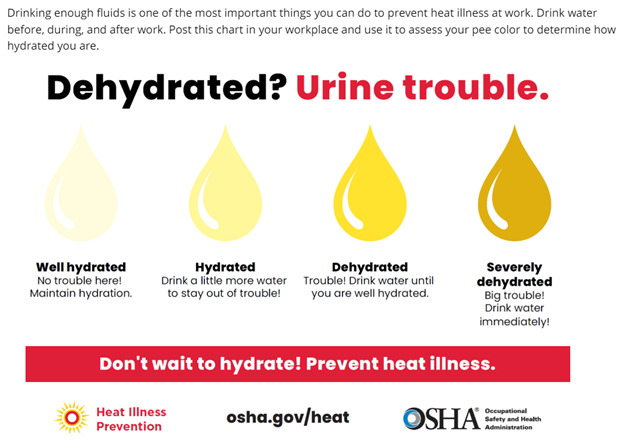
Infographic with different colored teardrops that indicate how urine color corresponds to personal hydration

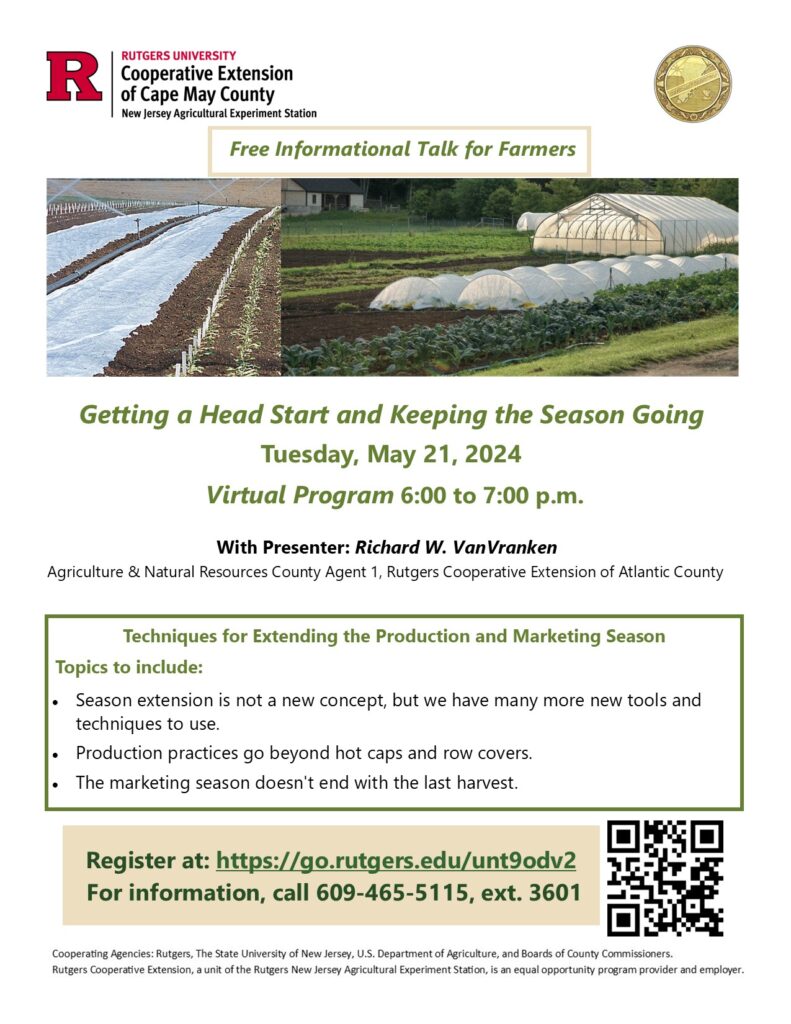
Webinar: Getting a Head Start and Keeping the Season Going

Register for the Free Informational Talk for Farmers, “Getting a Head Start and Keeping the Season Going,” on Tuesday, May 21, 2024, via Zoom from 6 to 7p.m.

For information, call 609-465-5115, ext. 3601 or email capemayag@njaes.rutgers.edu.

Register at: https://go.rutgers.edu/unt9odv2

Webinars: Don’t Sweat Heat Stress in Agriculture

The New Jersey Legislature is currently reviewing identical bills (A3521/S2422) which would establish an occupational heat stress standard and “Occupational Heat-Related Illness and Injury Prevention Program” under the NJ Department of Labor and Workforce Development. As we monitor the progress of these bills, the Farm Health and Safety Working Group of Rutgers Cooperative Extension has launched an educational program on heat stress mitigation in agriculture which includes weekly “Beat the Heat” articles published in the Rutgers Plant and Pest Advisory E-Newsletter, an update to the Rutgers factsheet “Preventing Heat Stress in Agriculture” and a webinar series.

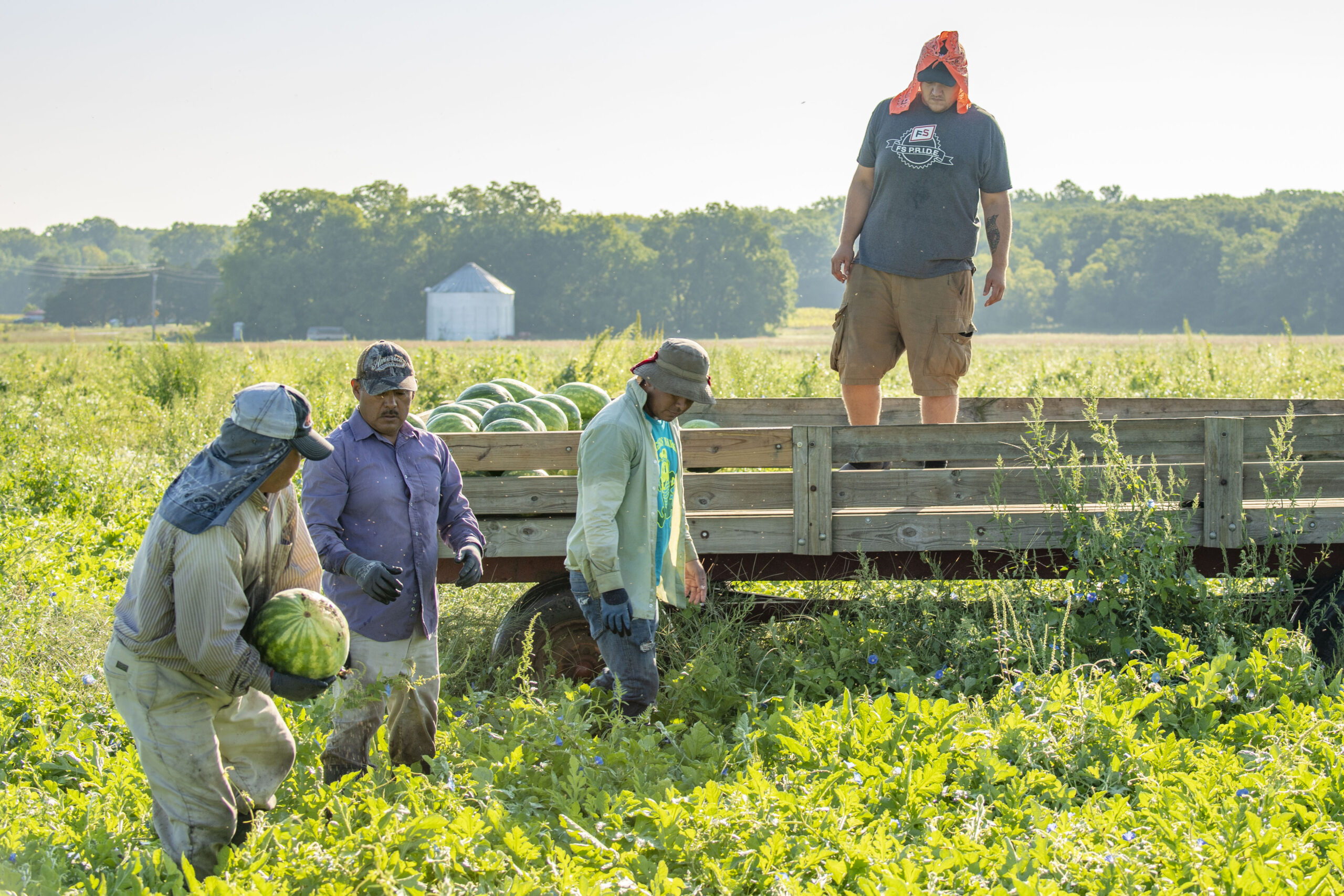
A farmworker has harvested a watermelon and prepares to pass it along to other workers who will place it on the harvest truck.

USDA photo by Preston Keres. 

In partnership with New Jersey Farm Bureau, we invite you to join us for a two-part webinar series titled “Don’t Sweat Heat Stress in Agriculture”.

  • Wednesday, June 5 from 7:00-8:00 PM
    • An introduction to heat stress issues in agriculture. We will also share tools farmers can use to evaluate heat risk and recommended resources for guidance on heat stress prevention.
  • Wednesday, June 12 from 7:00-8:00 PM
    • An overview on signs of heat stress and corresponding first aid, as well as strategies for heat stress prevention. A panel of farmers will discuss their currently used strategies for employee management during periods of high heat.

You must register to attend these webinars by visiting https://go.rutgers.edu/heat-stress-in-ag

Questions? Contact Kate Brown, County ANR Agent with RCE-Somerset County, at 908-526-6293 x4 or kbrown@njaes.rutgers.edu.

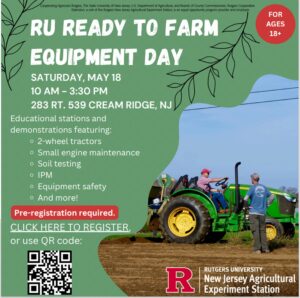
RU Ready to Farm Equipment Demo Day at Specialty Crop Research Farm – Cream Ridge

Register here or use the QR code:
https://go.rutgers.edu/RUReadytoFarmEquipmentDemo

RU Ready to Farm Equipment Demo May 18, 2024 flier


Webinar on the FSMA Final Rule on Pre-Harvest Agricultural Water – MAY 20, 2024 – Time: 1:00 PM – 2:00 PM ET

The U.S. Food and Drug Administration (FDA) invites the public to registerExternal Link Disclaimer for a webinar on the Standards for the Growing, Harvesting, Packing, and Holding of Produce for Human Consumption Relating to Agricultural Water (Agricultural Water Final Rule). The purpose of this webinar is to provide an overview of the final rule and answer pre-submitted and live questions.

Background

The final rule replaces certain pre-harvest agricultural water requirements for covered produce (other than sprouts) in the 2015 Produce Safety Rule with requirements for systems-based agricultural water assessments to determine and guide appropriate measures to minimize potential risks associated with pre-harvest agricultural water. Specifically, this rule:

  • Establishes requirements for agricultural water assessments that evaluate a variety of factors that are key determinants of contamination risks associated with pre-harvest agricultural water; this includes an evaluation of the water system, water use practices, crop characteristics, environmental conditions, potential impacts on water from adjacent and nearby land, and other relevant factors;


  • Includes testing pre-harvest agricultural water as part of an assessment in certain circumstances;


  • Requires farms to implement effective mitigation measures within specific timeframes based on findings from their assessments. Hazards related to certain activities associated with adjacent and nearby land uses are subject to expedited mitigation; and


  • Adds new options for mitigation measures, providing farms with additional flexibility in responding to findings from their pre-harvest agricultural water assessments.

The rule also finalizes the dates for compliance with the pre-harvest agricultural water requirements for non-sprout covered produce as follows:

  • For very small farms: 2 years, 9 months (April 5, 2007)
  • For small farms: 1 year, 9 months (April 6, 2026)
  • For all other farms: 9 months (April 7, 2025)

 Registration

The May 20 webinar is a virtual event. Registration is free and will be open through the day of the webinar. Persons interested in attending the public meeting must register at: FSMA Final Rule on Pre-Harvest Agricultural Water Webinar

If you have questions about the final rule that you wish to submit for possible discussion during the webinar, please note them during registration. All questions must be received by May 15, 2024, to be considered for discussion.

Beat the Heat: Tools for Evaluating Heat Risk

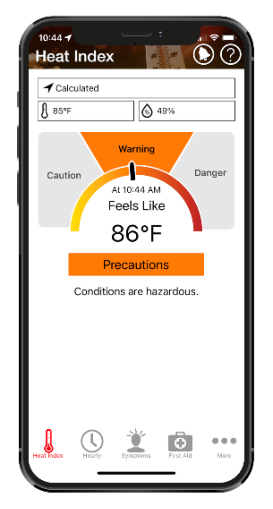
Heat index phone application

Heat safety tool phone app created by OSHA and NIOSH.

As the weather warms up, prepare yourself to evaluate the heat risk for outdoor tasks. We often use a weather application on our phone to check the daily high and low temperature, but air temperature alone is not sufficient to evaluate heat risk. Heat index is a more appropriate measurement because it combines the effects of air temperature and humidity to indicate the level of discomfort felt by the average person. 

One easy way to check the heat index is the Heat Safety Tool phone app (see photo) developed by the Occupational Safety and Health Administration (OSHA) and the National Institute for Occupational Safety and Health (NIOSH). The app calculates heat index at your specific site and displays the risk level to outdoor workers. It also provides insight into protective measures for the given risk level. This mobile phone app is available for both Android and iPhone

A similar, web-based tool is the HeatRisk website created by the U.S. Centers for Disease Control and Prevention (CDC). The HeatRisk homepage has a color-coded map to indicate today’s heat risk (no risk to extreme risk) for each county in the U.S. You can also enter your zip code to get the daily and 5-day forecasted heat risk for your site plus corresponding actions to reduce heat-related health risks. 

 Stay tuned for weekly posts on how beat the heat this summer!