On-Farm Food Safety Section

Keep up with the latest news on this dynamic topic that impacts growers on multiple levels. Developing a farm food safety plan is a good idea for all growers, and may be required as part of food safety audits if you sell to certain buyers.

View NJAES On-Farm Food Safety Essentials

Subscriptions are available via EMAIL and RSS.

On-Farm Food Safety Talks for the Busy Grower

The Rutgers On-Farm Food Safety Team has developed three video presentations.  Clip on  Three On The Go Webinars For the Busy Grower  to view the three videos listed below.

 Introduction to Food Safety Modernization Act (FSMA) and USDA Audits.  Find out the differences between FSMA inspections and USDA audits. Who do they apply to and who does the inspection or audits?

Building Your One-Way Street: Backflow Prevention and Your Farm.  Learn what backflow is, how to evaluate your operations and how to prevent problems with backflow to protect your packed produce.

How to Use Best Practices for On-Farm Recordkeeping.  Tried and true strategies for organized record keeping that complies with FSMA and will prepare you for USDA audits.
What water test do you need and how often do you need to do it?

FSMA Produce Safety Rule compliance, third party audit standards, and general best practices all include the need for irrigation, harvest, cleaning, sanitation, handwashing, pesticide application, drinking and postharvest water testing.  Not all tests are the same, but all cost money, so make sure what your paying for meets your needs.  
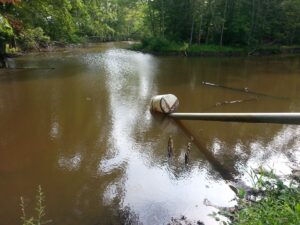
Pond

Here are the questions we commonly get from produce growers and answers that we hope you find helpful:

What water test do I need for a water source that is used only for irrigation of crops and/or pesticide applications?
– This water should be tested for generic E. coli, acceptable results give you a number answer of 126 CFU (colony forming units) or MPN (most probable number) or less. You do not want a presence/absence (P/A) test.  A P/A test would not be sufficient for a third-party audit requirement or the FSMA PSR.
-Most water testing labs on the NJ Water Testing Lab Map (link below) offer the EPA 1603 analysis, which satisfies both the FSMA PSR anticipated requirements and third-party audit requirements.
-Other acceptable analysis methods are described on the
Produce Safety Alliance Water Analysis Method Requirement fact sheet.
-Well water sources used for irrigation should be tested once a year.
-Surface water sources should be tested at least three times during their period of use, ideally when starting irrigation, mid-season, and close to harvest.  Surface water sources include irrigation ponds (spring fed, well fed, or other ponds), streams, rivers, and other bodies of water that are exposed to the surface.
-Municipal water sources used for irrigation should have a copy of the water testing record on file.  These testing records are often found online or are available upon request.  Made sure that generic E. coli is listed on the report.

What water test do I need for a water source that is used during the harvest process? Handwashing water? Cleaning and sanitizing use? Postharvest washing and cooling water? 
[Read more…]

Value-Added Producer Grants in New Jersey

Grant.gov applications are due by April 29, 2021 and
paper applications must be postmarked by May 4, 2021

The Value-Added Producer Grant (VAPG) program administered by the USDA’s Rural Development Agency (RD), helps agricultural producers enter into value-added activities related to the processing and marketing of new products. The goals of this program are to generate new products, create and expand marketing opportunities, and increase producer income. [Read more…]

Covid Update From Secretary of Agriculture

March 5, 2021


COVID-19 Vaccine Update

Dear Farm Owner/Operator:

On March 1, 2021 Governor Murphy announced that farmworkers will be eligible for the COVID-19 vaccine starting March 15, 2021.

We understand that the ag community is anxious to have everyone on their farm vaccinated as soon as possible, especially since some of you already have workers in the field.

Here is how the vaccination program will roll out over the next week:

  • The Department of Health (DOH) will send out a vaccine Q&A.
  • A brief survey will be included in that email that will help them with supply and delivery planning. Survey questions will include:
  • Business location
  • Contact person for scheduling vaccinations
  • Number of workers to be vaccinated
  • Logistic considerations


Once you receive the survey, please fill it out and return it as directed to the DOH.

A Health official will follow up with your contact person to schedule vaccinations either on your farm or at a standing location.


Sincerely,

Douglas H. Fisher

Secretary


Register for a Free Asparagus Webinar – March 17th 10:00AM

Asparagus

Penn State announced an upcoming free Zoom Meeting on Asparagus Production, Management, and Marketing. The presentation will be given by Carl Cantaluppi, Retired Area Extension Agent, North Carolina Cooperative Extension. Registration required to obtain Zoom link. 

The Meeting will be on Wednesday, March 17 from 10 A.M. to 12 Noon. It will be free and open to all that are interested. The publication entitled, “Growing Asparagus from A to Z” will be available for sale but is not required to attend the meeting.

Click on the link below to register for the meeting:

https://nam02.safelinks.protection.outlook.com/?url=https%3A%2F%2Fextension.psu.edu%2Fasparagus-production-management-and-marketing&data=04%7C01%7Cminfante%40njaes.rutgers.edu%7C6c4ad96b99884d60da8308d8d424f5e0%7Cb92d2b234d35447093ff69aca6632ffe%7C1%7C0%7C637492602501485088%7CUnknown%7CTWFpbGZsb3d8eyJWIjoiMC4wLjAwMDAiLCJQIjoiV2luMzIiLCJBTiI6Ik1haWwiLCJXVCI6Mn0%3D%7C1000&sdata=dwjiC0F1OFulJPA2AXvCRZEzpwmxht7JYQWtnGHnsNk%3D&reserved=0

Free Food Safety Webinar Series

The Rutgers On-Farm Food Safety Team will be presenting three free webinars in March from 12:00 pm to 1:00pm.  These will cover issues related to audits and the Food Safety Modernization Act (FSMA) – Produce Safety Rule.  On March 12 we will have an “Introduction to FSMA and Audits” discussing the difference between them, if a grower needs to comply with either and what is involved.  March 19 “Backflow Prevention in the Field and Packinghouse”, types of different devices, how to maintain them and where to place them.  March 26 “On-Farm Record Keeping” for FSMA and audits including the type of records required, what needs to be on the records and now long to maintain them.  To sign up for these free webinars go to RutgersOnFarmFoodSafety.Eventbrite.com.