USDA Increases Minimum Annual Payment for Conservation Stewardship Program

Conservation programs with USDA have received unprecedented increases in funding and farmers should investigate programs to make improvements on their farm. One program in particular, is increasing the minimum annual payments to producers for the Conservation Stewardship Program (CSP) from $1,500 to $4,000 in fiscal year 2024. The increase addresses challenges faced by small farms making participation more financially beneficial for smaller operations. The new minimum payment is available for new and renewed CSP contracts.

CSP offers technical and financial assistance to help agricultural and forest producers take their conservation efforts to the next level. The program is designed to compensate agricultural and forest producers who agree to increase their level of conservation by adopting additional conservation activities and maintaining their baseline level of conservation.

Examples of CSP enhancements that are suitable for being adopted by smaller scale and urban producers include:

  • Planting multi-species cover crops
  • Mulching with natural materials
  • Establishing pollinator habitats
  • Soil health crop rotation

Currently, an unprecedented amount of funding is available for CSP through the Inflation Reduction Act and Farm Bill. The Inflation Reduction Act provided $19.5 billion in additional funding for NRCS oversubscribed programs like CSP for five years. Inflation Reduction Act funds are available to help producers adopt climate-smart practices.

NRCS recently announced it increased the number of Climate-Smart Agricultural and Forestry Mitigation Activities eligible for Inflation Reduction Act funding for fiscal year 2024 through CSP, the Environmental Quality Incentives Program (EQIP), and the Regional Conservation Partnership Program (RCPP). To learn more, download the list of practices and a fact sheet.

NRCS accepts producer applications for its conservation programs year-round, but producers interested in this cycle of Inflation Reduction Act funding should apply as soon as possible. Producers interested in EQIP should apply by DATE or CSP should apply by DATE for consideration this year. Funding is provided through a competitive process and will include an opportunity to address the unmet demand from producers who have previously sought funding for climate-smart conservation activities.

For more information about assistance available, contact NRCS at your local USDA Service Center.

Webinar: 2024 NRCS Funding Opportunities

Monday, October 16 @ 6:30 pm – 7:30 pm EST

Join NRCS Soil Conservationist Kimberly Dalton and Natural Resource Specialist James Strehse for a webinar explaining 2024 NRCS Funding Opportunities.

REGISTER HERE

Whether you’re small or large scale, conventional or organic, there are NRCS practices that can apply to your operation. The presentation will include program information and guidance on how to apply with your local USDA service center.

Registration is through the NOFA-NJ website.

What Can Summer Cover Crops Do for Soil Health and Future Crops?

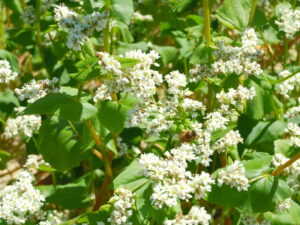
Plants floweringNow that some of our spring planted crops have finished, rather than leaving fields fallow or replanting fields that may have had some issues with plant diseases or insect pests, consider replanting with a summer cover crop. It is not too late to take advantage of summer cover crop benefits. What do summer cover crops do for soil health or future crop improvements? See below:

1. Increase Soil Organic Matter– One of the best attributes of having organic matter in the soil is improvement in soil structure. Adding organic matter improves tilth, water infiltration, water holding capacity, nutrient holding capacity and reduction of soil crusting. Also, as important is the increase in beneficial soil microbes and earthworms. Beneficial microbes can compete with pathogens and help release nutrients. Earthworms can cycle nutrients and improve pore spaces in the soil.
2. Reduce Soil Erosion – Just like with winter cover crops, summer cover crops can also reduce wind and water erosion in fields, especially those with slopes. During summer rainfall events, that can be significant if resulting from tropical storms, runoff may not just include soil loss, but also fertilizer and chemical movement. Therefore, keeping cover on a field during non-production times in any season is an excellent practice.
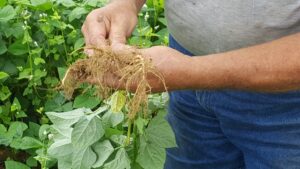
3. Nitrogen Cycling in the Soil – Nitrogen is often the most limiting nutrient for crop production, since it is so readily lost through nitrification and leaching. Storing nitrogen through plant cycling is an excellent way to improve fertility management. Whether it is a grass or non-leguminous cover crops N is still kept in the mix by the cover crop taking up residual N that wouldPerson holding plant to show root system otherwise be lost. The cover crop plant takes up the nitrogen and after the crop is incorporated it decomposes, thus releasing the N for subsequent crops to use. If legume cover crops are planted, they have the ability to “fix” nitrogen from the atmosphere and through the same decomposition process will provide N for subsequent crops. Be sure to inoculate legume seed just prior to planting with Rhizobium bacteria in order to gain the maximum N fixation benefits.
4. Reduce Weeds – When fields are left fallow after crops are harvested, weed growth can occur. If left to produce seeds, these weeds will multiply in subsequent crops. Therefore, managing the field by planting cover crops between cash crops is a great weed management option. As the cover crop grows, it will suppress the germination and growth of weeds through competition and shading. Some cover crop species can also suppress weeds biochemically, either while they are growing or while they are decomposing, which may prevent the germination or growth of other plants (allelopathy). Research has shown some cover crops like wheat, barley, oats, rye, sorghum, and sudangrass may suppress weeds. In some cases, it has also been reported that residues and leachates from crimson clover, hairy vetch, and other legumes have shown weed suppression.
5. Impacts on Plant Diseases – Cover crop residues could possibly be beneficial when it comes to plant pathogens, or can in some cases increase plant disease organisms. Some cover crop species are in the same plant families as cash crops and may be susceptible to the same disease organisms. Therefore, carrying the pathogen to the next crop. This is why paying attention to crop rotations is so important. In other cases, the cover crop residue can improve soil health in order to produce a better environment for beneficial microbes. By improving soil health, water infiltration, air pore space and other positive attributes, some soil pathogens may not survive as well, as in the case of water molds and water fungi. Some cover crops, like sorghum-sudangrass and sunnhemp, have been reported to reduce nematodes in soils. There are multiple positive factors from cover crops that can combat plant diseases.
6. Impacts on Insects – Like with plant diseases, cover crops can be susceptible to the same insect pests as cash crops. However, they may also attract beneficial insects into an area. Insect pests should be monitored in cover crops, just like in cash crops in order to not let populations get out of control and then move into nearby fields after the cover crop is killed.

For more resources on the us e of cover crops check out these resources: Cover Crops for Sustainable Crop Rotations – SARE

Monitor for Thrips in Vegetable Crops

Now that spring grains like wheat and rye have dried down and are being combined, thrips in those fields will move to vegetable crops, especially when small grains are adjacent to vegetable fields. Thrips are very small and often missed if casually looking at a plant since they hide in blossoms, under sepals, on under sides of leaves and other protected areas on the stems, leaves and flowers. To scout for thrips look at plant parts mentioned above. It is also important to dissect a flower, pulling back petals and sepals to find hiding thrips. It is difficult to see thrips with the naked eye. Therefore, the use of a hand lens will help.

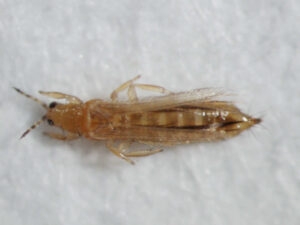
Most adult thrips are elongate, slender, very small (less than 1/20 inch long), and have long fringes on the margins of both pairs of their long, narrow wings. Immature thrips (called larvae or nymphs) are oblong or slender and elongate and lack wings. Most thrips range in color from translucent white or yellowish to dark brown or black. See the photo of an adult thrips below by Dr. David Kerns, Professor, IPM Coordinator and Extension Specialist, Texas A&M AgriLife Extension, College Station.Thrip

Thrips hatch from an egg and develop through two actively feeding larval stages and two nonfeeding stages, the prepupa and pupa, before becoming an adult. Late-instar larvae change in appearance and behavior and are called prepupae and pupae, even though thrips do not have a true pupal stage.

Females of most plant-feeding species lay their elongate, cylindrical to kidney-shaped eggs on or into leaves, buds, or other locations where larvae feed. Thrips have several generations (up to about eight) a year. When the weather is warm, the life cycle from egg to adult may be completed in as short a time as 2 weeks.

Thrips will feed on most all vegetable crops – solanaceous crops like eggplant, tomatoes, peppers, white potatoes, cucurbit crops like cucumber, squash and melons, bean crops, allium crops like onions, garlic and leeks and others.

Thrips feeding on plants can damage fruit, leaves, and shoots and very noticeably affect plants’ appearance. Leaves may be speckled on the top surface from feeding on under sides of leaves by the insect’s sucking mouthparts. Damage to fruit, like tomatoes may not appear until fruit ripen and can be seen as gold flecks on red tomato fruit. For many thrips species, by the time their damage is seen, such as after flowers open or fruit forms, the thrips may no longer be present.

Once thrips are identified, control can be difficult when they are found in high numbers. Preventative measures like the use of row covers and reflective mulch have some success. Both conventional and organic insecticides labeled for thrips control can be found in the Rutgers Commercial Vegetable Production Recommendations guide under the sections for individual vegetable crops. Always read the pesticide label for instructions, safety precautions, application rates and restrictions. Since thrips hide in tight areas of plant parts it is important to have good coverage and penetration when applying insecticides to reduce the population of this hard to control pest.

For more detailed information about thrips see the Rutgers Fact Sheet https://njaes.rutgers.edu/pubs/publication.php?pid=FS291

Magnesium Deficiency in Tomato and the Relationship with other Important Nutrients

How can growers prevent nutrient deficiencies in crops? Soil testing and tissue testing for fertility management of vegetable crops is key to having the correct levels of nutrients to have a high yielding, high quality crop to harvest and market. Soil testing is best done in fall so that pH levels can be adjusted with soil amendments like lime that correct pH levels for maximum return on fertilizer uptake. Why adjust pH to proper levels? Plant nutrients are hindered in availability when soil pH is too high or too low. Besides pH, fertility levels are important to monitor and adjust pre-plant for the best start to new seedlings and transplants.

With tomato production it is widely known that calcium (Ca) levels in soil are important for prevention of blossom end rot. Therefore, tomato growers have focused on application of adequate and even high levels of calcium to prevent this fruit disorder. Another primary nutrient, potassium (K) is also important for plant and fruit quality for regulating water movement/water loss in the plant and other functions. In addition, it is important to also pay attention to magnesium (Mg) levels. Ca, K, and Mg are all important in successful tomato production. It is important to know these nutrients compete with each other for plant uptake and their proper levels based on soil and tissue testing.

Even though blossom end rot resulting from Ca deficiency can cause tomato fruit to be unmarketable, Mg deficiency can reduce overall plant health and ultimately quality and yield. Low K in the plant can make the plant less tolerant of heat and drought stress. Magnesium in tomato plants plays an essential role in photosynthesis (the process of the plant to make energy to fuel growth), protein synthesis (necessary in cell formation), activation of plant enzymes (necessary for many cellular and growth functions), and chlorophyll synthesis (the green pigment in plants that is essential for optimum plant growth).

Magnesium deficiency can occur, especially in sandy soils, when soil is overwatered or after heavy rainfall events. However, when Ca and Mg levels are out of balance, deficiencies can still occur even when both are showing adequate levels in the soil. It is more important to look at the actual levels. If one is significantly higher than the other deficiency symptoms may occur. Since both Ca and Mg are +2 ions in soil when taken up by plant roots, the plant indiscriminately takes up these two nutrients. Therefore, if there is abundant Ca and lower Mg, Mg deficiencies may be seen. Conversely, when Mg levels are higher than Ca levels blossom end rot may be seen. It is best to have these two nutrients in soil at the same levels to keep a balance in uptake and ultimately promote both healthy fruit formation and foliage growth. Allowing Mg levels to remain deficient in the plant will result in lower yields and less energy for fruit production later in the plants lifecycle.

Magnesium deficiency is first seen on tomato plants as interveinal chlorosis – yellowing of leaf tissue between the veins of older leaves. Eventually the leaves become mostly yellow and purplish-red spots that become necrotic on the interveinal tissue may occur. See photos taken in the field on June 7, 2023.

Deficiency symptoms can be seen at any stage of growth, but are generally first seen when plants begin to flower, start fruit set, and fruit enlargement. When plants change from vegetative growth (production of leaves and stems) to reproductive growth (flowering and fruiting) leaves are stressed and energy and resources are reallocated into growth and development of new progeny (seed and fruit).

Fortunately, Mg deficiency is easily corrected when caught early in the tomato plant’s growth by the application of Epsom salts. Rates differ depending on soil type, soil levels, and plant tissue levels. Mg rates can vary from 5-25 pounds per acre. Application can be done through drip irrigation systems or applied on the soil surface by spraying near the rootzone. When applying through the drip tape, be sure to run the lines with clean water for at least 20 minutes after the salts have gone thorough to prevent salt build up in the emitters. Foliar applications of Mg can be sprayed on plants, but are not as efficient as soil application and root absorption. There are other products available to correct low levels of Mg, but most data available for the use of Epsom salts to raise Mg levels. Pre-plant, the use of high Mg liming products can balance Ca and Mg levels in soil if Mg levels are lower than Ca levels. Therefore, when lime is needed to raise pH it is very important to look at Ca and Mg levels on the soil test results before selecting which type of lime will work best for adjusting the levels of these two very important plant nutrients.

When managing fertility levels for successful crop production, it is important to know the levels of plant nutrients in soil and tissue tests. It is as important to understand the interactions between plant nutrients and how they affect plant growth. Seeing an “optimum” or “sufficient” level on a soil or tissue test report is not enough to fully determine what is needed for high yielding, high quality crops.

Free Webinar: Marketing Your Farm – Agritourism

Wednesday, March 29, 12-1pm Eastern Time

Rutgers Cooperative Extension is partnering with other New England states to deliver agritourism education. A free webinar will be held to help farmers learn the three essential components of marketing your farm, with a focus on agritourism. Myrna Greenfield is the “Top Egg” at Good Egg Marketing and the author of Marketing Your Farm: A practical guide to attracting loyal customers and increasing sales. Ellen Parlee is the co-owner of Parlee Farms in Tyngsboro, Massachusetts, which offers pick-your-own fruit and flowers, along with a farmstand, bakery, ice cream stand, animal petting area, and a food trailer for lunch. Ryan Wilson is the co-owner of DeMeritt Hill Farm in Lee, New Hampshire, which offers pick-your-own apples/peaches/blueberries/Xmas trees, hayrides, school tours, special events, Cross Country running, and hiking trails and has a full commercial kitchen. The farm plays host to Torey Roderick Performance Horses and every October, the world-famous Haunted Overload. Lisa Chase from University of Vermont Extension will moderate the session.

To register see: https://uvm-edu.zoom.us/webinar/register/WN_e3WWWaq9SoaQSR8nVkotdQ

This webinar is free, but registration is required.