Grower Input Needed for the Spotted-Wing Drosophila Organic Management Project

Dear Fruit Growers and Industry Professionals:

Please take a few minutes to fill out this spotted-wing drosophila (SWD) survey:

https://ugeorgia.ca1.qualtrics.com/jfe/form/SV_3NVhWTGnleU3bP7

This multi-state survey aims to help us to evaluate our research and educational efforts. Your participation will help us determine how growers and industry professionals have benefited from this project by asking questions regarding best management practices and satisfaction with the team’s efforts to organically combat the SWD pest.

Your answers will help improve our research and educational efforts to address this pest as well as providing accountability to our funder, the United States Department of Agriculture, National Institute of Food and Agriculture (USDA-NIFA). All responses are anonymous. No personal information will be collected.

Thank you for your time and interest in our efforts.

Dr. Cesar Rodriguez-Saona (Entomology)
On behalf of The SWD Research and Extension Team
Webinar on Organic Management of Spotted-Wing Drosophila

Organic management of spotted-wing drosophila (SWD) is challenging due to the low number of effective OMRI-approved materials and limited understanding on the biology of SWD to translate into non-chemical management tactics. This webinar will provide a comprehensive update on organic management of spotted-wing drosophila. It will summarize findings of the research conducted by our project team on organically approved strategies including behavioral, cultural, biological, and chemical tactics to manage SWD.

Date: March 9

Time: 2 pm ET

Register now at http://eorganic.org/node/34578


A Decade of SWD: Lessons for Management

In case you missed it, here is the video of the webinar on “A Decade of SWD: Lessons for Management” sponsored by the Sustainable SWD Management SCRI Project.


Grower Input Needed for the Spotted-Wing Drosophila Organic Management Project

Dear Fruit Growers and Industry Professionals:

Please take a few minutes to fill out this spotted-wing drosophila (SWD) survey:

https://ugeorgia.ca1.qualtrics.com/jfe/form/SV_3NVhWTGnleU3bP7

This multi-state survey aims to help us to evaluate our research and educational efforts. Your participation will help us determine how growers and industry professionals have benefited from this project by asking questions regarding best management practices and satisfaction with the team’s efforts to organically combat the SWD pest.

Your answers will help improve our research and educational efforts to address this pest as well as providing accountability to our funder, the United States Department of Agriculture, National Institute of Food and Agriculture (USDA-NIFA). All responses are anonymous. No personal information will be collected.

Thank you for your time and interest in our efforts.

Dr. Cesar Rodriguez-Saona (Entomology)
On behalf of The SWD Research and Extension Team
Webinar: “A decade of SWD: Lessons for management”

Join the Sustainable SWD Management Team on Tuesday December 8, 2020 at 12 pm (EST)

For a one hour webinar: “A decade of SWD: Lessons for management”

Register in advance for this webinar:
https://ncsu.zoom.us/webinar/register/WN_r__Q2lCTS2Wkf8UZmq4KlA

We will highlight what we have learned about spotted-wing drosophila populations, crop risk, pesticide efficacy, biological control, cultural & behavioral controls, and how to use this information to improve management.

A decade of SWD 12.8.2020

Cranberry Toad Bug Monitoring and Management

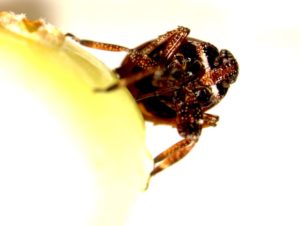
Cranberry toad bugs (Figure 1) should be the last insect pest of concern this season. Growers should start monitoring for this insect from now until the end of July.

Cranberry Toad Bug

Figure 1. Toad bug nymph. Photo by Elvira de Lange

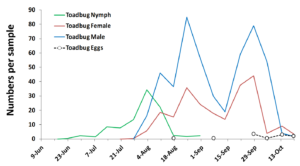
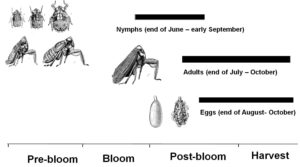
Life cycle. Toad bugs, Phylloscelis rubra (Hemiptera, Dictyopharidae), feed only on cranberries. This insect has a single generation per year. It overwinters as eggs. The nymphs appear by the end of June through early September; nymphal abundance peaks between last week in July and 1st week in August (Figure 2). The adults emerge from end of July through October (harvest) and eggs are laid from end of August through October (Figure 2). Figure 3 shows seasonal abundance of toad bug nymphs and adults in New Jersey cranberries based on sweep net samples.

Toad bug life cycle

Figure 2. Toad bug life cycle

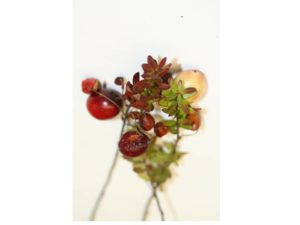
Injury. Feeding injury can be noticed in two stages. First stage feeding injury on vines causes closing in (towards the branch) of the leaves on the new growth. Second stage feeding causes changed in color (reddish to brown) of new growth (Figure 4). The injury can be seen from July until harvest. This injury will cause dying of the branch and the berries to shrivel up (Figure 4). Heavy infestation will result in dwarfed berries.

Seasonal abundance of toad bugs

Figure 3. Seasonal abundance of toad bugs in cranberry bogs

Toad bug injury

Figure 4. Toad bug injury to cranberries

Management. To determine infestation levels, lightly sweep problematic beds (bugs should be easy to catch in sweep nets as they are very active). There is currently no threshold established. Thus, insecticide applications should be based on the relative number of bugs per sweep compared with other sites and previous history of infestation. Currently, growers can use the following control options: Sevin 4F (carbamate), Diazinon, Imidan 70W (organophosphates), Actara or Assail 30SG (neonicotinoids). If infestation is high, treatments should be applied before the 1st week of August.