Sparganothis Fruitworm Degree-Day Update: as of June 06, 2021

Based on our degree-day model for Sparganothis fruitworm, flight initiation is expected at around 596 DD (see chart). As of June 06, Sparganothis has accumulated 706 DD (using March 1 as biofix; based on Wisconsin conditions) or 554 DD (using April 15 as biofix; a more realistic biofix based on the time when winter flood is removed from New Jersey beds). This indicates that flight activity has likely just started or will start in the next few days. Growers are advised to place pheromone traps for monitoring this pest as soon as possible if they haven’t done so already.
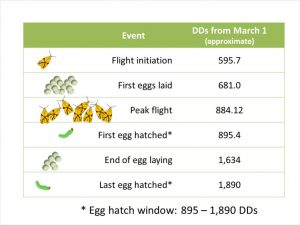
Degree-day model for Sparganothis fruitworm
Degree-day model for Sparganothis fruitworm
Sparganothis Fruitworm Degree-Day Update: as of May 30, 2021

Based on our degree-day model for Sparganothis fruitworm, flight initiation is expected at around 596 DD (see chart). As of May 30, Sparganothis has accumulated 607 DD (using March 1 as biofix) or 455 DD (using April 15 as biofix; a more realistic biofix based on the time when winter water was removed from most NJ beds). The later biofix indicates that flight activity will start very soon, i.e., within a week from now. Thus, growers are advised to place pheromone traps for monitoring this pest this coming week.

Degree-day model for Sparganothis fruitworm
Degree-day model for Sparganothis fruitworm
Managing Blunt-nosed Leafhoppers in Cranberries

Blunt-nosed leafhoppers (BNLH) continue to be an increasing threat to cranberries in NJ. BNLH has one generation a year. It overwinters as

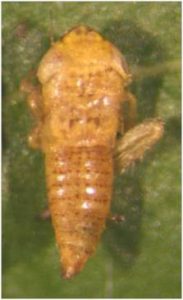
BNLH nymph

Picture 1. BNLH nymph. Photo by Elvira de Lange.

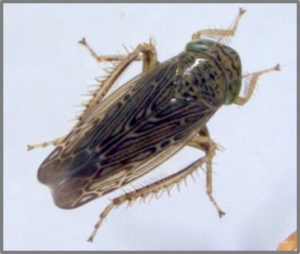
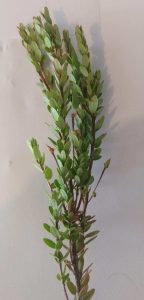
eggs, which begin to hatch in early May. The nymphs (Picture 1) will go through five instars in about a month. The adults (Picture 2) begin to appear by the end of June and are most abundant in mid-July. Numbers of this species start to diminish by the end of July. The adults have a characteristic blunt head and vary from light yellowish-gray to dark brown. Eggs are laid in June-July. Nymphs and adults get their food by sucking the juices of the cranberry vines with their piercing-sucking mouthparts. This direct injury is, however, not noticeable. They are most important as vectors of false blossom disease (Picture 3). Typical disease symptoms include distinctive branching of the upright shoots (witches’ broom) and malformed flowers where flowers stand erect and petals are redder than normal.

Here are some guidelines to consider when managing BNLH in cranberries:

  1. The most important point in BNLH control is locating the sites of infestation. Monitoring for this insect is accomplished best with an insect sweep net. Nymphs should be monitored before bloom using sweep nets (this time of year). Nymphs before bloom are small; thus, you may need to freeze the samples (to kill them), and then count the number of nymphs under a microscope or using a magnifying lens.
  2. To monitor, perform sweep sets of 25 sweeps each. The recommended number of sweep sets is: 1–3 sweep sets per 1–
    BNLH adult

    Picture 2. BNLH adult. Photo by Elvira de Lange.

    10 acres, at least 10 sweep sets per 10–20 acres, and 1 sweep set per 2 acres for more than 20 acres.

  3. A challenge for managing BNLH is the fact that they vector a phytoplasma that causes false blossom disease. For this reason, it is difficult to establish economic thresholds for this pest because we do not know the proportion of individuals that are infected in the population. Moreover, this proportion can vary depending on the variety. For instance, we have observed higher incidence of infection in the newer varieties even when populations of leafhoppers are low.
  4. Although they need to be tested, based on experience, I came up with the following tentative treatment thresholds: An average of 20 nymphs per sweep set if it is a new variety bed, bed with young plantings, and/or a bed that has a recent history of false blossom. Or, an average of 40 nymphs per sweep set if it is an older bed and older variety with no previous history of false blossom.
  5. If BNLH populations are increasing compared to previous years and the beds have not been treated for BNLH for 2-3 years, growers should consider treatment.
  6. If growers have treated for BNLH in the previous year and populations are low (average of less than 10–20 BNLH per sweep set), there is no need to treat again. Keep a record of the BNLH numbers and check those same beds again the following year to see if the numbers increase.

    False blossom-infected cranberry vine

    Picture 3. False blossom-infected cranberry vine.

  7. In most cases, there is no need to apply broad-spectrum insecticides (organophosphates, carbamates) to control BNLH for two or more consecutive years. These insecticides will disrupt the biological control of other pests such as Sparganothis fruitworm and therefore cause increases in insecticide use.
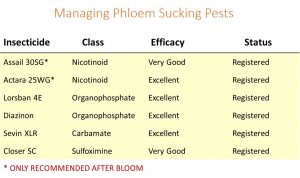
  8. If treatment is necessary, we have limited options to manage BNLH. The best timing for insecticide treatment is before bloom to target the young nymphs. We recommend the use of organophosphates such as Lorsban (chlorpyrifos) and Diazinon (diazinon), and carbamates like Sevin (carbaryl). The neonicotinoid Assail (acetamiprid) also works well against nymphs, but we do not recommend the use of neonicotinoids before bloom due to potential negative effects on bees-neonicotinoids are systemic insecticides that can accumulate in the pollen and nectar. A new registered insecticide, Closer (sulfoxaflor), is also effective against BNLH nymphs. Although Closer has a similar mode of action as the neonicotinoids, it belongs to a different class of insecticides. Closer use is prohibited during bloom (between 3 days prior to bloom and until after petal fall).
  9. Trials will be conducted this year at the Rutgers P.E. Marucci Center with existing and new insecticides against BNLH nymphs.

Gypsy Moth Seen in Cranberry Beds

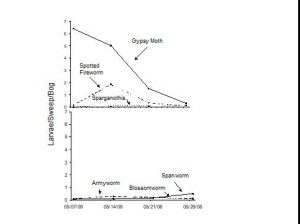
We are observing high populations of gypsy moth larvae in cranberry beds near wooded areas. The last time we saw these numbers was over a decade ago in 2007-2008. I am showing a graph (Figure 1) that illustrates the number of lepidopteran pests (gypsy moth, spotted fireworm, Sparganothis fruitworm, armyworms, cranberry blossomworm, and spanworms) observed in 2008 in various cranberry beds (from bud break to bloom). The graph shows the timing when gypsy moth larvae were found in beds in comparison with other common leps. Based on these data, number of gypsy moth larvae peaked at this time of the year and then decline in the following two weeks. It also shows an overlap of gypsy moth numbers with the numbers of spotted fireworm and Sparganothis fruitworm in beds. This indicates that treatment for gypsy moth should also control these other pests if the residue lasts for 10-14 days.

Lepidopteran Larvae in 2008 Sweep net Samples

Figure 1. Number of Lepidopteran Larvae in 2008 Sweep net Samples

Biology. Gypsy moth has one generation a year. It overwinters as eggs. Eggs hatch at this time of the year (we should have already passed peak egg hatch). First instars “balloon” on silken threads from infested trees onto nearby cranberry beds. Thus, gypsy moths tend to be one of the earliest caterpillars to show up in cranberry beds, usually during the first week of May. Observed larvae are mostly 2nd instars and will feed on the terminal buds. Although less common, it is also possible that eggs overwintered on the bog floor and that older larvae will crawl later in the season onto beds from surrounding trees.

Scouting and Control – Gypsy moth larvae are quite easy to detect by means of sweep net sampling and are easy to control with most of the insecticides at our disposal. The action threshold for gypsy moth is an average of 4.5 larvae in sets of 25 sweeps. We recommend the use of Intrepid, Delegate, Altacor, Exirel, or Verdepryn, if populations exceed action thresholds. These are reduced-risk insecticides that are very effective against lepidopteran pests.

Early Season Insect Pests of Cranberries

By now the winter flood is off from most New Jersey cranberry beds. Once the water is removed, the vines will start to initiate bud break. From now until bloom, growers should scout their beds using sweep net sampling for lepidopteran pests (blackheaded fireworm, spotted fireworm, Sparganothis fruitworm, and cranberry blossomworm), and blunt-nosed leafhoppers.

Blackheaded fireworm – Blackheaded fireworm eggs overwinter on the bed and usually hatch by around mid-May. It is important to catch

Blackheaded Fireworm Larva

Figure 1. Blackheaded Fireworm Larva

the first generation, if possible, because the second generation occurs during bloom and is typically much more destructive. Blackheaded fireworm larvae (Figure 1) can be detected by sweep net sampling and it is a good idea to look along the edges of beds where vines first begin to grow. Remember: blackheaded fireworm is much easier to control if detected during the early part of the season.

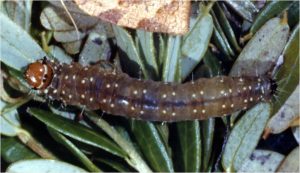
Spotted fireworm – This insect overwinters as a 2nd instar larva. They complete two generations a year. Larvae (Figure 2) feed between uprights they have webbed together. First-generation larvae injure the foliage causing it to turn brown as if burned. In New Jersey, first generation adult moths emerge the first week of June, followed by a second-generation of adult emergence in early August. Eggs are laid in masses on weedy hosts. Larvae from second-generation adults emerge in mid-August and may feed on fruit. Populations of spotted fireworm are regulated by their natural enemies, in particular Trichogramma wasps that parasitize the eggs.

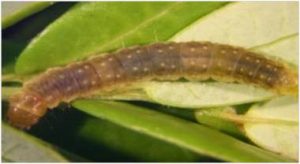
Sparganothis fruitworm – This insect is a serious pest in most cranberry-growing states.  Sparganothis fruitworm completes two generations a year and overwinters as an early-instar larva. Larvae (Figure 3) from the 1st generation feed on foliage. In New Jersey, first generation adult moths emerge from mid-June through the first weeks in July; pheromone traps are commonly used to monitor adult flight and population size. Second-generation eggs are laid on

Spotted Fireworm Larva

Figure 2. Spotted Fireworm Larva

cranberry leaves, and larvae will feed on fruit.

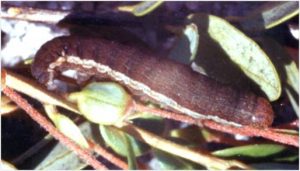
Cranberry blossomworm – Adults lay their eggs in October in cranberry beds. The eggs overwinter and hatch over a period of several weeks. Early instars can be found during the first week of May. Larvae go through 6 instars to complete development. Because the first instars feed during the day (and at night), scouting can be done during the daytime using sweep nets to estimate larval abundance. Larvae turn nocturnal during the later instars (Figure 4). At this time, night sweeping (9 pm – 1 am) is recommended for sampling. Larvae complete their development by June-July. Older instars are very voracious and capable of destroying 100 blossoms within a 3-week period. There is a pre-pupal stage that lasts until the end of August and a pupal stage that lasts until October. Adults emerge from the end of August to the end of October.

Cranberry Blossomworm Larva

Figure 3. Sparganothis Fruitworm Larva

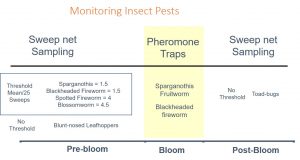
Lepidopteran Pests Monitoring and Control – Use sweep netting for monitoring early lepidopteran pests (pre-bloom) (Figure 5). A sweep set consists of 25 sweeps and 1 sweep set is recommended per acre (this may vary depending on the size of bogs). The action threshold for false armyworm, blossomworm, other cutworms, and gypsy moth (we use a combined threshold from adding all these caterpillars per sweep) is an average of 4.5 caterpillars in sets of 25 sweeps. For brown and green spanworms is an average of 18 per sweep set. The action threshold for blackheaded fireworm and Sparganothis fruitworm is an average of 1.5 per sweep set. We recommend the use of reduced-risk materials such as the insect growth regulator (IGR) Intrepid, the spinosyn insecticide Delegate or any of the diamide insecticides Altacor, Exirel or Verdepryn if populations exceed action thresholds. These are reduced-risk, softer insecticides that are very effective against lepidopteran pests. Remember to rotate insecticides with different modes of action to prevent onset of

Monitoring Insect Pests of Cranberries

Figure 4. Cranberry Blossomworm Larva

insecticide-resistant pest populations.

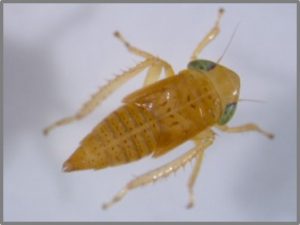
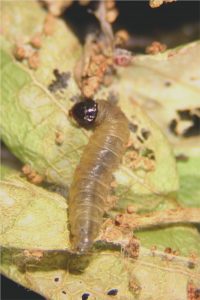
Leafhoppers –There is continuing concern among New Jersey cranberry growers of a potential increase in leafhopper populations because of changes in pest management strategies (e.g., adoption of new reduced-risk products and decreased applications of broad-spectrum insecticides). Blunt-nosed leafhopper is of particular concern because they can transmit cranberry false blossom disease. This leafhopper has one generation a year. The adults are found in highest numbers during July, although nymphs or adults may be found from the end of May until October. Eggs are laid in August-September. The eggs overwinter and hatch in May or June. The nymphs (Figure 6) go through 5 instars to complete development.

Leafhopper Monitoring and Control: Leafhopper nymphs can be sampled using sweep nets (as described above for lepidopteran pests)

Blunt-nosed Leafhopper Nymph

Figure 5. Monitoring Insect Pests of Cranberries

(Figure 5). Nymphs before bloom are small; thus, you may need to freeze the samples (to kill them), and then count the number of nymphs under a microscope or using a magnifying lens. Although there is no established threshold based on sweep net counts, we propose the following tentative thresholds: 20 nymphs per sweep set in young beds, new varieties, and/or with false blossom incidence; and 40 nymphs per sweep set in older beds, older varieties, and no incidence of false blossom. These decisions should be made also by comparing current numbers with prior infestation history.

In cases of high numbers of blunt-nosed leafhopper nymphs, we recommend application of a broad-spectrum insecticide, such as Sevin, Diazinon (no aerial applications allowed) or Lorsban (only pre-bloom applications allowed for Ocean Spray growers) (Figure 7). Broad-spectrum insecticides will disrupt biological control

particularly the natural enemies (predators and parasitoids) of Sparganothis fruitworm, so their use should be restricted only to areas of high leafhopper populations. Alternatively, growers can use Closer (sulfoxaflor). In our insecticide trials, Closer has shown good-to-excellent leafhopper control. This insecticide cannot be used when bees are active (i.e., between 3 days prior to bloom and until after

Leafhopper Control Options

Figure 6. Blunt-nosed Leafhopper Nymph

petal fall).

Leafhopper Control Options

Figure 7. Leafhopper Control Options

Activity Periods of Cranberry Insect Pests in New Jersey

This chart illustrates the periods of insect pest activity in cranberries in New Jersey. These are general guidelines based on knowledge on pest biology and field experience. The actual period of activity for any given pest may vary from year to year depending on the time when the spring flood water is removed from bogs, seasonal weather conditions, and other (biotic and abiotic) factors.

Activity of cranberry pests

Seasonal activity of insect pests of cranberries