Online Questionnaire on Spotted-Wing Drosophila (SWD)

The Specialty Crop Research Initiative (SCRI) team on Spotted-Wing Drosophila (SWD) is working on Best Management Practices to effectively manage this pest on small fruit crops in the United States. The research team has developed some technologies which are currently being used by growers and is still researching ways to improve on these technologies.  

The SCRI team is therefore interested in identifying the existing knowledge gaps and current technologies available to you and also your perception on the newly introduced technologies in your area.  

Your participation in the study requires completing an online questionnaire (see link below) that should take about 15 minutes and is completely voluntary. You do not have to answer any questions you do not want to answer, and your personal information will be kept confidential. All data will be reported on an aggregate level and personal identifiers will be removed from the resulting report. 

Link https://ufl.qualtrics.com/jfe/form/SV_4ORBHXrUCMUFqJg 

Your participation will actively contribute to enhancing the response of the SCRI Team to the emerging SWD-related activities in your area, which will potentially benefit your community and the country in the future.  

Thank you. 
Webinar on Spotted-Wing Drosophila Monitoring and Sampling

Registration is now open for our annual Sustainable SWD Management webinar, scheduled for Nov 10th at 1pm ET. Register here: https://ncsu.zoom.us/webinar/register/WN_JhupsLFhSKi_f8z4mzl56g 

This year’s webinar is entitled: Monitoring and sampling tools to improve spotted-wing drosophila management. This 1hr session will share current recommendations for adult and immature SWD sampling methods and practical applications of these tools for fruit growers. Presenters include: Rufus Isaacs & Steve Van Timmeren (Michigan State University), Hannah Burrack (NC State University), Cesar Rodriguez-Saona (Rutgers University), Phil Fanning (University of Maine), and Vaughn Walton (Oregon State University).

You can read more about the Sustainable SWD Management Project here: https://swdmanagement.org/

We look forward to sharing our work with you on November 10!

Cranberry Update: EPA Bans Use of Chlorpyrifos (Lorsban) On Food Crops

After years of debate, the U.S. Environmental Protection Agency announced on August 18, 2021 that this year will be the last that the insecticide chlorpyrifos (the active ingredient in Lorsban) will be allowed for use on food crops, including cranberries. This means that use of chlorpyrifos will no longer be allowed on cranberries in 2022 and thereafter. For more information, please see the press release here: https://www.epa.gov/newsreleases/epa-takes-action-address-risk-chlorpyrifos-and-protect-childrens-health.

In New Jersey, cranberry growers have mainly used chlorpyrifos early in the season to manage blunt-nosed leafhoppers as well as other insect pests such as Sparganothis fruitworm, blackheaded fireworm, and spotted fireworm. Growers can find alternative insecticide options for managing these pests in the Commercial Cranberry Pest Control Recommendations for New Jersey https://njaes.rutgers.edu/pubs/publication.php?pid=E308.

Monitoring for the Cranberry Toad Bug

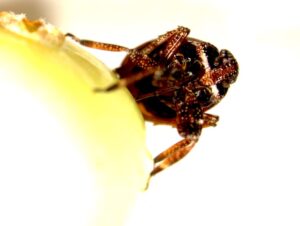
As we approach the end of July, growers need to start monitoring for the cranberry toad bug, Phylloscelis rubra (Figure 1). In a recent study,

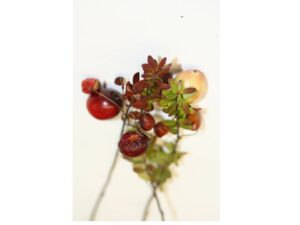
Cranberry toad bug

Figure 1. Cranberry toad bug.

we showed that even relatively low densities of this insect can cause significant injury to cranberries (Rodriguez-Saona et al. 2020. Characterizing the Feeding Injury Caused by Phylloscelis rubra (Hemiptera: Dictyopharidae) to Cranberries, Journal of Insect Science, 20 (6), 37, https://doi.org/10.1093/jisesa/ieaa143). Thus, monitoring for this insect from the end of July through mid-August is critical.

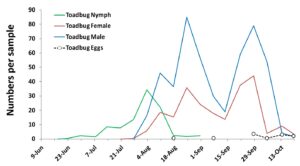
Life cycle. Cranberry toad bugs feed only on cranberries. This insect has a single generation per year. It overwinters as eggs. The nymphs appear by the end of June through early September, and the adults from end of July through October (harvest) (Figure 2). Eggs are laid from end of August through October.

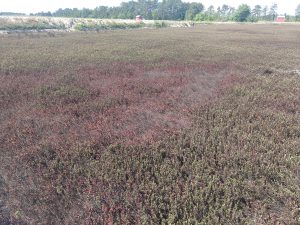
Damage. Feeding damage can be noticed in two stages. 1st-stage feeding damage on vines causes closing in (towards the branch) of the leaves on the new growth. 2nd-stage feeding causes changed in color (reddish to brown) of new growth. The damage can be seen from July until harvest. This damage will cause dying of the branch and the berries to shrivel up (Figure 3). Heavy infestation will result in dwarfed

Seasonal changes of the cranberry toad bug.

Figure 2. Seasonal changes of the cranberry toad bug.

berries.

Management. To determine infestation, lightly sweep problematic beds (bugs should be easy to catch in sweep nets as they are very active). Currently there is no threshold established for this pest. Thus, insecticide applications should be based on the relative number of bugs per sweep compared with other sites and previous history of infestation. If needed, growers can use the following control options: Sevin 4F (broad-spectrum carbamate), Diazinon, Imidan 70W (broad-spectrum organophosphates), Actara or Assail 30SG (neonicotinoid insecticides, effective against piercing-sucking insects). If infestation is high, treatments should be applied in early August for best control.

Injury caused by the cranberry toad bug.

Figure 3. Injury caused by the cranberry toad bug.

Post-Bloom Insect Pest Management

Sparganothis Fruitworm Degree-Day Update: as of July 07, 2021

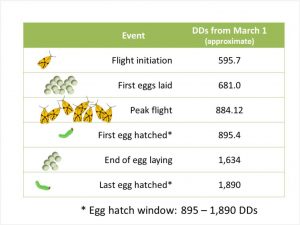
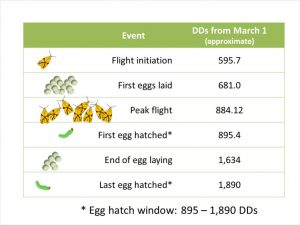
Based on our degree-day (DD) model for Sparganothis fruitworm, the window for egg hatch is between 895 and 1,890 DD (see chart). As of July 07, Sparganothis has accumulated 1,251 DD (using April 15 as biofix). This indicates that most eggs should have hatched by now and fruit is susceptible to infestation. Most beds are out of bloom (early varieties) or should be coming out of bloom. If trap counts have been high and you have not done so already, then you should consider treatment in the next few days to prevent damage to berries. Your best post-bloom options are Diazinon, Intrepid, Altacor, or Delegate. All treatments for lepidopteran pests should be done before the end of this week to avoid substantial injury to fruit.

Sparganothis fruitworm DD model

Root-feeding Pests of Cranberries

If your beds have damage caused by root-feeding insects, you should consider treatment with Imidacloprid (e.g. Admire Pro, Alias 4F, Alias 2F) after bees are removed. Occurrence of root-feeding insects will manifest by the presence of dead patches (see picture). Pulling dead vines and searching through the root zone and soil are needed to reveal the presence of larvae. Admire Pro (imidacloprid) is labeled for the control of cranberry rootworm, white grubs (Phyllophaga spp.), and other scarabs in cranberries.

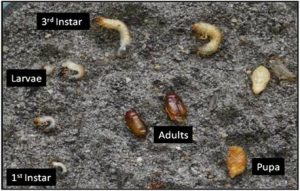
White grubs, Phyllophaga spp. There are several species of white grubs that infest cranberries in New Jersey, the most abundant being P. georgiana. Grubs are C-shaped and often found near bog margins. Adults are reddish brown and nocturnal. Grubs attack the cranberry roots; adults have not been reported to feed on cranberries. See pictures of grubs and adults in cranberries. The life cycles and abundance of white grub species in New Jersey is not well known. Most likely, Phyllophaga grubs have a 3-year life cycle (based on previous reports and our own observations). Eggs are laid in late-June and July, and will hatch in July. First instars can be found in late-July and August and turn into second instars by the end of August-September. The second instar grubs will overwinter. These grubs will feed the following year until June and molt to third insta

Cranberry Rootworm Injury

rs, which will overwinter. The following year, the third instars will feed for some time and then begin to pupate in June. Pupation will take place in July-August. Adults will appear in the soil in August-September. Adults will remain in the soil and overwinter. They will emerge in June, mate, and begin to lay eggs, completing the cycle.

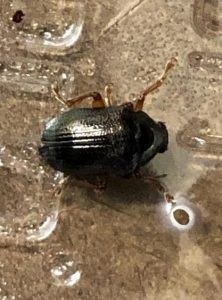
Cranberry rootworm (Chrysomelidae). Pupation starts in late May and beetles emerge in early June. Adults (see picture) are nocturnal and hide in leaf litter. Adults can be easily picked up in a

Phyllophaga developmental stages

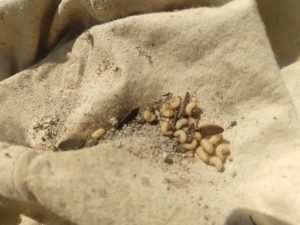
sweep net. Females feed on foliage before laying eggs. Young larvae will feed on roots, and feeding continues until October. The mature larvae (see picture) move down the soil in the fall to overwinter. Holding of the water will delay onset of pupation. Rootworm has a 1-year life cycle. Entomopathogenic nematodes (Heterorhabditis bacteriophora) can be used to control cranberry rootworm.

Use of Imidacloprid. If treatment is needed, use imidacloprid (Admire Pro or other generic insecticides such as Alias 4F) to control white grubs and rootworms. Imidacloprid works best against early- (1st-2nd) instar grubs. Imidacloprid should be used after bees are taken out of beds. Because of the 3-year life cycle, treatment should be continued for 2-3 consecutive years to ensure control. Imidacloprid (active ingredient) is a neonicotinoid insecticide registered for use in cranberries against cranberry rootworm and scarab grubs. This insecticide is a contact and stomach poison that affects the insect

Cranberry Rootworm Adult

Cranberry Rootworm Larvae

nervous system. It is highly systemic and toxic to honey bees; therefore, can be used only as a post-pollination insecticide. Imidacloprid can be applied by ground or by chemigation. Aerial application of this product is prohibited. Imidacloprid has a long residual activity (> 100 days) as long as the insecticide is not directly exposed to the sun. Admire Pro can be used at 7-14 fl oz/acre. A maximum of 14 fl oz of Admire Pro can be used per acre per season. The PHI is 30 days.

Sparganothis Fruitworm Degree-Day Update: as of June 27, 2021

Based on our degree-day (DD) model for Sparganothis fruitworm, first eggs hatch at about 895 DD (see chart). As of June 27, Sparganothis has accumulated 991.5 DD (using April 15 as biofix). This indicates that eggs have started to hatch, and fruit will become susceptible to infestation since larval injury to fruit usually begins after the eggs hatch. According to our model, peak flight should have occurred about a week ago (around June 20). Insecticide applications are usually recommended 10-14 days after peak flight (i.e., June 30-July 4). Most beds should be close to the end of bloom. If trap counts have been high, growers should consider treatment by the end of next week (depending on the variety and time of winter flood removal) to prevent damage to berries. If spraying when bees are present, your option is to use an insect growth regulator (IGR), such as Confirm or Intrepid, or the diamide Altacor. Our “standard” recommendation has been, however, to wait until bees are removed to apply an insecticide. Your post-bloom options include the organophosphate Diazinon, the diamides Altacor, Verdepryn, or Exirel, the spinosyn Delegate, or the IGR Intrepid. Timing of insecticide application is critical; so, if needed, do not wait too long to manage this pest.

Degree-day model for Sparganothis fruitworm

Degree-day model for Sparganothis fruitworm