Sparganothis Fruitworm Degree-Day Update: as of June 01, 2020

As we approach bloom, Sparganothis fruitworm, spotted fireworm, and blackheaded fireworm adults will start to emerge. Growers need to start monitoring for Sparganothis adults using pheromone traps. As in previous years, I will be tracking the activity of Sparganothis adults using a degree-day model we developed in collaboration with Dr. Shawn Steffan from University of Wisconsin-Madison/USDA-ARS. Based on our degree-day model for Sparganothis, flight initiation is expected at around 596 DD (using March 1 as biofix; see chart). As of June 01, Sparganothis has accumulated 345 DD (using April 15 as biofix). Last year, at around this time, Sparganothis had already accumulated 529 DD. This means we are about one week behind from last year. This indicates that flight activity has not started and will not start until about 10-11 days from now. Growers are advised to place pheromone traps for monitoring this pest by the end of this week or, at the latest, by early next week.
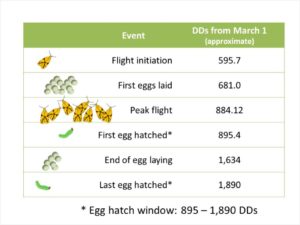
Sparganothis fruitworm degree-day model
Sparganothis fruitworm degree-day model
Efficacy of Old and New Insecticides on Cranberry Insect Pests

Four insecticides have recently been registered in cranberries. There are:
Cormoran. This insecticide from ADAMA is a mix of Rimon (novaluron) and Assail (acetamiprid). The cranberry use rate is 9-12 fl oz/acre and the label lists several insect pests including leafhoppers, blackheaded fireworm, cranberry blossomworm, Sparganothis fruitworm, and spotted fireworm. This insecticide has provided good control on leafhopper nymphs in our research trials (Table 1). This toxicity against leafhoppers is most likely due to Assail since Rimon has no toxic effects on leafhoppers. Rimon is an insect growth regulator (chitin inhibitor) that has potential toxicity on honeybee brood when foraging bees pick up residues from the field and take them back to the hive. Thus, care needs to be taken when using this product pre-bloom.

Exirel (cyantraniliprole). This insecticide from FMC has a use rate of 10-20.5 fl oz/acre and the label lists Sparganothis fruitworm, blackheaded fireworm, and cranberry fruitworm as target pests. In our insecticide trials, this product has provided excellent control of caterpillars (“worms”) (Table 1). Exirel belongs to the same class of insecticide as Altacor (diamides). I recommend using these insecticides in rotation with Intrepid and Delegate for the control of lepidopteran pests.

Table 1. Efficacy of Registered Cranberry Insecticides (New Insecticides in Bold)

Insecticide Sparganothis Fruitworm Spotted Fireworm Blackheaded Fireworm Leafhoppers Toadbugs Bee Toxicity
Altacor +++ +++ +++
Assail + ++ ++ +++ +++ xx
Exirel +++ +++ +++ x
Closer +++ ++ xx
Cormoran + ++ ++ +++ +++ xx
Confirm +++ +++ +++
Delegate +++ +++ +++ xxx
Diazinon +++ +++ +++ +++ +++ xxx
Imidan ++ ++ ++ ++ ++ xxx
Intrepid +++ +++ +++
Lorsban +++ +++ +++ +++ +++ xxx
Rimon + ++ ++ xx
Sevin +++ +++ +++ +++ +++ xxx

+++ Excellent control, ++ Moderate-to-Good control, + Poor control, – No control; x = bee toxicity

Movento (spirotetramat). This insecticide from Bayer Crop Sciences has a use rate of 8-10 fl oz/acre in cranberries. The label lists cranberry tipworm and leafhoppers as targets. In our insecticide trials, this product has provided excellent control against cranberry tipworm. However, cranberry tipworm has not been a pest problem of cranberries in New Jersey. It provides some control against leafhopper nymphs (Movento inhibits lipid metabolism so it works best against immature insects); however, the label says to not apply until after petal fall. Because Movento has limited use in New Jersey cranberries, I did not include it in Table 1.

Closer (sulfoxaflor). This insecticide from Corteva (former DowAgrosciences) has a use rate of 2.75-5.75 fl oz/acre in cranberries. The label lists leafhoppers as target pests. In our insecticide trials, Closer has shown good-to-excellent leafhopper control (Table 1). This product cannot be used when bees are active (between 3 days prior to bloom and until after petal fall).

Blunt-nosed Leafhoppers in Cranberries

There is continued concern among New Jersey cranberry growers of increases in blunt-nosed leafhopper populations due to changes in pest management strategies (e.g., adoption of new reduced-risk products and decreased applications of broad-spectrum insecticides). Blunt-nosed leafhopper is of particular concern because they are vectors of false blossom disease.

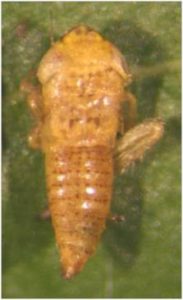
Blunt-nosed leafhopper nymphs

Blunt-nosed leafhopper nymphs. Photo credit: Lindsay Wells-Hansen.

Life Cycle – The blunt-nosed leafhopper has one generation a year. Blunt-nosed leafhopper eggs overwinter and begin to hatch in early May. The nymphs (see Picture; small yellow-colored insects) will go through five instars in about a month. The adults begin to appear early in July and are most abundant in late July. Numbers of this species start to diminish by the first week in August. The adults have a characteristic blunt head and vary from light yellowish-gray to dark brown. Eggs are laid in August-September.

Damage – Nymphs and adults get their food by sucking the plant juices of the cranberry with their piercing-sucking mouthparts. This direct injury is, however, not noticeable. They are most important as vectors of false blossom disease.

Scouting and Control – The most important point in leafhopper control is locating the infestation. Monitoring for this insect is accomplished best with an insect sweep net. Nymphs can be monitored before bloom using sweep nets. Nymphs before bloom are small; thus, you may need to freeze the samples (to kill them), and then count the number of nymphs under a microscope or using a magnifying lens. Perform sweep sets of 25 sweeps each. The recommended number of sweep sets is: 1 per 1–10 acres, at least 10 sweep sets per 10–20 acres, and 1 sweep set per 2 acres for more than 20 acres. In cases of high blunt-nosed leafhopper numbers, we recommend application of a broad-spectrum insecticide, such as Lorsban. This time of the year (May 20-30) would be the period for pre-bloom applications. The neonicotinoids Actara and Assail are very effective against blunt-nosed leafhoppers and can be used to target the adults after bloom. There is no threshold so decisions should be made based on current numbers and prior infestation history. Broad-spectrum insecticides will disrupt biological control particularly the natural enemies (predators and parasitoids) of Sparganothis fruitworm, so their use should be minimized to areas of high blunt-nosed leafhopper populations.

Exirel®: A New Insecticide Registered in Cranberries

Last year, the insecticide Exirel® (FMC Corporation) was registered for use in cranberries. The Exirel label includes the target pests: cherry fruitworm, cranberry fruitworm, blackheaded fireworm, and Sparganothis fruitworm. The active ingredient (a.i.) is cyantraniliprole. This insecticide belongs to a class of insecticides known as anthranilic diamides (similar to Altacor). This class of insecticides is particularly effective against lepidopteran pests but Exirel has broader insecticidal activity that includes flies, aphids, weevils, etc. After ingestion, anthranilic diamides work by impairing muscle contraction, resulting in feeding cessation, lethargy, and partial paralysis, eventually leading to the death of the insect.

Exirel is considered a reduced-risk insecticide and compatible with biological control and pollination. It should thus be considered as a new alternative when rotating insecticides with different modes of action for preventing the development of resistant populations.

Exirel has a 14-day pre-harvest interval (PHI) and a 12-hour re-entry interval (REI). A maximum of 0.4 lb a.i. can be applied per acre, which equates to three applications at the highest label rate (20.5 fl oz per acre).

Our previous work in laboratory and semi-field experiments has demonstrated that Exirel can provide similar, or sometimes even better, larval control as compared with other registered materials such as Intreprid, Delegate, and Altacor. I encourage growers to consider using Exirel as a pre- or post-bloom application for the control of lepidopteran pests. Because it is a new insecticide, we have limited (large-scale) field data, so I recommend growers to start by using Exirel in a few acreages and share their experiences with me.

Early-Season Insect Pests of Cranberries

The following insect pests bear special mention for early-season scouting in cranberry bogs:

Blackheaded fireworm – Blackheaded fireworm eggs overwinter on the bed and usually hatch by around mid-May. It is important to catch the first generation, if possible, because the second generation occurs during bloom and is typically much more destructive. Blackheaded fireworm larvae can be detected by sweep net sampling and it is a good idea to look along the edges of beds where vines first begin to grow. Remember: blackheaded fireworm is much easier to control if detected during the early part of the season.

Spotted fireworm – This insect overwinters as a 2nd instar larva. They complete two generations a year. Larvae feed between uprights they have webbed together. First-generation larvae injure the foliage causing it to turn brown as if burned. In New Jersey, first generation adult moths emerge the first week of June, followed by a second-generation of adult emergence in early August. Eggs are laid in masses on weedy hosts. Larvae from second-generation adults emerge in mid-August, and may feed on fruit. Populations of spotted fireworm are regulated by their natural enemies, in particular Trichogramma wasps that parasitize the eggs.

Sparganothis fruitworm – This insect is a serious pest in most cranber

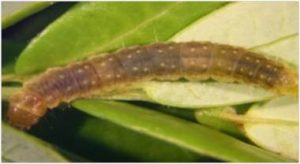
Blackheaded fireworm Larva

Blackheaded fireworm Larva (Photo by D. Schiffhauer)

ry-growing states. Sparganothis fruitworm completes two generations a year and overwinters as an early-instar larva. Larvae from the 1st generation feed on foliage. In New Jersey, first generation adult moths emerge from mid-June through the first weeks in July; pheromone traps are commonly used to monitor adult flight and population size. Second-generation eggs are laid on cranberry leaves, and larvae will feed on fruit.

Cranberry blossomworm – Adults lay their eggs in October in cranberry beds. The eggs overwinter and hatch over a period of several weeks. Early instars can be found during the first week of May. Larvae go through 6 instars to complete development.

Because the first instars feed during the day (and also at night), scouting can be done during the

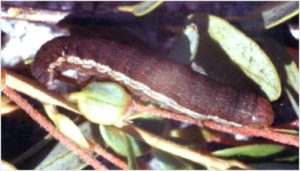
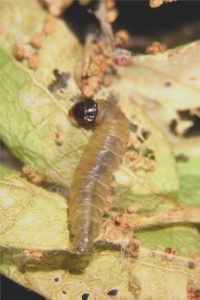
Spotted Fireworm Larva

Spotted Fireworm Larva

daytime using sweep nets to estimate larval abundance. Larvae turn nocturnal during the later instars. At this time, night sweeping (9 pm – 1 am) is recommended for sampling. Larvae complete their development by June-July. Older instars are very voracious and capable of destroying 100 blossoms within a 3-week period. There is a pre-pupal that lasts until the end of August and a pupal stage that lasts until October. Adults emerge from end of August to end of October.

Lepidopteran Pests Monitoring and

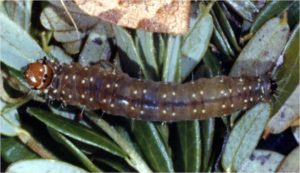
Sparganothis fruitworm Larva

Sparganothis fruitworm Larva (Photo by D. Schiffhauer

Control – Use sweep netting for monitoring early lepidopteran pests (pre-bloom). A sweep set consists of 25 sweeps and 1 sweep set is recommended per acre (this may vary depending the size of bogs). The action threshold for false armyworm, blossomworm, other cutworms, and gypsy moth (we use a combined threshold from adding all these caterpillars per sweep) is an average of 4.5 caterpillars in sets of 25 sweeps. For brown and green spanworms is an average of 18 per sweep set. The action threshold for blackheaded fireworm and Sparganothis fruitworm is an average of 1 to 2 per sweep set. We recommend the use of the reduced-risk materials Intrepid, Delegate, Altacor or Exirel if populations exceed action thresholds. Exirel is a newly-registered insecticide in cranberries. These are reduced-risk, softer insecticides that are very effective against lepidopteran pests. More information on these (and other) lepidopteran pests will be provided as the season progresses.

Leafhoppers –There is concern among New Jersey cranberry growers of a potential increase in leafhopper populations because of recent changes in pest management strategies (e.g., adoption of new reduced-risk products and decreased applications of broad-spectrum insecticides). Blunt-nosed leafhopper is of particular concern because

Cranberry blossomworm Larva

Cranberry blossomworm Larva

they can transmit cranberry false blossom disease. This leafhopper has one generation a year. Adults are found in highest numbers during July, although nymphs or adults may be found from the end of May until October. Eggs are laid in August-September. The eggs overwinter and hatch in May or June. The nymphs go through 5 instars to complete development.

Leafhopper Monitoring and Control: Leafhopper nymphs can be sampled using sweep nets (as described above for lepidopteran pests). Nymphs before bloom are small; thus, you may need to freeze the samples (to kill them), and then count the number of nymphs under a microscope or using a magnifying lens. There is no threshold based on sweep net counts, so decisions should be made based by comparing current numbers with prior infestation history and/or incidence of false blossom disease on those beds.
In cases of high numbers of blunt-nosed leafhopper nymphs, we recommend application of a broad-spectrum insecticide, such as Diazinon (no aerial applications allowed) or Lorsban (only pre-bloom applications allowed for Ocean Spray growers). Broad-

Blunt-nosed leafhopper Nymph

Blunt-nosed leafhopper Nymph (Photo by D. Schiffhauer)

spectrum insecticides will disrupt biological control particularly the natural enemies (predators and parasitoids) of Sparganothis fruitworm, so their use should be restricted only to areas of high leafhopper populations.

WEBINAR: Organic Management of Spotted-Wing Drosophila

Dear Organic Fruit Growers, Pest Management Professionals and other stakeholders:

Spotted-wing drosophila (SWD) has emerged as a devastating pest of small and stone fruits worldwide. We have organized a webinar to provide you with the most updated information on everything you need to know for organic management of SWD.

Please register at: https://eorganic.org/node/33992 to attend this webinar.

Date: March 4, 2020 (Wednesday) 2:00-3:30pm Eastern

Presented by: Ash Sial (UGA), Mary Rogers (UMN), Kelly Hamby (UMD), Kent Daane (UC Berkeley), Rufus Isaacs (MSU), Vaughn Walton (OSU), Oscar Liburd (UF), Craig Roubos (UGA), Elena Rhodes (UF) and other members of the SWD OREI project team.

Sponsored by: Award No. 2018-51300-28434 Organic Agriculture Research and Extension Initiative (OREI) USDA National Institute of Food and Agriculture