Insect Update

Cranberry beds are in bloom. If insects have been effectively managed prior to bloom, we recommend no sprays at this time. A reminder: when bees are present your only choices of insecticides are insect growth regulators (IGRs) such as Intrepid 2F or Bt products such as DiPel.

During bloom we recommend monitoring insect populations using pheromone traps. Pheromone traps should be used particularly to monitor activity of Sparganothis fruitworm and blackheaded fireworm, two key pests in New Jersey.

Sparganothis fruitworm– Adult flight should have started a few weeks ago and we will be at peak flight activity by next week (see DD model
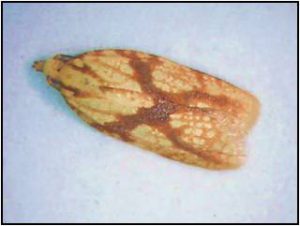
Sparganothis fruitworm adult

Sparganothis fruitworm adult

below). Damage by the second generation larvae begins after the eggs hatch, usually 9-12 days after they are laid. These larvae will feed on foliage and fruit. Larvae will partially feed on berries, causes scoring of the fruit. However, particularly on Ben Lear, larvae may feed inside the fruit. Insecticide treatment should target small larvae. Pheromone traps can be utilized to time insecticides sprays. If treatment is required, sprays should be applied two weeks after peak moth flight and/or earlier if using an IGR. If trap counts indicate a low population that requires management, a single insecticide application may be made post-bloom. If trap counts are high, then an early application of an IGR may be used when the first eggs start to hatch. This would be followed by a second application soon after bloom. Your post-bloom options are Diazinon, Altacor, Delegate, Exirel, or Intrepid.

As indicated above, controlling fruitworm populations is often very difficult and many require multiple applications depending on pest pressure. Sparganothis fruitworm populations in Massachusetts are resistant to organophosphate insecticides (e.g. Diazinon, Lorsban). Thus, organophosphates should be used with care, i.e., always rotate insecticides with different modes of action. Organophosphate insecticides will also negatively affect natural enemy populations. Delegate, Altacor, and Exirel are insecticides belonging to relatively new modes of action; these are registered against fruitworms and can be used as an alternative to organophosphates post-bloom.

Degree-day model for Sparganothis fruitworm

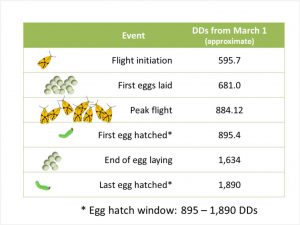
The figure details life history benchmarks of interest for Sparganothis fruitworm and associated degree-day estimates from March 1(credit:
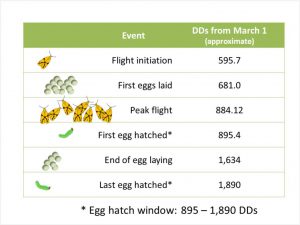
Sparganothis degree-day benchmarks

Sparganothis degree-day benchmarks

Elissa Chasen and Shawn Steffan, USDA-ARS and UW Entomology). Flight initiation is predicted around 595 DD, at a lower temperature threshold of 50°F. Based on this model Sparganothis fight was initiated in our region (Chatsworth, NJ) about a week ago. So far, we have accumulated (starting April 15) 688 DD, which means that egg laying has just started (depending on the DD accumulations specific to your farm); however, eggs are not expected to hatch until later this month. Also, a reminder that a single insecticide application aimed at Sparganothis larvae will likely have the greatest effect if it is timed between the beginning and the peak egg-hatch/larval-emergence, which is approximately 895-1,400 DD. I will keep you updated on these DD predictions as the season progresses.
IPM Guides for Spotted Wing Drosophila Now Available

IPM guides for spotted wing drosophila (SWD) in blueberries and brambles are now available!
Download them from the Northeastern IPM Center website, provided below, or via the SWD IPM Working Group website, www.northeastipm.org/working-groups/spotted-wing-drosophila/.

Spotted Wing Drosophila IPM in Raspberries & Blackberries
http://www.neipmc.org/go/swdpub1

Spotted Wing Drosophila IPM in Blueberries
http://www.neipmc.org/go/swdpub2

2019 Cranberry Growers Twilight Meeting

Location: Pine Island Cranberry Company, Inc.
Address: 3353A Rte 563, Chatsworth, NJ 08019
Date: Thursday June 13, 2019
Time: 5:30 P.M. to 8:00 P.M

Agenda

5:30-6:00 PM Dinner

6:00-6:25 PM “Cranberry Disease Management”
Dr. Peter Oudemans, Professor Blueberry/Cranberry Pathology

6:25-6:45 PM “Systemic Diseases of Cranberry”
Dr. James Polashock, Research Plant Pathologist, USDA-ARS

6:45-7:10 PM “Cranberry Weed Control Update”
Dr. Thierry Besancon, Assistant Extension Specialist, Weed Science

7:10-7:35 PM “Fruit Rot Resistance Variety Trials”
Dr. Nicholi Vorsa, Professor and Director, Rutgers P.E, Marucci Center
Dr. Jennifer Johnson-Cicalese, Research Associate

7:35-8:00 PM “Cranberry Insect Pest Management”
Dr. Cesar Rodriguez-Saona, Extension Specialist, Entomology

Sparganothis Fruitworm Degree-Day Update: as of May 30, 2019

Based on our degree-day model for Sparganothis fruitworm, flight initiation is expected at around 596 DD (see chart). As of May 30,

Sparganothis degree-day model benchmarks

Sparganothis degree-day model benchmarks

Sparganothis has accumulated 683 DD (using March 1 as biofix- a biofix used for the model) or 529 DD (using April 15 as biofix- a biofix more relevant to New Jersey cranberry cultural practices). This indicates that flight activity has just started or will start very soon. Growers are advised to place pheromone traps for monitoring this pest by this or next week, if they haven’t done so already.

Beating the Bugs in the Bogs: Fertilizer Affects Cranberry Volatile Emissions

Can you recall the smell of cut grass? Many plants, including cranberries, emit different smells, or volatiles, when damaged by cutting, but

Person working in a greenhouse

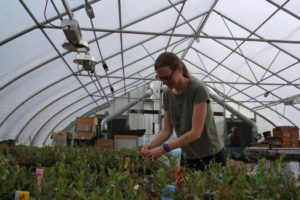
Dr. Elvira de Lange in the greenhouse

also when damaged by herbivorous insects. These volatiles could then be used by predators to find prey, or by parasitoids to find hosts. However, fertilizer applications may affect emissions of these herbivore-induced volatiles, and therefore the interactions between plants, herbivores, and their natural enemies.

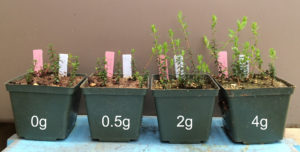
At the P.E. Marucci Blueberry & Cranberry Research Center, Drs. Elvira de Lange and Cesar Rodriguez-Saona studied the effects of fertilizer on volatile emissions in potted cranberry plants. They tested six cranberry varieties: Howes, Early Black, Potter, Stevens, Franklin, and Crimson Queen, exposed to four fertilizer regimes: 0, 0.5, 2, and 4 g NPK controlled-release fertilizer.

A previous study showed that increased fertilizer rates decreased resistance to herbivores. Three insect herbivores gained more weight on plants exposed to the higher fertilizer regimes, and also showed increased survival on these plants. Possibly, this was due to increased levels of nutrients and reduced levels of defensive compounds.

Experimenting with different amounts of fertilizer

Fertilizer regimes

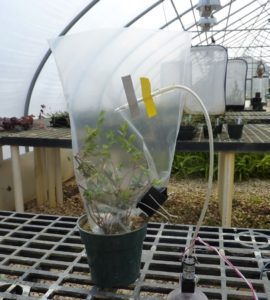
To test whether fertilizer also affects plant volatile emissions, we placed bags around potted cranberry plants, and using small pumps, sucked the air out of the bags. Connected to the pumps were trapping filters containing an adsorbent material, which was used to trap the volatiles. The results showed that higher fertilizer rates increased the total emission of volatiles, that is, the emission of all individual volatile compounds combined. This effect was found for all tested cranberry varieties, and was due to an increase in plant fresh weight. Indeed, higher fertilizer rates increased plant biomass substantially. Exposure to higher fertilizer rates also led to the emission of compounds that were not emitted when plants were exposed to lower fertilizer rates.

The effects of these increased volatile emissions, and changed volatile blends, on natural enemy attraction still need to be investigated. However, it is known that volatiles not only attract natural enemies, but they can also attract, as well as repel, insect pests. It is important to study possible changes in insect communities in response to fertilizer applications, to determine when and where to apply chemical and biological products for optimal pest control.

Volatile collection apparatus

Volatile collection apparatus

In cranberry, previous studies by Dr. Cesar Rodriguez-Saona showed that plant volatiles affect the attraction of an herbivore, Sparganothis fruitworm; several predators, such as lacewings, ladybeetles, and hoverflies; and some parasitoid wasps. Potentially, volatiles could be used to manipulate pests and natural enemies in agro-ecosystems, directing natural enemies towards crops, while directing pests away from them. Therefore, adjusting volatile emissions, through select fertilizer applications, use of synthetic volatiles, selection of particular varieties, or otherwise, could contribute to integrated pest management programs in cranberry.

This study is published in Plant Signaling & Behavior: https://doi.org/10.1080/15592324.2019.1616517

We thank Rob Holdcraft, Vera Kyryczenko-Roth, and the summer students in 2015 for assistance with the experiments. Funding was provided by Hatch Project No. NJ08192 and the New Jersey Blueberry and Cranberry Research Council, Inc., Cranberry Institute, Cape Cod Cranberry Growers Association, Canadian Cranberry Growers Coalition, and Ocean Spray Cranberries, Inc.

New Insecticide Registered in Cranberries

Earlier this year, Exirel® (FMC Corporation) was registered for use in cranberries. The Exirel label includes the target pests: cherry fruitworm, cranberry fruitworm, blackheaded fireworm, and Sparganothis fruitworm. The active ingredient (a.i.) is cyantraniliprole. This insecticide belongs to a class of insecticides known as anthranilic diamides (similar to Altacor). This class of insecticides is particularly effective against lepidopteran pests but Exirel has broader insecticidal activity that includes flies, aphids, weevils, etc. After ingestion, anthranilic diamides work by impairing muscle contraction, resulting in feeding cessation, lethargy, and partial paralysis, eventually leading to the death of the insect.

Exirel is considered a reduced-risk insecticide and compatible with biological control. It should thus be considered as a new alternative when rotating insecticides with different modes of action for preventing the development of resistant populations. Exirel has a 14-day pre-harvest interval (PHI) and a 12-hour re-entry interval (REI). A maximum of 0.4 lb a.i. can be applied per acre, which equates to three applications at the highest label rate (20.5 fl oz per acre).

Previous work in our laboratory has demonstrated that Exirel can provide similar, or sometimes even better, larval control as compared with other registered materials such as Intrepid, Delegate, and Altacor.