Beating the Bugs in the Bogs: Fertilizer Affects Cranberry Resistance against Insect Pests

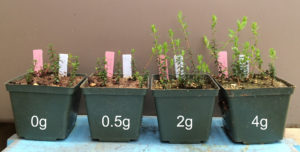
Fertilizer rates

Figure 1. Fertilizer rates

Cranberry plants originate from relatively nutrient-poor environments, but commercial cranberries receive fertilizer to improve plant growth and yield. Increased fertilizer use may influence plant resistance to insect pests.

At the P.E. Marucci Blueberry & Cranberry Research Center, a study by Elvira de Lange, Vera Kyryczenko-Roth, Jennifer Johnson-Cicalese, Joan Davenport, Nick Vorsa, and Cesar Rodriguez-Saona looked in detail at the effects of fertilizer on herbivore resistance in greenhouse-grown cranberry plants. Six cranberry varieties were tested: Howes, Early Black, Potter, Stevens, Franklin, and Crimson Queen. The fertilizer regimes were 0, 0.5, 2, and 4g NPK controlled-release fertilizer.

We first confirmed that increasing fertilizer rates enhanced nutrient availability in cranberry leaves. Indeed, N concentrations in plants exposed to the highest (4g) fertilizer rate were almost 3 times higher than those in plants without (0g) fertilizer. Also, we confirmed that increasing fertilizer rates enhanced plant growth. Indeed, upright lengths and weights of plants exposed to the highest fertilizer rate were 5 and 10 times higher, respectively, than those of plants without fertilizer (Figure 1).

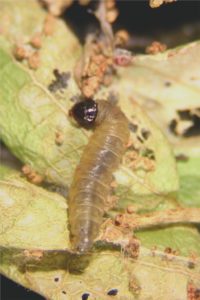
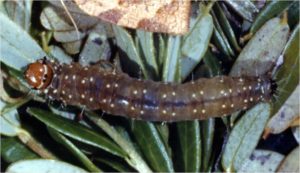
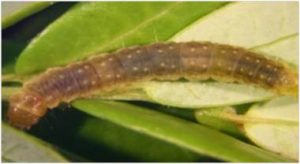
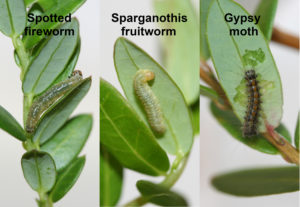
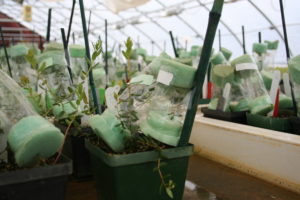
Then, we studied the effects of fertilizer on weight gain and mortality of three important insect herbivores: spotted fireworm, sparganothis fruitworm, and gypsy moth (Figure 2). Cranberry uprights were encased with a small transparent plastic cage, with tops and bottoms made out of foam (Figure 3). One larva was placed per cage, and weighted after 7 or 14 days. All three herbivores gained more weight on plants subjected to higher fertilizer rates – for all cranberry varieties. Also, the herbivores experienced lower levels of mortality on plants subjected to higher fertilizer rates. This improved insect performance on plants with high nutrient availability may be due to improved quality of the plants as a food source, and/or reduced levels of defensive compounds.

To study a possible reduction in levels of defensive compounds, we measured levels of proanthocyanidins (PACs) in cranberry leaves. PACs are involved in defenses against herbivores, as well as microbes. Increased fertilizer rates reduced PAC levels for all cranberry varieties, which may account for the observed increases in larval weight gain. However, gypsy moth larvae gained the most weight when feeding on Franklin, the variety with the highest PAC levels, and gained the least weight when feeding on Potter, the variety with the lowest PAC levels. Thus, at least for gypsy moth, additional defensive compounds are likely involved in cranberry resistance to insect pests.

Studying the effects of fertilizer on resistance to herbivorous insects in cranberry may contribute to the development of better practices for integrated pest management, and help to optimize cranberry health and yield.

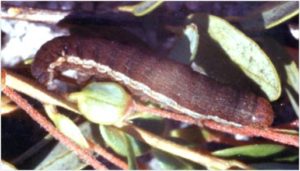
Cranberry pest

Figure 2. Cranberry pest

This study is published in Agricultural and Forest Entomology: https://doi.org/10.1111/afe.12335

We thank Rob Holdcraft, Kristy Adams, Dan Rice, and Lindsay Wells for assistance with the experiments. Funding was provided by Hatch Project No. NJ08192 and the New Jersey Blueberry and Cranberry Research Council Inc.

Insect cages

Figure 3. Insect cages

Beating the Bugs in the Bogs: Attracting Beneficial Insects

Cranberry plants produce volatiles when attacked by herbivorous insects, which can be used by beneficial insects, such as predators and parasitoids, to find food or hosts. Synthetic volatiles could potentially attract additional beneficial insects to cranberry fields, reducing insect damage and resulting in reduced yield losses. These volatiles could be used also to monitor the abundance of beneficial insects in agro-ecosystems.

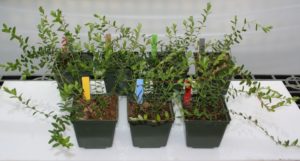
At the P.E. Marucci Blueberry & Cranberry Research Center, a study by Drs. Elvira de Lange, Jordano Salamanca, James Polashock, and Cesar Rodriguez-Saona looked in detail at the emission of volatiles in different cranberry varieties (Figure 1), as well as the effects of synthetic volatiles on attraction of natural enemies of herbivores.

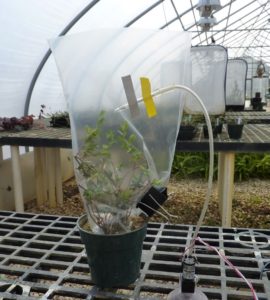
To study plant volatile emissions, we placed greenhouse-grown cranberry plants in bags, and sucked air out of the bags with small pumps (Figure 2). The air passed through a trapping filter with an adsorbent material, trapping the volatiles. Analysis revealed that volatile emissions in response to herbivory differed among cranberry genotypes. At the molecular level, we studied the expression of genes that are involved in the biosynthesis of these volatiles. We harvested leaf material, and found that the expression of two genes associated with volatile biosynthesis did not differ among the cranberry genotypes. These results indicate that other, not yet identified, genes may play a role in regulating volatile emissions in cranberry plants.

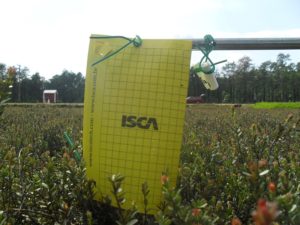
In the field, we placed yellow sticky traps (Figure 3), with or without a vial containing synthetic volatiles. We found that the volatile methyl salicylate, alone or in combination with other volatiles, increased the number of syrphid flies captured on the sticky traps by 6-fold. However, methyl salicylate repelled some natural enemies (i.e., megaspilid wasps). Similarly, the volatile

Cranberry genotypes

Figure 1. Cranberry genotypes

(Z)-3-hexenyl acetate repelled ladybeetles. Thus, the responses of natural enemies to synthetic volatiles in cranberry beds varied from repellency to attraction.

Experimentally changing plant volatile emissions may have some positive effects on biological control by attracting natural enemies, but can also have some serious negative consequences. Not only beneficial insects could be attracted, but herbivorous insects could be attracted as well. Also, certain natural enemies could be repelled. There is a possibility that when volatiles are present, but prey or hosts are absent, natural enemies learn to stop responding to the presence of volatiles. Our results indicate that, when practiced with care, synthetic volatiles may contribute to sustainable pest management practices in cranberry through the monitoring and recruitment of desirable natural enemies.

Volatile collection apparatus

Figure 2. Volatile collection apparatus

This study is published in the Journal of Chemical Ecology: https://doi.org/10.1007/s10886-018-1043-0.

We thank technicians Vera Kyryczenko-Roth, Rob Holdcraft, and Kristy Adams, as well as the summer students in 2014 and 2015, for assistance with the experiments. Funding was provided by Hatch Project No. NJ08192 and the New Jersey Blueberry and Cranberry Research Council Inc., Cranberry Institute, Cape Cod Cranberry Growers Association, Canadian Cranberry Growers Coalition, and Ocean Spray Cranberries, Inc.

Sticky trap baited with synthetic volatiles

Figure 3. Sticky trap baited with synthetic volatiles


American Cranberry Growers Association (ACGA) Winter Meeting

ACGA Winter Meeting Program

Date: Thursday, January 17, 2019

Location: Rutgers EcoComplex, Bordentown, NJ

Agenda:
8:00-8:30 Registration and Coffee

8:30-8:50 Welcoming Remarks– Shawn Cutts, President, ACGA
Treasurer’s Report – Shawn Cutts

8:50-9:10 Cranberry Statistics
Bruce Eklund, National Agricultural Statistics Service, Trenton, NJ

9:10-9:35 What did We Learn from Two Years of Research on Controlling Carolina Redroot?”
Thierry Besancon, ‎Weed Science Extension Specialist, Rutgers University, P.E. Marucci Center, Chatsworth, NJ

9:35-10:00 Cranberry Breeding Update: Pyramiding Genes for Fruit Rot Resistance, Genomics Work, and Fruit Chemistry Evaluations
Jennifer Johnson-Cicalese, P.E. Marucci Center, Chatsworth, NJ and Nicholi Vorsa, Professor, Department of Plant Biology and Pathology, Rutgers University

10:00-10:25 Disease Management Progress 2018
Peter Oudemans, Professor, P.E. Marucci Center for Blueberry & Cranberry Research & Extension, Rutgers University, Chatsworth, NJ

10:25-10:45 Break

10:45-10:55 The Benefits of using Remote Imagery in Cranberry Production
John Potter, Director of Agronomy, Skycision

10:55-11:20 Management of Blunt-nosed Leafhoppers in Cranberries: Lessons Learned from Insecticide Trials
Cesar Rodriguez-Saona, Professor, Department of Entomology, Rutgers University, New Brunswick, NJ; Vera Kyryczenko-Roth, and Robert Holdcraft, P.E. Marucci Center, Chatsworth, NJ

11:20-11:40 Understanding the Effects of False Blossom Disease on Cranberry Chemistry, Blunt-nosed Leafhoppers, and other Insect Herbivores
Nakorn Pradit, Department of Entomology, Rutgers University, New Brunswick, NJ

11:40-12:10 Cranberry Institute – An Update
John Wilson, Cranberry Institute, Carver, MA

12:10-1:00 Lunch

1:00 Adjournment- ACGA Board of Directors Meeting

Upcoming Event – ACGA Summer Meeting

Event: American Cranberry Growers Association 2018 Summer Field Day
Date: Friday August 17, 2018
Location: Rutgers P.E. Marucci Center for Blueberry & Cranberry Research & Extension, Chatsworth, NJ

AGENDA

CRANBERRY BOGS:

8:30–8:45 Opening Remarks
Shawn Cutts, President, American Cranberry Growers Association

8:45–9:10 Crop Phytotoxicity and Weed Control with Prospective Pre-emergence Herbicides for Cranberry (Bog 3)
Thierry Besancon and Baylee L. Carr, P.E. Marucci Center for Blueberry & Cranberry Research & Extension, Rutgers University, Chatsworth, NJ

9:10–9:35 Mitigation of the Ill Effects of Liquid Fertilizer with Lime Applications: Preliminary Results (Bog 5)
Nicholi Vorsa and Jennifer Johnson-Cicalese, P.E. Marucci Center for Blueberry & Cranberry Research & Extension, Rutgers University, Chatsworth, NJ

9:35-10:00 New fungicides and cultural methods for improving fruit quality (Bog 7)
Peter Oudemans, Timothy Waller, Dave Jones, Jacob Armitage, John Jensen, Dan Flath and Chris Constantelos. P.E. Marucci Center for Blueberry & Cranberry Research & Extension, Rutgers University, Chatsworth, NJ

10:00–10:25 Evaluation of Fungicide Treatments on Fruit Rot Resistant Cranberry Selections (Bog 11)
Jennifer Johnson-Cicalese, Timothy Waller, Peter Oudemans, and Nicholi Vorsa, P.E. Marucci Center for Blueberry & Cranberry Research & Extension, Rutgers University, Chatsworth, NJ

10:25–10:50 On-going Research on Sucking Insect Pests (Bog 19)
Cesar Rodriguez-Saona, Department of Entomology, Rutgers University; Vera Kyryczenko-Roth, P.E. Marucci Center; and Robert Holdcraft, P.E. Marucci Center, Chatsworth, NJ

CONFERENCE ROOM:

11:10-11-20 Cranberry Statistics
Bruce A Eklund, State Statistician, U.S. Department of Agriculture | National Agricultural Statistics Service

11:20–11:40 Advances in Cranberry Genomics
James Polashock, Research Plant Pathologist, USDA-ARS

11:40–12:00 Cranberry Fruit Chemistry and Potential Effects on Disease
Nicholi Vorsa, Jennifer Johnson-Cicalese, Karen DeStefano and Susan Vancho, P.E. Marucci Center for Blueberry & Cranberry Research & Extension, Rutgers University, Chatsworth, NJ

POLE BARN:

12:00–1:00 LUNCH

CONFERENCE ROOM:

1:00-3:00 Lab Tours (Optional)

Root-feeding Pests of Cranberries

If your beds have damage caused by root-feeding insects, you should consider treatment with Imidacloprid (e.g. Admire Pro, Alias 4F, Alias

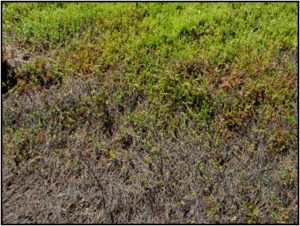
Symptoms caused by grub injury in cranberries

Symptoms caused by grub injury in cranberries

2F) after bees are removed. Occurrence of root-feeding insects will manifest by the presence of dead patches (see picture). Pull dead vines and search through the root zone and soil for grubs and worms. Admire Pro (imidacloprid) is labeled for the control of cranberry rootworm, white grubs (Phyllophaga spp.), and other scarabs in cranberries.

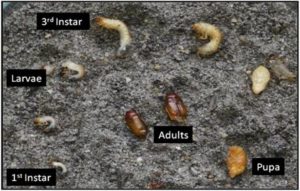
White grubs, Phyllophaga spp. There are several species of white grubs that infest cranberries in New Jersey, the most abundant being P. georgiana. Grubs are C-shaped and often found near bog margins. Adults are reddish brown and nocturnal. Grubs attack the cranberry roots; adults have not been reported to feed on cranberries. See pictures of grubs and grub damage in cranberries. The life cycles and abundance of white grub species in New Jersey is not well known. Most likely, Phyllophaga grubs have a 3-year life cycle (based on previous reports and our own observations). Eggs are laid in late-June and July, and will hatch in July. First instars can be found in late-July and August and turn into second instars by the end of August-September. The second instar grubs will overwinter. These grubs will feed the following year until June and molt to third instars, which will overwinter. The following year, the third instars will feed for some time and then begin to pupate in June. Pupation will take place in July-August. Adults will appear in the soil in August-September. Adults will remain in the soil and overwinter. They will emerge in June, mate, and begin to lay eggs, completing the cycle.

Phyllophaga grubs

Phyllophaga grubs

Cranberry rootworm (Chrysomelidae). Pupation starts in late May and beetles emerge in early June. Adults are nocturnal and hide in leaf litter. Adults can be easily picked up in a sweep net. Females feed on foliage before laying eggs. Young larvae will feed on roots, feeding continues until October. The mature larvae move down the soil in the fall to overwinter. Holding of the water will delay onset of pupation. Rootworm has a 1-year life cycle. Entomopathogenic nematodes (Heterorhabditis bacteriophora) can be used to control cranberry rootworm.

Use of Imidacloprid. If treatment is needed, use imidacloprid (Admire Pro or other generic insecticides such as Alias 4F) to control white grubs and rootworms. Imidacloprid works best against early- (1st-2nd) instar grubs. Imidacloprid should be used after bees are taken out of beds. Because of the 3-year life cycle, treatment should be continued for 2-3 consecutive years to ensure control. Imidacloprid (active ingredient) is a neonicotinoid insecticide registered for use in cranberries against cranberry rootworm and scarab grubs. This insecticide is a contact and stomach poison that affects the insect nervous system. It is highly systemic and toxic to honey bees; therefore, can be used only as a post-pollination insecticide. Imidacloprid can be applied by ground or by chemigation. Aerial application of this product is prohibited. Imidacloprid has a long residual activity (> 100 days) as long as the insecticide is not directly exposed to the sun. Admire Pro can be used at 7-14 fl oz/acre. A maximum of 14 fl oz of Admire Pro can be used per acre per season. The PHI is 30 days.

Post-bloom Insect Pest Control Recommendations

As we approach the end of bloom, growers should consider the need for any post-bloom applications. The main pest targets for these applications are mainly Sparganothis fruitworm and spotted fireworm.

Sparganothis fruitworm (SPARG) – If your farm has high pheromone trap counts, you should consider managing this pest as soon as bees are removed. The timing for this 1st post-pollination spray is at 2 weeks after peak pheromone trap catches, which usually coincides with this time of the year.

Spotted fireworm (SFW) – SFW is one of the most important pests in New Jersey. Male SFW moth catches typically peak in the second through third week in June. Although trap catches give an indication of population size, these numbers not always correlate with numbers of egg masses. This insect becomes a problem in “weedy” beds because female moths lay their eggs predominantly on weeds. Thus, growers need to monitor for the presence of SFW egg masses on weeds (broadleaf species and grasses). Keeping beds clean from weeds will keep this insect under control. Egg masses should be hatching by now. SFW larvae from this generation feed on foliage as well as fruit.

Control Options – Insect Growth Regulators (IGRs) (e.g. Intrepid and Confirm) are effective against SPARG. Alternatively, if you have used IGRs intensively (e.g. last year and this year as a pre-bloom or bloom spray), and would like to rotate with other chemistries, you may want to use Altacor, Delegate, or the broad-spectrum insecticides Diazinon, Imidan, or Lorsban. Broad-spectrum insecticides are also a choice if you have high blunt-nosed leafhopper populations (see below) because Intrepid, Delegate, and Altacor will have no effect against this insect. IF YOU ARE AN OCEAN SPRAY (OS) GROWER PLEASE CHECK RESTRICTIONS ON THE USE OF THESE INSECTICIDES. Lorsban in particular can’t be used by OS growers after bloom due to maximum residue limits (MRLs) for exporting cranberries. If you are an OS grower and want to use a post-bloom application to control SPARG then Delegate, Altacor, Diazinon (no aerial application allowed), or Imidan would be your options.

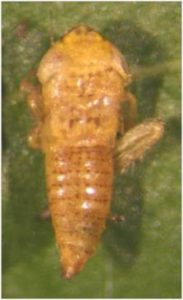
Blunt-nosed leafhoppers– The best timing for controlling blunt-nosed leafhoppers is before bloom when they are immatures. At this time of the year, most of the population are adults and already laying eggs. If you did not spray before bloom and have a high leafhopper population, you may consider a post-bloom application to prevent from an increase in population size. You may also consider spraying next year to control for those immatures that will emerge from the already laid eggs. I list the best products against leafhoppers. As indicated above, if you are an OS grower please check insecticide use restrictions based MRLs.

Recommendations for leafhopper control

Recommendations for leafhopper control