Archives for June 2025

Agritourism Marketing Survey

WVU Extension and other colleagues are trying to understand how we can better help you with your Agritourism Marketing. It will tremendously help us to help you in the future.

Please take a few minutes (at most 5 minutes) to answer the questions here: https://s.uconn.edu/agritourism-marketing
Fruit IPM Report June 11, 2025

Peach:

Bacterial Spot: Fruit symptoms are very low and only in highly susceptible varieties. Growers should continue to manage using Oxytetracycline and lower rates of copper, especially around rainy periods and severe weather. Fruit will become less susceptible to infection at pit hardening which is occurring now.

Figure 1. Rusty spot on peach. Photo by Karlton Raines-Neidigh.

Rusty Spot: Rusty spot infections are appearing on fruit in Northern and Southern counties and ongoing until pit hardening (Figure 1). Maintain coverage with effective materials such as Rally, Rhyme, or potassium bicarbonate products. Other choices include Flint Extra, Inspire Super, and Luna Sensation.


Peach Scab: Maintain good coverage with captan or other effective fungicides until July in orchards where scab was an issue last year.

Oriental Fruit Moth: A biofix point for OFM was set on 4/2 for southern counties and 4/17 in northern counties. Treatment timings targeting the second generation are shown in the table below.

OFM 2nd Generation Timing
Insecticide Type
County/Region Degree Days by  6/11 base 45 Conventional

1150-1200

1450-1500

Intrepid/Rimon

1050-1150

1300-1400

Diamides/Virus

1075-1150

1375-1450

Gloucester – Southern 1145 1st –June 11-13

2nd – too far off

1st –June 8-11

2nd – too far off

1st –June 9-11

2nd – too far off

Middlesex – Northern 1001 1st – too far off

2nd – too far off

1st – June 13-17

2nd – too far off

1st – June 14-16

2nd – too far off

Tarnished Plant Bugs; and Other Catfacing Insects: Catfacing insects are active, and activity is increasing with dry weather and summer temperatures. Very little recent fruit feeding has been observed.

Green Peach Aphid: We are observing reduced aphid counts across farm sites. If more than 1 colony of aphids are found in nectarines, or 2-3 colonies are found in peaches, an insecticide for aphids is needed. See the NJ Commercial Tree Fruit Production Guide for recommended materials and rates.

Scale Insects: White peach scale and San Jose scale crawlers began emergence around May 26 and will continue emergence for up to 6 weeks. Control options during crawler emergence include Noenicitinoids (suppression only), Sivanto, and the IGR’s Esteem and Centaur. See the NJ Commercial Tree Fruit Production Guide and the product labels for more information.

Apples and Pears:

Diseases: Now that primary scab is nearing the end, or has ended, the focus turns toward summer diseases such as fruit rots (esp. Bitter rot), and sooty blotch and fly speck. Bitter rot control has been difficult at best in recent years even where management programs have been rigorous. Research has suggested Products such as Merivon, Luna Sensation, Inspire Super, Omega, and Aprovia may be effective, and longtime reliable broad spectrum fungicides such as captan and ziram should provide control. Experience has suggested that the addition of phosphorous acid products such as Prophyt or Rampart to captan sprays may improve control. Observations are that these products improve control of other summer diseases such as sooty blotch and flyspeck, and may help suppress scab infections where present. Scab symptoms are appearing in some orchards statewide.

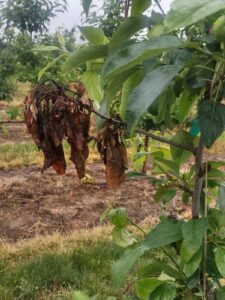
Figure 2. Fire blight strike in apple. Photo by Karlton Raines-Neidigh.

Fire Blight: Fire Blight symptoms began appearing in southern county apple orchards the week of 5/19, and we are seeing a significant increase in infection across the region (Figure 2). Typically it is recommended to cut out infected limbs however this is a practical decision that must be made.

This blog post from Michigan State may be helpful to decide whether it is worth cutting out infected tissue. Once the terminal buds set, typically in July, infected wood should be removed to prevent colonization by the bitter rot pathogen.

Codling Moth (CM): A codling moth biofix was set in southern counties on 4/28 and in northern counties on 4/30. Trap captures have decreased. The timing for codling moth applications for the first generation have passed in southern counties and is wrapping up in northern counties this week.

Codling Moth Degree Day Timing
Application and Insecticide Type
County Area Biofix Rimon:

75-100DD + 14-17 days later


Intrepid

150 + 450 DD

Diamides – Altacor, Voliam mixes: (150-200 DD)

Madex

250 DD + every 7-9 days during brood hatch (later if first spray is an IGR)

Standard Insecticides –  Delegate, Avaunt, OP’s, carbamates, pyrethroids

250 DD + 550 DD


DD 75 100 150 450 250 250 550
Southern April 28 past past past past past past past
Northern  April 30 past past past past past past June 10

Ambrosia Beetle : Infested trees are showing signs of stress. If you have had a history of this pest in your orchard, now is a good time remove and burn any trees that have been attacked as the flight appears to be declining or is over.

Wooly Apple Aphid (WAA); Green Apple (Spirea) Aphids (GAA): GAA colonies are being observed, some above threshold in some apple blocks. GAA is generally a pest that can be tolerated in orchards where beneficial insects are present. Generally treatment thresholds for GAA are if 50% of the shoots are infested where no beneficial insects are present. WAA aerial colonies are also forming in orchards statewide (Figure 3).

Figure 3. Wooly apple aphid colonizing pruned wood.

The best control for WAA is Movento applied before or when the first colonies appear. Diazinon is also effective at knocking down infestations. Movento will also control GAA and should control San Jose scale when applied in mid-May, and suppress scale when applied in late May or early June.  Do not combine diazinon, oil, or oil based penetrants with Captan.

Pear: Pear psylla are still actively laying eggs and nymphs continue to hatch. Options for control include spinosyn products such as Delegate and Entrust, and the neonicotinoids (IRAC group 4A). The addition of 0.25-1 gal of summer oil may improve control. Other options include Movento, the IGR’s Esteem and Centaur, and products containing abamectin. Be sure to read and follow the label instructions regarding the addition of penetrants for abamectin products, and Movento.

Grape: Grape diseases active at this growth stage are phomopsis, powdery mildew, downy mildew, and black rot. Disease infection periods can be monitored using the NEWA models. Choose the weather station closest to your vineyard. The biofix in southern counties for GBM was  5/24. Model timing will predict IGR and diamide materials for the second generation. The first generation is not really important in cultivated grapes, and the timing for the second generation treatments using Diamides or Intrepid is set at 810 degree days base 470F. Other materials may be applied a few days later. Given the current weather patterns, this should be about the last week of June in southern counties. The model works best when growers record their own bloom dates and use the Grape Berry Moth model at NEWA.

Blueberry: Spotted-wing drosophila (SWD) was found on traps placed in both Atlantic and Burlington Counties last week. Oriental beetle (OB) captures were reported in low numbers in Atlantic County last week. For weekly reports on blueberry pests and recommendations read the Rutgers Blueberry Bulletin.

The weather this season has been particularly wet, which can be a positive for plant vigor, but can complicate pest management. Recent pesticide applications may be washed off by rainfall, leaving fruit vulnerable to infestation. Supplemental treatments should be considered when rain washes off existing sprays, especially as we approach harvest of fruit crops to maintain coverage during this critical time. Additionally, rotating chemistries as much as possible helps reduce resistance risk. This blog post from Michigan State University contains valuable information on wash-off potential of insecticide residues after a rain event for various fruit crops.

Phenology Table: Based on annual observations made in Gloucester County.

Pest Event or Growth Stage Approximate Date 2025 Observed Date
 Bud Swell (Redhaven/PF-17)  March 23 +/- 15 Days March 30
1/4″ Green Tip Red Delicious March 31 +/- 13 Days March 30
Pink Peach (Redhaven/PF-17) April 4 +/- 15 Days April 1
Tight Cluster Red Delicious April 9 +/- 13 Days April 5
Full Bloom Peach (Redhaven/PF-17) April 9 +/- 14 Days April 10
Pink Apple (Red Delicious) April 14 +/- 12 Days April 16
Full Bloom Apple (Red Delicious) April 22 +/- 11 Days April 25
Petal Fall (Redhaven) April 22 +/- 10 Days April 19
Petal Fall (Red Delicious) April 27 +/- 13 Days May 2
Shuck Split (Redhaven) April 30 +/- 11 Days April 26
Pit Hardening June 15 +/- 9 Days

Tree Fruit Trap Captures – Southern Counties

Week Ending STLM TABM-A CM BMSB OFM-A DWB OFM-P TABM-P LPTB PTB
4/5/2025 0 0 0 0 0 0 0 0 0 0
4/12/2025 0 0 0 0 6 0 0 0 0 0
4/21/2025 0 0 0 0 36 0 1 0 0 0
4/27/2025 25 0 0 0 24 0 5 0 1 0
5/2/2025 517 0 4 0 12 0 6 0 13 0
5/9/2025 159 4 10 0 3 16 5 4 46 0
5/16/2025 91 11 6 0 1 36 2 14 69 0
5/23/2025 299 21 3 0 1 23 1 26 23 0
5/30/2025 399 14 2 0 0 41 1 11 10 3
6/6/2025 733 13 1 0 0 36 2 12 29 1

Tree Fruit Trap Captures – Northern Counties

Week Ending STLM TABM-A CM BMSB OFM-A DWB OFM-P TABM-P LPTB PTB AMBROSIA BEETLE
4/5/2025 387 0 0 0 0 0 0 0 0 0 0
4/21/2025 435 0 0 0 0 0 1.3 0 0 0 0
4/27/2025 26 0 0 0 0 0 25 0 0 0 72
5/2/2025 86 0 0.33 0 72.5 0 47.2 0 0 0 136
5/9/2025 56 0 5.3 0 58.8 0 22.9 0 0 0 145
5/16/2025 13.75 2.6 7.3 0 4 0 5 0 0 0 50.5
5/23/2025 4.8 10.3 10.5 0 0.6 31.25 4.2 0 14.6 1 22.2
5/30/2025 2.2 4.8 1.8 0 0 12.4 9.6 0 9.6 1.9 22.1
6/6/2025 3 4.83 2.8 .25 0 20 4.1 0 21.2 1.8 40.3

Basil downy mildew samples wanted by Rutgers!

Calling all commercial basil growers, researchers, home gardeners, and basil enthusiasts!
Our team at Rutgers University, UMass Amherst, Bar-Ilan University, and University of Florida
are asking for your help! Basil production is still threatened by the devastating Basil Downy
Mildew disease and current methods of prevention and resistance are wavering. It appears that
the pathogen is evolving rapidly, and we need your help to understand this phenomenon. We are
asking anyone who observes basil downy mildew on their plants to send infected leaf samples to
our researchers listed below and to report their infection to the following website:
https://basil.agpestmonitor.org/. These samples will be used to better understand the existing
pathogen populations and help drive solutions towards the downy mildew problem. This problem
cannot be solved alone, and we thank you!

Shipping Instructions:
Please collect as many infected leaves showing sporulation (or yellowing) as possible and wrap
in a dry paper towel before placing inside a sandwich bag. Seal the sandwich bag partially
(leaving about a quarter open) before placing in an envelope addressed with the information
below:

Rutgers University Mailing Information:
B.A.S.I.L.
Foran Hall, Rm 392
59 Dudley Rd
New Brunswick, NJ 08901
Please address any questions or concerns you may have to Robert Mattera III
(robert.mattera@rutgers.edu)


Vegetable IPM Update 6/5/25

Greetings from the Veg IPM team!

Sweet Corn

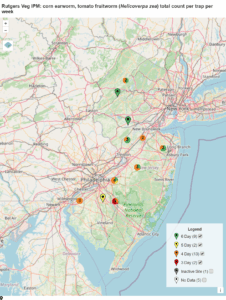
With the hot weather, we’re starting to see sweet corn really coming along. Some plantings of sweet corn are silking (especially in the south), so it’s time to think about corn earworm management. Moth captures in the Southern part of the state (see map) are indicating that 4 and even 3 day intervals are necessary in some areas. Rotation is important for avoiding resistance, and there are four IRAC groups that are registered in silking sweet corn: 1 (carbamates), 3 (pyrethroids), 5 (spinosyns), and 28 (diamides). Corn earworm is at least partly resistant to several pyrethroids, so a spray program should not rely solely on pyrethroids, although they can be useful in tank-mixes or as pre-mixed products, such as Besiege or Elevest (Group 28 + Group 3). For detailed information about resistance and potential spray programs, the University of Delaware has an excellent resource on corn earworm management.

Spray intervals based on nightly pheromone moth captures for the southern part of New Jersey. Note that not all locations in the IPM program are currently trapping. This map is based on the following thresholds: 0 moths = 6-7 day schedule, 1 moth = 5 day spray schedule, 2-20 moths = 4 day spray schedule, 20+ moths = 3 day spray schedule.

Cole Crops 

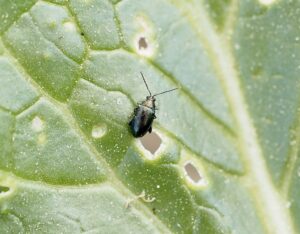
A shiny black beetle with straight antennae stands on a leaf surrounded by circular feeding holes.

Flea beetle surrounded by feeding damage. Picture by Maria Cramer.

Flea beetle activity seems to be slowing down some, but they are still active in various cole crops. This year, they have been especially prevalent in lacinato kale, Napa cabbage and bok choy. Young plants are especially vulnerable to attack from flea beetles. The treatment threshold for flea beetles in heading cole crops is 50% infestation.

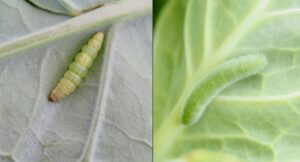
Two caterpillars on brassica leaves. Diamondback moth caterpillar on the left is smooth and tapered at each end. Imported cabbageworm on the right is fuzzy.

Left: Diamondback moth caterpillar, showing characteristic tapering at each end. Right: Imported cabbageworm caterpillar showing characteristic fuzziness. Pictures by Maria Cramer.

We’re still seeing caterpillar activity in cabbage and other cole crops. Treatment thresholds vary between crops and growth stage, but for heading cole crops between early vegetative and cupping, the treatment threshold is 30%. At this stage, sprayable Bt products (IRAC 11A) such as Dipel, Xentari, or Javelin can be effective on young imported cabbage worm caterpillars. Other materials approved for caterpillar control include Entrust/Radiant (IRAC 5), Proclaim (IRAC 6), Torac (IRAC 21A), and Exirel (IRAC 28). Diamondback moth has resistance to many insecticide groups, and pyrethroids (IRAC 3A) are not effective for their management. For Bt products and contact insecticides, coverage on the undersides the leaves is essential.

Tomatoes

In high tunnels and field plantings of tomatoes, we’re seeing limited aphid, thrips, and spider mite activity. If dealing with primarily aphids, products such as Beleaf (IRAC 29) are recommended, especially if plants have reached the flowering stage. We have seen aphid populations decline over the last couple of weeks without spray, probably due to natural enemies predation. For thrips, Entrust, Radiant (IRAC 5) and Torac (IRAC 21A) can be used. For spider mites, Nealta (IRAC 25) is an effective material that is more friendly to beneficial insects, but Portal (IRAC 21A) and other materials can be used to manage populations. We’ve seen very few Colorado potato beetles (CPB) in tomatoes, so while no controls are needed yet, we’ll keep an eye out for increasing populations.

Eggplants

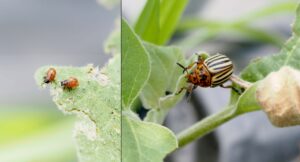
In eggplants we have seen some damaging populations of CPB. For plants under 6 inches, 2 small/1 large larvae per plant is the threshold, while for plants taller than 6 inches, the threshold is 4 small/2 large larvae per plant. Adults are hard to kill, so sprays should target the larvae, with younger/smaller larvae being more vulnerable than older larvae. CPB has resistance to many classes of insecticides and is notorious for quickly developing resistance to new ones, so plan to rotate IRAC groups if you’ve already treated or need to treat more than once. If you haven’t used a neonic (IRAC 4) at planting or in the drip, you can use a foliar neonic like Assail or a spinosyn like Entrust or Radiant (IRAC 5). Avoid IRAC 5 groups if you’ve already used a neonic, because there is risk of cross resistance. Diamide products like Coragen and Exirel (IRAC 28), Rimon (IRAC 15), and Torac (IRAC 21A) should all give good control.

On the left there are two orange beetle larvae on an eggplant leaf. On the right there is a large beetle with black and white striped wing covers and an orange head and abdomen, also on an eggplant leaf.

Left: Colorado potato beetle larvae and feeding damage on an eggplant leaf. Right: Adult Colorado potato beetle. Photos by Maria Cramer.

Diseases

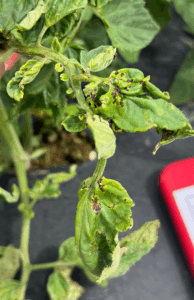
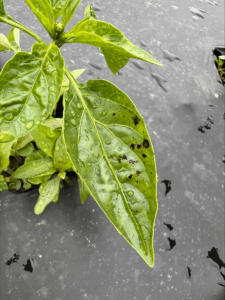
We’ve detected bacterial diseases of tomatoes and peppers on a few farms in the central and northern parts of the state (see photos below). Copper may help mitigate symptoms, but some strains have developed resistance due to continued copper use. Other products that may help include Actigard and Quintec. Otherwise, properly managing nutrients and growing conditions for the plant will be crucial for reducing the severity of this disease.

Bacterial leaf spot on tomato. Photo by Amanda Quadrel

Bacterial leaf spot on pepper. Photo by Amanda Quadrel.


Please consult the Mid-Atlantic Commercial Vegetable Production Guide for a more comprehensive list of materials that are labeled for specific crops and pests. As always, be sure to follow label rates and application instructions.

Authors: Amanda Quadrel (Northern NJ Veg IPM coordinator) and Maria Cramer (Southern NJ Veg IPM coordinator)

Bagworms + PEST ALERTS (SCALE crawlers) + Ornamental IPM 5/27 Recording Upload

Days old bagworm size

Bagworms should begin hatching NOW through – 4 weeks in NJ, beginning in the southern regions. Now is an optimal time to get this pest on your radar and prepare materials or approaches to attack first/second instar caterpillars. The control window for this pest is typically between 600-900 GDD50  when they begin to hatch and become airborne, i.e. the “ballooning” phase. It is important to check for egg-hatch prior to applications for greatest chemical efficacy, and to continue scouting as they often hatch and develop at asynchronous rates.

It is critical to target these insects EARLY! We need to target when they are as small as shown in the image. 

Bagworm management – mechanical: If eggs have not hatched: hand-remove sacs/bags. Typically female/egg filled sacs are higher in the canopy so keep that in mind while scouting. This removes the problem from the field or landscape.

Treatment options for Lepidoptera (caterpillars) to have at the ready – containing: B.t. (Bacillus thuringiensis), spinosad , bifenthrin ), cyfluthrin, carbaryl, chlorantraniliprole, cyclaniliprole, cyclaniliprole + flonicamid, Lambda-cyhalothrin, cyantraniliprole, Indoxacarb.  NOTE – Lethal pesticide doses are important, as sub-lethal doses can trigger early pupation, making the pest all but invincible to chemical or biological treatments. Follow label exactly.

Still time to Sign up for the 2025 – Rutgers Ornamental IPM Program

(Join us for the next Session Tuesday 6/10/25)

Note we have clearwing borer lures and wing or delta traps, scale crawler tape, and yellow sticky cards available to commercial grower program members at our Cumberland (twaller@njaes.rutgers.edu) and Monmouth (william.errickson@njaes.rutgers.edu) RCE offices.

ALERTS:

  1. Scale crawler emergence throughout the state
  2. Bronze Birch Borer (BBB) and Emerald Ash Borer approaching adult emergence
  3. Clearwing Borer adult flight – still capturing clearwings
  4. Red-headed flea beetle (RHFB) egg hatch – adult emergence
  5. Bagworm reminders – be vigilant

UPLOADS 5/27 SESSION: (contains information on flathead borers (Bronze Birch, Emerald Ash), Armored scales, bagworms, Volutella blight in Boxwoods, Mildews)

  1. Click here for a PDF of May 27, 2025 webinar
  2. Click here for VIDEO of May 27, 2025 webinar

Previous webinars:

(click the ‘Read More’ below for complete dates in S-C-Northern NJ per pest)


[Read more…]

Fruit IPM Report June 4, 2025

Peach:

Diseases:

Bacterial Spot: Bacterial spot leaf symptoms appeared on highly susceptible varieties in southern counties starting in May. Leaf infections appear water soaked, stay within the leaf veins, and gradually darken (Figure 1). Eventually the chlorotic tissue abscises from the leaf leaving a “shot-hole”. Copper injury appears similar. The main differences are copper injury will often appear at the leaf bottom where the spray collects as it runs off, and the shot-hole will cross over leaf veins. Copper injury often has a red appearance at the shot-hole margins (Figure 2). Fruit injury from bacterial spot results in dark lesions that are often accompanied by gummosis. So far fruit symptoms are very low and only in highly susceptible varieties. Growers should continue to manage using Oxytetracycline and lower rates of copper, especially around rainy periods and severe weather. Fruit will become less susceptible to infection at pit hardening which should occur around the middle of June.

Figure 1. Bacterial spot infection on leaf in peach. Photo by David Schmitt.

Figure 2. Copper injury to peach leaf.

Rusty Spot: Rusty spot infections are appearing on fruit in southern counties and ongoing until pit hardening. Maintain coverage with effective materials such as Rally, Rhyme, or potassium bicarbonate products. Other choices include Flint Extra, Inspire Super, and Luna Sensation.

Peach Scab: Maintain good coverage with captan or other effective fungicides until July where scab was an issue last year.


Oriental Fruit Moth: A biofix point for OFM was set on 4/2 for southern counties and 4/17 in northern counties. All Treatments for the first generation have past.

OFM 2nd Generation Timing
Insecticide Type
County/Region Degree Days by  6/2 base 45 Conventional

1150-1200

1450-1500

Intrepid/Rimon

1050-1150

1300-1400

Diamides/Virus

1075-1150

1375-1450

Gloucester – Southern 912 1st –June 11-13

2nd – too far off

1st –June 7-10

2nd – too far off

1st –June 8-10

2nd – too far off

Middlesex – Northern 775 1st – too far off

2nd – too far off

1st – too far off

2nd – too far off

1st – too far off

2nd – too far off

Tarnished Plant Bugs; and Other Catfacing Insects: Catfacing insects are active, but very little recent fruit feeding has been observed.

Green Peach Aphid: We are still observing aphid colonies above threshold at some farm sites. If more than 1 colony of aphids are found in nectarines, or 2-3 colonies are found in peaches, an insecticide for aphids is needed. See the NJ Commercial Tree Fruit Production Guide for recommended materials and rates.

Scale Insects: White peach scale and San Jose scale crawlers began emergence around mid-May in southern counties and San Jose scale crawlers began emergence around May 26 and will continue emergence for up to 6 weeks. Control options during crawler emergence include Neonicotinoids (suppression only), Sivanto, and the IGR’s Esteem and Centaur. See the NJ Commercial Tree Fruit Production Guide and the product labels for more information.

Apples and Pears:

Diseases: Now that primary scab is nearing the end, or has ended, the focus turns toward summer diseases such as fruit rots (esp. Bitter rot), and sooty blotch and fly speck. Bitter rot control has been difficult at best in recent years even where management programs have been rigorous. Research has suggested products such as Merivon, Luna Sensation, Inspire Super, Aprovia, and Omega may be effective, and longtime reliable broad spectrum fungicides such as captan and ziram should provide control. Experience has suggested that the addition of phosphorous acid products such as Prophyt or Rampart to captan sprays may improve control. Observations are that these products improve control of other summer diseases such as sooty blotch and flyspeck, and may help suppress scab infections where present. Scab symptoms are appearing in some orchards statewide.

Fire Blight: Fire Blight symptoms began appearing in southern county apple orchards the week of 5/19. Typically it is recommended to cut out infected limbs however this is a practical decision that must be made. This blog post from Michigan State may be helpful to decide whether it is worth cutting out infected tissue. Once the terminal buds set, typically in July, infected wood should be removed to prevent colonization by the bitter rot pathogen.

Codling Moth (CM): A Codling Moth Biofix was set in Southern counties on 4/28 and in Northern counties on 4/30. Codling moth applications for the first generation is due later this week into the weekend. See the chart below for timings based on location and the chemistry being used.

Codling Moth Degree Day Timing
Application and Insecticide Type
County Area Biofix Rimon:

75-100DD + 14-17 days later


Intrepid

150 + 450 DD

Diamides – Altacor, Voliam mixes: (150-200 DD)

Madex

250 DD + every 7-9 days during brood hatch (later if first spray is an IGR)

Standard Insecticides –  Delegate, Avaunt, OP’s, carbamates, pyrethroids

250 DD + 550 DD


DD 75 100 150 450 250 250 550
Southern April 28 past past past past past past June 5
Northern  April 30 past past past June 4 past past June 8


Ambrosia Beetle : Infested trees are showing signs of stress. If you have had a history of this pest in your orchard, now is a good time remove and burn any trees that have been attacked as the flight appears to be declining or is over.

Wooly Apple Aphid (WAA); Green Apple (Spirea) Aphids (GAA): GAA colonies are present in some apple blocks. GAA is generally a pest that can be tolerated since they do little direct damage. Treatment thresholds for GAA are if 50% of the shoots are infested with no beneficial insects present. WAA colonies are also beginning to form in southern counties. In most years these are controlled by beneficials; however, in some years like 2022, serious outbreaks can occur. The best control for WAA is Movento applied before or when the first colonies appear. Diazinon is also effective at knocking down infestations. Movento will also control GAA and should control San Jose scale when applied in mid-May, and suppress scale when applied in late May or early June.  Do not combine diazinon, oil, or oil-based penetrants with Captan.

Pear: Second generation pear psylla began hatching about 5/19. Options for control include spinosyn products such as Delegate and Entrust, and the neonicotinoids (IRAC group 4A). The addition of 0.25-1 gal of summer oil may improve control. Other options include Movento, the IGR’s Esteem and Centaur, and products containing abamectin. Be sure to read and follow the label instructions regarding the addition of penetrants for abamectin products, and Movento. Pear Psylla are still actively laying eggs and nymphs continue to hatch.

Grape: Early blooming native grapes were at trace bloom on 5/16, therefore we have set the Grape Berry Moth biofix at 5/16 for southern counties. Since V. riparia typically blooms with early natives we used Concord to set the biofix. The model works best when growers record their own bloom dates and use the Grape Berry Moth model at NEWA. Applications for GBM using Intrepid or Diamides should be made at 810 DD base 47. Other effective materials can be applied a few days later. Applications have been historically made around the end of June in southern counties. As for diseases, we are seeing low levels of phomopsis and symptoms of downy mildew beginning in some vineyards. Bloom is the critical time to protect against cluster infections from Downy and Powdery Mildew; Black rot; Botrytis; and ripe rot. Dr. Mizuho Nita at Virginia Tech has a comprehensive summary of fungicide choices for bloom.

Phenology Table: Based on annual observations made in Gloucester County.

Pest Event or Growth Stage Approximate Date 2025 Observed Date
 Bud Swell (Redhaven/PF-17)  March 23 +/- 15 Days March 30
1/4″ Green Tip Red Delicious March 31 +/- 13 Days March 30
Pink Peach (Redhaven/PF-17) April 4 +/- 15 Days April 1
Tight Cluster Red Delicious April 9 +/- 13 Days April 5
Full Bloom Peach (Redhaven/PF-17) April 9 +/- 14 Days April 10
Pink Apple (Red Delicious) April 14 +/- 12 Days April 16
Full Bloom Apple (Red Delicious) April 22 +/- 11 Days April 25
Petal Fall (Redhaven) April 22 +/- 10 Days April 19
Petal Fall (Red Delicious) April 27 +/- 13 Days May 2
Shuck Split (Redhaven) April 30 +/- 11 Days April 26
Pit Hardening June 15 +/- 9 Days


Tree Fruit Trap Captures – Southern Counties

Week Ending STLM TABM-A CM BMSB OFM-A DWB OFM-P TABM-P LPTB PTB
4/5/2025 0 0 0 0 0 0 0 0 0 0
4/12/2025 0 0 0 0 6 0 0 0 0 0
4/21/2025 0 0 0 0 36 0 1 0 0 0
4/27/2025 25 0 0 0 24 0 5 0 1 0
5/2/2025 517 0 4 0 12 0 6 0 13 0
5/9/2025 159 4 10 0 3 16 5 4 46 0
5/16/2025 91 11 6 0 1 36 2 14 69 0
5/23/2025 299 21 3 0 1 23 1 26 23 0
5/30/2025 399 14 2 0 0 41 1 11 10 3

Tree Fruit Trap Captures – Northern Counties

Week Ending STLM TABM-A CM BMSB OFM-A DWB OFM-P TABM-P LPTB PTB AMBROSIA BEETLE
4/5/2025 387 0 0 0 0 0 0 0 0 0 0
4/21/2025 435 0 0 0 0 0 1.3 0 0 0 0
4/27/2025 26 0 0 0 0 0 25 0 0 0 72
5/2/2025 86 0 0.33 0 72.5 0 47.2 0 0 0 136
5/9/2025 56 0 5.3 0 58.8 0 22.9 0 0 0 145
5/16/2025 13.75 2.6 7.3 0 4 0 5 0 0 0 50.5
5/23/2025 4.8 10.3 10.5 0 0.6 31.25 4.2 0 14.6 1 22.2
5/30/2025 2.2 4.8 1.8 0 0 12.4 9.6 0 9.6 1.9 22.1