Archives for May 2024

Tree Fruit IPM Report for May 14, 2024

Peach:

Bacterial Spot: Copper formulations should be used starting at petal fall to suppress bacterial spot. Generally we recommend starting at 0.5 ozs metallic copper and gradually lowering the rate as the season progresses. The rate applied will depend on the formulation. Dr. Lalancette published a chart listing common copper formulations and rates for peach and nectarine applications. Avoid combining copper with captan especially if it has been overcast for several days. Also avoid acidic spray solutions when applying copper. Dr. Lalancette has published a handy guide for copper applications in early covers. Antibiotics containing oxytetracycline may also be used and may offer slightly more residual activity during long wetting periods. We have not seen any bacterial spot symptoms as of this writing except for one location in a northern county.

Oriental Fruit Moth: A biofix point for OFM was set on 4/10 in both northern and southern counties.  All Treatments for the first generation have past.

OFM 1st Generation Timing
Insecticide Type
County/Region Degree Days by  5/7 base 45 Conventional

170-200, 350-375

Diamide

100-150, 300-350

Gloucester – Southern 487 1st –past

2nd – past

1st –past

2nd –past

Middlesex – Northern 393 1st –past

2nd –past

 1st – past

2nd –past

Green Peach Aphid: GPA colonies begin forming sometime during bloom. Examine trees for the presence of colonies from pink to shuck split. Count the number of colonies on ten trees and use a treatment threshold of 2 colonies/tree at petal fall for peach, and 1 colony/tree for nectarine. The best way to scout for aphids during bloom is with a beating tray. Blossoms may also be collected, opened, and examined for the presence of aphids using a hand lens. This is particularly important for nectarine blocks. Check 10 trees per block with the beating tray. Collect 50 blossoms per block and examine for the presence of aphids. If more than 1 colony of aphids are found in nectarines, or 2-3 colonies are found in peaches, an insecticide for aphids will be needed when all petals are off. See the NJ Commercial Tree Fruit Production Guide for recommended materials and rates. The first aphid colonies curling leaves was noted in southern counties the week of 4/22.

Plum Curculio; Tarnished Plant Bugs; and Other Catfacing Insects: Plum Curculio start to move into orchards at about 88-100 degree days base 50 after January 1. Applications for PC should be initiated once all petals are off, with a second application made with ovicidal materials at 379-402 DD. Currently we have accumulated about 390 DD base 50 in southern counties, and 289 DD base 50 in northern counties. Growers can monitor degree day development at their site by finding the nearest weather station and using the degree day development tool at NEWA. PC and Catfacing insects are active now and can cause injury.

Scale Insects: White peach scale crawlers have not yet emerged but usually begin emergence about the third week of May and continue emergence until about the middle of June. San jose scale crawlers typically begin emergence about late May or Early June and continue emergence for up to 6 weeks. Control options during crawler emergence include Neonicitiniods (suppression only), and the IGR’s Esteem and Centaur. See the NJ Commercial Tree Fruit Production Guide and the product labels for more information.

Lesser and Greater Peach Tree Borers: Growers using mating disruption for borer control can begin placing dispensers around the end of April and should have them in place by mid-May.

Apples and Pears:

Diseases: Now that primary scab is nearing the end, or has ended, the focus turns toward summer diseases such as fruit rots (esp. Bitter rot), and sooty blotch and fly speck. Bitter rot control has been difficult at best in recent years even where management programs have been rigorous. Research has suggested Products such as Merivon, Luna Sensation, Inspire Super, and Aprovia may be effective, and longtime reliable broad spectrum fungicides such as omega, captan and ziram should provide control. Experience has suggested that the addition of phosphorous acid products such as Prophyt or Rampart to captan sprays may improve control. Observations are that these products improve control of other summer diseases such as sooty blotch and flyspeck, and may help suppress scab infections where present. Scab Symptoms are now visible in some orchards statewide.

Codling Moth: A Codling Moth Biofix was set in southern counties on 4/22 and on May 1 in northern counties. See the NJ Commercial Tree Fruit Production Guide for recommended materials and rates. Where Mating Disruption has been employed, supplemental Madex applications should be made at the timings listed below.

Codling Moth Degree Day Timing
Application and Insecticide Type
County Area Biofix Rimon:

75-100DD + 14-17 days later


Intrepid

150 + 450 DD

Diamides – Altacor, Voliam mixes: (150-200 DD)

Madex

250 DD + every 7-9 days during brood hatch (later if first spray is an IGR)

Standard Insecticides –  Delegate, Avaunt, OP’s, carbamates, pyrethroids

250 DD + 550 DD


DD 75 100 150 450 250 250 550
Southern April 22 past past past Too far off May 17 May 17 Too far off
Northern  May 1 past past 5/17 Too far off May 26 May 26 Too far off

Scale Insects: Dormant oil applications are standard recommendations for scale control but in some years when conditions are not optimal for oil application scale control may be less than desired. Where oil was not applied or in orchards where scale is a recurring problem, an application of Centaur at petal fall or Movento between petal fall and first cover should “clean up” problem blocks. Centaur is recommended at 34.5 ozs./ac and Movento should be applied at 6-9 ozs./ac. A penetrant must be included to Movento as per the product label. Movento will also control apple aphids, including Wooly Aphid, when used at this timing. In pears Movento may also control aphids and 2nd generation pear psylla (if eggs are present) when applied at first cover.

Rosy Apple Aphid:  If a pre-bloom application was not made, monitor for colonies during bloom and use a treatment threshold of 1 colony/tree at petal fall. Rosy aphid colonies were noted in a few southern county orchards last week.

Wooly Apple Aphid (WAA); Green Apple (Spirea) Aphids (GAA): GAA colonies are beginning to appear in some apple blocks. GAA is generally a pest that can be tolerated since they do little direct damage. Treatment thresholds for GAA are if 50% of the shoots are infested with no beneficial insects present. WAA aerial colonies are also beginning to form in southern counties. This is about a month earlier than usually observed. In most years these are controlled by beneficials however in some years like 2022, serious outbreaks can occur. The best control for WAA is Movento applied before or when the first colonies appear. Diazinon is also effective at knocking down infestations. Movento will also control GAA and should control san jose scale when applied in mid-May, and suppress scale when applied in late May or early June.  Do not combine Diazinon with Captan.

Ambrosia Beetle : Trap captures are beginning to drop off and may be signaling the end of the first flight. The second flight may begin very soon. Infested trees should be showing signs of stress or will be soon. Once these beetles bore into the trunk, they will form a gallery in the heartwood of the tree to lay their eggs and farm the ambrosia fungus to feed themselves and their larvae. Once the female lays her eggs, it will take about 30 days for them to become adults and emerge from their host tree to begin the second flight. If you have had a history of this pest in your orchard, you should begin scouting for damage and remove any trees that have been attacked. It may be beneficial to leave attacked trees in the orchard for a few weeks before removal so they can act as trap trees to reduce populations. Beetles generally do not leave the host tree once they’ve attacked it. They will attract other beetles to the stressed tree and adjacent trees so they tend to stay in one area rather than spread throughout the orchard.

Pear Psylla:  Second generation pear psylla adults are present and layong eggs in southern counties. Hatch will begin in about a week to 10 days. Options for control include spynosyn products such as Delegate and Entrust, and the neocitinoids (IRAC group 4A). The addition of 0.25-1 gal of summer oil may improve control. Other options include Movento, and products containing abamectin. If planning to use Movento for the second generation it should be applied just before hatch or as soon as newly hatched nymphs appear as it takes about a week for the material to move throughout the tree. Be sure to read and follow the label instructions regarding the addition of penetrants for these products.

 Grapes Grapes: The most important diseases to manage at this time are Phomopsis, black rot, and powdery mildew. At 3″ growth start managing for Black Rot. More information about early season disease control can be found in this blogpost from Virginia Tech. SLF have started hatching in southern counties and will continue to hatch over the next few weeks.

Phenology Table: Based on annual observations made in Gloucester County.

Pest Event or Growth Stage Approximate Date 2024 Observed Date
 Bud Swell (Redhaven/PF-17)  March 23 +/- 15 Days March 13
1/4″ Green Tip Red Delicious March 31 +/- 13 Days March 18
Pink Peach (Redhaven/PF-17) April 4 +/- 15 Days March 18
Tight Cluster Red Delicious April 9 +/- 13 Days March 30
Full Bloom Peach (Redhaven/PF-17) April 9 +/- 14 Days April 5
Pink Apple (Red Delicious) April 14 +/- 12 Days April 9
Full Bloom Apple (Red Delicious) April 22 +/- 11 Days April 20
Petal Fall (Redhaven) April 22 +/- 10 Days April 15
Petal Fall (Red Delicious) April 27 +/- 13 Days  May 3
Shuck Split (Redhaven) April 30 +/- 11 Days  April 22
Pit Hardening June 15 +/- 9 Days


Tree Fruit Trap Captures – Southern Counties

STLM TABM-A CM BMSB OFM-A DWB OFM-P TABM-P LPTB PTB
3/23/2024 70 0
3/30/2024 29 0 0
4/6/2024 421 0 0
4/13/2024 415 7 1
4/20/2024 900 7 0
4/27/2024 312 2 22  1
5/4/2024 137 2 8 27 1 5
5/11/2024 6 2 15 2 1 10 42 6

Tree Fruit Trap Captures – Northern Counties

STLM TABM-A CM BMSB OFM-A DWB OFM-P TABM-P LPTB PTB AMBROSIA BEETLE
3/23/2024
3/30/2024
4/6/2024 0 0
4/13/2024 3.25 37.6
4/20/2024 11.75 93
4/27/2024 0 19 50
5/4/2024 1 16 19 124
5/11/2024


3 4 18 112

Theories on managing fungicide resistance development by tank mixing or rotating fungicides

The question of whether to tank mix high-risk (HR) fungicides with low-risk (LR) protectant fungicides or the rotation of HR fungicides with LR fungicides remains an open debate. The tank mixing or alternation of fungicides has been widely advocated as a means to delay or minimize the risks of resistance development (Genet et al., 2006; McGrath 2011; Van der Bosch and Gilligan, 2008; van den Bosch et al., 2014; Elderfield et al, 2018), although differences in opinion on whether one is better than the other exist (Genet et al., 2006), or that either method may be an effective means at reducing resistance development (van den Bosch and Gilligan, 2008). The theories behind the rotation or tank mixing of different fungicides follows strategies analogous with managing antibiotic resistance, using methods known as complementary therapy or cycling therapy (van den Bosch and Gilligan, 2008). Fungicide resistance studies with tank mixes or alternations use similar density-independent models as antibiotic resistance and assumes the sensitive and resistant strains to be at low initial densities. Resistance management studies incorporate what is often referred to as takeover time as the evaluation criterion (Van der Bosch and Gilligan, 2008). Take-over time is defined as the time-period in which the fraction of the resistant population passes a critical threshold level, thereby reducing the value of the fungicide for disease control (van den Bosch and Gilligan, 2008).

The concept behind the alternation of fungicides with different modes-of-action is that cyclic selection pressure placed on the fungus should help reduce the buildup of resistant populations, however, this idea has been criticized by numerous authors (van den Bosch and Gilligan, 2008). The argument against the alternation of fungicide chemistries is that this method would only work if it comes with a fitness cost (e.g., the ability to reproduce) associated with the resistant population in absence of selection pressure against the target fungicide (van den Bosch and Gilligan, 2008). Thus, without a fitness cost, the fraction of the resistant pathogen population would not change during the time period when the target fungicide is not used (van den Bosch and Gilligan, 2008). This suggests that resistance development would continue as if there had been no alternation at all, and it would take exactly the same number of fungicide applications of the target fungicide to build up a given level of resistance to that fungicide, although the time for resistance buildup (i.e., take-over time) would be potentially delayed (van den Bosch and Gilligan, 2008). Birch and Shaw (1997) state that one of the advantages to alternation is the possibility of stabilizing selection pressure, if only one of the fungicides were applied at a time.

The concepts behind the tank mixing of fungicides closely follows the concept behind the alternation of fungicides with different modes-of-action. Van den Bosch and Gilligan (2008) using density-dependent models, showed that if no fitness costs exist, mixtures are no different from alternation strategies when comparable doses are used. Tank mixes can be useful if fitness costs exist, but is questionable whether fitness costs would ever be large enough to make mixtures a useful resistance management strategy. Van den Bosch and Gilligan (2008) suggested that tank mixtures deserve attention for their ability to act as insurance in the sense that large scale losses could be avoided if one component of the tank mixture (i.e., the HR fungicide) suddenly fails, and that this is especially important in pathogens where large-scale epidemics (e.g., cucurbit downy mildew) may occur in one year, but not others. Van den Bosch et al. (2014) using empirical and theoretical modeling suggested the following conclusions with using mixtures as a fungicide resistance tactic: 1) adding a multi-site (i.e., LR fungicide) or a specific site (another HR) fungicide to a high-risk fungicide helps reduce the rate of selection against the fungicide(s) with the specific mode-of-action, 2) adding a partner fungicide while reducing the dose of the high-risk fungicide reduces the selection pressure for resistance development without compromising effective control; and 3) while there were few studies done, evidence suggests that mixing two high-risk fungicides is also a useful resistance management strategy. The authors also pointed out that due to the limited research in this area of tank mixes, the lack of these studies should be a warning against over interpreting the findings in their review (van den Bosch et al., 2014). Elderfield et al. (2018) in exploring the alternation or tank mixing of low- and high-risk fungicide programs on lifetime yield (e.g., use) of the high-risk fungicide, in other words, the time period before the high-risk fungicide was no longer economically effective, showed through empirical and theoretical modeling that lifetime yield may be different for different fungicide-pathosystems and that alternation or tank mixing may lead to longer lifetime yields (i.e., use). The authors, based on their evidence, suggest that mixtures of low and high risk fungicides will always be the best resistance management tactic when the objective is optimizing the lifetime yield (i.e., use) of the high-risk fungicide (Elderfield et al., 2018). Gisi et al. (2006) determined in the testing of resistance development in P. viticola (down mildew of grape) using a QoI (FRAC group 11) and protectant (LR) fungicide tank mix that increasing the dose of the non-QoI partner (LR) fungicide in the mixture resulted in reduced selection pressure. The authors also suggested that the choice of non-QoI (LR) fungicide tank-mix partner and its dosage can significantly affect the success of QoI resistance management strategies under practical conditions.

Parnell et al. (2007) suggested that in-field strategies, such as the alternation or tank mixing of fungicides, used to combat fungicide resistance development may be more useful through the restricted deployment of fungicides over large areas. Restrictions on fungicide use in this manner may be extremely beneficial in controlling and managing fungicide resistance development in pathogens such as Podosphaera xanthii (cucurbit powdery mildew) and Pseudoperonospora cubensis (cucurbit downy mildew) which spread over vast geographic areas (i.e., the east coast of the U.S.) each year. Research in the mid-Atlantic region of the U.S. has confirmed the presence of cucurbit powdery mildew populations resistant to FRAC codes 3 and 11 fungicides in recent years. This suggests that QoI- and/or DMI-resistant cucurbit powdery mildew populations could be disseminating up the east coast from the southeast region of the U.S. each production season. Importantly, fungicides in FRAC code 11 are still widely recommended and used in some southern tier states, whereas recommendations and use of FRAC code 11 fungicides for cucurbit powdery mildew control in the mid-Atlantic region have been mostly discontinued in recent years. In order to help combat fungicide resistance development issues such as this in the future, more collaboration between extension personnel from different regions must be done to help establish more defined fungicide resistance management guidelines for large geographic areas such as the south- and northeast regions of the US.

 Importance of risk management.

Because certain pesticide chemistries have specific MOA’s there is always a much greater chance for pests (e.g., pathogens, weeds, or insects) to develop resistance. For example, fungi which produce a vast amount of asexual inoculum (i.e. conidia), undergo multiple diseases cycles during a given production season (e.g., powdery and downy mildews), or fungi which have a high probability for sexual reproduction in a field population (e.g., Phytophthora capsici) often have a much greater chance for fungicide resistance development. Importantly, in controlling pathogens where there are but a few, HR fungicide chemistries available for use, selection pressure put on the pathogen may be increased through their overuse. Therefore, the lack of proper chemical rotations (i.e., pesticides with different modes-of-action) or improper tank mixes or rotations may have a dramatic effect on resistance development, especially if these high-risk pesticides are over used or used improperly according to the label.

The grouping of similar chemistries together by their modes-of-action (e.g., FRAC group) and the inclusion of resistance management guidelines on pesticide labels are designed to i) reduce the chances for resistance development and ii) help agricultural producers develop and follow resistance management programs. Although application restrictions and resistance management guidelines have been widely adopted by the chemical industry, the follow-through effects of such guidelines have been left solely to the individual applicator; or extension personnel or crop specialists who help train those applying agricultural pesticides. Jutsum et al. (1998) pointed out that the challenge was to develop fungicide resistance management strategies which were relevant to local production practices. In recent years, the use of FRAC, HRAC and IRAC codes has been widely included in state and regional vegetable commercial production recommendations and promoted and used by extension personnel and crop advisors as education and teaching tools in many production regions of the United States. Even with increased awareness and training, the proper use of these pesticides is ultimately placed upon the end-user (e.g., the farmer/applicator) to make sure that the pesticides are properly applied according to the label rate, its restrictions, and state and federal laws.

 Take home thoughts

There is still a lot to learn in the understanding of tank mixing and rotating HR and LR fungicides with each other, and the rotation of HR fungicides with different modes of action on a weekly basis. First, growers need to follow the label. The label is the law. Where appropriate, growers need to rotate HR fungicides with different modes of action (i.e., from different FRAC groups) as much as possible to limit the overuse of any one FRAC group during the production season. In general, tank mixing HR fungicides with LR fungicides will help reduce overall section pressure for resistance development to the HR fungicide. In crops, where there are but one or a few HR fungicides labeled for control of a specific disease, the use of the HR fungicide(s) needs to be done judiciously.

Author citations in parenthesis are from peer-reviewed journal publications.

North Jersey Tree Fruit Twilight Meeting II

North Jersey Tree Fruit Twilight Meeting II

May 22, 2024
4:30 PM-7:30 PM
Riamede Farm
122 Oakdale Rd, Chester, NJ 07930


Program

4:15 PM – Registration / Light Refreshments

4:30 PM – Welcome and Farm Tour
                    Ashley Asdal and Jamie Bourgeois, Riamede Farm

5:00 PM – Tree Fruit IPM Updates
                     Kaitlin Quinn, North Jersey Tree Fruit IPM Program Associate, Rutgers NJAES

5:30 PM – Comparison of the Effects of Beneficial Fungi Inoculation in Young Apple Orchards
                    Megan Muehlbauer PhD, Hunterdon County Agricultural Agent II, Rutgers NJAES

5:50 PM – Optimizing Tree Fruit Disease Management During the 2024 Season
                    Kari Peter PhD, Associate Research Professor, Tree Fruit Pathology, Penn State U. Extension

6:20 PM – Pesticide Safety Rules for Compliance
                    Patricia Hastings, Extension Pesticide Safety Education Coordinator, Rutgers NJAES

6:50 PM – Spotted Wing Drosophila Management Recommendations in Fruit Crops
                    Janine Spies PhD, State Fruit IPM Program Leader, Rutgers NJAES


Light refreshments will be served.

The following pesticide recertification credits will be awarded
3 CAT 10     3 CAT 1A     1 CORE     3 PP2


Please RSVP by May 20, 2024 for the meetings with a call to:
Kim Crommelin at 908.788.1338 or kfrey@co.hunterdon.nj.us

Quick reviews of fungicide chemistries, FRAC groups, and fungicide resistance management

Did you know that first EBDC fungicide was registered for use in vegetable crops in 1964 followed by chlorothalonil in 1966. Historically speaking, the first New Jersey Vegetable Production Recommendations Guide was produced in 1969 and was only 33 pages long (it’s 502 pages now). Things have changed significantly over the past 55 years when it comes to pest management! For a quick review on fungicides, FRAC groups, and managing fungicide resistance development please click on the links below.

Using tank mixes and fungicide rotations and information on FRAC group 4, FRAC group 7, and FRAC group 3 and FRAC group 11 fungicides.

As a reminder, the new 2024-2025 Mid-Atlantic Commercial Vegetable Production Recommendations Guide can be purchased at most county offices and is also available for FREE on-line here!

Beat the Heat: Hydration is Key

The body uses water to help dissipate heat through sweat and evaporation of sweat. Water lost as sweat must be replaced through water consumption to help the body maintain temperature regulation. During moderate activity, the CDC recommends drinking at least 1 cup of water every 15-20 minutes to replace water lost through sweat.  

Sports drinks are likely unnecessary to replenish the body’s electrolytes when adequate hydration is combined with regular meals.  However, sports drinks may be beneficial to help balance the body’s water and electrolytes when tasks conducted under hot temperatures result in prolonged sweating over several hours.  

Limit consumption of energy drinks, alcohol, and caffeine-containing beverages such as coffee, tea, and soda. These beverages can contribute to dehydration, increasing the risk of heat illness.  

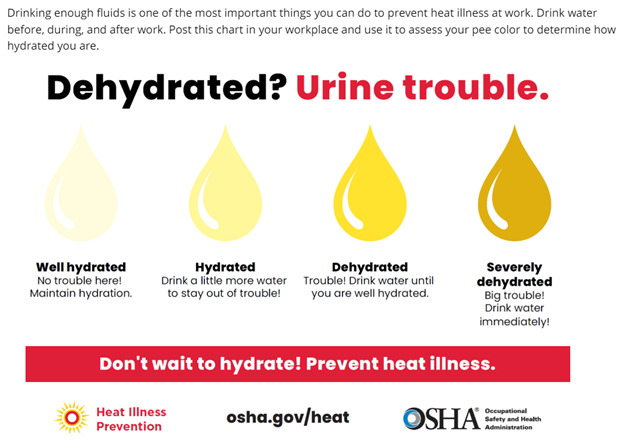
Staying hydrated starts before work then continues throughout the day and after work. Attention to personal hydration decreases the risk of heat illness and other risks associated with chronic dehydration, such as kidney stones. 

Infographic with different colored teardrops that indicate how urine color corresponds to personal hydration

Understanding Protectant Fungicides (FRAC groups M01 – M12) in 2024

Protectant (contact) fungicides, such as the inorganics (copper, FRAC group M01) and sulfur (FRAC code M02); the dithiocarbamates (mancozeb, M03), phthalimides (Captan, M04), and chloronitriles (chlorothalonil, M05) are fungicides which have a low chance for fungicide resistance to develop. Protectant fungicides typically offer broad spectrum control for many different pathogens.

Why wouldn’t fungi develop resistance to protectant fungicides? Protectant fungicides are used all the time, often in a weekly manner throughout much of the growing season.

[Read more…]