Archives for May 2020

Labor Will Be Hot Topic For 7:00PM Wednesday Night Webinar – “Ask the Ag Agent”

This week, the webinar will be concentrated on the topic of farm labor. Since updates are coming to the industry and we have learned of some programs for migrant workers please join us for discussion. Please feel free to bring up other topics.

Ask the Ag Agent – 7:00PM Weekly – Every Wednesday – Farmer Video Conference/Call-In ForumAsk the Ag agent

“Ask the Ag Agent” weekly 1-hour sessions for farmers will be hosted again on Wednesday May 13th and continue each Wednesday until May 27th. The online conferencing/call in events will begin at 7:00PM with an open forum to discuss ag-related questions about production, marketing, regulations and any other topics farmers wish to discuss. All are welcome. Events are hosted by William Bamka, Stephen Komar, Meredith Melendez and Michelle Infante-Casella – Agricultural Agents.

To access via WebEx on a computer go to https://go.rutgers.edu/rc9n3kxt

Or, Join by phone
+1-650-429-3300 USA Toll
Access code: 799 743 872

For additional Rutgers Cooperative Extension educational programs check out https://events.rutgers.edu/njaes/
NJ Statewide Wine Grape Twilight Meeting (online)

Please join the NJ Statewide Wine Grape Twilight Meeting on the Wed, May 20, 2020 4:20 pm using the below link. Also, please see below for the program details.

Meeting Host: Hemant Gohil

https://rutgers.webex.com/rutgers/j.php?MTID=mbdbb2eafedfe9d44f3694adeedf61269

Meeting number: 222 571 928:

Password: MJht93B8Pzx

Join by phone    +1-650-429-3300

Access code: 222 571 928 [Read more…]

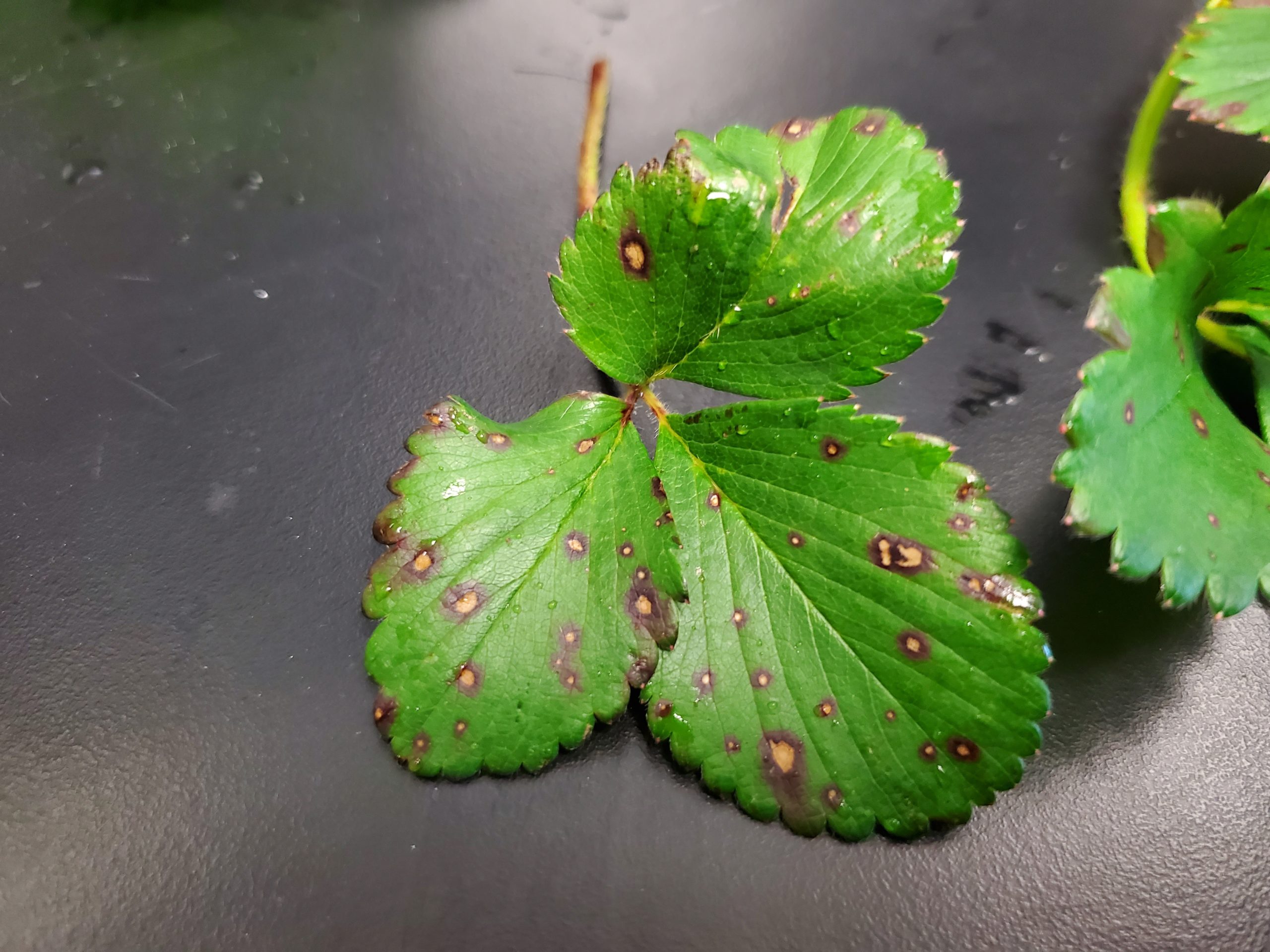
Vegetable Disease Update – 5/12/20

Early-Season Insect Pests of Cranberries

The following insect pests bear special mention for early-season scouting in cranberry bogs:

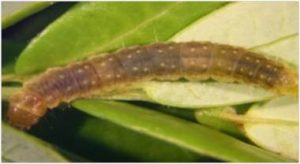
Blackheaded fireworm – Blackheaded fireworm eggs overwinter on the bed and usually hatch by around mid-May. It is important to catch the first generation, if possible, because the second generation occurs during bloom and is typically much more destructive. Blackheaded fireworm larvae can be detected by sweep net sampling and it is a good idea to look along the edges of beds where vines first begin to grow. Remember: blackheaded fireworm is much easier to control if detected during the early part of the season.

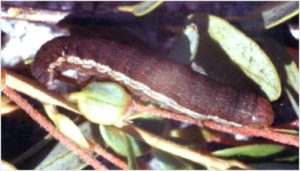
Spotted fireworm – This insect overwinters as a 2nd instar larva. They complete two generations a year. Larvae feed between uprights they have webbed together. First-generation larvae injure the foliage causing it to turn brown as if burned. In New Jersey, first generation adult moths emerge the first week of June, followed by a second-generation of adult emergence in early August. Eggs are laid in masses on weedy hosts. Larvae from second-generation adults emerge in mid-August, and may feed on fruit. Populations of spotted fireworm are regulated by their natural enemies, in particular Trichogramma wasps that parasitize the eggs.

Sparganothis fruitworm – This insect is a serious pest in most cranber

Blackheaded fireworm Larva

Blackheaded fireworm Larva (Photo by D. Schiffhauer)

ry-growing states. Sparganothis fruitworm completes two generations a year and overwinters as an early-instar larva. Larvae from the 1st generation feed on foliage. In New Jersey, first generation adult moths emerge from mid-June through the first weeks in July; pheromone traps are commonly used to monitor adult flight and population size. Second-generation eggs are laid on cranberry leaves, and larvae will feed on fruit.

Cranberry blossomworm – Adults lay their eggs in October in cranberry beds. The eggs overwinter and hatch over a period of several weeks. Early instars can be found during the first week of May. Larvae go through 6 instars to complete development.

Because the first instars feed during the day (and also at night), scouting can be done during the

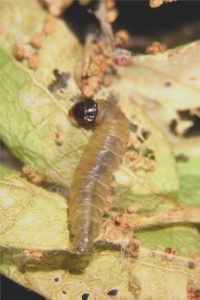
Spotted Fireworm Larva

Spotted Fireworm Larva

daytime using sweep nets to estimate larval abundance. Larvae turn nocturnal during the later instars. At this time, night sweeping (9 pm – 1 am) is recommended for sampling. Larvae complete their development by June-July. Older instars are very voracious and capable of destroying 100 blossoms within a 3-week period. There is a pre-pupal that lasts until the end of August and a pupal stage that lasts until October. Adults emerge from end of August to end of October.

Lepidopteran Pests Monitoring and

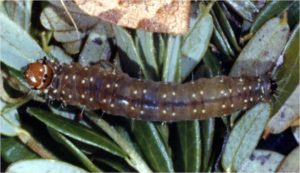
Sparganothis fruitworm Larva

Sparganothis fruitworm Larva (Photo by D. Schiffhauer

Control – Use sweep netting for monitoring early lepidopteran pests (pre-bloom). A sweep set consists of 25 sweeps and 1 sweep set is recommended per acre (this may vary depending the size of bogs). The action threshold for false armyworm, blossomworm, other cutworms, and gypsy moth (we use a combined threshold from adding all these caterpillars per sweep) is an average of 4.5 caterpillars in sets of 25 sweeps. For brown and green spanworms is an average of 18 per sweep set. The action threshold for blackheaded fireworm and Sparganothis fruitworm is an average of 1 to 2 per sweep set. We recommend the use of the reduced-risk materials Intrepid, Delegate, Altacor or Exirel if populations exceed action thresholds. Exirel is a newly-registered insecticide in cranberries. These are reduced-risk, softer insecticides that are very effective against lepidopteran pests. More information on these (and other) lepidopteran pests will be provided as the season progresses.

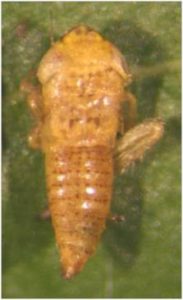
Leafhoppers –There is concern among New Jersey cranberry growers of a potential increase in leafhopper populations because of recent changes in pest management strategies (e.g., adoption of new reduced-risk products and decreased applications of broad-spectrum insecticides). Blunt-nosed leafhopper is of particular concern because

Cranberry blossomworm Larva

Cranberry blossomworm Larva

they can transmit cranberry false blossom disease. This leafhopper has one generation a year. Adults are found in highest numbers during July, although nymphs or adults may be found from the end of May until October. Eggs are laid in August-September. The eggs overwinter and hatch in May or June. The nymphs go through 5 instars to complete development.

Leafhopper Monitoring and Control: Leafhopper nymphs can be sampled using sweep nets (as described above for lepidopteran pests). Nymphs before bloom are small; thus, you may need to freeze the samples (to kill them), and then count the number of nymphs under a microscope or using a magnifying lens. There is no threshold based on sweep net counts, so decisions should be made based by comparing current numbers with prior infestation history and/or incidence of false blossom disease on those beds.
In cases of high numbers of blunt-nosed leafhopper nymphs, we recommend application of a broad-spectrum insecticide, such as Diazinon (no aerial applications allowed) or Lorsban (only pre-bloom applications allowed for Ocean Spray growers). Broad-

Blunt-nosed leafhopper Nymph

Blunt-nosed leafhopper Nymph (Photo by D. Schiffhauer)

spectrum insecticides will disrupt biological control particularly the natural enemies (predators and parasitoids) of Sparganothis fruitworm, so their use should be restricted only to areas of high leafhopper populations.

Frost Advisory in Effect Monday May 11 through Thursday May 14, 2020

Frost Advisory in Effect Monday May 11 through Thursday May 14, 2020.

A frost advisory is in effect for parts of Northern New Jersey for the nights of Monday May 11, Tuesday May 12, and Wednesday May 13 with temperatures at or below freezing predicted.  Please take appropriate measures to protect tree fruit, grapes, strawberries and other small fruit.

Below are resources for determining the critical temperatures for tree and small fruit.  Note that the critical temperature for damage at a particular bud stage may vary by 4 or 5⁰F depending on temperatures during the previous few days before the cold event.

Tree Fruit

Please note the PPA post from May 6, 2020 “Frost Protection in Orchards – What Should You Monitor?“

Note the critical temperature for some of the most common pome and stone fruit crops In New Jersey is available at:

https://www.canr.msu.edu/news/critical_spring_temperatures_for_tree_fruit_bud_stages.

Additional information on frost protection methods is available at:

https://njaes.rutgers.edu/peach/orchard/pdf/Frost-Protection-in-Orchards-Methods,-Updates-and-Costs.pdf


Small Fruit

Frost and Freeze Damage on Berry Crops

Kathy Demchak Senior Extension Associate Penn State University

Here is a review of critical temperatures for damage to berry crops, symptoms of the damage, and some key points regarding protecting plants.

Critical Temperatures for Blossoms

Damage to blossoms is the biggest concern; critical temperatures are those at which you can expect damage to occur. Air temperature close to the ground is often much colder (as much as 5°F) than the low temperature reached at the typical eye-level height where we usually post our thermometers, and if your field is in a low spot, may be even colder. We also need to factor in the fact that the blossoms radiate heat into the sky (called radiational cooling), much like your vehicle roof that may have frost on it on the mornings when the low temperature didn’t reach freezing. Of course, low temperatures in any out-of-town rural location are often quite a lot lower than those forecasts; some growers subscribe to services that forecast more accurately for their specific location.

Critical temperatures for strawberry blossoms

For strawberries, critical temperatures for flower buds are 10° when just emerging from the crown, 22° when blossoms are emerged but still tightly closed, 26° when closed but petals are visible (“popcorn” stage), and 30° when open. Young green fruit is actually better able to tolerate cold temperatures than open blossoms, having a critical temperature of 28°. Some recommend actually inserting a thermocouple into the flower buds to most accurately measure their temperatures. Just propping up a thermometer at the end of the row so it’s exposed to air on all sides and radiates heat like a blossom would have mirrored the temperatures at which we get damage quite well. Frost-damaged blossoms will have a black center.

Critical temperatures for blueberry

Blueberry blossoms can tolerate colder temperatures than strawberry blossoms. Different sources give somewhat different values for certain stages, so ranges are given here. Critical temperatures are 15-20° at bud swell; 18-23° when flower clusters are still tight; 22-25° when flowers buds in the cluster have separated; 25-26° when flowers are still closed but full-size; and 27° for open blossoms. The stage where the petals have just fallen off is actually the most tender, with a critical temperature of 28°. Petals will turn brown if damaged, and fruit tissue inside the blossom will have a water-soaked appearance.

Critical temperatures for raspberry blossoms

We never used to mention frost damage on raspberries as a possibility, since raspberries typically bloom so late that we are usually past danger of frost by the time they bloom. However, in two out of the past ten years, we had frost damage to open raspberry blossoms; this occurred when temperatures were barely below freezing, which makes me think that the critical temperature is in the 30-32° range. Frost damaged blossoms on raspberries turn black in their center, but this is a little less obvious than on strawberries because the anthers extend beyond the damaged portion.

Frost Protection Methods

For berry crops, frost protection methods consist of either applying water with overhead irrigation or using row covers, or a combination of the two. Other methods such as wind machines and under-canopy irrigation don’t typically provide enough protection for berries or can’t be used due to plant architecture.

Frost protection using overhead irrigation

The theory behind why overhead irrigation works for frost protection is that heat is released as the water freezes (144 BTUs per pound of water), so the blossom temperature stays at 32°. The water application rate must be sufficient to keep a layer of liquid water on the ice that is forming, and coverage must be fairly even. If water completely freezes before additional water is applied by the next sprinkler rotation, heat is no longer being released by the freezing process.

This means that blossom temperatures can drop to ambient air temperature instead of being kept at 32°. When coverage is uneven or it is windy (more than about 3 mph), the application pattern is uneven, and you have more heat loss from evaporation than usual, so you are likely to have more damage than if you had done nothing at all. Irrigation should be kept running in the morning until ice starts to melt from the plants.

Frost protection using overhead irrigation

The theory behind why overhead irrigation works for frost protection is that heat is released as the water freezes (144 BTUs per pound of water), so the blossom temperature stays at 32°. The water application rate must be sufficient to keep a layer of liquid water on the ice that is forming, and coverage must be fairly even. If water completely freezes before additional water is applied by the next sprinkler rotation, heat is no longer being released by the freezing process.

This means that blossom temperatures can drop to ambient air temperature instead of being kept at 32°. When coverage is uneven or it is windy (more than about 3 mph), the application pattern is uneven, and you have more heat loss from evaporation than usual, so you are likely to have more damage than if you had done nothing at all. Irrigation should be kept running in the morning until ice starts to melt from the plants.

Keep in mind that you will need to allow time for the irrigation system to fully wet the plants, and there will be evaporation from the water than will lower the plant temperature at first; for this reason, we generally recommend starting the irrigation when the air temperature is 4° above the critical temperature. Of course, if the low temperature is forecasted to occur very late in the overnight hours and is close to the critical temperature, you will need to judge whether it is worth starting irrigation up or not.

Frost protection using row covers

Row covers can be effective, but they work best on still nights and when you only need 3 or 4° of frost protection. A row cover that is fairly stiff so it doesn’t cling to the plants and ground and maintains some air space works best; clingy ones may not provide much protection. There is one particular 1.25 oz/sq. yd. fabric that works well. It is more expensive than others but has a long field life, so it can be used for multiple seasons and is less expensive in the long run.

Row covers should be pulled over the field during the afternoon to allow some heat buildup under the cover. If it is windy, protection will be less, and if winds are over 5 mph or so, you may not get any protection at all. If you have an old row cover, it can be applied as a second layer underneath the newer cover – this helps on very cold nights and also helps to some degree on windy nights.

Recently there have been some questions regarding whether anthracnose can survive on row covers. One study showed that spores can survive on fabric (in the study’s case, denim) for 5 weeks. However, typically row covers aren’t still being used when anthracnose lesions are present in PA, but if they are, this may be a concern.

Overhead irrigation – row cover combination

We have had very good results with pulling on row covers and then irrigating over top of them for frost protection. Depending on the night, this has resulted in needing no overhead irrigation at all or delaying the time that we needed to start the irrigation since the temperature under the row cover is higher than the outside temperature, and water use is greatly decreased. You’ll want to pull the row covers back off as soon as you can the next day though to allow the plants to dry, otherwise, it will likely get steamy under the row cover, increasing the possibility of disease issues.

Frost Damage to Vegetative Tissues

Vegetation on small fruit crops is quite hardy in the spring. New vigorously growing raspberry canes can get “nipped” however, sometimes seriously. I can think of two instances when this happened with ours. Once was about 20 years ago when we hit 16° in mid-April when the new canes were about a foot tall, and the second time was about in 2012 when raspberries in our high tunnels had grown to about a foot and then got nailed. Fortunately, these canes are replaced by new canes, so the damage wasn’t devastating for the long haul. The damage, if not noticed could be mistaken for some sort of disease, but the difference is that the plants grow vigorously otherwise, and the damage is all at the same location on the plants throughout the planting.


For more detailed information go to Appendix A of Mid Atlantic Berry Guide Guide

Using Growing Degree-day calculators, nursery pest and pathogen updates, important resource links

Announcements:

NJ Department of Agriculture Issues Burn Permit for Frost Protection –May 7 thru May 11

New Jersey Department of Agriculture has issued a notice concerning open burning due to colder spring overnight temperatures presently forecasted for areas of New Jersey from Thursday, May 7 through Monday, May 11, 2020, which could adversely affect fruit, vegetable, and floriculture crops in bloom or near bloom around the state. For more information: https://plant-pest-advisory.rutgers.edu/nj-department-of-agriculture-issues-burn-permit-for-frost-protection-thru-may-11/

Sourcing PPE for your workers:

If you need PPE for you and your workers, please do not wait to obtain more supplies! When our region re-opens to the masses there will be another wave of high-demand for masks and PPE. https://plant-pest-advisory.rutgers.edu/sourcing-personal-protective-equipment-ppe-for-your-farm-employees/

Recent financial Plant and Pest Advisory Posts:

US Small Business Admin Opens Economic Injury Disaster Loan (EIDL) Programs to Agriculture: https://plant-pest-advisory.rutgers.edu/us-small-business-admin-opens-economic-injury-disaster-loan-eidl-programs-to-agriculture/

SBA resumed accepting Paycheck Protection Program applications: https://plant-pest-advisory.rutgers.edu/sba-resumed-accepting-paycheck-protection-program-applications/


Utilizing Growing Degree-day calculators and resources:

(As of 5/7/20 using NEWA, Upper Deerfield = 213.5GDD50 ; Howell = 153.5 GDD50 ; Pequest = 88.0 GDD50) (GDD50 = Growing Degree-Day with min. temp. set to 50F)

Using Growing Degree Day models to plan pest management timing is a proven method for understanding when a pest or pathogen will rear its ugly head. These models utilize temperature min. and max. throughout the day to generate “growing degree day” units that accumulate throughout the year (typically starting on Jan. 1st, with a minimum temperature set to 50F (base-50)). Correlations between degree-day accumulation and vulnerable life stage events, such as egg hatch or adult emergence, allow pest management to be conducted, or scouted for, more efficiently. These models can track or predict insect, mite, weed, and plant pathogen lifecycles as well as those of beneficial insects, allowing us to protect that arm of Integrated Pest Management (IPM).

Within these models the user can set multiple parameters, allowing hyper-localized information for most of the country. Simple models are also available. The temperature min/max, can be manipulated for specific pests, however a minimum temperature of 50F (aka base-50) is most often cited in growing degree-day pest lists. These models are general in nature, as biology occurs over some span of time or set of conditions, and should therefor be ground-truthed at each location if at all possible. Many other types of pest or disease predictive models are available within the resources listed below, and the agents can help you understand what information you need for those calculations.

Note: The nursery agents are working to develop a local, Rutgers centralized, growing degree-day calculator that will provide information on key pests as well as nursery and greenhouse BMPs thereof. Armed with this information, we will be generating charts and other visual aids that target multiple pests per application, thus increasing labor efficiency.

Degree Day Calculators (select a local weather station within the website):

NEWA (Cornell): http://newa.cornell.edu/index.php?page=growing-degree-days

–        Very easy to use

Integrated Plant Protection Center (Oregon State): http://uspest.org/

–        More complicated but has many different modeling options

–        ***Boxwood blight specific risk model: https://uspest.org/risk/boxwood_app  , also available as an iOS or Android app ***

Typically the procedure is as follows: select a close by weather station, select degree-day calculator, select the min. temperature (50F or “base-50”), select max. temperature (arbitrarily high- 110F), click graph or calculate or get report, then locate the date(s) of interest on the computed table. The accumulated growing degree-days of those dates can then be compared to the target GDD50 on the pest lists below. *Tim Waller will help you set up a local degree-day calculation, or understand how to use this information if needed (twaller@njaes.rutgers.edu)

Pest lists with GDD50 targets:

Ohio State: http://cues.cfans.umn.edu/old/Web/049DegreeDays.pdf

University of California: http://ipm.ucanr.edu/MODELS/index.html

University of Maryland: https://extension.umd.edu/node/11155

University of New Hampshire: http://ccetompkins.org/resources/using-growing-degree-days-for-insect-management

*Some discrepancies between degree-day targets; go with what you have observed locally*


Pests and diseases to be on the lookout for:

(Upper Deerfield = 213.5GDD50 ; Howell = 153.5 GDD50 ; Pequest = 88.0 GDD50)

Pests: Looking towards our southern neighbor states, several pests are either currently present or will become evident in the near future including: Boxwood leafminer, Allium Leaf miner, Lilac borer, Ambrosia beetles (multiple species), Red-headed flea beetle, Hemlock woolly adelgid, Pine Bark adelgid, Roseslug sawflies, Spruce spider mites, Wooly elm aphids, Spirea aphid, Andromeda lace bug, Azalea lace bug, and Pine needle scale. The warm weather jump-started pest development only to be slowed by the current cool days and cooler nights, providing more wiggle room for protective or systemic pesticide applications. Utilize growing degree-day (GDD50) models to apply protectant applications as well as systemic soil drenches when applicable or allowable for pollinator protection.

Red-headed flea beetle larva will be hatching between 250-480 GDD50, with adults emerging between 500-1000 GDD50. A second generation of larva will then be active between 1,570 to 1860 GDD50, emerging later 1,878 to 2,318 GDD50. Brian Kunkel, entomologist at the University of Delaware, has determined that up to three, overlapping, generations can be present in container grown ornamentals. Ambrosia beetles, particularly Xylosandrus crassiusculus (granulate ambrosia beetle), and Xylosandrus germanus (black stem borer), should begin flights soon, or have already done so to some degree. These small beetles begin flight when temperatures hover around 60-70F and are attracted to alcohol produced by woody ornamentals in the spring. The cooler nighttime temperatures and daily averages have kept much of this activity low but scouting should be vigilant during this time. Another invasive pest, the Box tree moth, has been identified approaching the border of US and Canada. This pest has prompted APHIS importation amendments for Boxwood, Euonymus, and Illex. (https://content.govdelivery.com/accounts/USDAAPHIS/bulletins/27f467d)

Diseases: The current temperatures coupled with long wetness-periods, provide optimal pathogen conditions for diseases such as Botrytis, Sclerotinia sclerotiorum, Black spot on roses, multiple Needle cast diseases of conifers, root rots, and bacterial diseases. Once temperatures begin to increase again, pathogen numbers could explode. Efforts towards protectant applications are critical, especially in situations where plants are being held longer than previously anticipated due to COVID-19 related disruptions. Any steps geared towards increasing airflow, reducing wet-feet, and limiting mechanical injury during this wet and cool period will benefit disease management approaches. Please consult your agents for specific disease control recommendations.

Beach Leaf Disease, caused by an exotic nematode, is affecting beeches in the Great Lakes region  and into Pennsylvania. Little is known about the disease, other than the nematodes distort beech leaves by forming sunken lesions, which eventually turn the leaf yellow and drop off. Please contact your local agent if you suspect this disease to be anywhere in New Jersey (forest, farm, etc.). https://www.state.nj.us/dep/parksandforests/forest/docs/Pest_Alert-Beech_Leaf_Disease.pdf .USDA-ARS (more info on the nematode): https://tellus.ars.usda.gov/stories/articles/what-s-killing-beech-trees/

Please advise what pests/pathogens you are seeing in the field so we can be better informed on their management!


Online events and resources:

Ask the Agent (every Wednesday @ 7:00pm): https://go.rutgers.edu/t7wjkit1

A new online forum has been created where anyone can log-on and speak with Rutgers Cooperative Extension agents (multiple agents from multiple counties).

NJAES YouTube webpage: https://www.youtube.com/user/RutgersNJAES/

Our Rutgers Nursery Working group will be uploading many more instructional videos to the NJAES YouTube page in the near future. This webpage has numerous pest/pathogen/ID educational videos, especially from the Plant Diagnostics Lab here at Rutgers.

Tim Waller has posted an introduction video to the newly created “Commercial Nursery and Greenhouse Production” playlist https://youtu.be/RQbXmc5Uug8.

(Please email twaller@njaes.rutgers.edu or william.errickson@njaes.rutgers.edu with ideas for videos!)

 2020 Nursery Industry Survey: https://forms.gle/dUjLxaiu6qDQYYsRA

The new nursery agents have prepared a preliminary survey aimed at understanding the needs of our growers and clientele, i.e. you. Please take a moment to complete the survey, as this type of information really helps the agents secure grant funding to deal with the problems you actually have. Thank you! Please share with other growers that may not have access.

RU Sustainable Nursery Production website: https://njaes.rutgers.edu/nursery/

March meeting PDF: https://njaes.rutgers.edu/nursery/documents/2020%20SJ%20Nursery%20Meeting%20Proceedings.pdf


Thank you.

Contact information for the new nursery agents:

 Timothy J. Waller

County Agent
Specialty areas: Commercial nursery production, plant health, and phytopathology
   

Rutgers Cooperative Extension of Cumberland County
291 Morton Ave. Millville, NJ 08332
856-451-2800
twaller@njaes.rutgers.edu

Bill Errickson

County Agent
Specialty areas: Nursery and turfgrass production, agricultural innovation, and soil fertility

Rutgers Cooperative Extension of Monmouth Count
4000 Kozloski Rd., P.O. Box 5033. Freehold, NJ 07728
732-431-7260, ext. 7273
william.errickson@njaes.rutgers.edu