Greetings from the Veg IPM team! We hope everyone is staying cool in these extreme temperatures as we move into July. Read more for the latest pest and disease updates.
Sweet Corn
Pheromone traps for corn earworm (CEW) have been deployed throughout the state. If your corn is approaching silking, it’s time to start thinking about your spray program. Sprays should be initiated at 10% green silks, and continued in intervals as determined by your local CEW pheromone trap counts. Refer to the map below to see this week’s CEW pressure. In South Jersey, the pressure is quite high (3-4 day spray intervals), and North Jersey pressure is lower, but beginning to increase in pressure. Remember, when the average maximum temperature for the next 3 days is above 80 degrees, shorten the spray interval by one day. Rotation is important for avoiding resistance, and there are four IRAC groups that are registered in silking sweet corn: 1 (carbamates), 3 (pyrethroids), 5 (spinosyns), and 28 (diamides). Corn earworm is at least partly resistant to several pyrethroids, so a spray program should not rely solely on pyrethroids, although they can be useful in tank-mixes or as pre-mixed products, such as Besiege or Elevest (Group 28 + Group 3). For detailed information about resistance and potential spray programs, the University of Delaware has an excellent resource on corn earworm management.

Spray intervals based on nightly pheromone moth captures for the southern part of New Jersey. Note that not all locations in the IPM program are currently trapping. This map is based on the following thresholds: 0 moths = 6-7 day schedule, 1 moth = 5 day spray schedule, 2-20 moths = 4 day spray schedule, 20+ moths = 3 day spray schedule.
Caterpillar pests in the whorl and tassel stage. We found our first fall armyworm (FAW) this week in Atlantic County, so we recommend being on the lookout for FAW. Young larvae will cause damage known as “window paning”, in which the top surface of the leaf is eaten away, leaving behind thin, white, membranous-looking scratch marks (A). As the larvae get bigger, these feeding marks become more ragged (B). The damage can look somewhat similar to European corn borer feeding, but FAW damage will be more severe and will lead down into the whorl. The caterpillars have a dark head capsule with a distinct, inverted Y-shaped suture (C). They can also be identified by four dark dots arranged in a square on their last segments (D). We use a treatment threshold of 12% fresh feeding damage in pre-tassel corn. Below this level, treatments for FAW are unlikely to pay off and can flare up aphids. For treatment, we recommend using products other than diamides (IRAC Group 28) when treating whorl-stage infestations, as diamides are important to save for silk protection. Effective products include Lannate (Group 1A), Radiant (Group 5), Intrepid (Group 18), Intrepid Edge (5+18), and Avaunt (Group 22). Note that Avaunt can only be used through tassel push.
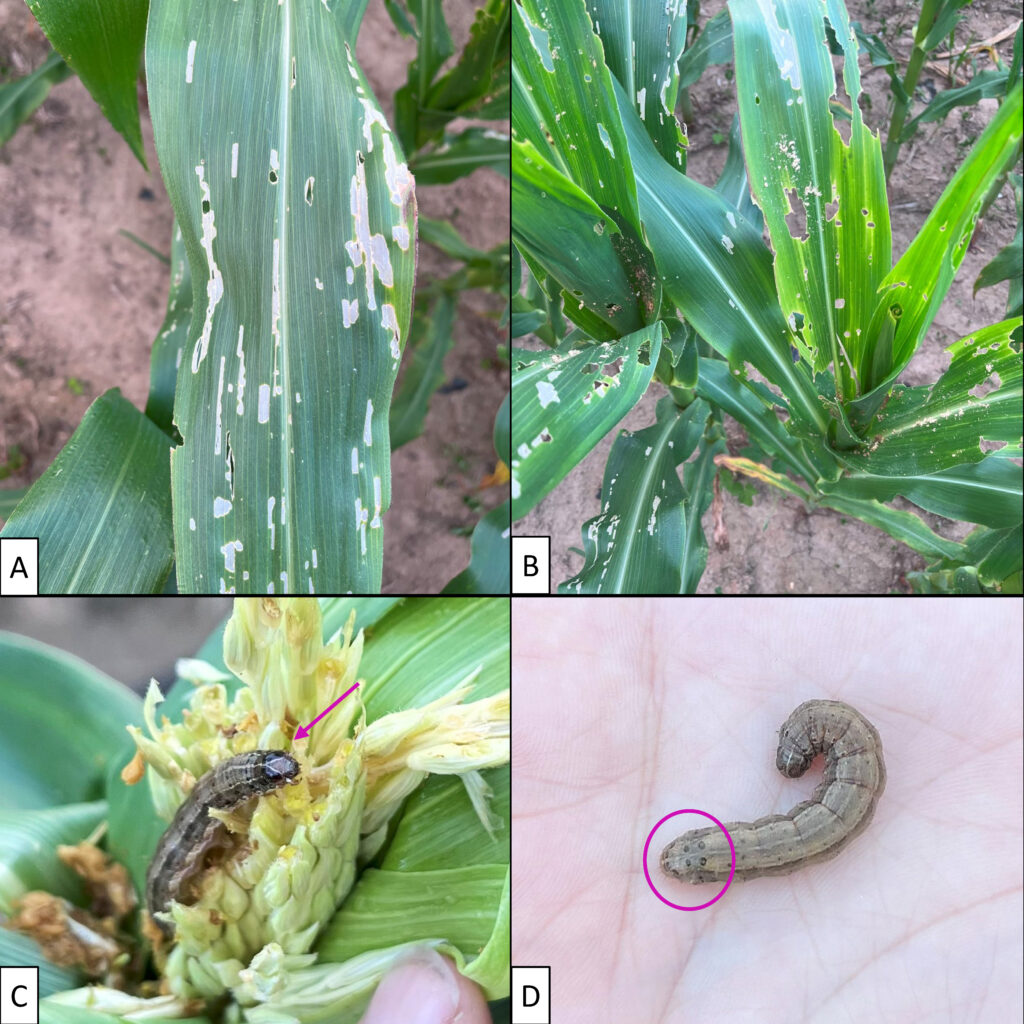
Fall armyworm identification: A) Windowpane damage, B) ragged holes, C) larva with inverted “Y” on head capsule, and D) larva with 4 dots arranged in a square. Pictures by Maria Cramer.
Tomatoes and Peppers
This week, our scout Cassandra Dougherty found a case of tomato spotted wilt virus (TSWV) in a pepper field in central NJ. We encourage everyone to stay vigilant when scouting for thrips and rogueing out infected plants.
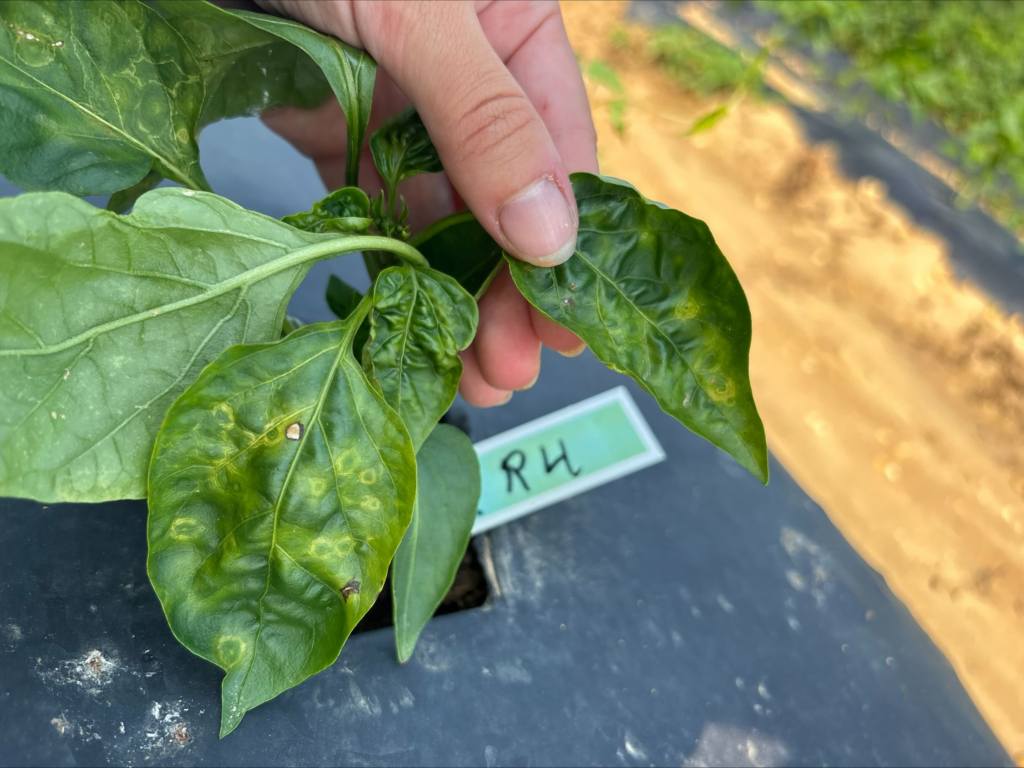
Tomato spotted wilt virus symptoms in pepper leaves. Photo by Cassandra Dougherty.
We also found our first pepper weevil in Southern NJ this week. See our alert for more details on identification and management.

Pepper weevil on pepper stem. Picture by Maria Cramer.
Thrips are the main pest of concern in tomatoes at the moment. In south Jersey, high thrips numbers are coming with outbreaks of TSWV in both susceptible and resistant tomato varieties. While there is no straightforward solution to thrips and TSWV, there are a number of actions that can help. First, scout plantings for plants with viral symptoms and remove them (see figure below for example of a plant with TSWV). This can prevent secondary spread in the field from infected to healthy plants. Often multiple plants will be affected and symptoms will appear over a couple of days or weeks, so keep checking the planting for plants that need to be rogued. If you need help identifying TSWV, please contact us with the form at the end of this post.
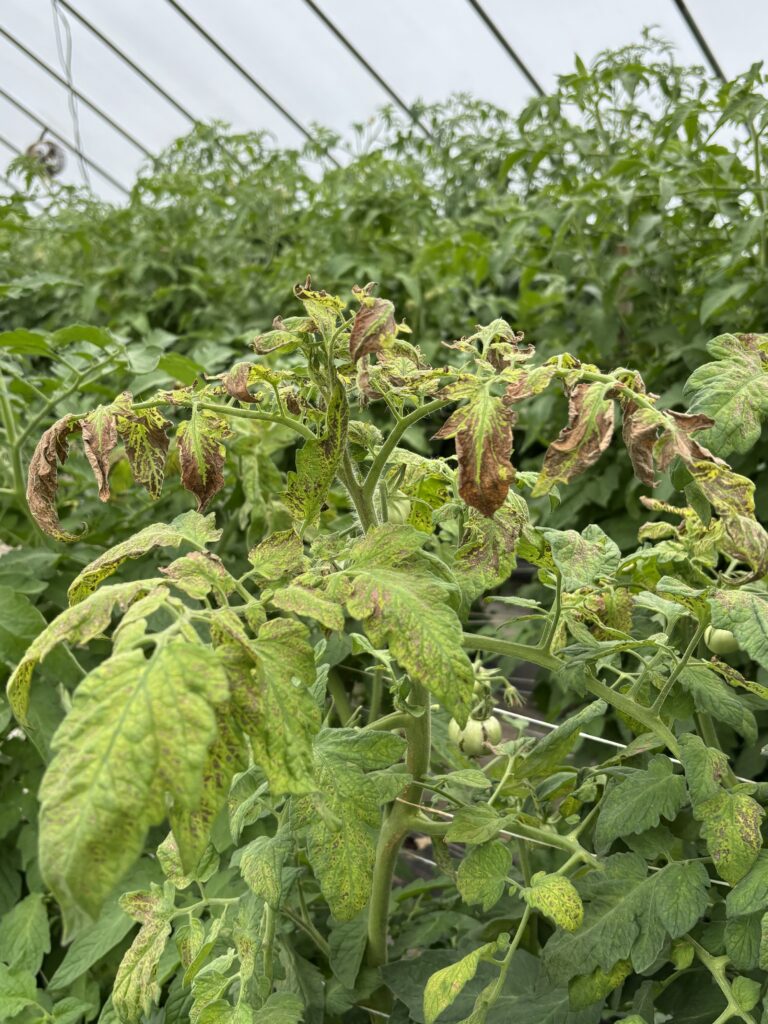
Tomato spotted wilt virus symptoms on a greenhouse tomato. Picture by Maria Cramer.
Second, scout plants for thrips. This is important even if you have already sprayed for thrips, because you need to know how well the spray worked. Unfortunately, there is no established treatment threshold for thrips, especially when TSWV is a risk, although one adult western flower thrips (the TSWV vector) per flower has been suggested. In the veg IPM program, we typically scout foliage for thrips, as these are most likely to be western flower thrips, but at this point most of the thrips we are finding are western flower thrips, so we advise monitoring both flowers and foliage to get a sense of thrips pressure in a planting.
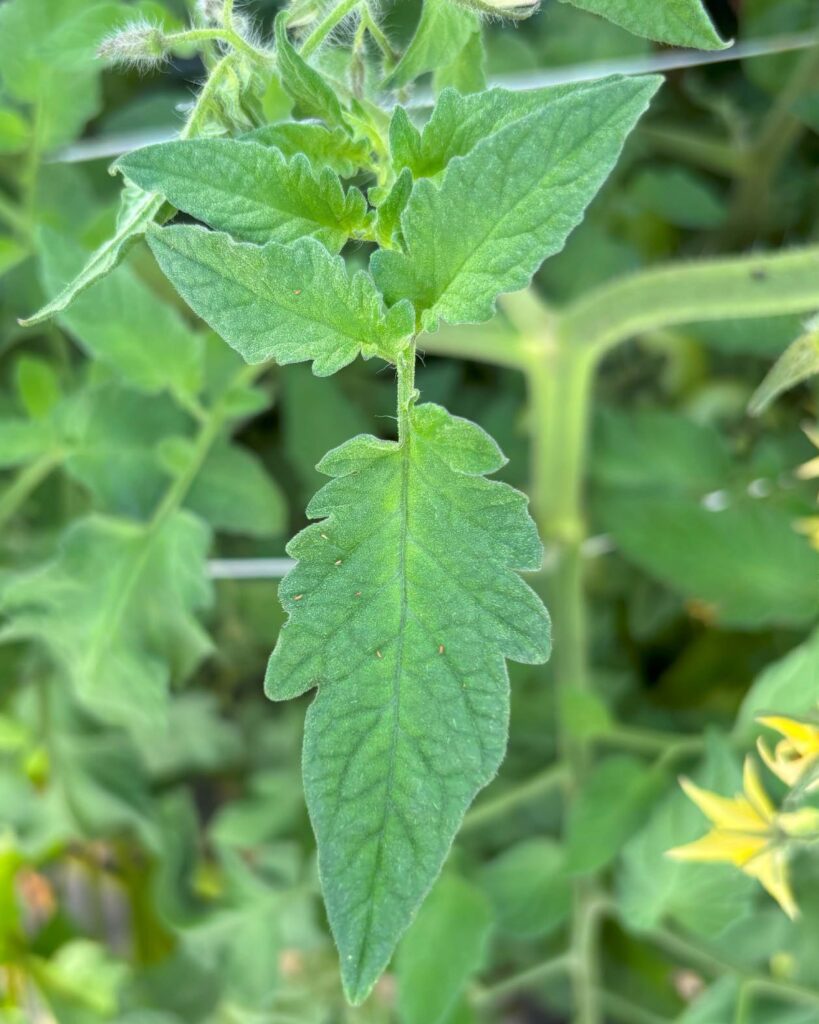
Thrips on a tomato leaf. Picture by Maria Cramer.
Managing thrips with insecticides is challenging because many populations of thrips have developed resistance to one of the best products for thrips (Radiant, IRAC 5). Because of this, we do not recommend using Radiant in south Jersey for thrips. The remaining products vary in efficacy and most are limited to two applications, which is key for avoiding insecticide resistance. In order to plan which products to use, consult our earlier article on thrips management which lists the IRAC group number, efficacy, and application limits for products. Note that pyrethroids (IRAC 3) are often labeled for thrips, but we do not recommend these due to resistance and their potential to flare up spider mites.
Pay attention to fertility: over-fertilized plants are more attractive to thrips.
Finally, separating late plantings as far as possible from early plantings that have thrips and/or TSWV can help slow movement of populations into those late plantings and keep them healthier.
We have seen elevated spider mite counts in some tunnel tomatoes and peppers. Otherwise, tomatoes and peppers have been relatively free of aphids, stinkbugs, and caterpillars. When sampling spider mites on tomatoes, check 10 upper leaflets in at least 5 sites per field. Typically, the treatment threshold is 2 mites per leaflet on average (one of the individual leaves that makes up the compound tomato leaf). Keep in mind that in 2025 we saw miticide resistance on farms where crop rotation was limited and the same miticides were used for multiple years — If you apply a miticide, check whether the application has decreased mite populations, and if it did not work well, do not keep using it. Rotate between miticides and only treat when above threshold. Some products for spider mites in tomatoes include:
- Nealta (group 25)
- Oberon (group 23)
- Portal (group 21A)
- Agri-Mek (group 6) *7 day PHI
- Kanemite (group 20B)
- Acramite (group 20D) *3 day PHI
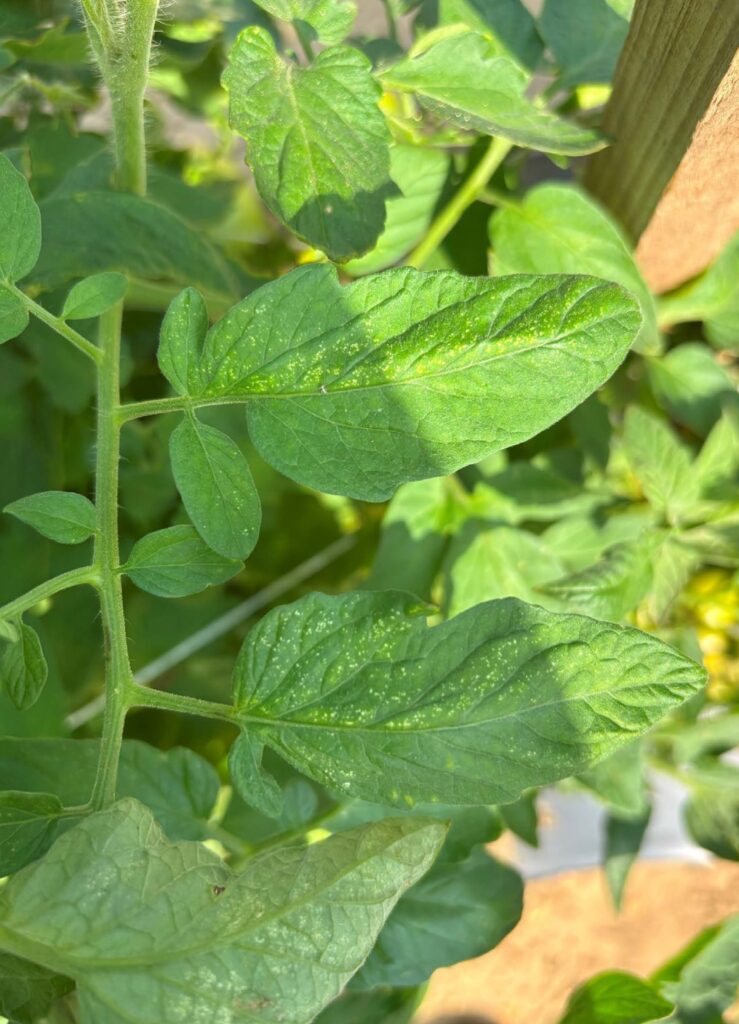
Spider mite stippling on the top of tomato leaves. If you turn the leaf over, you will often see spidermites on the lower surface. When spidermite infestations are large they may be on both surfaces of the leaves. Picture by Maria Cramer.
Cucurbits
We are beginning to see all stages of squash bugs in pumpkin plantings. Typically pumpkins that are beyond the seedling-4-leaf stage are not heavily impacted by squash bug feeding. However, if you are scouting your pumpkins and find that your plants have more than one egg mass or nymph cluster per plant on average, it may warrant treatment. Materials for squash bug treatment include Sivanto Prime (IRAC 4D), Cormoran (IRAC15+4A), Incipio (IRAC 30), and various neonicotinoids and pyrethroids. Treatments should target the nymphs, and coverage of the undersides of the leaves is essential.
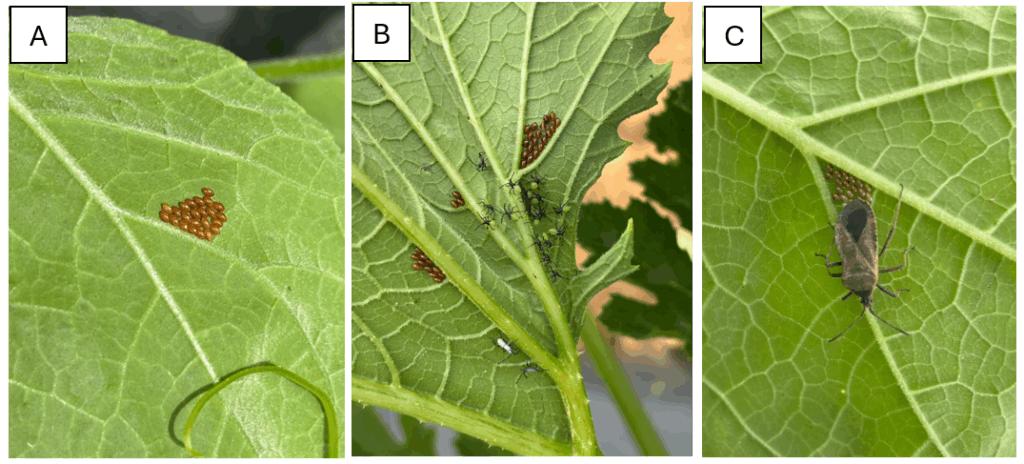
Squash bug eggs (A), newly hatched nymphs (B), and an adult (C). Photos by Amanda Quadrel
We have also been spotting sporadic squash vine borer (SVB) adults when scouting fields. SVB tends to be most destructive in smaller plantings, or in plantings with giant pumpkins. A female adult will lay eggs singly on the main stem right above the soil line. Once the larvae hatch, they bore into the main stem, which eventually results in plant death. To protect plantings against SVB, applying a product at vine-run can be helpful for protection. Materials approved for SVB control include acetamiprid (Assail, IRAC 4A), the combo product Cormoran (IRAC 15+4A), and various pyrethroids. If treating for other pests such as squash bugs and aphids, some products such as Incipio and Exirel can also provide SVB control.
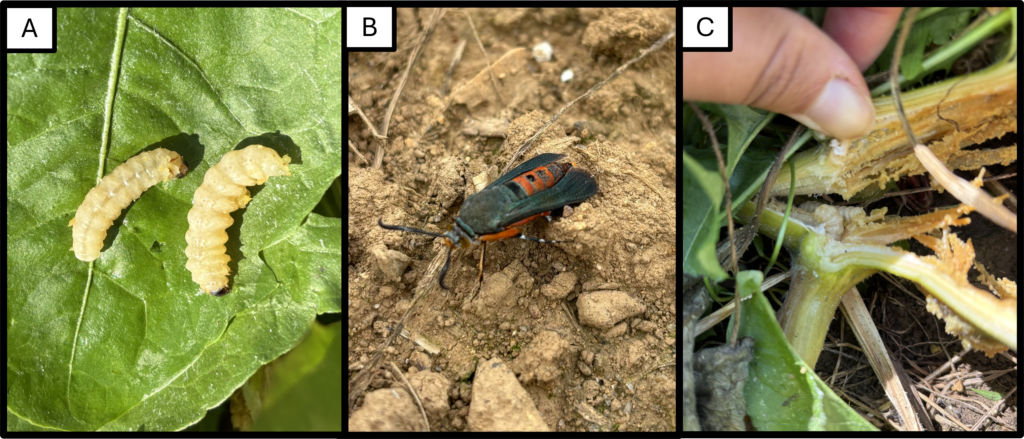
Squash vine borer larvae (A), adult (B), and damage (C). Pictures by Amanda Quadrel.
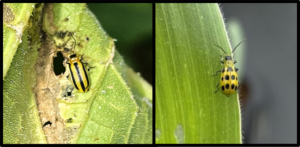
A striped (left) and spotted (right) cucumber beetle. Pictures by Amanda Quadrel and Maria Cramer.
Pumpkins in many places are still vulnerable to bacterial wilt, a disease that is vectored by cucumber beetles. Seedlings and young plants are particularly vulnerable to bacterial wilt, so it is crucial to manage cucumber beetle populations during this growth stage to limit the spread of the disease. Seeds that have been pre-treated with a neonicotinoid such as FarMore FI400 can provide protection against cucumber beetles and other early-season pests for about 2-3 weeks. For organic production, or if your seeds are not treated, you may wish to scout your seedlings for cucumber beetles. Choose 10 random sites, and at each site, look at 5 consecutive plants (50 plants total). If you have six or more sites with actively feeding cucumber beetles, you may want to consider treating. Once the vines begin to run, the plants are usually able to overcome the disease on their own and tolerate light feeding from the beetles. Cucumber beetles could potentially become a problem again for mature plants, as they can damage the rinds of the fruits. Materials for cucumber beetle management can be found in the Pumpkins and Winter Squash section of Mid-Atlantic Commercial Vegetable Production Guide.
We have our sentinel plots for Cucurbit Downy Mildew (CDM) planted at the Snyder Farm in Pittstown and RAREC in Bridgeton. These plots contains two varieties of cucumber (a susceptible and resistant variety), watermelons, cantaloupe, and various types of winter squash. As of this week, we still haven’t detected CDM. According to the IPMPipe website for CDM, the latest sighting of the disease was found in Georgia on cantaloupe and cucumbers on June 25th. If we detect CDM, either in our sentinel plots or elsewhere in the state, we will send out an alert immediately, but the IPMPipe site can be used to see the most recent sightings of the disease throughout the country.
As a reminder, the new 2026/2027 Mid-Atlantic Commercial Vegetable Production Guide is now available for free online (click here) or as spiral-bound hard copies that can be purchased at your local county extension office. Consult this guide for a more comprehensive list of materials that are labeled for specific crops and pests.
We want to give a huge thanks to our scouting team for keeping an eye on things for us throughout the season!
North NJ: Connor Colonese, Shayne Miller, and Cassandra Dougherty
South NJ: Alex White, Renee Carter, and Peter Combs
Authors: Amanda Quadrel (Northern NJ Veg IPM coordinator) and Maria Cramer (Southern NJ Veg IPM coordinator)
Questions or comments? Contact us below:



