Potato | Tomato Disease Forecast 5-26-17

Click to View | Download Report 5-26-17

Potato Disease Forecasting Report

We will be tracking DSVs for Late blight development and calculating P-days for initiating the first early blight fungicide application.

The first late blight fungicide application is recommended once 18 DSVs accumulate from green row. Green row typically occurs around the first week in May in southern NJ. An early season application of a protectant fungicide such as mancozeb (Dithane, Manzate, Penncozeb) or Bravo (chlorothalonil) as soon as the field is accessible is suggested. Please be vigilant and keep a lookout for suspect late blight infections on young plants. No late blight has been reported in our region to date.

Remember the threshold for P-days is 300!  Once 300 P-days is reached for your location, early blight fungicide applications should be initiated. Growers who are interested in using this model should choose the location above that is closest in proximity to their farming operation and should regularly check the Cornell NEWA website (http://newa.cornell.edu) where this information is compiled from. Click on Pests Forecasts from the menu, select your weather station, and click on tomato diseases, set accumulation start date, and a table of daily and total DSVs will be generated.

Tomato Disease Forecasting Report

Disease severity values (DSVs) for early blight, septoria leaf spot, and tomato anthracnose development are determined daily based on leaf wetness (due to rainfall, dew) and air temperature.

On a daily basis DSV values can range from 0 to 4 where 0 = no chance for disease development to 4 = high chance for disease development. DSVs are accumulated during the production season.

Fungicide applications are based on an individually determined DSV threshold. The first fungicide application for the control of these three diseases is not warranted until 35 DSVs have accumulated from your transplanting date. After that, growers can base fungicide applications on different DSV thresholds.

Reports generated by Ryan Tirrell

Rutgers, The State University of New Jersey
Potato | Tomato Disease Forecast 5-23-17

Click to View | Download Report 5-23-17

Potato Disease Forecasting Report

We will be tracking DSVs for Late blight development and calculating P-days for initiating the first early blight fungicide application.

The first late blight fungicide application is recommended once 18 DSVs accumulate from green row. Green row typically occurs around the first week in May in southern NJ. An early season application of a protectant fungicide such as mancozeb (Dithane, Manzate, Penncozeb) or Bravo (chlorothalonil) as soon as the field is accessible is suggested. Please be vigilant and keep a lookout for suspect late blight infections on young plants. No late blight has been reported in our region to date.

Remember the threshold for P-days is 300!  Once 300 P-days is reached for your location, early blight fungicide applications should be initiated. Growers who are interested in using this model should choose the location above that is closest in proximity to their farming operation and should regularly check the Cornell NEWA website (http://newa.cornell.edu) where this information is compiled from. Click on Pests Forecasts from the menu, select your weather station, and click on tomato diseases, set accumulation start date, and a table of daily and total DSVs will be generated.

Tomato Disease Forecasting Report

Disease severity values (DSVs) for early blight, septoria leaf spot, and tomato anthracnose development are determined daily based on leaf wetness (due to rainfall, dew) and air temperature.

On a daily basis DSV values can range from 0 to 4 where 0 = no chance for disease development to 4 = high chance for disease development. DSVs are accumulated during the production season.

Fungicide applications are based on an individually determined DSV threshold. The first fungicide application for the control of these three diseases is not warranted until 35 DSVs have accumulated from your transplanting date. After that, growers can base fungicide applications on different DSV thresholds.

Reports generated by Ryan Tirrell

Rutgers, The State University of New Jersey

Potato | Tomato Disease Forecast 5-19-17

Click to View | Download Report 5-19-17

Potato Disease Forecasting Report

We will be tracking DSVs for Late blight development and calculating P-days for initiating the first early blight fungicide application.

The first late blight fungicide application is recommended once 18 DSVs accumulate from green row. Green row typically occurs around the first week in May in southern NJ. An early season application of a protectant fungicide such as mancozeb (Dithane, Manzate, Penncozeb) or Bravo (chlorothalonil) as soon as the field is accessible is suggested. Please be vigilant and keep a lookout for suspect late blight infections on young plants. No late blight has been reported in our region to date.

Remember the threshold for P-days is 300!  Once 300 P-days is reached for your location, early blight fungicide applications should be initiated. Growers who are interested in using this model should choose the location above that is closest in proximity to their farming operation and should regularly check the Cornell NEWA website (http://newa.cornell.edu) where this information is compiled from. Click on Pests Forecasts from the menu, select your weather station, and click on tomato diseases, set accumulation start date, and a table of daily and total DSVs will be generated.

Tomato Disease Forecasting Report

Disease severity values (DSVs) for early blight, septoria leaf spot, and tomato anthracnose development are determined daily based on leaf wetness (due to rainfall, dew) and air temperature.

On a daily basis DSV values can range from 0 to 4 where 0 = no chance for disease development to 4 = high chance for disease development. DSVs are accumulated during the production season.

Fungicide applications are based on an individually determined DSV threshold. The first fungicide application for the control of these three diseases is not warranted until 35 DSVs have accumulated from your transplanting date. After that, growers can base fungicide applications on different DSV thresholds.

Reports generated by Ryan Tirrell

Rutgers, The State University of New Jersey

Potato | Tomato Disease Forecast 5-16-17

Click to View | Download Report 5-16-17

Potato Disease Forecasting Report

We will be tracking DSVs for Late blight development and calculating P-days for initiating the first early blight fungicide application.

The first late blight fungicide application is recommended once 18 DSVs accumulate from green row. Green row typically occurs around the first week in May in southern NJ. An early season application of a protectant fungicide such as mancozeb (Dithane, Manzate, Penncozeb) or Bravo (chlorothalonil) as soon as the field is accessible is suggested. Please be vigilant and keep a lookout for suspect late blight infections on young plants. No late blight has been reported in our region to date.

Remember the threshold for P-days is 300!  Once 300 P-days is reached for your location, early blight fungicide applications should be initiated. Growers who are interested in using this model should choose the location above that is closest in proximity to their farming operation and should regularly check the Cornell NEWA website (http://newa.cornell.edu) where this information is compiled from. Click on Pests Forecasts from the menu, select your weather station, and click on tomato diseases, set accumulation start date, and a table of daily and total DSVs will be generated.

Tomato Disease Forecasting Report

Disease severity values (DSVs) for early blight, septoria leaf spot, and tomato anthracnose development are determined daily based on leaf wetness (due to rainfall, dew) and air temperature.

On a daily basis DSV values can range from 0 to 4 where 0 = no chance for disease development to 4 = high chance for disease development. DSVs are accumulated during the production season.

Fungicide applications are based on an individually determined DSV threshold. The first fungicide application for the control of these three diseases is not warranted until 35 DSVs have accumulated from your transplanting date. After that, growers can base fungicide applications on different DSV thresholds.

Reports generated by Ryan Tirrell

Rutgers, The State University of New Jersey

UMaine to Hold International Potato Disease Summit Nov. 9, 2017

Orono, Maine — Two bacteria threatening the potato industry worldwide will be the focus of a Potato Disease Summit Nov. 9 in Bangor, Maine, convened by the University of Maine.

Plant pathologists, researchers and scientists from The Netherlands, Scotland and five U.S. states will present the latest information on the bacteria — Dickeya and Pectobacterium — that cause blackleg disease, an emerging potato seed problem.

In the past three growing seasons, Dickeya, a bacterial pathogen of potatoes, has caused significant economic losses in seed nonemergence and crop loss nationwide. In addition, an associated pathogen, Pectobacterium, has caused potato crop losses in the field and in storage. The bacteria have caused losses to the potato industry in Europe for an even longer period.

“The University of Maine is responding to this situation by holding an international summit focused on the latest research and what steps are needed to help the potato industry,” says University of Maine President Susan J. Hunter. “As Maine’s only public research university, we are a longstanding partner with the state’s potato industry in addressing its needs, including the growing threat posed by Dickeya and Pectobacterium.”

 The Potato Disease Summit, 8 a.m.–5 p.m., Nov. 9 at the Cross Insurance Center, 515 Main St., Bangor, Maine, is designed for scientists, consultants, regulatory officials, and potato seed growers and buyers. It will focus on such topics as current advances in detection and diagnosis of Dickeya; an overview of Pectobacterium in the U.S.; and management of Enterobacteriaceae spread and risk.

The $80 per person fee includes materials, lunch and breaks. Registration deadline is Oct. 2 and is available online: extension.umaine.edu/agriculture/programs/dickeya-and-pectobacterium-summit.

For more information or to request a disability accommodation, contact Steve Johnson, 207.554.4373, stevenj@maine.edu.

Update on Use of Chateau for Weed Control in Potato

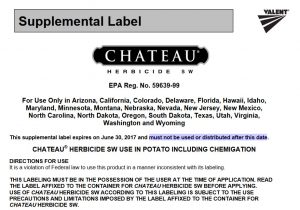
Chateau herbicide has a supplemental label for application to potatoes after hilling for preemergence suppression of various broadleaf weed species. This supplemental label will expire on June 30, 2017 and Chateau must not be used on potato after this date.

This supplemental label will not be renewed by Valent as the company is in the process of putting this supplemental label on the federal label. However, this use for potatoes will show up on the revised federal label when it reissues from the EPA.

We currently do not have a time frame for that but it probably will not before June 30. We are expecting that the revised federal label will be issued prior to the use season next year.