Impacts of Pesticides on Soil Health – Part II?

Disinformation, misinformation, bad science, bad reporting… the public is becoming more aware that one of the toughest challenges faced these days is sorting out what is good reporting (and good science), versus what is misleading or untruthful. It seems ironic that after my post yesterday, the following article showed up in my inbox this morning – Perspective: This pesticide ‘research’ is short on data, big on hype .

In this post, the author, farmer-agronomist Jack DeWitt, critiques a commentary in Scientific American magazine that promotes a ‘study’ conducted by the same authors of the commentary, who happen to be the director and research assistant at the non-profit Center for Biological Diversity, an organization with a stated agenda. Their ‘analysis’ published online in Frontiers in Environmental Science appears to be a legitimate review of previous scientific studies concerning the effects of ‘pesticides’ on soil organisms, again the current often-cited gauge of “soil health”, though in this case they focused only on soil invertebrates (worms and insects, basically) and ignored fungi and bacteria.

Standard scientific journal formats require ‘materials and methods’ sections so that one can read how a study was conducted and determine if the results are analyzed and conclusions drawn appropriately from the data and how that was collected. If properly reviewed in the pre-publication stage, poorly conducted studies and/or inappropriate conclusions would be cause for rejection of the manuscript, or at least would require a significant revision and/or further explanation of how the data supports the conclusions. Scientists reading articles with such flaws scratch their heads in wonder how they were published, and in very rare cases, if there is enough negative reaction citing improper methodology, analysis and/or conclusions, an article is recanted after publication. In this case, going back to the original scientific review, DeWitt illustrates how carefully selected data are misinterpreted and/or misrepresented to support the authors’ cause, er … conclusions.

Moral of the story… don’t take scientific reporting as gospel, even from respected media outlets, until you consider the source, the funding, and take a careful look at the original article, if it’s available.

Washington State University Summary ‘Comparing Effects of Herbicides, Fertilizers, and Tillage on the Soil’

Sometimes (many times) following social media (SM) threads can lead down some interesting rabbit holes. With a lot of news, research, and programming these days focusing on soil health and ‘regenerative agriculture’ (which focuses on soil health impacts on climate – read more here and here), the following article from Washington State University’s Center for Sustaining Agriculture and Natural Resources (CSANR) caught my eye when it popped up in my Twitter feed. In this post, Irrigated Cropping Systems Agronomist Andrew McGuire reviews the scientific literature for the latest (although the post is actually 3 years old now) analyses of impacts of pesticides, especially herbicides compared to tillage, and fertilizers on microbiological activity, organic matter, and soil structure, i.e. soil health. It may be surprising to find the science doesn’t support the ‘chemicals kill the soil’ narrative being portrayed these days.

Comparing effects of herbicides, fertilizers, and tillage on the soil

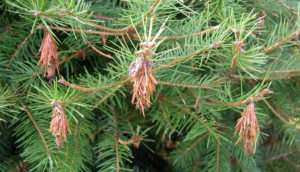
It is time to put Bagworms on your radar in Southern NJ

Bagworms

Photo: Rich Buckley

Bagworms should begin hatching in the next 2-6 weeks throughout NJ, starting in the southern regions. Now is an optimal time to get this pest on your radar and prepare materials or approaches to attack first/second instar caterpillars. The control window for this pest is typically between 600-900 GDD50 (growing degree-days) and treatments should be in use prior to their mobile, airborne, “ballooning” phase. Check that the eggs have hatched prior to application of pesticides – as most compounds will not be effective at all if the first instar caterpillars are not present. Lethal pesticide doses are important, as sub-lethal doses can trigger early pupation, making the pest all but invincible to chemical or biological treatments.


Bagworm management – mechanical: If eggs have not hatched: hand-remove sacs/bags. Typically female/egg filled sacs are higher in the canopy so keep that in mind while scouting.

Treatment options for Lepidoptera (caterpillars) to have at the ready – containing: B.t. (Bacillus thuringiensis)(Dipel), spinosad (Entrust SC), bifenthrin (Talstar, UP-Star), cyfluthrin (Decathlon 20WP), carbaryl (Sevin SL), chlorantraniliprole (Acelepryn), cyclaniliprole (Sarisa), cyclaniliprole + flonicamid  (Pradia), Lambda-cyhalothrin (Scimitar GC), cyantraniliprole (Mainspring), Indoxacarb(Provaunt)

IT IS CRITICAL TO ROTATE AS MUCH AS POSSIBLE BETWEEN IRAC GROUPS DUE TO THE NUMBER OF POTENTIAL APPLICATIONS

DISCLAIMER: The label is the law, always refer to it for allowable host crops, use-restrictions, application rates, reapplication intervals, re-entry intervals (REI), and mix compatibility information. Production and pesticide information on this site are for private/commercial pesticide applicators and landscape professionals only, and are NOT for home gardener use. Provided materials represent examples and do not cover all possible control scenarios. Trade-names listed do not imply endorsement and are used as examples only. Please contact your local agent or chemical sales representative for more information or to discuss additional pest management options.

More information on Bagworms:

Steve Rettke’s 2020 PPA Post – Bagworm caterpillars have hatched throughout most of NJ

RU Bagworm FactSheet 

Bagworms on Ornamental Landscape Plants


Photo Credits: Rich Buckley (Plant Diagnostics Laboratory) https://njaes.rutgers.edu/plant-diagnostic-lab/