While visiting some grass hay fields across the state I have encountered several fields where cutting height was too low. While we all want to get the maximum yield possible from our fields, cutting too low can have negative impacts. Disk mowers allow the crop to be cut very close to the ground, in some cases almost cut to the ground level. While older haybines or sickle bar mowers require some stubble height to remain. Many may not realize that cutting height has an impact on forage stand longevity. Cutting too low reduces the energy reserves of the crop vital to regrowth for the next cutting. The energy reserves of grasses are stored above ground in the base of the stem and tillers, Continual cutting of grass hay close to ground level will result in depletion of energy reserves which in turn reduces stand longevity. So, the question most often asked is how low can I cut my grass hay while maintaining stand longevity? For our cool season grasses such as orchard grass and timothy we manage the cutting height different for establishment and production years. For the establishment year it is recommended to maintain a cutting height of 4 inches. During the following production years, a minimum cutting height of 3 inches is recommended. These heights are the minimum recommendations; it is certainly acceptable to cut higher. Cutting too much top growth in grasses removes growing points and reduces the amount of leaf exposed to the sun. This can result in slow regrowth, which indirectly results in a shortening of the growing season for the crop and reduced yield potential. Another benefit of cutting higher is reducing competition from weeds. Weakened or stressed grass results in reduced stand density which provides an opportunity for weeds to establish.
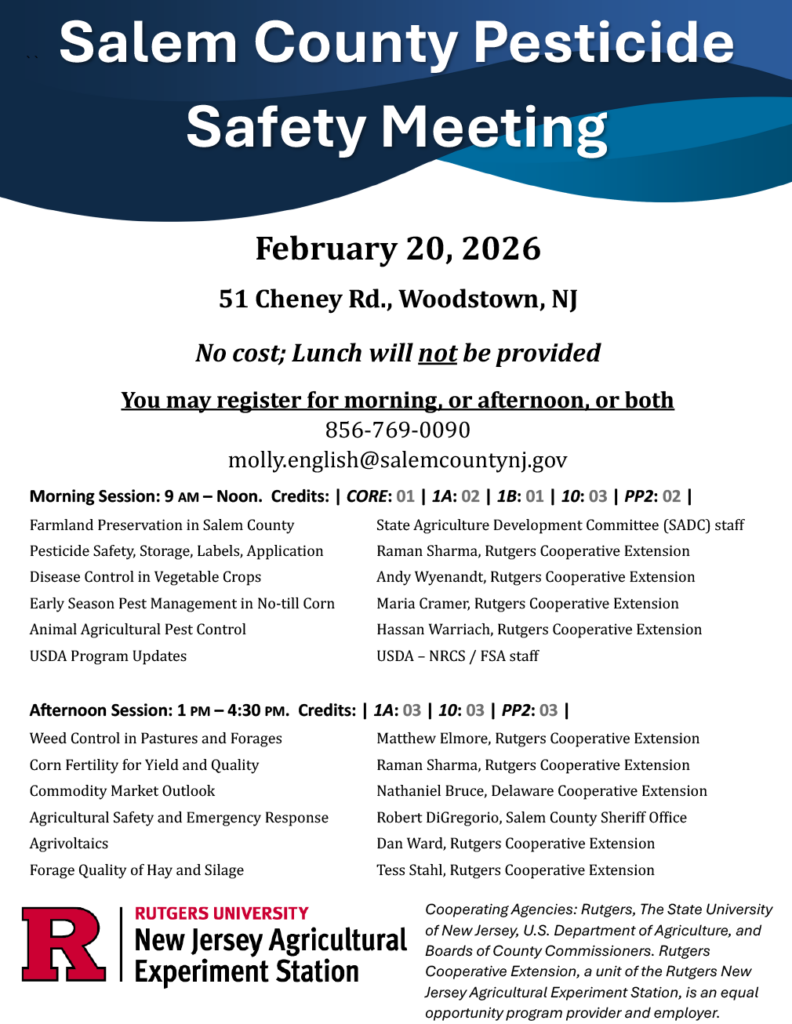
Salem County Pesticide Safety Meeting – Pesticide Credits Available – February 20, 2026 – Woodstown
Salem County Pesticide Safety Meeting
February 20, 2026
51 Cheney Rd., Woodstown, NJ
To register for morning, afternoon, or both
856-769-0090
molly.english@salemcountynj.gov
| Morning Session: 9 am – Noon. Credits: | CORE: 01 | 1A: 02 | 1B: 01 | 10: 03 | PP2: 02 | | |
| Farmland Preservation in Salem County | State Agriculture Development Committee (SADC) staff |
| Pesticide Safety, Storage, Labels, Application | Raman Sharma, Rutgers Cooperative Extension |
| Disease Control in Vegetable Crops | Andy Wyenandt, Rutgers Cooperative Extension |
| Early Season Pest Management in No-till Corn | Maria Cramer, Rutgers Cooperative Extension |
| Animal Agricultural Pest Control | Hassan Warriach, Rutgers Cooperative Extension |
| USDA Program Updates | USDA – NRCS / FSA staff |
| Afternoon Session: 1 pm – 4:30 pm. Credits: | 1A: 03 | 10: 03 | PP2: 03 | | |
| Weed Control in Pastures and Forages | Matthew Elmore, Rutgers Cooperative Extension |
| Corn Fertility for Yield and Quality | Raman Sharma, Rutgers Cooperative Extension |
| Commodity Market Outlook | Nathaniel Bruce, Delaware Cooperative Extension |
| Agricultural Safety and Emergency Response | Robert DiGregorio, Salem County Sheriff Office |
| Agrivoltaics | Dan Ward, Rutgers Cooperative Extension |
| Forage Quality of Hay and Silage | Tess Stahl, Rutgers Cooperative Extension |
RCE Animal Ag, Field and Forage Working Group Webinar Recordings
In case you missed one of the RCE Animal Ag, Field and Forage Working Group Webinars this past year, here are the recorded video links to access them in the future.
Basic Pasture Management: https://go.rutgers.edu/sz36rbvt
- Assessing Pastures
- Soil Sampling and Yields Expected
- Basic Pasture Management and Fertility
Horse Pasture Management: https://go.rutgers.edu/239mnwb5
- Stretching Your Hay using Pasture
- Importance of Pasture for Horse Nutrition
Livestock Pasture Management: https://go.rutgers.edu/uepljvmj
- Forage Quality
- Nutrition
- Grazing Systems
Pasture Renovation: https://go.rutgers.edu/qn74rjj5
- Update on COVID-19 Resources for Equine Farmers
- Pasture Renovation
- No-Till Drills and Renovation
Pasture Management: https://go.rutgers.edu/mw0l8wd1
- Weed Identification and Control
- Manure Management with Pastured Animals
- NRCS Programs for Pasture Management
Manure Management: https://go.rutgers.edu/19bim643
- Using a Stress Lot to Maximize Pasture Utilization
- Incorporating Fertility in a Manure Management Plan
- Pasture Fertility
Selecting Hay for Horses and Other Livestock Session 1: https://go.rutgers.edu/q9teoewg
- Current Hay Market Quantity & Quality
- Testing Your Hay for Nutrient Quality
Selecting Hay for Horses and Other Livestock Session 2: https://go.rutgers.edu/bfsqi1zv
- What Hay is Best for Horses
- Winter Feeding for Ruminants
