Fruit IPM Updates Week of 4/13/2026

Tree Fruit Phenology Update

Tree fruit development resumed rapidly across New Jersey this past week following earlier frost events, with warm temperatures accelerating phenology. While some frost damage may be present in advanced blocks—particularly in southern counties—overall development is progressing quickly and bloom is widespread. A freeze event is expected overnight Monday 4/20 into Tuesday, and temperatures will gradually moderate through the remainder of the week.

In apples, early varieties such as ‘Pink Lady’ are now at full bloom in southern counties, with most other varieties progressing through pink to early bloom across central and northern regions. Bloom is becoming more widespread statewide.

In pears, most varieties are beginning petal fall in southern counties. Asian pears remain slightly more advanced.

Peach and nectarine varieties are close to 100% petal fall in southern counties, with early varieties beginning shuck split. In northern counties, most varieties are at bloom, with some earlier varieties reaching petal fall.

Apples
Apple Phenology Update

Apple phenology continues to progress across New Jersey, with development advancing rapidly under recent warm temperatures. Observations indicate that most varieties statewide are at pink bud, while early varieties in southern counties, such as Pink Lady, have entered bloom.

This stage marks a critical transition in disease management, particularly for fire blight, apple scab, powdery mildew, and cedar apple rust, while also representing an important period for early-season insect management and monitoring.

Phenology Dates by County (earliest varieties)

County Green Tip Tight Cluster Pink Bud Bloom
Cumberland 3/22 3/28 4/3 4/8
Gloucester 3/22 3/28 4/3 4/8
Burlington 3/22 3/28 4/2 4/13
Mercer 3/22 3/28 4/2 4/13
Middlesex 3/22 4/1 4/4 4/14
Monmouth 3/22 4/1 4/4 4/14
Hunterdon 3/22 4/1 4/10 4/17
Morris 3/26 4/4 4/11 4/17
Warren 3/30 4/4 4/13 4/17
Sussex 3/31 4/10 4/14 TBD
Bergen 3/22 4/1 4/4 4/14

Apple Scab
Models

Apple scab infection risk continues to increase as we move through bloom. Models available through NEWA and RIMpro. indicate that ascospore maturity is progressing rapidly, and we are entering a critical period for primary infection.

While conditions have been relatively dry over the past several days, upcoming weather patterns may result in infection events. Growers should continue to monitor forecasts closely and maintain fungicide coverage, particularly during bloom when susceptibility is high.

Current Update using the Upper Deerfield Station
  • ~58% ascospore maturity as of April 15–17
  • ~28% cumulative ascospore discharge to date
  • Forecasted to reach ~65–75% maturity by April 18–21
  • Cumulative ascospore discharge forecasted to increase to ~57–58% by April 19–20
Management Considerations

Fungicide applications should be maintained through bloom, prior to predicted infection events.

Programs should prioritize control of fire blight, apple scab, powdery mildew, and cedar apple rust, especially in blocks at full bloom or entering petal fall.

Recommended Programs

  • Protectant + single-site tank mix:
    • Mancozeb + single-site fungicide (use reduced rate when tank mixing)
  • FRAC 3 (DMI fungicides):
    • Rally, Indar, Inspire Super, Topguard, Cevya
    • Provide strong activity on scab, powdery mildew, and cedar apple rust
  • FRAC 7 fungicides:
    • Fontelis, Miravis, Sercadis
    • Effective for scab and mildew, but limited rust activity
    • Reserve Aprovia for summer bitter rot programs (max 4 applications)
  • FRAC 9 or FRAC 1 fungicides:
    • Vangard, Scala, Topsin
    • Useful for scab, but do not control cedar apple rust
  • Rotation of Kasugamycin, Streptomycin and Oxytetratracycline for fire blight
    • Kasumin is only labeled for bloom and petal fall applications
    • Streptomycin and oxytetracycline are labeled for post bloom use (note that Fireline 45 only allows for 1 postbloom application on apple).
    • The addition of Actigard, Apogee/Kudos, or other plant defense elicitors may improve control.

Monitor:

  • NEWA models
  • Weather/wetting events
  • Phenology
Insect Update

Early control is critical to avoiding season-long pressure.

Ambrosia Beetle

  • Significant flight activity has been observed across New Jersey, with high trap captures reported in multiple counties.
  • Activity is increasing in all regions.
  • Continue monitoring activity closely, particularly in stressed, declining, or newly planted blocks, which remain most susceptible.
  • Growers should remain alert, as peak flight activity typically coincides with warm temperatures during bloom.

Mating Disruption Timing

  • Codling moth (CM) mating disruption should be deployed by bloom (pink–early bloom timing is ideal).
  • Most counties are now at bloom, and applications should be completed immediately if not already done.
Key Reminders
  • Apply on a 3–7 day interval during bloom, tightening ahead of rain
  • Powdery mildew can develop under dry conditions
  • Do not tank mix Captan with oil due to phytotoxicity risk
  • Rotate FRAC groups and preserve FRAC 11 fungicides for summer use

Pears
Pear Phenology Update

Pear development has progressed rapidly across New Jersey, with warm temperatures accelerating bloom.

Most European pear varieties are now early-petal-fall in southern counties.

Asian pear varieties remain slightly more advanced, with many blocks in southern counties moving through late bloom into early petal fall, and northern plantings at full bloom to late bloom.

Pear Psylla

Pear psylla activity continues to be variable across southern New Jersey, though pressure remains generally low to moderate in most orchards. Earlier oil applications, particularly where combined with materials such as Esteem, have likely helped suppress early populations.

  • Gloucester County: None observed
  • Salem County: Adults observed
  • Burlington County: No activity observed to date
  • Mercer County: No activity observed to date

As orchards move through petal fall, psylla populations are expected to increase with continued warm temperatures.

At Petal Fall:

  • Continue monitoring for adults, eggs, and early nymph hatch
  • Use beating trays to assess adult activity
  • Examine developing shoots and leaf undersides for eggs and emerging nymphs

Management Considerations:

  • Insecticide applications can resume at petal fall, targeting early nymph stages
  • Timing is critical—applications shortly after egg hatch provide the most effective control
  • Prioritize blocks with historically high pressure or current egg presence

Recommended Petal Fall Options:

  • Movento – excellent systemic control of psylla, scale, and aphids (use with a spreading-penetrating adjuvant to improve efficacy)
  • Also effective options at petal fall: Actara, Assail, Belay, Centaur, Sivanto Prime, and Agri-mek

Management should focus on targeting newly hatched nymphs, as this stage is the most susceptible and critical for preventing population buildup.

Pear Diseases
Fire Blight and Early Season Management

As pear orchards move through petal fall, the primary bloom infection period is wrapping up; however, fire blight risk remains elevated under warm conditions. Bacteria can still spread to young tissues, particularly during periods of rain, wind, or rapid growth.

At Petal Fall and Post-Bloom:

  • Continue to monitor forecasts using NEWA for any late infection or trauma blight risk
  • Discontinue streptomycin use after petal fall (not labeled beyond this stage)
  • Kasumin may be used up to petal fall, but should not be applied afterward
  • Focus on protecting actively growing shoots, especially during warm, wet, or stormy conditions

Management Considerations:

  • Watch for trauma events (hail, wind, heavy rain), which can trigger infections
  • Maintain awareness in blocks with a history of fire blight
  • Be prepared to transition to post-bloom management strategies if conditions remain favorable
Pear Scab

RIMpro modeling continues to indicate that ascospore availability remains high, and infection risk persists during wetting events. As trees move beyond bloom, maintaining coverage remains critical to prevent primary infections.

At Petal Fall:

  • Maintain protective fungicide coverage, especially ahead of rainfall
  • Apply prior to wetting events, as infections occur during leaf wetness periods
  • If ≥2 inches of rainfall occurs after an application, consider reapplication to maintain coverage

Recommended Options:

  • Protectants: Mancozeb, Ziram, Ferbam
  • Resistance-risk materials: Procure, Cevya, Flint, Merivon, Luna Sensation, Inspire Super, Vangard (tank mix with protectant)
Summary
  • Most pear varieties across southern New Jersey are now at petal fall, with some blocks moving into early post-bloom stages; northern counties remain at full bloom to late bloom.
  • Asian pear varieties remain slightly more advanced, with many blocks at petal fall.
  • Pear psylla pressure remains low to moderate, likely due in part to prior oil applications, particularly where combined with Esteem.
  • Insecticide applications can resume at petal fall, with a focus on targeting early nymph hatch.
  • Growers should continue scouting for adults, eggs, and newly hatched nymphs to guide post-bloom management decisions.
  • Recent and forecasted wetting events continue to support pear scab infection risk, and fungicide coverage should be maintained.
  • Fire blight risk remains elevated, particularly under warm conditions; monitor for trauma events and late infection risk.
  • Continued scouting and close monitoring of weather conditions and tree growth will be critical over the next 7–10 days as post-bloom disease and insect pressure develop.

Peaches
Peach Phenology
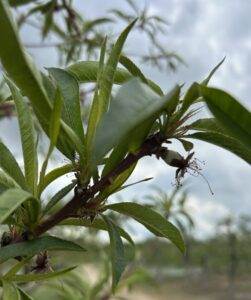
  • Peach at shuck split in Gloucester County, NJ.

    Figure 1. Peach at shuck split in Gloucester County, NJ.

    Peach and nectarine development has progressed rapidly across New Jersey, with warm temperatures accelerating bloom and early fruit set.

  • Most varieties in southern counties are now at petal fall to early shuck split (Figure 1), while northern counties are at full bloom, with some earlier varieties at petal fall.
  • Development is expected to continue advancing quickly under continued warm conditions, with southern blocks moving further into early fruit development stages over the next week.


Brown Rot

Blossom blight risk declines as orchards move through petal fall; however, infections can still occur on remaining blossoms and young fruitlets under favorable conditions.

Infection is favored during wetting periods between 41–86°F, with optimal conditions in the mid-70s, and risk remains elevated during extended wet periods. Fruitlets remain susceptible until shuck split, when natural resistance begins to increase.

Management Considerations

  • Maintain fungicide coverage through petal fall and into early cover, especially ahead of rainfall
  • Focus on protecting young fruitlets, particularly in blocks with a history of brown rot
  • If prolonged wetting occurred during bloom, ensure continued protection post-bloom
  • Rotate fungicide chemistries to reduce resistance risk

Recommended Petal Fall / Early Cover Materials

  • Effective options:
    • Indar, Inspire Super, Luna Sensation, Merivon, Pristine, Cevya, Flint Extra
  • Additional options:
    • Rovral (prior to petal fall timing only)
    • Captan (useful in cover sprays)

Notes:

  • Many of the most effective materials (FRAC 7, 11, 3) also play key roles in pre-harvest brown rot control—plan rotations accordingly
  • Avoid over-reliance on any single FRAC group
  • Abound and Quadris Top are highly effective, but are phytotoxic to apples—do not use if the same sprayer is used across crops

Petal Fall / Early Cover Considerations: 

  • Peach scab:
    • Apply Flint Extra or Abound at petal fall for anti-sporulant activity in high-pressure blocks
  • Bacterial spot:
    • Begin protection at petal fall in susceptible blocks using copper or Mycoshield, especially under warm, wet conditions
  • Rusty spot:
    • Programs should begin at petal fall, with Rally commonly used as the first application
Insect Update

Oriental Fruit Moth (OFM)

OFM traps are active across southern New Jersey, with biofix set for April 7 in South NJ and April 15 for most counties in North NJ.

Degree-day accumulation should be tracked from this date to properly time first-generation management. The first insecticides for first generation Oriental Fruit Moth control should be applied at 170-200 degree days (base 45 deg F) after biofix. This timing generally coincides with petal fall in peaches. Do not apply insecticides until all bloom is off regardless of degree day timing. No Insecticides for OFM should be needed where Mating Disruption is implemented.

As blocks move through petal fall, growers should begin preparing for first cover applications targeting OFM larvae. Timings can be calculated using the degree day calculator at the NEWA website by choosing the weather station nearest your farm, entering the biofix date as the start date, and choosing base 45 in the “degree day type” menu.

Keep in mind that plum curculio is also active at petal fall so an insecticide that targets both pests should be selected.

OFM 1st Generation Timing
  Insecticide Type
County/Region Degree Days

by 4/19 base 45

Conventional

170-200, 350-375

Diamide

100-150, 300-350

Gloucester – Southern 178 1st –4/18-4/23

2nd

1st –past

2nd

Middlesex – Northern 101 1st –4/27-4/29

2nd

 1st – 4/19-4/25

2nd

Scale

  • Delayed dormant oil applications are complete for most orchards.
  • Continue monitoring historically infested blocks and plan for crawler management later in the season if populations persist.

Green Peach Aphid

  • GPA colonies begin forming sometime during bloom. Examine trees for the presence of colonies from pink to shuck split.
  • Continue scouting as terminals expand and colonies begin to establish.
  • Count the number of colonies on ten trees and use a treatment threshold:
    • Nectarines: 1 colony per tree
    • Peaches: 2–3 colonies per tree

Petal Fall Considerations

Insecticide applications can resume at petal fall

  • Target key pests including:
    • OFM (timed by degree-days from biofix)
    • Plum curculio
    • Tarnished plant bug and other catfacing isnects
    • Green peach aphid

Early applications should focus on preventing the establishment of first-generation pests, particularly in blocks with a history of pressure

Recommended Petal Fall Options

  • OFM / Leafrollers:
    • Altacor, Delegate, Besiege, Voliam Flexi
  • Plum Curculio / Catfacing Insects:
    • Imidan, Avaunt, Actara, pyrethroids (e.g., Warrior II, Lambda-Cy)
  • Green Peach Aphid:
    • Assail, Actara, Admire Pro
Summary
  • Most peach and nectarine varieties in southern New Jersey are now at petal fall to early shuck split, while northern counties are at full bloom.
  • Development has progressed rapidly under recent warm temperatures and will continue advancing quickly with favorable weather.
  • Brown rot risk remains present, particularly during wetting events, with young fruitlets susceptible through shuck split.
  • Maintain fungicide coverage through petal fall and into early cover, especially ahead of rainfall.
  • OFM biofix was set for 4/7 for southern counties and 4/15 for northern counties, and growers should continue tracking degree-day accumulation to time first-generation management.
  • Insecticide applications can resume at petal fall, targeting key pests including OFM, plum curculio, and green peach aphid.
  • Delayed dormant oil timing has passed; focus should shift to in-season insect monitoring and management.
  • Continue scouting for green peach aphid, with treatment thresholds of 1 colony/tree in nectarines and 2–3 colonies/tree in peaches.
  • Continued scouting and timely applications will be critical over the next 7–10 days as crop development and pest pressure increase.

Fruit IPM Updates Week of 4/06/2026

Tree Fruit Phenology Update

While tree fruit phenology seemed to advance rapidly late last month into early April across New Jersey, temperatures dropped below freezing overnight early in the week, slowing development and prompting frost warnings, negatively impacting advanced crops and cultivars in bloom. Warmer temperatures are forecast for the weekend and into next week, resuming and accelerating rapid development. It is also important to note that NJ remains under a NJ Department of Environmental Protection Drought Warning, and the entire state is currently in a moderate drought or abnormal dryness according to the US Drought Monitor.

In apples, most varieties have reached pink bud across the state, with early varieties such as Pink Lady now entering bloom in southern counties. In pears, most varieties are at bloom statewide, with Asian pears remaining slightly more advanced. Peach and nectarine varieties have reached full bloom in southern counties and pink in most northern counties, with some early varieties in southern counties beginning to enter petal fall. 

Apples
Apple Phenology Update

Apple phenology continues to progress across New Jersey, with development advancing rapidly under recent warm temperatures. Observations indicate that most varieties statewide are at pink bud, while early varieties in southern counties, such as Pink Lady, have entered bloom. 

This stage marks a critical transition in disease management, particularly for apple scab, powdery mildew, and cedar apple rust, while also representing an important period for early-season insect management and monitoring. 

Phenology Dates by County (earliest varieties)

County Green Tip Tight Cluster Pink Bud Bloom
Cumberland 3/22 3/28 4/3 4/8
Gloucester 3/22 3/28 4/3 4/8
Burlington 3/22 3/28 4/2 TBD
Mercer 3/22 3/28 4/2 TBD
Middlesex 3/22 4/1 4/4 TBD
Monmouth 3/22 TBD 4/4 TBD
Hunterdon 3/22 TBD TBD TBD
Morris 3/26 TBD TBD TBD
Warren 3/30 TBD TBD TBD
Sussex 3/31 TBD TBD TBD
Bergen 3/22 4/1 TBD TBD
Figure 1. Pink Lady apple variety in Gloucester County entering bloom on 04/06/2026. Photo by Katrina DeWitt.

Figure 1. Pink Lady apple variety in Gloucester County entering bloom on 04/06/2026. Photo by Katrina DeWitt.

Apple Scab
Models

Apple scab models are available through NEWA and RIMpro. Current models indicate that ascospore maturity is increasing rapidly, with infection risk expected to rise significantly as we move through bloom. While no major infection events are currently forecast for the next several days, growers should continue to monitor the weather closely and maintain fungicide coverage

Current Update using the Upper Deerfield Station
  • ~40% maturity on April 8  
  • ~42% maturity on April 9  
  • ~28% cumulative ascospore discharge to date 
  • Forecasted to reach ~48–59% by April 10–15 
Management Considerations

As apples progress from pink through bloom, maintaining fungicide coverage is critical, as ascospore maturity and discharge increase rapidly during this period. Growers should select fungicides that protect against apple scab, powdery mildew, and cedar apple rust, particularly in susceptible varieties and southern counties where bloom is underway. 

Keep in mind that powdery mildew favors warm, dry conditions and does not require rainfall for infection, while cedar apple rust management becomes increasingly important from pink through bloom.  

Recommended fungicide programs include: 

  • Mancozeb + single-site fungicide tank mix (use half-rate mancozeb when tank mixing with resistance-risk fungicides)  
  • FRAC 3 fungicides (DMI), including Rally, Procure, Indar, Inspire Super, Topguard, or Cevya for strong activity against scab, powdery mildew, and cedar apple rust  
  • FRAC 7 fungicides, including Fontelis, Miravis, or Sercadis for scab and mildew control, though these provide limited/no cedar apple rust activity  (Aprovia should be saved for bitter rot management later in the season since it is limited to 4 applications per season)
  • FRAC 9 fungicides, including Vangard or Scala for scab suppression, though ineffective on cedar apple rust   
  • FRAC 1 fungicides, including Topsin, though ineffective on cedar apple rust

Important Notes: 

  • Mancozeb remains highly effective for apple scab and cedar apple rust but does not control powdery mildew.  
  • Avoid combining Captan with oil products due to the risk of phytotoxicity.  
  • Consider saving some FRAC 11 materials for summer disease programs to assist with resistance management. 

Monitor:

  • NEWA models
  • Weather/wetting events
  • Phenology

Early control is critical to avoiding season-long pressure.

Insect Update

Ambrosia Beetle:

  • The first flight of the ambrosia beetle has been detected in southern New Jersey.  
  • There has been minimal activity observed further north at this time. 
  • Continue monitoring traps closely, particularly in stressed, declining, or newly planted blocks, as beetle activity is expected to increase with continued warming temperatures. 

Mating Disruption Timing:

  • Codling moth (CM) mating disruption should be applied around pink. 
  • Growers should begin preparing materials and planning applications now. 
Summary
  • Apple phenology continues to progress rapidly across New Jersey, with most varieties at tight cluster to pink bud and early southern varieties entering bloom.  
  • This stage marks a critical period for disease management, particularly for apple scab, powdery mildew, and cedar apple rust, as well as key insect monitoring timings.  
  • Apple scab ascospore maturity has increased to approximately 40–42% and is forecasted to reach 48–59% over the next week, increasing overall infection risk as bloom progresses.  
  • No major infection events are currently forecast, but growers should continue to monitor the weather closely and maintain fungicide coverage ahead of rain events.  
  • Fungicide programs should target apple scab, powdery mildew, and cedar apple rust, with materials selected based on orchard phenology and disease pressure.  
  • Southern counties entering bloom should maintain cedar apple rust protection and continue scouting for early-season insect activity.  

Pears
Pear Phenology Update

Pear phenology has advanced rapidly across southern New Jersey over the past week. Observations indicate that most European pear varieties are now in full bloom, with orchards progressing quickly under recent warm temperatures. 

Asian pear varieties remain slightly more advanced, with most blocks also at full bloom or moving toward late bloom in the earliest plantings. 

Figure 2. Bloom. Asian pear variety phenology. Gloucester County, NJ. Photo by Katrina DeWitt.

Figure 2. Bloom. Asian pear variety phenology. Gloucester County, NJ. Photo by Katrina DeWitt.

Pear Psylla

Pear psylla activity has remained variable across southern New Jersey. Observations from April 7 indicate differences by county: 

  • Gloucester County: None observed  
  • Burlington County: No activity observed to date  
  • Mercer County: No activity observed to date  

Overall pressure remains relatively low in many orchards. This is likely due, in part, to recent oil applications, particularly where oil was combined with materials such as Esteem, which can suppress egg laying and early population development. 

At this stage (full bloom): 

  • Continue monitoring for adults, eggs, and the onset of nymph hatch  
  • Use beating trays to assess adult activity  
  • Examine developing shoots and leaves for egg presence 

Management considerations:

  • Do not apply insecticides during bloom due to pollinator protection restrictions.  
  • Continue scouting to monitor psylla population development and identify blocks where pressure may increase rapidly.  
  • Prepare for petal fall applications targeting early nymph hatch, as this timing is critical for effective suppression. 

Recommended post-bloom / petal fall options include: 

  • Movento – excellent activity on pear psylla and aphids  
  • Agri-Mek / Gladiator / Minecto Pro – strong knockdown where higher pressure exists  
  • Delegate / Danitol / Warrior II / Lambda-Cy – additional options where adult populations remain elevated  
  • Centaur / Sivanto Prime – softer alternatives for moderate pressure situations  

Management should focus on targeting newly hatched nymphs shortly after petal fall, when control is most effective. 

Pear Diseases
Fire Blight and Early Season Management

With pear orchards now in full bloom across southern New Jersey, fire blight risk is increasing significantly. Forecasted warm temperatures for next week, combined with moisture, create favorable conditions for bacterial multiplication, spread, and blossom infection. 

During bloom:

  • Monitor weather closely and use forecasting models, such as NEWA, to track infection periods.  
  • Apply bactericides when the first blossoms open, and repeat every 3–7 days during bloom as needed, based on weather/infection risk.  
  • Streptomycin (Agri-Mycin/FireWall/Streptrol) remains a primary option for blossom blight protection.  
  • Kasumin may also be used through petal fall.  
  • Oxytetracycline products (Mycoshield/FireLine) may be rotated to manage resistance.  
  • Rotate chemistries, when possible, to reduce resistance development. 
Pear Scab

RIMpro modeling for pear scab in Upper Deerfield indicates that infection risk has increased, with multiple infection periods observed in recent days and additional ascospores still available. Current modeling suggests that the inoculum remains available and that conditions continue to favor infection during wetting events. 

At bloom:

  • Maintain protective fungicide coverage throughout bloom, especially ahead of forecasted rainfall.  
  • Effective protectant options include Mancozeb, Ziram, or Ferbam.  
  • Effective resistance-risk materials include Procure, Cevya, Flint, Merivon, Luna Sensation, Inspire Super, or Vangard (tank-mixed only).  
  • Applications should be made prior to rainfall/wetting periods, as infections occur during wet conditions.  
  • If 2 inches or more of rainfall occurs following an application, consider a follow-up spray to maintain coverage.  

Additional Considerations:

  • Continue programs targeting pear scab, Fabraea leaf spot, and powdery mildew during bloom.  
  • Asian pear blocks may require particularly close attention, as they often progress slightly ahead of European pears and may be more susceptible during bloom. 
Summary
  • Most pear varieties across southern New Jersey are now at full bloom, with Asian pears generally slightly more advanced.   
  • Reduced pressure in some blocks is likely due to prior oil applications, particularly where oil was combined with Esteem.  
  • No insecticide applications should be made during bloom to protect pollinators.  
  • Growers should continue scouting for adults, eggs, and early nymph hatch to prepare for post-bloom management decisions.  
  • Recent rainfall and wetting events have increased disease pressure, particularly for pear scab and fire blight.  
  • Protective fungicide programs should be maintained throughout bloom, with reapplication considered following 2 inches or more of rainfall.  
  • Fire blight risk is increasing significantly during bloom, and growers should be prepared to apply antibiotics during infection periods if favorable conditions persist.  
  • Continued scouting and close monitoring of weather conditions will be critical over the next 7–10 days as bloom progresses and disease/insect pressure increases. 

Peaches
Peach Phenology

Peach and nectarine phenology have advanced rapidly across New Jersey over the past week. Most peach and nectarine varieties in southern counties are now in full bloom while northern counties are at pink, with some early varieties in southern New Jersey beginning to enter petal fall. Development is progressing quickly under recent warm temperatures. 

Brown Rot

Blossom infections from the brown rot fungus can occur whenever pistils are exposed, and favorable environmental conditions are present. 

Infections can occur during any wetting period when temperatures are between 41 and 86°F, with optimal infection when wetting periods coincide with mid-70s temperatures. During extended wetting periods, blossoms may become infected regardless of temperature. 

Blossoms and fruitlets remain susceptible until the pistil desiccates, which typically occurs between petal fall and shuck split. 

Management Considerations

  • Maintain fungicide coverage throughout bloom and petal fall, particularly ahead of wetting periods favorable for blossom blight infection.  
  • If favorable weather persists, a third blossom blight spray may be warranted, noting some products are only labeled for two bloom applications.  
  • Fungicides used during bloom should be rotated appropriately for resistance management and should not overly rely on chemistries intended for later pre-harvest brown rot control.  

Recommended Bloom-Stage Materials: 

  • Vangard, Flint Extra, Inspire Super, Luna Sensation, or Rovral  
  • Bravo Weather Stik (through shuck split only)  
  • Fontelis, Indar, Luna Experience, Merivon, Pristine, Cevya, Orius, and Tilt are other rotational options but these should be saved to target brown rot at the pre harvest stage as these products all have a 0-day PHI
  • Rally is also effective but consider saving this product to target rusty spot
  • While Abound and Quadris Top are very effective to control this disease, they are highly phytotoxic to apples and should not be used if you are using the same sprayer on apples and peaches

Petal Fall / Early Cover Considerations: 

  • Where peach scab has historically been problematic, Flint Extra at petal fall is advised for anti-sporulant activity.  
  • For highly susceptible cultivars, warm/wet springs, or blocks with a history of bacterial spot, begin bacterial spot protection at petal fall with materials such as copper or Mycoshield.  
  • Rusty spot programs should begin at petal fall, with Rally commonly used as the first application. 
Insect Update

Oriental Fruit Moth (OFM)

  • OFM traps were deployed this week in southern New Jersey counties.  
  • Biofix for Oriental Fruit Moth was set to April 7, 2026, by Dr. Anne Nielsen.  
  • Growers utilizing degree-day models should begin tracking accumulation from this date to properly time future management applications. 

Scale:

  • Delayed dormant oil timing has now passed for most blocks.  
  • Growers should continue monitoring historically infested blocks and prepare for crawler management later in the season if pressure persists.  

Green Peach Aphid:

  • Continue scouting for green peach aphid colonies as terminals begin developing.  
  • Treatment thresholds remain:  
    • 1 colony per tree in nectarines  
    • 2–3 colonies per tree in peaches  

Bloom/Petal Fall Considerations 

  • Avoid insecticide applications during bloom to protect pollinators.  
  • As blocks move through petal fall, growers should begin preparing for upcoming petal-fall insect management timings based on OFM degree-day accumulation. 
Summary
  • Most peach and nectarine varieties in southern New Jersey are now at full bloom, with some early southern varieties beginning to enter petal fall.  
  • Development has progressed rapidly under recent warm temperatures and will continue advancing quickly with favorable weather.  
  • Brown rot infection risk remains present whenever blossoms are exposed under wet conditions, particularly between 41–86°F.  
  • Blossoms and young fruit remain susceptible until pistil desiccation, typically between petal fall and shuck split.  
  • Fungicide coverage should be maintained through bloom and petal fall, particularly ahead of wetting periods favorable for blossom blight infection.  
  • OFM traps were deployed this week in southern counties, and biofix has been established as April 7, 2026.
  • Growers should begin tracking degree-day accumulation from biofix to prepare for upcoming OFM management timings.  
  • The delayed dormant oil timing has passed for most blocks, and focus should shift to in-season insect monitoring.  
  • Continue scouting for green peach aphid, with treatment thresholds of 1 colony/tree in nectarines and 2–3 colonies/tree in peaches.  
  • Avoid insecticide applications during bloom to protect pollinators.  
  • Continued scouting and timely applications will be critical over the next 7–10 days as phenology and pest pressure continue to progress. 

Fruit IPM Updates Week of 3/30/2026

Tree Fruit Phenology Update

Tree fruit phenology is progressing across New Jersey, with development in southern counties remaining slightly advanced and northern regions beginning to catch up. Overall, the 2026 season is showing a more compressed phenology window than typical. Warm temperatures this week significantly advanced phenology.

In apples, most varieties have reached tight cluster across the state, with early varieties in southern counties at pink bud. In pears, most varieties are at early white bud to popcorn, with Asian pears more advanced and approaching bloom. Peach varieties have reached pink bud across New Jersey, with nectarines near or in bloom in South Jersey.

Apples
Apple Phenology Update

Apple phenology continues to progress across New Jersey. Observations indicate that northern counties are primarily at tight cluster, while southern counties are at pink bud in early varieties.

This stage marks a critical transition in disease management, particularly for apple scab, powdery mildew, and cedar apple rust, as well as key insect management timings.

Phenology Dates by County (earliest varieties)

County Green Tip Tight Cluster Pink Bud
Cumberland 3/22 3/28 4/3
Gloucester 3/22 3/28 4/3
Burlington 3/22 3/28 4/2
Mercer 3/22 3/28 4/2
Middlesex 3/22 4/1 TBD
Monmouth 3/22 TBD TBD
Hunterdon 3/22 TBD TBD
Morris 3/26 TBD TBD
Warren 3/30 TBD TBD
Sussex 3/31 TBD TBD
Bergen 3/22 4/1 TBD
Pink Lady apple variety in pink bud. Gloucester County, NJ. Photo by Katrina DeWitt

Figure 1: Pink Lady apple variety in pink bud. Gloucester County, NJ. Photo by Katrina DeWitt

Apple Scab
Models

Apple scab models are available through NEWA and RIMpro. These models currently indicate that ascospore maturity is increasing and will continue to rise rapidly over the next several days. Apply fungicides before infection events.

Current Update using the Upper Deerfield Station
  • ~13% maturity on April 1
  • ~15% on April 2
  • Forecasted to reach 25–40% by April 4–8
Management Considerations

Now that we have reached the tight cluster stage, it is important to select fungicides that target both apple scab and powdery mildew. Manzate is ineffective against powdery mildew. Keep in mind that powdery mildew prefers warm, dry conditions and does not require rainfall to infect. For farms in southern counties that have reached pink stage, it is important to begin targeting cedar apple rust. Manzate is effective against cedar apple rust.

  • Manzate + single-site fungicide
  • DMI (FRAC 3) for high pressure
  • Vangard (FRAC 9; not effective on cedar apple rust)
  • FRAC 7 (save Aprovia for summer; not effective on cedar apple rust)
  • Axios (great for scab and powdery mildew; novel FRAC 52)
  • FRAC 11 (save for summer)
  • Topsin (limited uses; consider saving for summer; FRAC 1; not effective on cedar apple rust)

Monitor:

  • NEWA models
  • Weather/wetting events
  • Phenology

Early control is critical to avoiding season-long pressure.

Insect Update

Ambrosia Beetle:

  • Ambrosia beetles have been detected in Burlington, Salem, Gloucester, and Middlesex counties
  • Activity has not yet been observed further north at this time
  • Observed activity is low and is not a concern

Continue monitoring traps, particularly in stressed or newly planted blocks, as activity may increase with warming temperatures.

Mating Disruption Timing:

  • Codling moth (CM) mating disruption should be applied around pink
  • Growers should begin preparing materials and planning applications now
Summary
  • Apple phenology is progressing across New Jersey, with northern counties at tight cluster and southern counties at pink bud in early varieties
  • This stage marks a critical period for apple scab and powdery mildew management, as well as key insect timings
  • Apple scab ascospore maturity is increasing (~13–15%) and is forecasted to reach 25–40% over the next several days, increasing infection risk
  • Fungicide applications should be applied prior to infection events, with materials selected to target both scab and powdery mildew
  • In southern counties at pink, begin targeting cedar apple rust

Pears
Pear Phenology Update

Pear phenology has advanced rapidly across southern New Jersey over the past week. Observations made on April 2 indicate that most European pear varieties are now at early white bud, following cluster separation but prior to petal show, with some blocks progressing into popcorn stage.

Asian pear varieties are more advanced, with many blocks at popcorn stage and approaching bloom.

White bud/popcorn. Asian pear variety phenology. Salem County, NJ.

Figure 2. White bud/popcorn. Asian pear variety phenology. Salem County, NJ. Photo by Katrina DeWitt.

Pear Psylla

Pear psylla activity has been variable across southern New Jersey. Observations from April 2 indicate differences by county:

  • Salem County: adults and eggs observed
  • Gloucester County: none observed
  • Burlington County: no activity observed to date
  • Mercer County: no activity observed to date

Overall pressure remains relatively low in many orchards. This is likely due, in part, to recent oil applications, particularly where oil was combined with materials such as Esteem, which can suppress egg laying and early population development.

At this stage (white bud to popcorn):

  • Continue monitoring for adults, eggs, and the onset of nymph hatch
  • Use beating trays to assess adult activity
  • Examine developing shoots and leaves for egg presence

Management considerations:

  • In blocks without prior applications, or where psylla is present, consider a pre-bloom insecticide application
  • Consider applying particle films such as dormant oil or Surround to deter egg laying
  • With pre-bloom insecticide applications, softer materials should be used to avoid harming pollinator or beneficial insect populations
  • In blocks where adults are present at low pressure, insecticide options include Esteem (up to 2 applications 14 days apart), Centaur, or Aza-Direct
  • In blocks where adults are present at high pressure (more than 4 adults per beating tray), insecticide options include Apta, Assail, or AgriMek
  • Insecticides should be applied prior to bloom, as use during bloom is restricted due to pollinator protection

As bloom approaches (particularly in Asian pears):

  • Avoid applications that may impact pollinators
  • Management focus will shift to early nymph control post-bloom
Pear Diseases
Fire Blight and Early Season Management

As pears approach bloom, fire blight risk will increase significantly, especially given the recent wet conditions and continued rainfall through the weekend. These conditions are favorable for bacterial spread and infection.

As bloom approaches:

  • Begin planning for antibiotic applications, particularly if warm and wet conditions persist
  • Kasumin may be used at bloom and petal fall
  • Streptomycin and oxytetracycline remain key options, particularly post-bloom
  • Rotate chemistries to support resistance management
Pear Scab

RIMpro modeling for pear scab in Upper Deerfield has indicated low infection risk to date, but conditions are rapidly becoming more favorable for infection.

The primary infection model shows maturing ascospores present and available, with multiple wetting events occurring from late March through early April. These rain events are driving spore release and infection potential, with additional infection periods forecasted in the coming days.

From white bud to popcorn:

  • Protective fungicide programs should now be in place and maintained, particularly ahead of rain events
  • Applications of mancozeb or ziram tank-mixed with Procure, Cevya, or Vangard are effective options for scab control
  • Applications should be made prior to rainfall events, as infections occur during wetting periods
  • If 2 inches or more of rainfall occur following an application, a follow-up spray should be considered to maintain protection

As we move toward bloom:

  • Continue programs targeting pear scab, rust diseases, and Fabraea leaf spot
  • Particular attention should be paid to Asian pear varieties, which are further advanced and at greater risk
Summary
  • Observations from April 2 indicate most European pears are at early white bud, with some at popcorn stage
  • Asian pears are at popcorn and approaching bloom
  • Pear psylla activity remains variable across counties, with adults and eggs observed in Salem County
  • Reduced pressure in some blocks is likely due to oil applications, with or without Esteem
  • Where oil was not applied, or psylla is present, pre-bloom insecticide applications should be considered
  • Insecticide applications must be completed prior to bloom to protect pollinators
  • Recent and continued rainfall is increasing disease pressure, particularly for pear scab and fire blight
  • Fungicide programs should be actively maintained, with reapplication needed after significant rainfall (2 inches or more)
  • Fire blight risk will increase rapidly as bloom approaches, so antibiotic programs should be prepared

Continued scouting is critical over the next 7–10 days as phenology and pest pressure accelerate.

Peaches
Peach Phenology

Peach varieties across New Jersey were observed at the pink bud stage this week. Nectarines are more advanced, with the majority observed near or in bloom in South Jersey. Development is progressing steadily and will continue as temperatures warm.

Brown Rot

Blossom infections from the brown rot fungus can occur whenever pistils are exposed, and favorable environmental conditions are present.

Infections can occur during any wetting period when temperatures are between 41 and 86°F. Optimum conditions occur with wetting and temperatures in the mid-70s. During extended wetting periods (several days or more), blossoms can be infected regardless of temperature. Infections under suboptimal conditions are generally less severe.

Blossoms and fruitlets remain susceptible until the pistil desiccates, which occurs sometime between petal fall and shuck split.

Management Considerations

  • Fungicides used for control at the blossom blight stage should not overlap with fungicides used in the pre-harvest stage of brown rot
  • Try to save fungicide options with low pre-harvest intervals for later in the season
  • Bravo Weather Stik + single-site fungicide
  • Vangard (applied at pink stage)
  • Rovral (applied at full bloom)
  • Flint Extra (applied at petal fall)

Initiate coverage for blossom blight starting at pink for short-petaled varieties and at 5–10% bloom for showy flowers. Refer to the NJ Commercial Tree Fruit Production Guide for recommended materials and rates.

Insect Update

Mating Disruption Timing:

  • Oriental fruit moth mating disruption should be applied at pink
  • Growers should begin preparing materials and planning applications now

Scale:

  • Oil applications may be safely applied up to pink on peach
  • Oil can be applied alone or in combination with insecticides, including Centaur, Sivanto Prime, and Esteem

Green Peach Aphid:

  • Scouting should begin at pink stage
  • Thresholds for treatment are 1 colony/tree in nectarines or 2–3 colonies/tree in peaches
Summary
  • Observations indicate peaches are at pink bud across New Jersey, with nectarines more advanced and approaching or in bloom in South Jersey
  • Development is progressing steadily and will accelerate with warming temperatures
  • Brown rot infection risk is present whenever blossoms are exposed under wet conditions, particularly between 41–86°F
  • Blossoms remain susceptible through petal fall to shuck split
  • Fungicide programs should be initiated at pink to early bloom, depending on flower type, while avoiding overlap with pre-harvest materials
  • Oriental fruit moth mating disruption should be applied at pink; growers should prepare materials now
  • Oil applications for scale can be made up to pink and may be tank-mixed with labeled insecticides
  • Green peach aphid scouting should begin at pink, with treatment thresholds of 1 colony/tree in nectarines and 2–3 colonies/tree in peaches

Continued scouting and timely applications will be critical over the next 7–10 days as phenology advances.

The A-B-C’s of cucurbit powdery mildew control

Cucurbit powdery mildew (CPM), caused by Podosphaera xanthii, is one the most important diseases of cucurbit crops throughout the world. The pathogen is an obligate parasite, just like cucurbit downy mildew, meaning it needs a living host in order to survive. In northern regions that have a killing frost in the fall the pathogen will die out when the crop freezes. Not being able to overwinter, the pathogen must be re-introduced each spring or summer in the mid-Atlantic region. The pathogen accomplishes this by re-infecting cucurbit crops in the spring as they are planted up the east coast starting in Florida, then the Carolina’s, Virginia, and so forth. By late May, as soon as cucurbit crops begin to germinate in the mid-Atlantic region, the potential threat for potential powdery mildew infections begin.

The first step in mitigating CPM begins with planting powdery mildew tolerant (PMT) or resistant (PMR) cultivars if they meet your needs. It is important to remember that these cultivars are not “immune” to CPM; they will become infected at some point in the growing season depending on disease pressure. Hopefully, this will occur later in the season when compared to CPM susceptible cultivars. Organic growers hoping to mitigate losses to powdery mildew should always chose CPM tolerant or resistant cucurbit cultivars first. There are a number of OMRI-approved fungicides labeled to help suppress CPM development, these should always be used in concert with CPM tolerant or resistant cultivars and a preventative fungicide program. Cultural practices such as increasing in-row plant spacing to improve air flow and cultivation to keep weeds to a minimum will also be advantageous. Avoiding the use of overhead irrigation will help reduce disease pressure from another important pathogen, cucurbit downy mildew. Thus, growing cucurbits on a mulch with drip irrigation has its advantages, but also increases costs.

In the past, a typical conventional fungicide program consisted of rotating two different FRAC group fungicides every other week, such that the pattern looked like:

A – B – A – B – A – B

Often a protectant fungicide such as chlorothalonil or mancozeb is added to the tank mix on a weekly basis to 1) help control other important fungal diseases, such as anthracnose or gummy stem blight and 2) to help reduce selection pressure on the high-risk fungicide that was being applied. This type of preventative program was used for many years, because, in most cases there were just a few effective fungicides available for CPM control depending on the crop. An example of this would be:

A = (azoxystrobin [FRAC group 11] + chlorothalonil (MO5) rotated weekly with B = (myclobutanil [FRAC group 3] + chlorothalonil (MO5)

This type of control strategy worked extremely well as long as the pathogen didn’t develop resistance to either the FRAC group 11 (azoxystrobin) or FRAC group 3 (myclobutanil) fungicide. To better understand modes of action and how fungicide resistance develops in FRAC group 11 and FRAC group 3 fungicides please click here. Unfortunately, because of fungicide resistance development this type of program is no longer effective and is no longer recommended for CPM control.

Over the past 10 years, there have been a number of new fungicides released with new modes of action (i.e., new FRAC groups) for CPM control in cucurbit crops. Unfortunately, all have a moderate to high-risk for resistance development because of their specific modes of action. The good news are these new fungicide chemistries have less effects on humans, non-target organisms, and the environment.

These fungicides include:

  • FRAC group 13 (quinoxyfen)
  • FRAC group 39 (fenazaquin)
  • FRAC group 50 (metrafenone)
  • FRAC group U06 (cyflufenamid)
  • FRAC group U013 (flutianil)

Not all of the fungicides listed above are labeled for all cucurbit crops. Growers will need to refer to local recommendations and the label for crop specifics. Remember, the label is the law.

These fungicides offer new strategies when it comes to controlling and mitigating losses to CPM. Instead of rotating two fungicides with a moderate to high-risk for resistance development every other week ( A – B – A – B), growers now have option to reduce the total number of times any single fungicide might be applied during the production season; further reducing the risk for resistance development to any one mode of action. For example, in pumpkin, a new CPM preventative fungicide program may look like this:

A – B – C – D – E – A – B – C – D – E

Where A=(FRAC group 3);B=(FRAC group 13); C=(FRAC group 50); D=(FRAC group U013); E=(FRAC group 11)

A protectant fungicide such as chlorothalonil or mancozeb should be added to the tank mix with each high-risk fungicide to reduce selection pressure and to help control other important diseases such as anthracnose and plectosporium blight.

In this type of CPM preventative program any one high-risk fungicide would only be applied twice per growing season and 5 weeks apart greatly reducing the risk for fungicide resistance development. Importantly, for cucurbit growers, the easiest method to mitigate the potential for fungicide resistance development are to reduce the total number of applications of any one high-risk fungicide during the production season.

When to start spraying for CPM

Initiating a preventative spray programs begins with paying attention to Extension reports, scouting, and when the crop was seeded. If the crop is seeded the early-spring (i.e., early to late May) there is a very good chance CPM is not present in the mid-Atlantic region. If CPM is not present, there is no need to initiate a spray program using high-risk fungicides. In this instance, general protectant fungicides such as chlorothalonil will help mitigate other foliar diseases. As cucurbit crops are seeded into early to mid-June (and afterward) the risk for CPM development will rise in the mid-Atlantic region. This is when scouting and paying close attention to Extension reports becomes important. The first application should be done when CPM has been detected in the immediate region or when it is detected by scouting (e.g., with one lesion found on the underside of 45 mature leaves per acre). This will help reduce the use of unwarranted high-risk fungicide applications early in the production season. Importantly, the use of PMR or PMT cucurbit varieties will also help delay the onset of CPM development as well. Once CPM preventative fungicide programs are initiated, applications need to occur at every 7 to 10 days (at the latest) for as long as you expect to harvest (e.g., summer squash) or hold the crop (e.g., pumpkin and winter squash). During harvest, growers need to pay careful attention to pre-harvest intervals because they may vary significantly between different FRAC groups or fungicides within the same FRAC group (a good example are fungicides in FRAC group 3). Once harvest is complete, those blocks or fields need to be destroyed immediately to help reduce the spread of CPM to other blocks or fields that are scheduled to be harvested later in the production season. This is especially important for other diseases such as cucurbit downy mildew.

In some instances, rotating between many different FRAC group fungicides are not an option because the chemistries aren’t available for use. An example would be leaf spot control in spinach, where FRAC groups (7, 11, 7 + 11, 7 + 12, and 9 + 12) are available. In this example, options for control might look like this:

A – B – C – D

Where A=(FRAC group 7); B=(FRAC group 9 + 12); C=(FRAC group 11); D=(FRAC group 7 + 12)

Here, we have maximized the use of as many different FRAC groups as possible and spread their use as far apart as we can during the production season. Its important to remember that fungicides with more than one active ingredient (e.g., 7 + 11) should also be rotated as far apart as possible with fungicides that contain the single active ingredient (e.g., FRAC group 7 or FRAC group 11).

Monitoring fungicide efficacy

With the use of high-risk fungicides, all growers need to monitor fungicide efficacy accordingly. Once the lack of efficacy is detected there is a chance that fungicide resistance might be present. Importantly, the lack of efficacy should not be misconstrued with poor applications or waiting too long between fungicide applications. Reports of poor efficacy from Extension personnel from one region may not reflect fungicide efficacy in another region. Therefore, fungicide efficacy needs to be done at the farm level and the only way to accomplish this is to scout your fields and know what is and isn’t working for you.

The principles mentioned above also extend to other important diseases in vegetable production where there are multiple FRAC groups with high-risk fungicides available to control specific diseases. As a general rule, growers need to rotate as many different modes-of-action (i.e., fungicides from different FRAC groups) as possible during the production season to help mitigate fungicide resistance development in conjunction with best management practices.

For more information on fungicide use, FRAC groups, and specific control recommendations please see the 2024/2025 Mid-Atlantic Commercial Vegetable Production Recommendation Guide.


Quick reviews of fungicide chemistries, FRAC groups, and fungicide resistance management

Did you know that first EBDC fungicide was registered for use in vegetable crops in 1964 followed by chlorothalonil in 1966. Historically speaking, the first New Jersey Vegetable Production Recommendations Guide was produced in 1969 and was only 33 pages long (it’s 502 pages now). Things have changed significantly over the past 55 years when it comes to pest management! For a quick review on fungicides, FRAC groups, and managing fungicide resistance development please click on the links below.

Using tank mixes and fungicide rotations and information on FRAC group 4, FRAC group 7, and FRAC group 3 and FRAC group 11 fungicides.

As a reminder, the new 2024-2025 Mid-Atlantic Commercial Vegetable Production Recommendations Guide can be purchased at most county offices and is also available for FREE on-line here!

Preparing for cucurbit downy mildew in 2025

In 2004, cucurbit downy mildew re-emerged in the US with a vengeance causing significant losses in cucurbit production. In most years prior to this, concern for CDM control was minimal, since the pathogen arrived late in the growing season (in more northern regions), or the pathogen caused little damage, or never appeared. After 2004, with significant losses at stake, and with very few fungicides labeled for its proper control, CDM became a serious threat to cucurbit production. Importantly, at the time, cucumber varieties with very good levels of CDM resistance were no longer resistant, suggesting a major shift in the pathogen population. Research done over the past 19 years has led to a better understanding of the pathogen. Recent research has determined that the CDM falls into two separate clades: Clade I and Clade II. [Read more…]