Help Evaluate New Farm Safety “Tailgate Trainings”

Injury Prevention

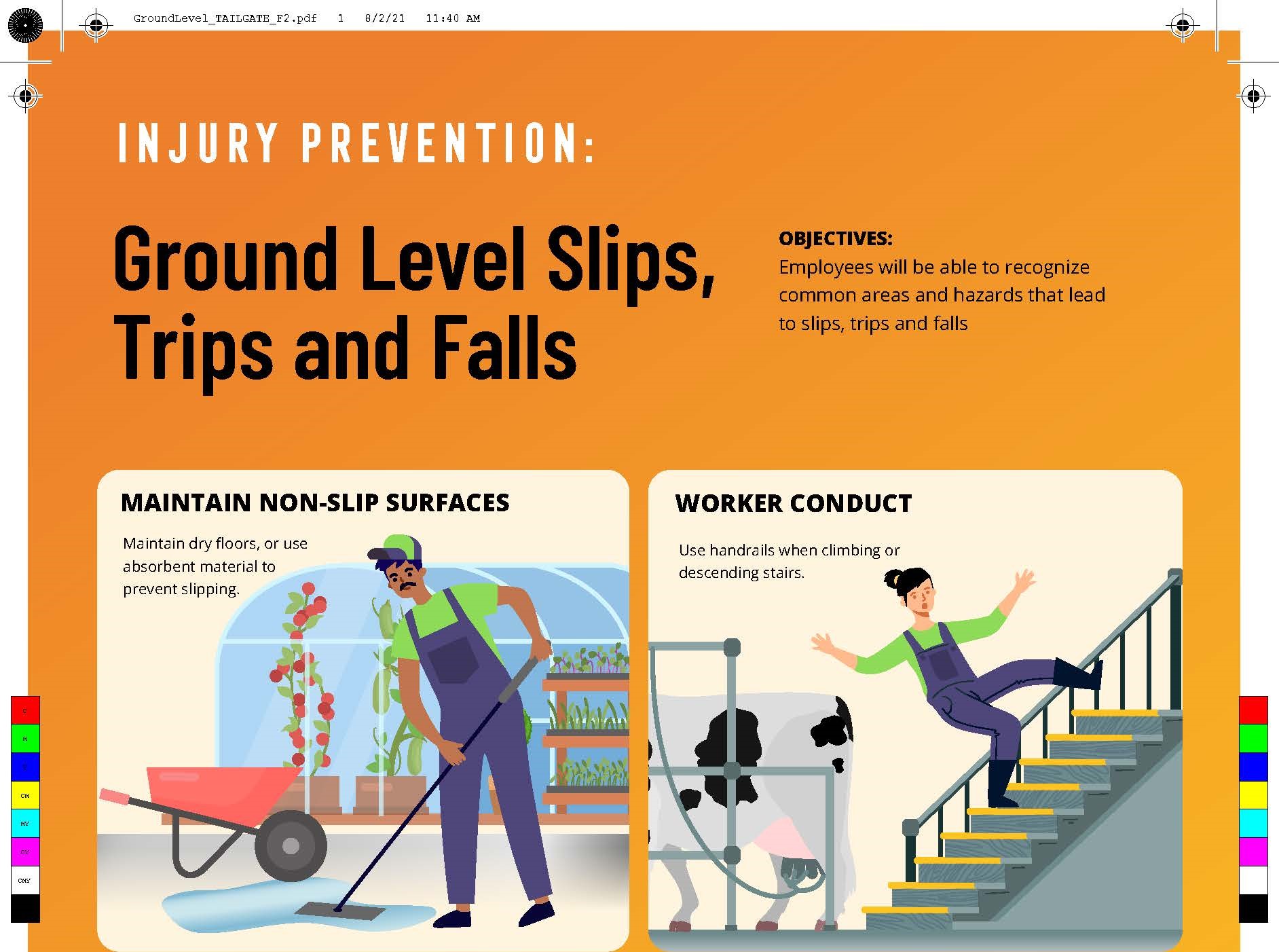
Preview of the “Ground Level Slips, Trips and Falls” Tailgate Training sheet

The Northeast Ag Safety and Health Coalition is looking for farmers willing to field-test and evaluate their new set of “Tailgate Trainings” – short, simple, training sessions that a farm owner or manager can use with a small group of workers. The trainings are designed to be done with small groups, anywhere, and promote retention of material. Topics of the current “tailgate” training sheets include 1) Ground Level Slips, Trips, and Falls, 2) Cattle Handling, and 3) Tractor Side-Overturn.

If you are willing to participate, the Coalition requests that farmers or managers conduct one training session with workers using the provided “tailgate” training sheet. Once the training session is complete, you are asked to fill out a very brief (5 question) evaluation form and mail it back to the Coalition. All material and postage paid/self-addressed return envelopes will be provided (to return the evaluation form).

If you are interested, please email Kate Brown kbrown@njaes.rutgers.edu with the following information by October 1, 2021.

  • Farm Name
  • Mailing Address
  • Requested training sheet(s) [see topics 1, 2, and 3 above]

Your time and participation in this project would be greatly appreciated. Thank you.


National Farm Safety and Health Week: September 19-25, 2021

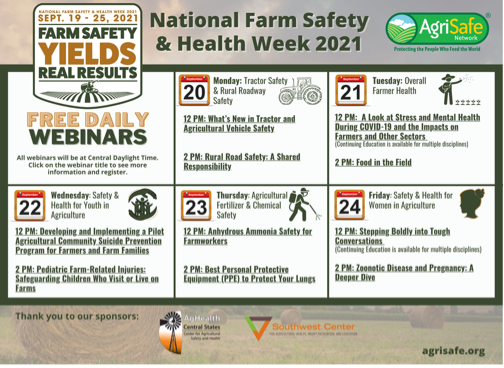
Flyer for NFSHW 2021 Webinars

NFSHW webinars to be held 9/20-9/24/2021. Click here to register.

September precedes one of the busiest and most dangerous seasons of the year in agriculture – fall harvest time. For this reason, National Farm Safety and Health Week (NFSHW) is recognized annually during the third week of September. The theme this year is “Farm Safety Yields Real Results”.

AgriSafe will host two FREE webinars each day during NFSHW to highlight new technology, discuss incident prevention, and inform your decision-making and conversations. The webinars will feature discussion on each of the daily topics. Visit The National Education Center for Agricultural Safety website to register (scroll down to ‘Webinars’). Note that the webinar times are posted for Central Daylight Time.

Take an active role in keeping yourself and others safe this harvest season. Plan to join in on a webinar, encourage others to do the same, and take to social media to spread the message: “Farm Safety Yields Real Results”. Stay tuned to the Rutgers Agriculture and Natural Resources Facebook page for content to share each day during NFSHW!


Be Proactive, Keep Youth Safe on the Farm

How often do you say this: “do as I say, not as I do”?

The farm can be a fun, engaging, and nostalgic place to raise children; however, life on the farm comes with inherent risks that require certain precautions to make the farm a safe place for kids. The curious nature of children makes this especially difficult, as they often exhibit a lack of fear or a clear understanding of danger. According to the Children’s Safety Network, 42% of fatal injuries to youth on U.S. farms involve machinery and motor vehicles (e.g. tractors, ATVs, etc.) while another 16% of fatal injuries are due to drowning. As the school year comes to a close and your own children and grandchildren spend more time on the farm, use your actions and attitude to establish safety as a priority.

In addition to being a positive role model, make time to identify hazards around the farm and implement changes to improve safety. We have included some of these hazardous “hot spots” in the table below, along with recommendations for injury prevention.

Hazards for Children Recommendations to Prevent Injury
Workshops, chemical and grain storage areas Install gates, doors, or other locking systems to keep children out

Explain the meaning of warning signs around the farm

Clean and dispose of empty chemical containers

Establish designated safe play areas

Machinery and equipment Equipment should be turned off, disengaged, and inaccessible

Leave front end loaders and similar equipment in the down position

Lock vehicle cabs after use

Keep vehicle keys out of reach of children

Never allow children to play around machinery

Never allow children (or anyone) to be an extra rider on a tractor

Livestock Pens Only allow children to work with livestock under adult supervision

Secure livestock pens so children cannot wander into the area


If you’re looking for fun ways to talk with children about farm safety, check out this farm safety activity book created by the National Child Safety Council. The book includes games, puzzles, crafts, and more on a wide array of topics from livestock and tractor safety to first aid.

For more details on age-specific hazards, protective measures, and appropriate tasks for youth check out our NJAES factsheet titled “Farm Safety Tips for Children”.

Source: Brennan, M.F. and Brumfield, R.B. “FS937: Farm Safety Tips for Children.” Rutgers University, March 1999. https://njaes.rutgers.edu/pubs/publication.php?pid=FS937. Accessed on 10 June 2021.

3rd Agritourism Webinar: Visitor Incidents and Media Communication

Kids riding in a tractorRutgers Cooperative Extension is working with other extension professionals in the northeastern states to deliver weekly, one-hour webinar programming for agritourism and on-farm direct market operators. The 3rd session will focus on what to do in the event of an confrontation, accident, or injury, and how to communicate with the media in a crisis. Registration is being handled through the University of Vermont. See information below to join the webinars. There are separate registrations for each event. 

Session 3: What to Do when Something Goes Wrong, Incident Response and Media Relations, When: May 18, 2021 7:00-8:00 PM Eastern Time. Presenters: Bill Bamka, Stephen Komar, Bill Hlubik, Rutgers Cooperative Extension – Register HERE

Session 4: Liability Insurance, When: May 25, 2021 12:00-1:00 PM Eastern Time. Presenter will be an insurance agent from VT:  – Register HERE

Recorded past sessions will be posted to this website if you missed any sessions: https://www.uvm.edu/extension/vtagritourism/safety-and-liability-farms-during-covid-19

To request a disability-related accommodation to participate in this program, please contact Christi Sherlock at 802-476-2003 or Christi.Sherlock@uvm.edu for assistance.

Tractor Safety – “No Seat, No Rider”

There is no argument that tractors have forever changed agriculture. The use of tractors has long replaced the presence of draft horses on almost every farm in America. It is estimated that cultivation of land with a modern tractor allows 64 acres to be plowed in the time it took to cultivate one acre with a draft horse. The use of tractors also comes with a dark side. As long as farmers have been using tractors they have been injured and killed by them. The Bureau of Labor Statistics reports 274 transportation related deaths, which includes tractor deaths in 2018. In any given year half of all tractor fatalities are from overturns, almost another one-fourth are from runovers. Many have a tradition of allowing extra passengers to ride on tractors. Sometimes trying to transport a worker from one task to the next or possibly saving them from walking back to the barn. Some even allow children to come along for a ride – a very dangerous practice. Whether it be on the tongue, side steps, fender or extra passenger in the cab, remember these places are not designed for riders. As we enter one of the busiest seasons in agriculture remember one of the most important safety rules NO SEAT, NO RIDER!

  • Riders that fall off are immediately in danger of being run over by a tractor wheel
  • On rough or uneven ground, riders are first to bounce off (especially children)
  • Riders distract the driver and can bump controls
  • Rollover Protective Structures are designed to protect drivers, not riders

Do not ever think “it won’t happen to me.” Every farmer can tell a story of an incident that happened to someone they know in the farm community that involves a tractor. Make sure everyone makes it through the harvest – NO SEAT, NO RIDER!

Posted on behalf of Bill Bamka, Agricultural Agent, RCE-Burlington County.

Stand Up 4 Grain Safety Week: March 29 – April 2

Every year hundreds of employees are injured or die from preventable hazards while working in grain storage and handling. Stand Up 4 Grain Safety Week, sponsored by the OSHA Alliance Program, is a coordinated industry effort to raise awareness of grain handling hazards and educate industry members to prevent injuries and incidents associated with grain handling.

Stand Up 4 Grain Safety Week 2021 will feature daily educational events which are virtual and free to attend. Be aware that the events begin at 10am CDT (11am EST).

  • Monday, 3/29 – Kick-Off Event
  • Tuesday, 3/30 – Near Miss Reporting
  • Wednesday, 4/1 – Impact of Quality on Safety
  • Thursday, 4/2 – Bin Safety
  • Friday, 4/3 – Emergency Action Plans

Assert your commitment to grain safety by registering for these educational events via the Grain Handling Safety Coalition EventBrite page. For additional information and resources on grain safety, visit the Stand Up 4 Safety Week website at https://standup4grainsafety.org.

The OSHA Alliance Program includes the Great Plains Chapter of the Grain Elevator and Processing Society (GEAPS), the National Grain and Feed Association (NGFA), and the Grain Handling Safety Council (GHSC).