As we approach the end of August, harvest of blueberries and peaches are ending while apple and grape harvest is beginning across the state. Temperatures for the month, particularly in the last week have been mild with high relative humidity. Heavy periods of rainfall were seen late last week with some areas recording more than 2 inches. Below are recent observations and considerations for pest management in fruit crops statewide.
Apples
Disease Management Considerations
Summer disease control is coming to an end for early-season apple varieties. Mid- to late-season varieties will need further applications on a two-week schedule, or every 2 inches of rain, using single-site materials from FRAC groups 11, 7, or 3 to manage summer rots, sooty blotch, and fly speck. See the NJ Tree Fruit Production guide for effective materials.
Fire blight strikes that are apparent should be pruned out during dry weather, cutting 8 to 12 inches below diseased wood. Pruning tools are sanitized after each cut by dipping them into a 10 percent bleach solution. Young trees with fire blight cankers that have spread to the main leader should be removed.
Insect Update
Brown Marmorated Stink Bugs (BMSB) are increasing at some farms and injury to fruit has been observed (Figure 1). If stinkbugs are a concern for your orchard, see the NJ Tree Fruit Production guide for effective materials.
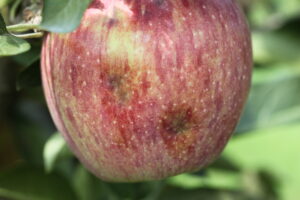
Figure 1. Injury from stink bug feeding on fruit looks like bruising and corking of flesh just under the skin.
Codling Moth (CM) pressure remains low in orchards statewide; however, we are seeing damage to fruit where populations have been high. Additional treatments should be applied if trap captures exceed 5 moths/trap.
Woolly apple aphids (WAA) are increasing in some orchards and spreading to shoots, particularly in older orchards with dense canopies. Sefina has a 7-day PHI and is a good option to manage WAA. Assail will also help to suppress WAA.
Scale crawler emergence is past peak and declining. Options at this point include Group 4A products labeled for scale, including Assail, and the bioinsecticide Venerate. Venerate has a 0-day PHI, making it useful for blocks near or at harvest.
Dogwood borer (DWB) continues to be captured in pheromone traps in orchards statewide. If this pest has been a problem in your blocks in the past, you may consider adding mating disruption next year.
Traps
Average Trap Captures in Apple – Southern Counties
| Week | STLM | TABM | CM | OFM | DWB | AMBROSIA BEETLE | BMSB |
| 5/11/2026 | 18 | 11 | 6 | 3 | 25 | 2 | – |
| 5/18/2026 | 16 | 21 | 3 | 10 | 54 | 13 | – |
| 5/25/2026 | 1.3 | 23 | 2 | 2 | 71 | 7 | – |
| 6/1/2026 | 378 | 33 | 3 | 2 | 49 | 6 | 0.4 |
| 6/8/2026 | 258 | 11 | 2 | 1 | 61 | 21 | 1.2 |
| 6/15/2026 | 355 | 4 | 0.6 | 1.5 | 57 | 13 | 0.8 |
| 6/22/2026 | 178 | 5 | 0.6 | 2 | 54 | 8 | 1.2 |
| 6/29/2026 | 504 | 0.3 | 0.1 | 0.5 | 27 | 12 | 0.8 |
| 7/6/2026 | 202 | 1.1 | 1.6 | 0.6 | 25 | 7.5 | 0.6 |
| 7/13/2026 | 226 | 0.9 | 1 | 1 | 33 | 1 | 1.6 |
| 7/20/2026 | 253 | 1.8 | 2 | 3 | 26 | 2.3 | 2.4 |
| 7/27/2026 | 246 | 1.5 | 5 | 1.6 | 38 | 2 | 1.6 |
| 8/3/2026 | 253 | 1.6 | 2 | 1 | 47 | 1.4 | 2.6 |
| 8/10/2026 | 1 | 1 | 1 | 48 | 2.7 | 0.8 | |
| 8/17/2026 | 375 | 1.9 | 1 | 1 | 47 | 2.6 | 2.2 |
Average Trap Captures in Apple – Northern Counties
| Week | STLM | TABM | CM | DWB | AMBROSIA BEETLE | BMSB |
| 5/11/2026 | 13.7 | 1.5 | 1.8 | 12.8 | 1.1 | – |
| 5/18/2026 | 8.3 | 13.25 | 2.4 | 18.5 | 10.8 | – |
| 5/25/2026 | 2.2 | 13.75 | 1.2 | 24.5 | 5.1 | – |
| 6/1/2026 | 25.1 | 24.3 | 3.4 | 23.8 | 9.4 | 0.3 |
| 6/8/2026 | 94 | 22.3 | 0.3 | 24.6 | 18 | 1.4 |
| 6/15/2026 | 68 | 22.3 | 1 | 22.6 | 14 | 1.1 |
| 6/22/2026 | 105.9 | 35 | 0.7 | 27.2 | 8.2 | 0.5 |
| 6/29/2026 | 100 | 11.5 | 0.3 | 28.9 | 5.3 | 0.3 |
| 7/6/2026 | 50.2 | 7.3 | 0.6 | 26.4 | 5.2 | 0.2 |
| 7/13/2026 | 52.4 | 7 | 0.5 | 24.8 | 5.3 | 0.2 |
| 7/20/2026 | 69.7 | 2.5 | 0.7 | 27.4 | 4.3 | 0.1 |
| 7/27/2026 | 92.4 | 2 | 0.6 | 30.6 | 5.3 | 0.2 |
| 8/3/2026 | 78.6 | 1.8 | 0.5 | 2.3 | 2.2 | 0.5 |
| 8/10/2026 | 56.5 | 3.3 | 0.7 | 26.3 | 3.2 | 0.1 |
| 8/17/2026 | 23 | 3.3 | 0.8 | 26.9 | 0.4 |
Peaches
Insect Update
Scale crawler emergence is past peak and declining. White Peach scale has a third generation in September, and San Jose scale may have a third generation in October. Options at this point include Group 4A products labeled for scale, including Assail, and the bioinsecticide Venerate. Venerate has a 0-day PHI, making it useful for blocks near or at harvest.
Lesser Peachtree Borer (LPTB) and Peachtree Borer (PTB) trap counts have been high at several farms this season throughout the state. Where mating disruption is not used, trunk sprays with pyrethroids can be applied from early to mid-September. An additional application can be made in mid to late September. Since this can be a labor-intensive practice, it would be most efficient to prioritize younger, more productive orchards. See the NJ Tree Fruit Production for effective materials and rates.
Traps
Average Trap Captures in Peach – Southern Counties
| Week | OFM | TABM | LPTB | PTB | BMSB |
| 5/11/2026 | 5 | 10 | – | – | – |
| 5/18/2026 | 4 | 20 | – | – | – |
| 5/25/2026 | 2 | 20 | 31 | 1 | – |
| 6/1/2026 | 4 | 46 | 28 | 3 | 0 |
| 6/8/2026 | 8 | 13 | 25 | 3 | 0.75 |
| 6/15/2026 | 5 | 6 | 13 | 3 | 0.75 |
| 6/22/2026 | 6 | 4 | 23 | 7 | 1 |
| 6/29/2026 | 3 | 0.2 | 16 | 6 | 2 |
| 7/6/2026 | 5 | 0.6 | 16 | 4 | 1.3 |
| 7/13/2026 | 9 | 1.4 | 18 | 7 | 3.5 |
| 7/20/2026 | 8 | 2.4 | 12 | 6 | 2.5 |
| 7/27/2026 | 6 | 2 | 6 | 6 | 8 |
| 8/3/2026 | 3 | 2 | 13 | 10 | 1.3 |
| 8/10/2026 | 4 | 1 | 25 | 10 | 1 |
| 8/17/2026 | 5 | 2 | 30 | 12 | 4 |
Average Trap Captures in Peach – Northern Counties
| Week | OFM | LPTB | PTB |
| 5/11/2026 | 4.4 | 24 | 0 |
| 5/18/2026 | 2.4 | 16.5 | 0.2 |
| 5/25/2026 | 0.7 | 8.75 | 0.1 |
| 6/1/2026 | 1.8 | 11 | 0.5 |
| 6/8/2026 | 0.6 | 8.5 | 0.05 |
| 6/15/2026 | 3.5 | 9.7 | 1.2 |
| 6/22/2026 | 3.4 | 7.4 | 1.6 |
| 6/29/2026 | 2 | 4.6 | 1.1 |
| 7/6/2026 | 1.7 | 8.5 | 1.8 |
| 7/13/2026 | 0.5 | 2.8 | 3.7 |
| 7/20/2026 | 2.1 | 1.5 | 2.9 |
| 7/27/2026 | 4.3 | 0.9 | 1.7 |
| 8/3/2026 | 3.8 | 1.5 | 1.2 |
| 8/10/2026 | 1.5 | 4.5 | 2.1 |
| 8/17/2026 | 1.3 | 3.5 | 1.5 |
Blueberries
Scouting Update
As we look at postharvest management in blueberries, the focus is on sharp-nosed leafhopper, scale, black shadow, and fall weed management. Sharp-nosed leafhopper numbers remain low, but scale activity has increased in some areas. If you notice scale markings on your fruit during harvest, you may want to consider treatment to help reduce populations for next season.
For weekly reports on blueberry pests and recommendations, read the Rutgers Blueberry Bulletin.
Grapes
Insects
Grape Berry Moth timing for the third generation is past. No further treatments should be needed, especially where harvest has begun and insecticides are being applied for Spotted lanternfly and Spotted-wing drosophila.
Spotted Lanternfly (SLF) adults are appearing in vineyards in low numbers, mostly on vineyard edges. As we move into September, adult migration will increase, and at that point, growers should apply materials with long residual efficacy. More information on biology and control is available at Penn State.
Diseases
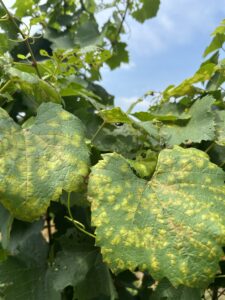
Figure 2. Downy mildew on grape foliage.

