Landscape, Ornamentals, Nursery, and Turf Edition

Seasonal updates on ornamental, nursery, and turf pests.
Subscriptions are available via EMAIL and RSS.


Companion Website Links:

Rutgers Turf Blog - Articles on turfgrass diseases and cultural practices for the commercial turfgrass industry. Subscription available via RSS.


Rutgers Weather Forecasting - Meteorological Information important to commercial agriculture.

Free Webinar: Strategies to Help Ag Producers Plan During the COVID-19 Crisis

Eastern farmers and agricultural producers have experienced unprecedented challenges in handling the vulnerability of our food systems. As we move forward to plan for a new season and a new year during the COVID pandemic, there is an urgent need to seek and identify best strategies to support farmers and agricultural producers in adjusting goals and achieving prosperity. This Open Forum – January 20, 2021 at 12:00 – 1:30 p.m. – will provide practitioners, extension agents, farmers, and agricultural producers an opportunity to identify gaps, brainstorm ideas, and share examples to support each other. Presenters leading the discussions will share 1-2 best practices to assist farmers and agricultural producers, including value-added production, agritourism, and other operations types.

This event is free and open to anyone, but registration is required to get the Zoom link. Registration is available by clicking here.

eXtension is embedded in the U.S. Cooperative Extension System and serves on the Extension Committee on Organization and Policy (ECOP). eXtension provides an array of opportunities for Extension professionals that foster innovation creation, the adoption of innovations at member institutions, and increased impact of Extension programs.

NJDEP & Rutgers OCPE Announce Roll Out of New Online Pesticide Exam Portal!

The New Jersey Department of Environmental Protection and Rutgers University are pleased to announce that the new online Pesticide Applicator Certification Exam Registration (PACER) system is NOW AVAILABLE for your use.  Anyone interested in taking a Pesticide exam must register through the PACER system at pacer.rutgers.edu. The registration PACER system and exams are available 24/7.   All exams […]

Winter Pest Monitoring in the Landscape

During the winter dormant season, there are a significant number of potential pests of ornamentals that require monitoring. Pest populations ignored during the off season is a missed opportunity to evaluate future problems. These potential concerns can be especially pronounced on evergreen shrubs and conifers. Therefore, this winter do not make the mistake of thinking that landscape problems can be forgotten about until next spring. A little vigilance now can go a long way toward recording & possibly reducing future problems. The following is a review of some of the major pest problems that require monitoring and possible management actions during the next few months.

Winter pest monitoring can still be achieved during the off-season. (Photo Credit: Steven K. Rettke, Rutgers Coop. Ext.)

[Read more…]

Quality Loss Adjustment (QLA) Program Now Available for Eligible Producers Affected by 2018, 2019 Natural Disasters

The U.S. Department of Agriculture’s (USDA) Farm Service Agency (FSA) has announced that signup for the Quality Loss Adjustment (QLA) Program began Wednesday, Jan. 6, 2021. Funded by the Further Consolidated Appropriations Act of 2020, this new program provides assistance to producers who suffered eligible crop quality losses due to natural disasters occurring in 2018 and 2019. The deadline to apply for QLA is Friday, March 5, 2021. [Read more…]

Diplodia Tip Blight: The Key to Infections is Found Within the Cones

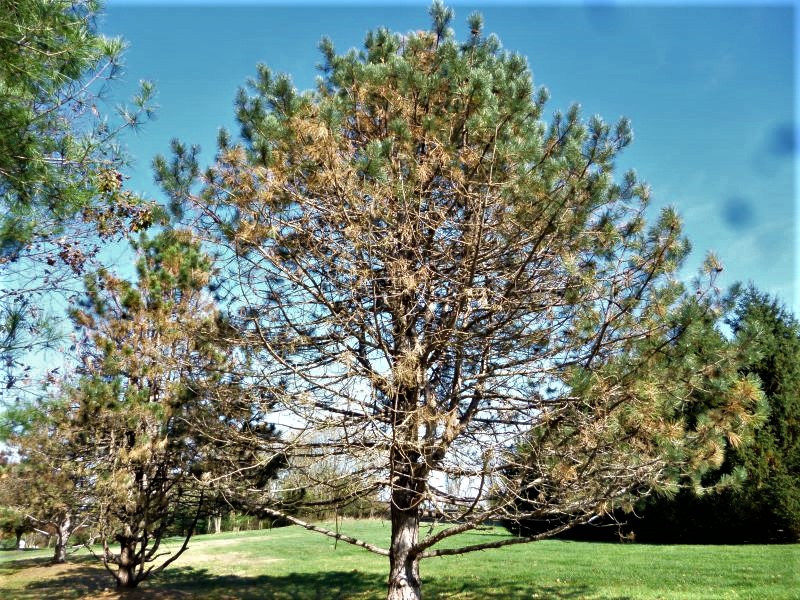
Diplodia Tip Blight (Diplodia pinea) is a fungus disease in the landscape commonly observed on Austrian pines (Pinus nigra), but can also be found infecting mugo, red, black, & Scots pines. This blog will emphasize with photos the infections seen on Austrian pines.

The symptoms of Diplodia Tip Blight are stunted or dead shoots. With extensive infections, almost every branch & twig can be affected as the disease spreads over the years. The lower branches of the Austrian pines are usually infected first. For numerous years, the upper canopy will initially show few symptoms. The fungus kills developing needles in the spring, resulting in dead candles that are deformed & much shorter than the growth found on healthy twigs.

Austrian pine with obvious symptoms from Diplodia Tip Blight infections. (Photo Credit: Steven K. Rettke, Rutgers Coop. Ext.)

Stunted or dead newly emerged twig shoots on Austrian pine branch. (Photo Credit: Steven K. Rettke, Rutgers Coop. Ext.)


[Read more…]

USDA Extends Crop Insurance Flexibilities Amid Continuing COVID-19 Pandemic

Through today’s announcement, USDA’s Risk Management Agency (RMA) is extending crop insurance flexibilities for producers amid the continuing COVID-19 pandemic. Specifically, relief provided for electronic notifications and signatures is extended through July 15, 2021; organic certification, replant self-certification and assignment of indemnity are extended through June 30, 2021. [Read more…]
