Landscape, Ornamentals, Nursery, and Turf Edition

Seasonal updates on ornamental, nursery, and turf pests.
Subscriptions are available via EMAIL and RSS.


Companion Website Links:

Rutgers Turf Blog - Articles on turfgrass diseases and cultural practices for the commercial turfgrass industry. Subscription available via RSS.


Rutgers Weather Forecasting - Meteorological Information important to commercial agriculture.

Nostoc in Nurseries: Herbicides to Control the Slippery Slime Threat


Nostoc is a cyanobacterium and is one of the oldest organisms on earth (over 3.5 billion years). It is a primitive growth, like algae, moss, and liverwort. Many years ago, it was incorrectly identified as blue-green algae. Nostoc has no roots, no vascular tissues & is not a plant but it is photosynthetic. It can be found growing within gravel, stones, limestone chips, granite, saturated soils & on-ground cloth within container nurseries. It can tolerate long periods of desiccation but requires plentiful amounts of water for establishment. This cyanobacterium growth can become common & persistent at certain nursery/greenhouse sites where long-term overhead irrigation is done.
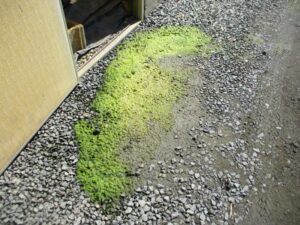
Nostdoc growing in front of container

Nostoc growing in front of container bay opening. The opening allowed the overhead irrigation to saturate the soil/gravel at entrance. (Photo Credit: Steven K. Rettke, Rutgers Coop. Ext.)
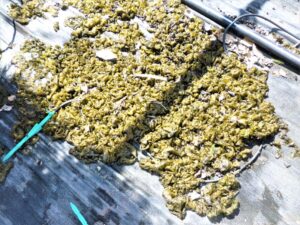
Nostdoc on ground

Nostoc growing on ground cloth within a nursery container bay. Creates a serious slipping hazard for nursery personnel. (Photo Credit: Steven K. Rettke, Rutgers Coop. Ext.)

Nostoc is not toxic & does not directly compete with nursery/greenhouse crops or landscape plants, but it can harbor fungus gnats & snails. Nostoc first became a growing concern in nurseries approximately 30 years ago. Slipping hazards are the primary threat this organism poses to nursery & greenhouse personnel. It forms gelatinous masses composed of filaments linked together by protective jelly-like coverings. This creates a surface as slick as wet ice. Nostoc can occasionally be found growing within turf or landscape settings but is not common.

This blog will show with photographic images how Nostoc can be identified & will also review available control options.      

[Read more…]

REGISTER & STUDY NOW: Pesticide Certification Testing Thursday 10am at NJACTS for New & Renewing New Jersey Applicators!

2023 New Jersey Agricultural Convention & Trade Show – Educational Sessions & Workshops at Harrah’s Resort and Waterfront Convention Center, Atlantic City, New Jersey Date: Thursday, February 9, 2023. TIme: 10 AM. Location: WILDWOOD 2 & 3 [Examination room (WILDWOOD 2 & 3) sponsored by the Vegetable Growers Association of New Jersey. Exams will be […]

Requirements for Private Pesticide Applicator Certification and Licensing

Prior to regulations changes in November of 2001, only those private applicators using restricted use pesticides were required to be certified and licensed. The regulations require agricultural producers using either general or restricted use pesticides to become licensed. Those only using general use pesticides to produce an agricultural commodity had 2 years (until November 19, […]

USDA is requesting input on rodent control in agriculture (due Monday January 23rd)

[Posted to NACAA listserv, and provided courtesy of Rick Van Vranken]. Request to agricultural producers: if you (as a Private Applicator) and/or your agent (a Commercial Applicator) makes applications of rodenticides, please respond to this survey yourself and also forward to any Commercial Applicator service you hire to perform rodenticide treatment(s). Thank you. USDA’s Office […]

Recent Agriculture Bills Passed in NJ Senate and Other News

Bill A1929 Aca (1R)
Session 2022 – 2023 – signed in to Law, September 22, 2022.
“Directs Department of Agriculture to establish New Jersey Minority, Women, and Underserved Farmer Registry.”

For more information see: https://njleg.state.nj.us/bill-search/2022/A1929

For a synopsis of this bill see, https://wrnjradio.com/bill-assisting-minority-women-farmers-signed-into-law/


Bill A285. Session 2022 – 2023. ASSEMBLY, No. 285. Establishes “New Farmers Improvement Grant Program” to provide matching grants for farm improvements to beginning farmers.

For more information see, https://njleg.state.nj.us/bill-search/2022/A285/bill-text?f=A0500&n=285_I1

For a synopsis of this bill see https://wrnjradio.com/committee-clears-bill-that-will-create-grant-opportunities-for-new-farmers/


Other Bills of interest to New Jersey Farmers. Bill Text: NJ S757. “Authorizes special occasion events at certain commercial farms on preserved farmland, under certain conditions.” https://legiscan.com/NJ/text/S757/id/2608677.

For more on this bill and it’s implications, from the Secretary of Agriculture. “Please click the video below to hear from Secretary Douglas H. Fisher regarding an important bill, S757/A2772, which will allow additional, nonagricultural special occasion event to be held NOT JUST on preserved farm wineries – but on ALL preserved farms.”- January 13, 2023. Secretary of Agriculture.


Women farmers. For additional resources on agriculture business, finance, market, and biosecurity planning, see the late registration option for Annie’s Project. The next session is Wednesday, January 18th. Contact the project coordinator for late registation options via the instructions in: https://sites.rutgers.edu/annies-project/wp-content/uploads/sites/753/2023/01/Poster_2023_AnniesProject_Online.pdf

Pennsylvania Advises PA Poultry Owners to House Poultry Indoors

Poultry owners, please be aware of the advisory in Pennsylvania copied below regarding the continued spread of High-Path Avian Influenza.

The appropriate New Jersey letters are found in the following links:

Highly Pathogenic Avian Influenza Letter for Veterinarians

Highly Pathogenic Avian Influenza Letter to Poultry Owners

Highly Pathogenic Avian Influenza Letter to Live Bird Markets

Highly Pathogenic Avian Influenza Letter to Poultry Distributors

“January 9, 2023
Pennsylvania Poultry Industry

Dear Pennsylvania Poultry Producers,
As you know, Highly Pathogenic Avian Influenza (HPAI) (H5) has been circulating in the wild bird population in the United States and was identified in commercial poultry in early 2022. On April 14, 2022, the first case of HPAI H5 was detected in a commercial layer flock in Pennsylvania. Since then, the virus has continued to spread into backyard flocks and commercial poultry facilities across the United States, affecting 47 states to date. More than 57 million birds have been lost due to HPAI. More than 4.5 million birds have been lost in Pennsylvania, and a total of 38 Pennsylvania flocks have been affected. Identification of new cases has continued across the United States. The most recent case of HPAI has been reported in the US as recently as January 4th. Wild bird detections continue in multiple states. These recent cases should act as a reminder that a virulent strain of Avian Influenza virus continues to circulate in the wild bird population and still threatens commercial and backyard poultry. The Pennsylvania Department of Agriculture first recommended that organic producers move poultry indoors in February 2022. At this time, we recommend that all poultry [In PA] be maintained indoors. Producers are also encouraged to implement strict biosecurity practices, monitor bird health, and report any unexplained mortality and morbidity [In PA] to the Department at 717-772-2852 (24/7).”

[state added by Melissa Bravo for clarification for plant pest advisory post]

Thank you,
Kevin D. Brightbill, DVM | State Veterinarian | Director
Pennsylvania Department of Agriculture | Bureau of Animal Health and Diagnostic Services
2301 North Cameron Street | Harrisburg, PA 17110
Phone: 717.705.1626 | Fax: 717.787.1868
www.agriculture.pa.gov
kebrightbi@pa.gov
