Landscape, Ornamentals, Nursery, and Turf Edition

Seasonal updates on ornamental, nursery, and turf pests.
Subscriptions are available via EMAIL and RSS.


Companion Website Links:

Rutgers Turf Blog - Articles on turfgrass diseases and cultural practices for the commercial turfgrass industry. Subscription available via RSS.


Rutgers Weather Forecasting - Meteorological Information important to commercial agriculture.

The 2022 Census of Agriculture – There’s Still Time To Be Counted!

New Jersey farmers still have time to be counted in the 2022 Census of Agriculture, according to the U.S. Department of Agriculture’s (USDA) National Agricultural Statistics Service (NASS). Although the deadline for submitting the ag census has just passed, NASS will continue to accept completed census questionnaires through the spring to ensure all farmers and ranchers take advantage of the opportunity to be represented in the widely used data.

“My sincere appreciation goes to producers who have already completed the census. We want to partner with New Jersey producers to show the importance of New Jersey agriculture,” said NASS New Jersey State Statistician Bruce Eklund. “There is strength in numbers. The time to do your part is now. There is still time for farmers to respond.”

NASS will continue to follow up with producers throughout the spring with mailings, phone calls, and personal visits. Farmers and ranchers are encouraged to complete their ag census either online at agcounts.usda.gov or by mail as soon as possible.

Federal law under Title 7 USC 2204(g) Public Law 105-113 mandates that everyone who received the 2022 Census of Agriculture questionnaire complete and return it, even if they are not currently farming. The same law requires NASS to keep all submissions confidential, use the information for statistical purposes only, and publish aggregate data to prevent disclosing the identity of any individual producer or farm operation.

If you need a survey code or questionnaire, please contact the USDA, NASS Northeastern Regional Field Office, 4050 Crums Mill Rd., Suite 203, Harrisburg, PA 17112; Phone – 717-787-3904; eFax – 1-855-270-2719; or Email – nassrfoner@usda.gov.

NASS will release the results of the ag census in early 2024. To learn more about the Census of Agriculture, visit nass.usda.gov/AgCensus. On the website, producers and other data users can access frequently asked questions, past ag census data, special study information, and more. For highlights of these and the latest information, follow USDA NASS on Twitter at @usda_nass.

NASS is the federal statistical agency responsible for producing official data about U.S. agriculture and is committed to providing timely, accurate, and useful statistics in service to U.S. agriculture. USDA is an equal opportunity provider, employer, and lender.
White Pine Weevil: Overwintering Adults Become Active in March & April

Many arborists & landscapers often find it difficult to prevent white pine weevil pests (Pissodes strobi), because they are typically applying fertilizer & dormant oil treatments during the control window. In the state of NJ, the control window against feeding white pine weevil adults occurs in March & April. Adults over-winter in the duff beneath trees. The WPW adults will often crawl or sometimes fly to the top terminal leaders of pine, spruce, or Douglas-fir trees. Eastern white pine & Norway spruce species are the most severely attacked & the death of the terminal leaders of these trees will often occur.

Treatment timing is critical with this pest and controlling the adult female before egg laying is necessary. Apply preventative sprays (e.g., pyrethroids) only to the terminal leaders during this time. Before mating & egg laying, adults will feed by chewing holes within the central leader & cause a characteristic pitch flow that becomes white in color when dry. Then females will lay eggs in new cut-out holes within the top 12 inches of the leader just below the terminal bud. This blog will describe with the help of photographs the 7-stage lifecycle of this native weevil borer. Control & management options will also be provided.   

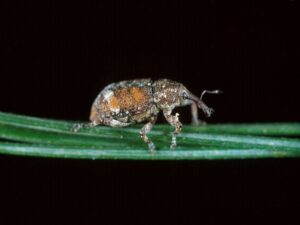
Beetle on stem

White pine weevil adults are about 1/4+ inch long & have a long snout with two white spots on back of wing covers. Adults feed at terminal leaders during March & April. Most eggs will then be laid during April & May. (Photo Credit: Michigan State University)


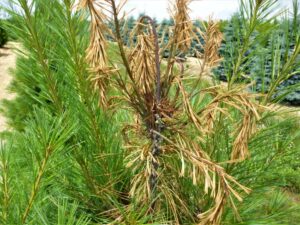
Infected pine tree

Severe white pine weevil infestations to terminal leaders can destroy two or more years worth of growth to pine, spruce, & Douglas-fir trees. (Photo Credit: Steven K. Rettke, Rutgers Coop. Ext.)

[Read more…]

2023 Pre-Season Farm Labor Meetings to be Held Soon

Sponsored by NJ Farm Bureau and Rutgers NJAES Cooperative Extension, two opportunities for farmers to learn about seasonal updates for farm labor will take place at two different locations. See below:

When: Wednesday, March 22, 7-9pm

Where: Cumberland County Rutgers Cooperative Extension Office, 291 Morton Ave., Millville, NJ


When: Thursday, March 30, 7-9pm

Where: Atlantic County Rutgers Cooperative Extension Office, 6260 Old Harding Highway, Mays Landing, NJ 08360

These meeting will consist of presentations on regulations pertaining to farm labor. The presenters will be from the Department of Labor, NJ DEP Pesticide Control Program, and NJFB. The topics discussed will be as follows. This will be an opportunity to ask any questions you may have going into the growing season.

• Worker Protection Standards Overview of new EPA WPS rules-NJ DEP Bureau of Pesticide Control
• Federal Labor Regulations Update & Overview of MSPA, FLSA and transportation -US Dept. of Labor
• NJ Labor Regulations Update & Overview Wage and Hour and paid sick leave -NJ Dept. of Labor
• Farm Bureau update

NJ DEP Licensed Pesticide Applicators can receive 1 CORE Recertification Credit for attending this event. 

For additional information contact: Ben Casella, New Jersey Farm Bureau, 609-393-7163

NJDEP Bureau of Water Allocation and Well Permitting Workshops Held

The New Jersey Department of Environmental Protection coordinated workshops in the past two weeks to assist farmers with Agricultural Water Certifications/Registrations who needed 5-year renewals. Those farmers with certifications expiring in 2023 were invited by NJDEP to attend the scheduled workshops. NJDEP Staff visited the 4 counties: Gloucester, Salem, Burlington, and Cumberland to complete renewals for 2023. These workshops are an efficient way to make sure forms are accurate, complete, and acceptable to NJDEP – avoiding the need to mail back paperwork to correct any information. If a farmer receives an invitation in the future to attend these NJDEP coordinated workshops, it is really important to attend and update your forms.

If a farmer was unable to attend workshops, or their county did not have a workshop, they must complete the 5-year renewal form mailed by DEP and make an appointment with the County Agricultural Agent in their county to finalize the forms in order to keep their status current. County Agricultural Agents do not have access to obtaining the renewal packets and farmers must bring them completed to the appointment or contact NJDEP for another copy, if they cannot locate their copy.

As per the NJDEP’s instruction, Agricultural Agents are to complete an “agent irrigation calculations sheet” and sign off on the form prior the forms are submitted to DEP. The forms can also be reviewed during an appointment with the Agricultural Agent. All other portions of the form are the responsibility of the farmer to complete. Also, it is important to read all instructions – that includes having a written daily log of the last month water was used in the past year to submit with the 5-year renewal application.

If a farmer does not have an Agricultural Water Use Certification or Registration, they can contact the NJDEP using the information below to obtain the forms.

If a farmer has any questions, NJDEP asks they contact staff at:

NJ Department of Environmental Protection, Division of Water Supply and Geoscience, Bureau of Water Allocation and Well Permitting, Mail Code 401-04Q, P.O. Box 420, Trenton, NJ 08625-0420, 609-984-6831. Also see the website at http://www.nj.gov/dep/watersupply/


Resources for Attendees of 2023 Central Jersey Vegetable Growers Meeting

      Central Jersey Vegetable Growers Meeting 2023 Private Applicator Resource Guide

December Prices Received by Farmers Data

The ‘December Prices Received by Farmers’ section of the USDA NASS Agriculture Prices publication contains useful price-margins-costs of production forecasting information for producers.

The report highlights prices received by farmers for principal crops, livestock and livestock products; indexes of prices received by farmers; feed price ratios; indexes of prices paid by farmers; and parity prices. Historical data covering years 1910-60 reported in 1962 publication.

To access the December report go to: https://downloads.usda.library.cornell.edu/usda-esmis/files/c821gj76b/gx41nx339/2b88rs02s/agpr0123.txt

Future reports will be released on: Upcoming releases:Feb 28 2023 3:00 PM. Mar 31 2023 3:00 PM. Apr 28 2023 3:00 PM. May 31 2023 3:00 PM. Jun 30 2023 3:00 PM. Jul 28 2023 3:00 PM. Aug 31 2023 3:00 PM. Sep 29 2023 3:00 PM. Oct 31 2023 3:00 PM. Nov 30 2023 3:00 PM. Dec 29 2023 3:00 PM.
