Vegetable Crops Edition
Seasonal updates and alerts on insects, diseases, and weeds impacting vegetable crops. New Jersey Commercial Vegetable Production Recommendations updates between annual publication issues are included.
Subscriptions are available via EMAIL and RSS.
Quick Links:
 NJ Commercial Vegetable Production Recommendations
Rutgers Weather Forecasting - Meteorological Information important to commercial agriculture.
Pesticide Product Management Practices, Proper Disposal Methods, and Container Recycling Options for NJ Farms
Vegetable IPM Update 9/13/23
Sweet Corn
Fall armyworm (FAW) infestations in whorl stage plantings in northern and central counties have dropped to very low levels. This may not be the case in southern counties. Growers are advised to check whorl and seedling stage corn plantings weekly for signs of FAW. Consider treating if infestation rates exceed 10%. This pest is capable of significant injury to sweet corn plants, resulting in severe stunting and failure to produce viable ears. Note that growers of Attribute II type genetically engineered corn are unlikely to see damage from FAW.
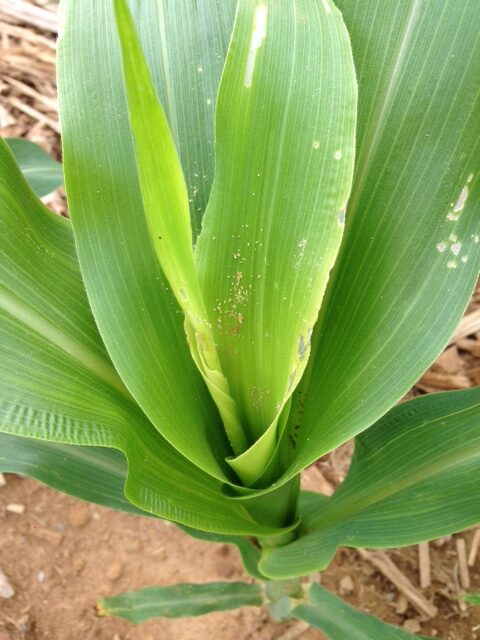
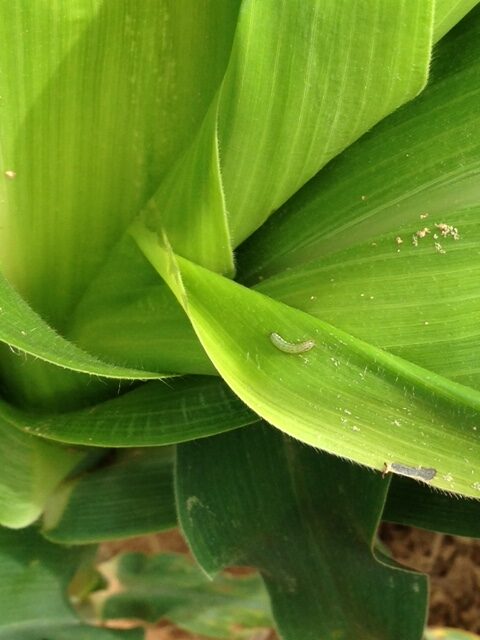 Newly hatched FAW larvae cause holes and scratches on leaves that are similar to European corn borer (ECB) feeding, except that they tend to be more concentrated and always lead down into the whorl (see photos at left). As the larvae grow, the feeding becomes more destructive, with large ragged holes and obvious droppings deposited in the whorl (see photo at right).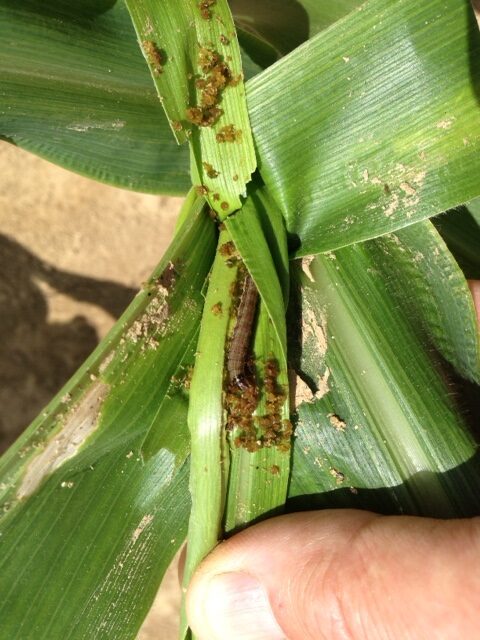
We will provide updates on new FAW appearances and severity as reports come in. FAW are resistant to synthetic pyrethroids. Effective sprays should include IRAC grp. 5 (spinosyns) or IRAC grp. 28 (diamides). The carbamate (IRAC grp. 1A) Lannate is also still effective. Sufficient water should be used in the applications to allow the solution to penetrate the layer of droppings that may have formed above the caterpillar.
Notice of Public Hearing on SADC Rule Proposal Establishing Soil Protection Standards on Preserved Farmland
Proposed rules: PRN_2023-079_SADC_2_76-25
Original Notification of Public Hearing: Notice of public hearing SPS rule proposal
Important information:
DATE: September 27, 2023
TIME: 6:00 p.m. to 9:00 p.m
LOCATION: TEAMS Virtual Meeting
To join the hearing via computer: Click here to join the meeting
To join the hearing via phone: Call (856)338-7074
Conference ID: 268 371 32#
Meeting Link and Call-In information is also available on the SADC website at https://www.nj.gov/agriculture/sadc/
NOTE: If you wish to provide oral testimony at the virtual public hearing, you must
register with the SADC no later than 5:00 p.m. Monday, September 25, 2023. Participants
may register by emailing Jessica.uttal@ag.nj.gov or calling her at (609) 913-6567.
From original notice:
STATE AGRICULTURE DEVELOPMENT COMMITTEE
Notice of Public Hearing on SADC Rule Proposal Establishing Soil Protection Standards
on Preserved Farmland
Proposal of new rules, N.J.A.C. 2:76-25, Soil Disturbance on Preserved Farmland; N.J.A.C.
2:76-25A, Supplemental Soil Disturbance Standards
PUBLIC NOTICE
Take notice that the New Jersey State Agriculture Development Committee (SADC) is holding
a virtual public hearing for the proposed new rules defining what activities on preserved
farmland constitute soil disturbance, establishing a soil disturbance limitation on preserved
farms, allowing for waivers of the soil disturbance limit under certain conditions, providing
preserved farm landowners written notice of and an opportunity to be heard on mapped soil
disturbances, and promulgating technical standards for certain agricultural practices for
compliance with the soil disturbance limitation.
The notice of proposal was published in the New Jersey Register on August 7, 2023, at 55
N.J.R. 8(1).
The SADC will be holding a virtual public hearing on Wednesday, September 27, 2023 at
6:00 p.m. through the SADC’s video conferencing software (Microsoft TEAMS).
Registration: If you wish to provide oral testimony at the virtual public hearing, you must
register with the SADC no later than 5:00 p.m. Monday, September 25, 2023. Participants
may register by emailing Jessica.uttal@ag.nj.gov or calling her at (609) 913-6567. Please
provide your name, organization, telephone number, and email address. A verbal or written
confirmation will be provided of your interest to testify at the hearing.
Please note that the SADC will take oral testimony at the hearing by alphabetical order of the
testifying person’s last name, and that this hearing will be recorded.
DATE: September 27, 2023
TIME: 6:00 p.m. to 9:00 pm
LOCATION: TEAMS Virtual Meeting
To join the hearing via computer: Click here to join the meeting
To join the hearing via phone: Call (856)338-7074
Conference ID: 268 371 32#
Meeting Link and Call-In information is also available on the SADC website at https://www.nj.gov/agriculture/sadc/
The SADC is also accepting written and/or electronic comments on the proposed rule
through October 6, 2023. Please submit electronic comments to SADC@ag.state.nj.us. In
the alternative, comments may be submitted on paper to:
Susan E. Payne, Executive Director
State Agriculture Development Committee
P.O. Box 330
Trenton, NJ 08625-0330
Please refer to the original notice of proposal for detailed information regarding the proposed
rules.
Vegetable IPM Update 9/06/23
Sweet Corn
Fall armyworm (FAW) infestations in whorl stage plantings in northern and central counties have dropped to very low levels. This may not be the case in southern counties. Growers are advised to check whorl and seedling stage corn plantings weekly for signs of FAW. Consider treating if infestation rates exceed 10%. This pest is capable of significant injury to sweet corn plants, resulting in severe stunting and failure to produce viable ears. Note that growers of Attribute II type genetically engineered corn are unlikely to see damage from FAW.
Newly hatched FAW larvae cause holes and scratches on leaves that are similar to European corn borer (ECB) feeding, except that they tend to be more concentrated and always lead down into the whorl (see photos at left). As the larvae grow, the feeding becomes more destructive, with large ragged holes and obvious droppings deposited in the whorl (see photo at right).
We will provide updates on new FAW appearances and severity as reports come in. FAW are resistant to synthetic pyrethroids. Effective sprays should include IRAC grp. 5 (spinosyns) or IRAC grp. 28 (diamides). The carbamate (IRAC grp. 1A) Lannate is also still effective. Sufficient water should be used in the applications to allow the solution to penetrate the layer of droppings that may have formed above the caterpillar.
DCPA (Dacthal) Technical Herbicide Product Suspended by EPA
Vegetable IPM Update 8/30/23
Sweet Corn
Fall armyworm (FAW) infestations in whorl stage plantings remain a presence, although in many scouted fields in northern and central counties, the incidence of FAW has declined. Re-infestation rates are fairly low, even in coastal areas. This may not be the case in southern counties. Growers are advised to check whorl and seedling stage corn plantings weekly for signs of FAW. Consider treating if infestation rates exceed 10%. This pest is capable of significant injury to sweet corn plants, resulting in severe stunting and failure to produce viable ears. Note that growers of Attribute II type genetically engineered corn are unlikely to see damage from FAW.
Newly hatched FAW larvae cause holes and scratches on leaves that are similar to European corn borer (ECB) feeding, except that they tend to be more concentrated and always lead down into the whorl (see photos at left). As the larvae grow, the feeding becomes more destructive, with large ragged holes and obvious droppings deposited in the whorl (see photo at right).
We will provide updates on new FAW appearances and severity as reports come in. FAW are resistant to synthetic pyrethroids. Effective sprays should include IRAC grp. 5 (spinosyns) or IRAC grp. 28 (diamides). The carbamate (IRAC grp. 1A) Lannate is also still effective. Sufficient water should be used in the applications to allow the solution to penetrate the layer of droppings that may have formed above the caterpillar.

