Vegetable Crops Edition

Seasonal updates and alerts on insects, diseases, and weeds impacting vegetable crops. New Jersey Commercial Vegetable Production Recommendations updates between annual publication issues are included.
 
Subscriptions are available via EMAIL and RSS.
 
Quick Links:

NJ Commercial Vegetable Production Recommendations

Rutgers Weather Forecasting - Meteorological Information important to commercial agriculture.

Food Safety Modernization Act (FSMA) Produce Safety Rule Inspections to Resume

The Food and Drug Administration has announced that FSMA inspections can resume when the state is ready.  The New Jersey Department of Agriculture (NJDA) will be starting inspections of fruit and vegetable operations in the next couple of weeks.  NJDA will contact individual growers to schedule the inspection.  These will be educational inspections covering operations with sales of $250,000 and above.  If the farm thinks they are qualified exempt they will need to show some type of financial records for the last three years proving they meet the qualified exemption standard.

To be eligible for a qualified exemption, the farm must meet two requirements:

  1. The farm must have food sales averaging less than $500,000 per year adjusted for inflation during the previous three years.
  2. The farm’s direct sales to qualified end-users must exceed sales to all other buyers combined during the previous three years. A qualified end-user is either (a) the consumer of the food or (b) a restaurant or retail food establishment that is located in the same state or not more than 275 miles away.

If the operation is qualified exempt the requirement other than the financial records is to label either individual containers or have a roadside stand/farmers market sign prominently and conspicuously displayed that has the name and complete business address of the farm where the produce was grown.

For additional information contact Chris Kleinguenther, at Christian.Kleinguenther@ag.nj.gov
USDA – Farm Service Agency – Coronavirus Food Assistance Program (CFAP)

USDA is providing critical support to our nation’s farmers and ranchers through the Coronavirus Food Assistance Program (CFAP). CFAP provides vital financial assistance to producers of agricultural commodities with financial assistance that gives them the ability to absorb sales declines and increased marketing costs associated with the COVID-19 pandemic.

The attached fact sheet provides an overview of the program.

For more information about the CFAP program, visit farmers.gov/cfap or contact your local FSA office. To find your local FSA office, visit offices.usda.gov.

Recorded Sessions Available: May 2020 “On-Farm Direct Marketing” Weekly Webinar Series

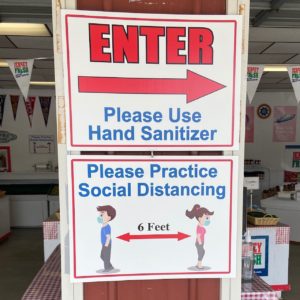
A weekly “On-Farm Direct Marketing” webinar series was hosted in May 2020, by Agricultural Sign for Covid directionsAgents Michelle Infante-Casella, Meredith Melendez, William Bamka, Stephen Komar and Wesley Kline to educate famers selling directly to the public about changes occurring to the industry as a result of the COVID-19 pandemic. Four sessions in May were presented with the last session being a farmer panel discussion about changes on farms forced due to the pandemic. Farmers included Tracy Duffield – Duffield’s Farm Market, Dave Specca – Specca You-Pick Farm, and Jess Niederer – Chickadee Creek Organic Farm. In May, 145 participants attended this online series, offered on Tuesday Evenings from 7:00-8:00 PM. All sessions were recorded and are available to view online. The topics included the following:
Session 1: Maintaining Social Distancing and Food Safety Handling: Guidance for Farm Markets. Recording found at: https://go.rutgers.edu/pqalghh7 – Wesley Kline, Ag Agent, RCE of Cumberland Co. and Meredith Melendez, Ag Agent, RCE of Mercer Co.

Session 2: Meeting Customer Demands for New Jersey Agricultural Products in Response to the COVID-19 Pandemic. Recording found at: https://go.rutgers.edu/8u8r4qb8 – William Bamka, Ag Agent, RCE of Burlington Co. and Stephen Komar, RCE of Sussex County

Session 3: U-Pick Best Management Practices During COVID-10 and Executive Order Compliance. Recording found at: https://go.rutgers.edu/dy026twh  – Meredith Melendez, Ag Agent, RCE of Mercer Co.

Session 4: Farmer Panel – Changes Made to On-Farm Direct Marketing Due to the COVID-19 Pandemic. Recording Found at: https://go.rutgers.edu/zm5msjt0 – Moderators & Co-Organizers: Meredith Melendez, RCE of Mercer Co. and Michelle Infante-Casella, RCE of Gloucester Co.

For more information on COVID-19 Farm Safety and other Food Safety resources see the Rutgers On-Farm Food Safety webpage.

IPM Update 6/03/20

Sweet Corn

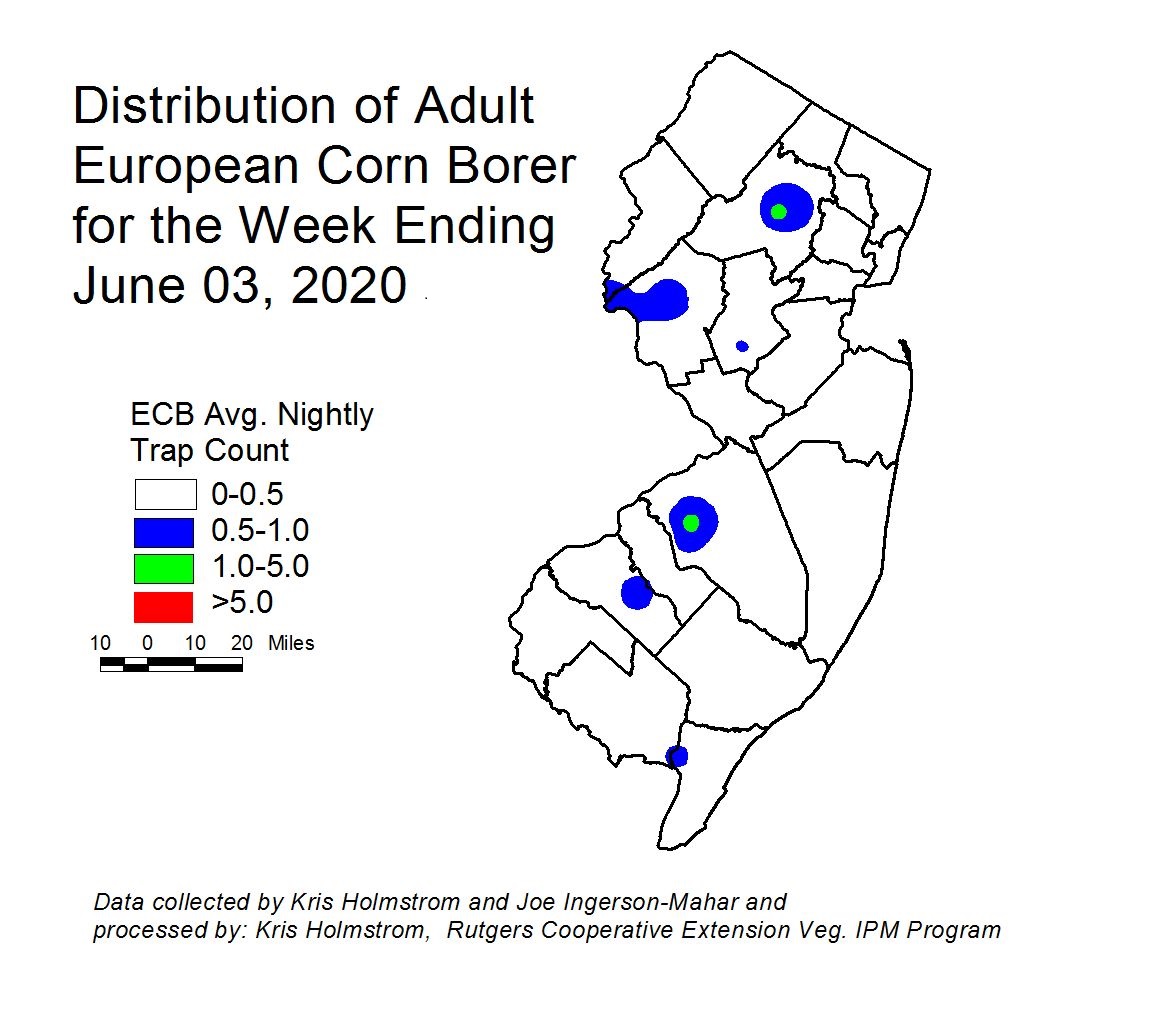
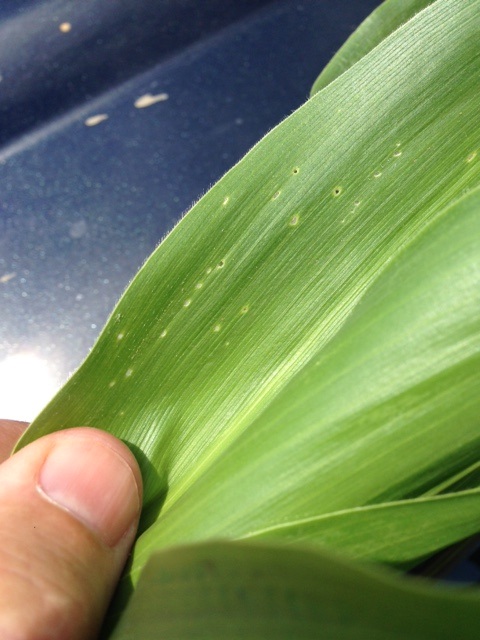
Increasing numbers of European corn borer (ECB) moths have been captured over the past week, although overall numbers remain low.  At this time, activity is highest in central Morris County and western Burlington County (see ECB map at left).  The number of traps registering moderate catches is fairly low, and catches are widely dispersed.  Overall, this year’s population is late, and whether numbers increase much or not remains an open question.  Early corn is now in whorl or pre-tassel stage and able to support ECB larvae.  It is time to begin scouting corn in these advanced growth stages.


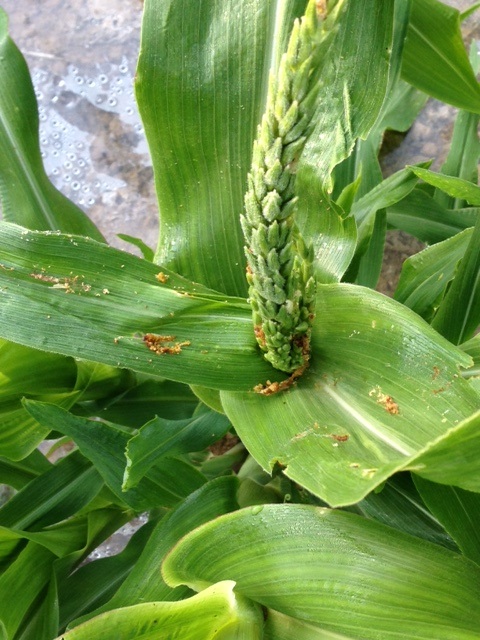
Look for the characteristic “shot-hole” type of feeding (photo below at right) and consider treating when infested plants exceed 12% in a 50 plant sample.  As plantings proceed to the pre-tassel stage, ECB larvae may be found in emerging tassels (see photo at left).  It is a good idea to treat individual plantings as they move into the full tassel/first silk stage one time.  This eliminates any ECB larvae that have emerged with the tassels as they begin to move down the stalk to re-enter near developing ears.

Useful insecticides for this particular application include synthetic pyrethroids (IRAC Grp 3), spinosyns (including OMRI approved Entrust) IRAC Grp 5), and diamides such as Coragen (IRAC Grp 28) or materials such as Besiege which include the active ingredient in Coragen.  Synthetic pyrethroids alone should NOT be used for corn earworm (CEW) protection on silking corn.  Control with these materials is very inconsistent.

The highest nightly trap catches of ECB for the week ending 6/03/20 are as follows:

Denville   2 Clinton   1 Milford   1
Asbury   1 Downer   1 Oldwick   1
Bellemeade   1 Eldora   1 South Branch   1
Califon   1 Medford   1 Springdale   1


Widely scattered, and low catches of corn earworm (CEW) occurred this past week.   While there was an increase in activity over the previous week, this pest does not pose a threat to sweet corn that has not yet reached the silk stage.

The highest nightly trap catches of CEW in black light traps for the week ending 6/03/20 are as follows:

Chester   1 Eldora   1 Milltown   1 Oldwick   1
Crosswicks   1 Elm   1 Morristown   1

[Read more…]

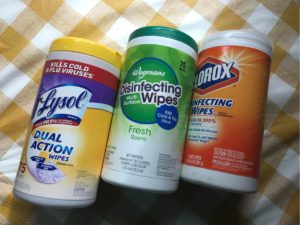
Are Disinfectant Wipes Working for You?

Disinfectant wipes can seem like an easy Disinfecting wipesoption to disinfect surfaces during the COVID-19 pandemic. Label instructions for disinfectant wipes include a “allow to remain wet” statement for efficacy. In many cases, the surface needs to stay wet for at least 4 minutes in order to be effective. Check your product label to verify the time for your specific wipes.

How wet your wipe is to start, how large of a surface you use the wipe on, the surface type and environmental conditions will all impact how long the surface stays wet. In a simple test to evaluate the ability to maintain the required wet time, three disinfectant wipe products were tested on fours surfaces. In an indoor setting at 70 degrees and 60% relative humidity without much air movement these wipes were used on a finished wood surface, a solid countertop, a plastic folding table, and a plastic table cloth. In all cases one wipe on a 4 [Read more…]

EPA Releases Temporary Guidance on Respiratory Protection for Agricultural Pesticide Handlers During COVID-19

U.S. EPA Office of Chemical Safety and Pollution Prevention sent this bulletin at 06/01/2020 03:35 PM EDT Additional Information There is no higher priority for EPA than protecting the health and safety of Americans, especially during the COVID-19 public health emergency. EPA has heard from states and stakeholders about Personal Protective Equipment shortages in the […]