Organic Farm Advisory

The Plant & Pest Advisory serves NJ growers by reporting on important pests and recommending responses that are grounded in reproducible trials.

Articles in this section contain information helpful to the NJ commercial organic grower.
Sharing organic practice trial results between land-grant universities is a cost effective way to create a common knowledge base built on the strengths of individual programs. In the sidebar, find institutions with programs in organic agriculture which augment knowledge developed at the Rutgers New Jersey Ag Experiment Station.

Rutgers Cooperative Extension Field Guides: These concise guides help with decision making from pre-planting to harvest. For each crop listed, learn what pests to proactively look for as the season progresses, how to look for them, and when to take action.

Field Guide List

Monitor for Thrips in Vegetable Crops

Now that spring grains like wheat and rye have dried down and are being combined, thrips in those fields will move to vegetable crops, especially when small grains are adjacent to vegetable fields. Thrips are very small and often missed if casually looking at a plant since they hide in blossoms, under sepals, on under sides of leaves and other protected areas on the stems, leaves and flowers. To scout for thrips look at plant parts mentioned above. It is also important to dissect a flower, pulling back petals and sepals to find hiding thrips. It is difficult to see thrips with the naked eye. Therefore, the use of a hand lens will help.

Most adult thrips are elongate, slender, very small (less than 1/20 inch long), and have long fringes on the margins of both pairs of their long, narrow wings. Immature thrips (called larvae or nymphs) are oblong or slender and elongate and lack wings. Most thrips range in color from translucent white or yellowish to dark brown or black. See the photo of an adult thrips below by Dr. David Kerns, Professor, IPM Coordinator and Extension Specialist, Texas A&M AgriLife Extension, College Station.Thrip

Thrips hatch from an egg and develop through two actively feeding larval stages and two nonfeeding stages, the prepupa and pupa, before becoming an adult. Late-instar larvae change in appearance and behavior and are called prepupae and pupae, even though thrips do not have a true pupal stage.

Females of most plant-feeding species lay their elongate, cylindrical to kidney-shaped eggs on or into leaves, buds, or other locations where larvae feed. Thrips have several generations (up to about eight) a year. When the weather is warm, the life cycle from egg to adult may be completed in as short a time as 2 weeks.

Thrips will feed on most all vegetable crops – solanaceous crops like eggplant, tomatoes, peppers, white potatoes, cucurbit crops like cucumber, squash and melons, bean crops, allium crops like onions, garlic and leeks and others.

Thrips feeding on plants can damage fruit, leaves, and shoots and very noticeably affect plants’ appearance. Leaves may be speckled on the top surface from feeding on under sides of leaves by the insect’s sucking mouthparts. Damage to fruit, like tomatoes may not appear until fruit ripen and can be seen as gold flecks on red tomato fruit. For many thrips species, by the time their damage is seen, such as after flowers open or fruit forms, the thrips may no longer be present.

Once thrips are identified, control can be difficult when they are found in high numbers. Preventative measures like the use of row covers and reflective mulch have some success. Both conventional and organic insecticides labeled for thrips control can be found in the Rutgers Commercial Vegetable Production Recommendations guide under the sections for individual vegetable crops. Always read the pesticide label for instructions, safety precautions, application rates and restrictions. Since thrips hide in tight areas of plant parts it is important to have good coverage and penetration when applying insecticides to reduce the population of this hard to control pest.

For more detailed information about thrips see the Rutgers Fact Sheet https://njaes.rutgers.edu/pubs/publication.php?pid=FS291

Controlling basil downy mildew in the field in 2023

For over a decade, basil downy mildew (BDM) has caused significant losses in basil grown in organic and conventional field and greenhouse production across the United States. At the time of its introduction, there were very few fungicides labeled for its control making it nearly impossible to grow a successful crop in many areas of the country. [Read more…]

Vegetable IPM Update 7/05/23

Sweet Corn

European corn borer (ECB) moth activity is extremely low in areas where blacklight traps are operating in the northern and central counties.  Feeding in whorl and pre-tassel stage corn has increased slightly over the past week, but only in a few areas.  Many plantings exhibiting no ECB injury at all.    While ECB has become something of a local phenomenon in NJ, growers should not assume that feeding is below economic levels in their area.

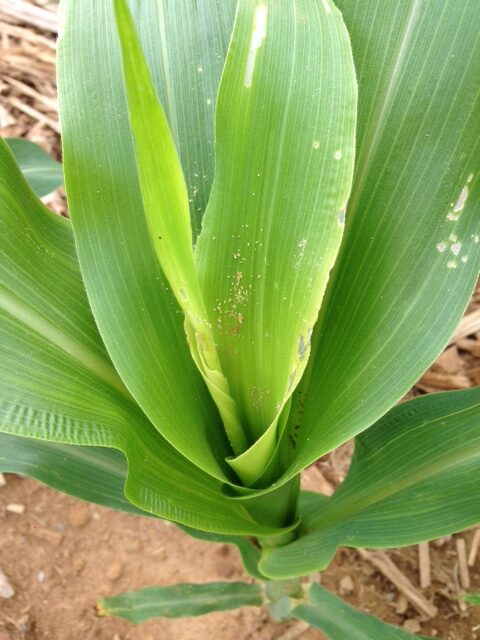
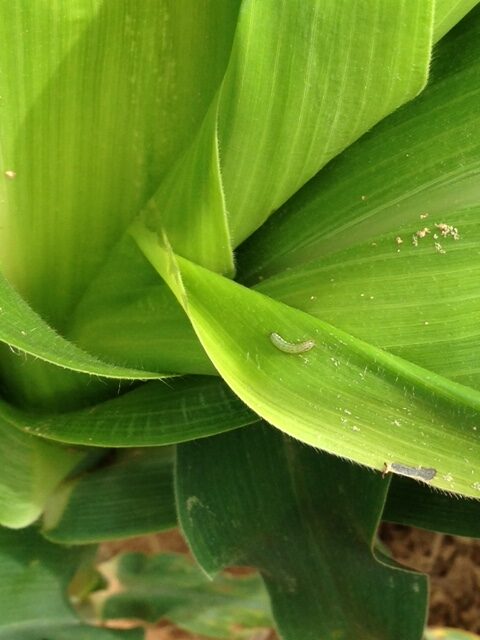
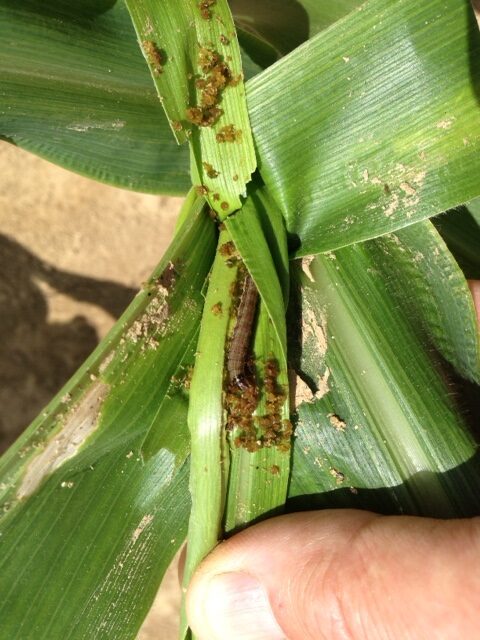
European corn borerLook for the characteristic “shot-hole” type of feeding (photo  below at right) and consider treating when infested plants exceed 12% in a 50 plant sample.  As plantings proceed to the pre-tassel stage, ECB larvae may be found in emerging tassels (see photo at left)It is a good idea to treat individual plantings as they move into the full tassel/first silk stage one time.  This eliminates any ECB larvae that have emerged with the tassels as they begin to move down the stalk to re-enter near developing ears.


Useful insecticides for this particular application include synthetic European corn borerpyrethroids (IRAC Grp 3), spinosyns (including OMRI approved Entrust) IRAC Grp 5), and diamides such as Coragen or Vantacor (IRAC Grp 28) or materials such as Besiege which include the active ingredient in Coragen.  Synthetic pyrethroids alone should NOT be used for corn earworm (CEW) protection on silking corn.  Control with these materials is very inconsistent.

The highest nightly trap catches of ECB for the week ending 7/05/23 are as follows:

Allentown   1 Hillsborough   1
Asbury   1 Milford   1
Bellemeade   1 Lawrenceville   1

[Read more…]

Vegetable IPM Update 6/28/23

Sweet Corn

Low numbers of European corn borer (ECB) moth activity has declined to very low levels in areas where blacklight traps are operating in the northern and central counties.  Feeding in whorl and pre-tassel stage corn has increased only slightly over the past week, with many plantings exhibiting no ECB injury at all.    While ECB has become something of a local phenomenon in NJ, growers should not assume that feeding is below economic levels in their area.

European corn borerLook for the characteristic “shot-hole” type of feeding (photo  below at right) and consider treating when infested plants exceed 12% in a 50 plant sample.  As plantings proceed to the pre-tassel stage, ECB larvae may be found in emerging tassels (see photo at left)It is a good idea to treat individual plantings as they move into the full tassel/first silk stage one time.  This eliminates any ECB larvae that have emerged with the tassels as they begin to move down the stalk to re-enter near developing ears.


Useful insecticides for this particular application include synthetic European corn borerpyrethroids (IRAC Grp 3), spinosyns (including OMRI approved Entrust) IRAC Grp 5), and diamides such as Coragen or Vantacor (IRAC Grp 28) or materials such as Besiege which include the active ingredient in Coragen.  Synthetic pyrethroids alone should NOT be used for corn earworm (CEW) protection on silking corn.  Control with these materials is very inconsistent.

The highest nightly trap catches of ECB for the week ending 6/28/23 are as follows:

Califon   1 Sergeantsville   1
Pennington   1 South Branch   1
Princeton   1

[Read more…]

Vegetable IPM Update 6/21/23

Sweet Corn

Low numbers of European corn borer (ECB) moths remain active in areas where blacklight traps are operating in the northern and central counties, although feeding in whorl and pre-tassel stage corn is low and sporadic in occurrence.  The highest feeding levels are in southern Hunterdon and Monmouth counties.   ECB injury around 20% of plants infested has been found in those areas recently.  While ECB has become something of a local phenomenon in NJ, growers should not assume that feeding is below economic levels in their area.   It is typical for feeding percentages to rise as the moth catch declines.  We expect feeding to increase for the next 1-2 weeks before peaking.

European corn borerLook for the characteristic “shot-hole” type of feeding (photo  below at right) and consider treating when infested plants exceed 12% in a 50 plant sample.  As plantings proceed to the pre-tassel stage, ECB larvae may be found in emerging tassels (see photo at left)It is a good idea to treat individual plantings as they move into the full tassel/first silk stage one time.  This eliminates any ECB larvae that have emerged with the tassels as they begin to move down the stalk to re-enter near developing ears.


Useful insecticides for this particular application include synthetic European corn borerpyrethroids (IRAC Grp 3), spinosyns (including OMRI approved Entrust) IRAC Grp 5), and diamides such as Coragen or Vantacor (IRAC Grp 28) or materials such as Besiege which include the active ingredient in Coragen.  Synthetic pyrethroids alone should NOT be used for corn earworm (CEW) protection on silking corn.  Control with these materials is very inconsistent.

The highest nightly trap catches of ECB for the week ending 6/21/23 are as follows:

Bellemeade   1 Oldwick   1
Califon   1 Pennington   1
Clinton   1 Sergeantsville   1
Lawrenceville   1 South Branch   1

[Read more…]

Webinar: Managing Food Safety Risks in Hydroponic Operations

Incorporate food safety into your hydroponics setup and worker training.

August, 17, 2023 12:00 – 1:00 p.m. Free!
Register online
You will get the link to sign on or call in a few days before the event.

Hydroponic growers use a variety of methods to grow, harvest, and pack produce. This webinar will focus on general best practices in the hydroponic growing environment to reduce the risk of human pathogen growth and spread.
This webinar will focus on risk assessment and management through:
1. Appropriate worker training
2. Evaluation of growing and harvest processes
3. Identification of food contact surfaces
4. Development of a cleaning and sanitation process