Fruit Crops Edition - Wine Grape Section

Seasonal updates on diseases, insects, weeds impacting small fruit (blueberry, cranberry, and wine grape). Fruit Pest Alerts are also available via this category feed.
 
Subscription is through the general Fruit feed available via EMAIL and RSS.

Save the Date – 2018 South Jersey Commercial Tree Fruit Meeting

Dear Growers,

The 2018 South Jersey Commercial Tree Fruit Meeting has been scheduled for February 15. The meeting will be held at, Rutgers Agricultural Research and Extension Center, 121 Northville Road, Bridgeton NJ.

The meeting will consist of presentations on the horticulture, entomology, and pathology of tree fruits during the morning, followed by an included lunch. The Full program will be published in the upcoming weeks.

Pre-registration is required and a fee will be charged to cover the cost of morning coffee/pastries and lunch.

Pesticide Credits Category: Core (2); 10 (6); 1A (07); 3A (07); 3B (01); & PP2 (07)

For registration call or email:

Susan Bradbury at bradbury@aesop.rutgers.edu or (856) 455-3100 x 4101 or

Joan Medany at jmedany@co.gloucester.nj.us or (856) 307-6450 x1

For program details contact: Hemant Gohil at 856-418-6538 or email at gohil@njaes.rutgers.edu
Fruit IPM for August 16, 2017

Peach:

Spotted Wing Drosophila (SWD), Crop Diversity, Alternate Hosts, Wild Grape, Tall Trees and ‘Ready to Eat Fruit, Table-Ripe’ Fruit: Some farms, particularly in northern counties have diverse crops where stone fruit, raspberries, blackberries, blueberries, strawberries, and cherries (all SWD hosts) are grown on the same farm and often next to or close to each other. These same farms may be surrounded by woodlands that include wild chokecherry, wild grape, maturing pokeweed and other alternate hosts for SWD. As the season progresses, be aware that SWD populations go in only one direction – UP! The later the season, then the higher the population, and the greater the pest pressure. This means that the likelihood of infestation is increased, while control is made more difficult if sprays are skipped.

[Read more…]

Delayed Harvest and Extended Storage of ‘Gloria’ Peaches.

‘Gloria’ is a large, yellow-fleshed, freestone, non-melting peach that ripens around mid-August. This late blooming variety, developed by Rutgers New Jersey Agricultural Experiment Station is unique because of its very attractive color, low acidity, distinctive flavor, and very firm flesh. Previously we saw that letting ‘Gloria’ hang longer lets fruit get sweeter and larger. Firm flesh allows for relatively longer hang time on the tree after fruit has reached commercial maturity, providing greater flexibility in harvest scheduling and shipping to growers as well as buyers. We have estimated how long it is safe to let ‘Gloria’ fruit remain on the tree and in cold storage without affecting fruit quality. Studies in two orchards in Southern NJ indicated that; [Read more…]

Grape Root Borer – Do I Need to Treat?

Dean Polk, Statewide Fruit IPM Agent and Dr. Anne Nielsen, Extension Specialist in Fruit Entomology

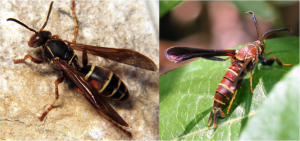
A number of growers have recently asked about treatments for grape root borer. Grape root borer (Vitacea polistiformis Harris) is a comparatively large clearwing moth. The adults can resemble Polistes wasps, and can often be confused with these insects, especially since it is often easier to see a wasp in a vineyard than an adult grape root borer. See the images that compare the 2 insects below in Figure 1.

Figure 1. Polistes wasp on left, compared to male grape root borer on right. Credits Hermann 2012 and Copeland 2012.

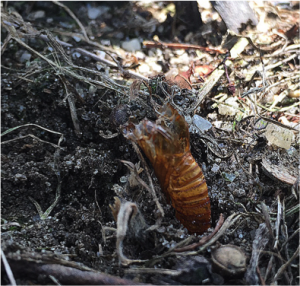
One important difference is that grape root borer (GRB) larvae feed inside grape roots, while wasp larvae do not. Although the grape borer is more of a southern pest, it is present in New Jersey and can be a pest that does significant damage. Adult females lay eggs on the vine surface and on weeds near the crown. Shortly after hatching the larvae enter the crown and central root system, boring into the roots where they can last for 2 years. When the larvae mature, they exit the wood and pupate close to the soil surface where they emerge from early July through August. GRB is not considered an economic pest until about 5% of the vines are infested. This is determined by examining the bases of numerous vines at weekly intervals for signs of adult emergence, or pupal cases (exuvia), throughout the summer, see Figure 2. Pheromone traps can also be used to measure adult emergence, but since they attract moths from both the surrounding woods and vineyards, they are practically useless to tell us what is going on in any specific vineyard. Counting pupal cases is labor intensive, but does tell us if the vineyard is or is not truly infested.

Figure 2. Pupal case from newly emerged adult GRB.


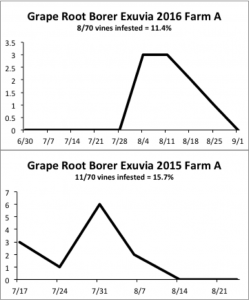
During 2015 -’16 we monitored 2 plantings at each of 9 vineyards. During that time we found 3 vineyards that had populations of GRB that merited treatment, or were above the 5% infestation level. While infestation levels can change over time, this does tell us a few things about GRB in NJ. First, about 33% of the vineyards we sampled had economic populations of GRB. Therefore growers need to determine if they indeed have GRB populations that merit treatment prior to actually doing a GRB treatment. Secondly most GRB adults emerged from the soil a little later than we first thought. Counting the pupal cases over time, we can get an emergence curve as in Figure 3. This vineyard does merit treatment, since the total vines infested is over 5%. Most of the insects that emerged peaked in late July and early August.

Figure 3. GRB exuvia counts over time Farm A, 2015, ’16.

Treatments: If the vineyard has an economic population, then the standard treatment would be using Lorsban at the start of adult emergence, which would be now in most years. The material is applied to the soil around the base of each vine, and forms a barrier that kills young larvae as they burrow into the soil and root system. Growers can use any of several formulations. The rates vary depending on the formulation that is used. Lorsban Advanced: Use 4.5 pt/100 gal, with 2 qt applied to a 15 sq ft area around each vine; Lorsban 4E: Use the same amount as with the ‘Advanced’; Lorsban 75WG: Use 3 lb/100 gal, with 1.5 qt applied to 11 sq ft around each vine. There is a 35 day PHI with Lorsban products for grapes. Do not contact the fruit surface, and apply only to the soil at the base of each vine.

Fruit IPM for 7/13/17

Peach:

Oriental Fruit Moth (OFM): The 3rd OFM flight is well underway in all counties. These adults produce 3rd brood of larvae, which primarily infest the fruit.

[Read more…]

Spotted Lanterfly

Have you seen this Insect?

Some people may think it is a moth but it’s really a plant hopper known as the spotted lanternfly, Lycorma deliculata (White) and is a member of the order Hemiptera, family Fulgoridae.

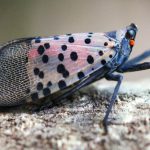
Spotted Lanternfly adult. Adults are about 1″ long

Its normal distribution is in eastern Asia, China, India, and Vietnam and has been found in Japan and South Korea. The adults are large (~1” long) and quite colorful with a black head, grayish black spotted forewings and reddish black spotted hind wings.

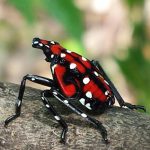
Young juveniles are black with white spots and as they get older they become red and black with white spots.

Spotted lanterfly nymph. Nymphs are black with red markings and white dots. Do not confuse them with BMSB nymphs which do not have spots and have white banding on the antennae.

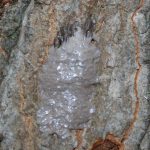
Egg masses are brownish grey and generally laid on bark in early fall and appear like a smudge of mud. Egg masses are 1-1.5” long and ½ – ¾ “ wide and survive the winter.

 This insect was accidentally introduced into Pennsylvania and was confirmed in the state September of 2014. At first it was also found in Berks County, however, today it has been collected from Lehigh, Northampton, Bucks, Montgomery, and Chester County. Cities in these counties where Spotted Lanternfly has been found are currently under quarantine meaning that live Spotted Lanternfly and any material or object that can spread the insect cannot be moved from the quarantine area. Inspection of shipments for egg masses and subsequent removal may be an effective management tool if it becomes established in New Jersey. The Pennsylvania Department of Agriculture has a video series on egg mass scraping.

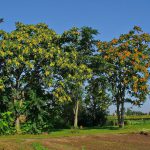
The spotted lanternfly is known to feed on more than 70 plant species including cultivated grapes, fruit trees, and hardwood trees. One tree of particular importance is Ailatus altissima (P. Mill) or the “Tree of Heaven”.

Tree of Heaven

Tree of Heaven typically grows in sunny areas along highways or disturbed habitat in clumps such as along farm edges. The Spotted Lanternfly must feed on Tree of Heaven to survive. Spotted Lanternfly has a sucking mouthpart and produces significant amounts of excess sugar from the plant sap, known as “honey dew”, during feeding. Honeydew can block sunlight absorption and reduce plant growth. We are concerned about this insect becoming established in New Jersey grape vineyards. In grapes, the honeydew produced during feeding is difficult to wash off and can reduce grape quality and perhaps growth. A 2015 and 2016 of 9 vineyards within southern New Jersey by the fruit entomology lab did not observe any spotted lanternfly adults or nymphs. However, in Pennsylvania, adults and nymphs were found in commercial vineyards in 2016 in Chardonnay, Concord, and Niagara plantings, although populations were low. Vineyard rows neighboring forested edges are at highest risk.

Egg mass


Additional information regarding this insect can be found at:

The Pennsylvania Department of Agriculture

Penn State Extension


If you think you seen or collected a spotted lanternfly please report it the New Jersey Department of Agriculture and the Department of Entomology at the Rutgers University School of Environmental and Biological Sciences by emailing slanternfly@njaes.rutgers.edu. This post was written by Anne L Nielsen and George C. Hamilton from the Department of Entomology.