Fruit Crops Edition

Seasonal updates on diseases, insects, weeds impacting tree fruit and small fruit (blueberry, cranberry, and wine grape). Fruit Pest Alerts are also available via this category feed.
 
Subscriptions are available via EMAIL and RSS.

Redroot and Smooth Pigweed: Non-Herbicide Management Options in Specialty Crops

Redroot and smooth pigweeds reproduce in abundance by seed which is easily transported across a farm. Using knowledge about the life cycle of this weed is important when making management decisions that require time and effort throughout a growing season. Learn more about non-herbicide management methods to control smooth and redroot pigweed populations on your farm by using the smooth and redroot pigweed decision tool fact sheet and a companion presentation.  These resources are one of a five-part weed management series created by Extension Specialist Thierry Besancon and County Agricultural Agent Meredith Melendez, funded by USDA Specialty Crop Block Grant AM190100.  You can provide feedback through an online survey about these resources.Redroot plant sprouting

SARE Farmer Grants for 2023 – Webinar on October 4th

Truck spreading fertilizerMultiple Northeast SARE (Sustainable Agriculture Research and Education) grant recipient Tommye Lou Rafes, of T.L. Fruits and Vegetables in West Virginia, is sharing her experiences to help other farmers experiment with new ideas through the Farmer Grant program.

At noon on October 4th, 2022, Rafes will join Northeast SARE Grant Coordinator Candice Huber for an informational webinar to assist farmers interested in applying for up to $30,000 in funding for projects beginning in March 2023. Registration is required and participants are encouraged to submit questions ahead of the event. The Call for Farmer Grant Proposals is currently available and the online system for submitting applications is opening soon. Applications are due November 15, 2022.

Northeast SARE Farmer Grants are perfect for farmers looking to grow through new practices. Rafes first learned about SARE while attending a Good Agricultural Practices (GAP) training. One of the professors hosting the meeting was a SARE reviewer who invited the attendees to apply for a grant. Rafes knew sustainable practices like using renewable-powered high tunnels to extend growing seasons could be good for business as well as the planet. “Growing in the winter months is a completely different way than you do in the summer months,” she said. “I decided to test varieties that were successful during the winter months as well as growing conditions that could be improved so that people would be more successful.”

Grant Coordinator Candice Huber says Farmer Grants are an opportunity for farmers to try things that could improve their operations. SARE funds can cover the farmer’s time on the project, any farm workers time spent on the project, supplies that are not capital purchase, technical support, soil testing and other budgeted items. Farmer grant projects generally are for one year.

If you have an idea and you need resources to really explore it, a Farmer Grant can connect you with those resources. This webinar will be a good starting point and participants must pre-register. See below.

To sign up for the October 4th webinar at 12:00PM go to https://us02web.zoom.us/webinar/register/6516611235851/WN_RoG_IkMmSDGsduZwmFgKkA

For information about the application for SARE Farmer grants see https://www.sare.org/wp-content/uploads/Northeast-SARE-Farmer-Grant-Call-for-Proposals.pdf

For general information about Northeast SARE go to Northeast SARE Home Page – SARE Northeast

Hairy Galinsoga: Non-Herbicide Management Options in Specialty Crops

Hairy galinsoga spreads throughout a farm by seeds that germinate quickly once exposed to light, with multiple generations in a growing season.  Using knowledge about the life cycle of this weed is important when making management decisions that require time and effort throughout a growing season. Learn more about non-herbicide management methods to control hairy galinsoga populations on your farm by using the hairy galinsoga decision tool fact sheet and a companion presentation.  These resources are one of a five-part weed management series created by Extension Specialist Thierry Besancon and County Agricultural Agent Meredith Melendez, funded by USDA Specialty Crop Block Grant AM190100.  You can provide feedback through an online survey about these resources.Hairy galinsoga

SLF: 2022 Management Recommendations in Vineyards

by Katarzyna Madalinska and Anne L. Nielsen

Adult SLF are moving into vineyards from the surrounding landscape. The number of SLF on each vine varies greatly within each vineyard and locations in the state. In most vineyards in NJ and PA there is a strong border effect with numbers highest along the outside rows. However, the orientation and shape of your vineyard influences border effects. SLF are actively feeding on grapevines and will continue to feed for 1-2 months. Most SLF are in the upper canopy and as the grapes start to store carbohydrates for the winter, SLF will move down the vine, eventually feeding at the base of the vine. Research suggests that feeding by adult SLF may harm primary bud formation the following season and reduce winter hardiness. There is not a specific treatment threshold, but a good rule of thumb is 10 SLF per vine. Movement into the vineyards will continue for several weeks so multiple insecticide applications may be needed.

Treatment at this time of year is of course complicated by pre-harvest intervals (PHI) for each insecticide and grape variety. It is important to remember that SLF will feed on vines post-harvest. There are several effective insecticides available with pre-harvest intervals and residual activity (Table 1). When treating vines pre-harvest, dead SLF are commonly observed in the clusters. Post-harvest, insecticides such as Danitol or Brigade/Bifenture/bifenthrin have the longest residual activity and are expected to reduce feeding.

There are several reasons to manage adult SLF in September and October during peak movement.

  1. Adults feed on the canes, cordon, and trunk of grape vines. Excessive feeding has been shown to lower winter hardiness by >1.5°C.
  2. SLF females lay egg masses in October. Killing females prior to egg laying will decrease population growth the following year.

Table 1. Effectiveness of Insecticides Against Spotted Lanternfly Adults. Modified recommendations from Leach et al. Crop Protection 2019 v. 24  DOI:10.1016/j.cropro.2019.05.027

Trade name Active ingredient SLF Activity Rate per acre Seasonal Allowance Residual Activity PHI

(days)

REI

(hrs)

Labeled for SLF?
Mustang Maxx 0.8EC cypermethrin Good 4 oz 24 oz <3 1 12 Yes, 2(ee)
Scorpion 35SL dinotefuran Excellent 5 oz. 20.9 oz <7 1 12 Yes, 2(ee)
Actara 25WDG thiamethoxam Excellent 3.5 oz 7.0 oz <14 5 12 Yes, 2(ee)
Carbaryl 4L carbaryl Excellent 1-2 qt 10 qt 7 7 12 No
Avaunt 30DG indoxicarb Fair 6 oz 12 oz 7 7 12 Yes, 2(ee)
Danitol 2.4EC fenpropathrin Excellent 16-21.33 oz 42.66 oz >26 21 24 Yes, 2(ee)
Brigade 2EC bifenthrin Excellent 3.2-6.4 oz. 6.4 oz 21 30 12 Yes, 2(ee)


There are several reasons to manage adult SLF in September and October during peak movement.

  1. Adults feed on the canes, cordon, and trunk of grape vines. Excessive feeding has been shown to lower winter hardiness by >1.5°C.
  2. SLF females lay egg masses in October. Killing females prior to egg laying will decrease population growth the following year.

Notes from the 2021 Chardonnay Wine Tasting and Evaluations Workshop

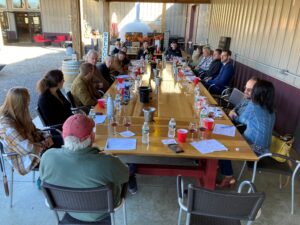
A Chardonnay wine tasting and evaluation workshop for winemakers was held on August 18, 2021, at the William Heritage Winery, located in Gloucester County. Chardonnay is one of the most suitable Vitis vinifera varieties for New Jersey for both north and south New Jersey. It is also one of the best white varieties for New Jersey in terms of consistency in ripening. It can be easily adapted in the winery for Sparkling, dry still varietals, and white wine blends. For example, a few wineries blended 75-80% Chardonnay with the remaining comprised of Pinot Noir, Pinot Gris, and Sauvignon Blanc. The responses to a survey weeks before the event formed the basis of discussion at the workshop. Winemakers also described how they accomplished each of their wines. [Read more…]

USDA Assistance for On-Farm Food Safety Expenses


The United States Department of Agriculture (USDA) has a new program to offset some expenses related to preparing for the food safety requirements.  The “Food Safety Certification For Specialty Crops” (FSCSC) will cost share expenses for:

  • Developing a food safety plan for first-time food safety certification.
  • Maintaining or updating an existing food safety plan.
  • Food safety certification.
  • Certification upload fees.
  • Microbiological testing for products, soil amendments and water.
  • Training.

The FSCSC application period for 2022 is June 27, 2022, through January 31, 2023, and the application period for 2023 will be announced at a later date. Farm Service Agency will issue payments at the time of application approval for 2022 and after the application period ends for 2023. If calculated payments exceed the amount of available funding, payments will be prorated.

Interested specialty crop producers can apply by completing the FSA-888, Food Safety Certification for Specialty Crops Program (FSCSC) application. The application, along with other required documents, can be submitted to the FSA office at any USDA Service Center nationwide by mail, fax, hand delivery or via electronic means. Producers can visit farmers.gov/service-locator to find their local FSA office. Specialty crop producers can also call 877-508-8364 to speak directly with a USDA employee ready to assist.

Farm Storage Facility Loans

A second program that has been available for several years is the farm storage loan program.  This covers cold storage construction along with equipment in a packing operations such as baggers, brush polishers, bulk bin tippers, cement flooring, circulation fans, dip tanks, conveyors, graders, refrigeration units, sizers, sorting bins and tables, trucks, washers, waxers, etc.  A grower may borrow up to $500,000 for up to 12 years.  If an operation needs to make major changes in a packinghouse or needs a refrigerated truck this program is worth considering.  Contact your local FSA office for details.

 RAM-AMS Harmonized GAP Assistance Program

The USDA Risk Management Agency (RMA) and USDA Agricultural Marketing Service (AMS) covers the cost of voluntary USDA Harmonized GAP and Harmonized Plus audits.  This is only available for growers, producer cooperatives and food hubs.  Once the audit is completed USDA will generate a bill to the auditee which summarizes the cost and then show a credit for the same amount.  The funds will cover 100% of the audit fees.  These funds are available for 2022 which may be the last year of availability.