Fruit Crops Edition - Cranberry Section

Seasonal updates on diseases, insects, weeds impacting small fruit (blueberry, cranberry, and wine grape). Fruit Pest Alerts are also available via this category feed.
 
Subscription is through the general Fruit feed available via EMAIL and RSS.

Don’t Let Your Guard Down With Farm Worker Health

The COVID-19 pandemic highlighted the critical and essential role of farm labor in getting food from farm to plate. However, health concerns should not stop with a negative COVID test or vaccine, especially if an employee or family member is exhibiting any of the ‘flu-like’ symptoms that are associated with corona virus.

From the Vermont Law School Center for Agriculture and Food Systems (CAFS) – “The CAFS launched the Food System Worker Law and Policy Project in 2021 with research focused on farmworkers, who—despite forming the backbone of a trillion-dollar industry in the U.S.—face a level of occupational risk unrivaled by most workers. From repeated exposure to pesticides and extreme heat, …. ” Their newly published “report titled “Essentially Unprotected: A Focus on Farmworker Health Laws and Policies Addressing Pesticide Exposure and Heat-Related illness,” … May 2021, provides an overview of the findings as well as policy recommendations that are urgently needed to protect farmworkers.”

Typically not seen until July, we’ve already had 3 heat waves beginning in May that expose workers to a number of potential health risks that may present very similar symptoms and can be equally health, and even life, threatening. Published studies from the Rutgers Institute of Earth, Ocean, and Atmospheric Sciences suggest growing numbers of people worldwide are at risk of heat stress and related complications, including farmers and ag laborers working in high heat and humid conditions. Last year, OSHA-NIOSH released a Heat Index App (in English and Spanish at the Apple App Store or Google Play) featuring:

  • A visual indicator of the current heat index and associated risk levels specific to your current geographical location
  • Precautionary recommendations specific to heat index-associated risk levels
  • An interactive, hourly forecast of heat index values, risk level, and recommendations for planning outdoor work activities in advance
  • Editable location, temperature, and humidity controls for calculation of variable conditions
  • Signs and symptoms and first aid information for heat-related illnesses

For more information about safety while working in the heat, see OSHA’s heat illness webpage, including online guidance about using the heat index to protect workers.

In addition to heat stress, harvesting and other activities along field edges, including going into the woods instead of using a portable bathroom facilities, create a high risk for tick bites which can also carry a number of diseases, many as or more debilitating than Lyme disease. It is critical for your employees’ health and well-being to get proper diagnosis and treatment for all of these ailments. This table illustrates how many tick-born diseases, as well as heat stress, all have potential symptoms very similar to those of COVID-19. Each is linked to additional resources at the CDC. In many cases, it may be the ‘other symptoms’ that may be unique to each disease and assist a medical practitioner with correct identification and lead to better verification with further testing.

   Disease    >

Symptoms  v

COVID-19 Heat Stress Lyme Disease Ehrlichiosis Babe- biosis Powas-san Rocky Mtn Spotted Fever
Vector* Human Black-legged Tick (a.k.a. Deer Tick) (I. scapularis) Lone Star Tick (A. americanum) & Black-legged Black-legged Tick Ground hog(I. cookei), Squirrel (I. marxi) & Black-legged Ticks American Dog Tick (D. variabilis)
Fever or chills X X X X X X X
Cough X X
Shortness of breath/difficulty breathing X
Fatigue X X X X
Muscle/body aches X X X X X X
Headache X X X X X X X
New loss of taste or smell X
Sore throat X
Congestion or runny nose X
Nausea/vomiting X X X X X X X
Diarrhea X X
Rash X X X
Other symptoms X X X X X X
Potentially Deadly/Disabling
X X X X X X X

*NOTE – main vector listed, but many tick born diseases may be vectored by other species of ticks, or different species causing same disease may be carried by different tick species.
Sparganothis Fruitworm Degree-Day Update: as of June 27, 2021

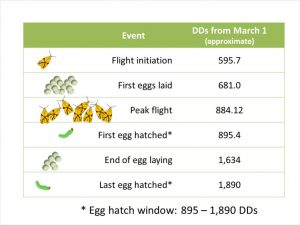
Based on our degree-day (DD) model for Sparganothis fruitworm, first eggs hatch at about 895 DD (see chart). As of June 27, Sparganothis has accumulated 991.5 DD (using April 15 as biofix). This indicates that eggs have started to hatch, and fruit will become susceptible to infestation since larval injury to fruit usually begins after the eggs hatch. According to our model, peak flight should have occurred about a week ago (around June 20). Insecticide applications are usually recommended 10-14 days after peak flight (i.e., June 30-July 4). Most beds should be close to the end of bloom. If trap counts have been high, growers should consider treatment by the end of next week (depending on the variety and time of winter flood removal) to prevent damage to berries. If spraying when bees are present, your option is to use an insect growth regulator (IGR), such as Confirm or Intrepid, or the diamide Altacor. Our “standard” recommendation has been, however, to wait until bees are removed to apply an insecticide. Your post-bloom options include the organophosphate Diazinon, the diamides Altacor, Verdepryn, or Exirel, the spinosyn Delegate, or the IGR Intrepid. Timing of insecticide application is critical; so, if needed, do not wait too long to manage this pest.

Degree-day model for Sparganothis fruitworm

Degree-day model for Sparganothis fruitworm

Sparganothis Fruitworm Degree-Day Update: as of June 06, 2021

Based on our degree-day model for Sparganothis fruitworm, flight initiation is expected at around 596 DD (see chart). As of June 06, Sparganothis has accumulated 706 DD (using March 1 as biofix; based on Wisconsin conditions) or 554 DD (using April 15 as biofix; a more realistic biofix based on the time when winter flood is removed from New Jersey beds). This indicates that flight activity has likely just started or will start in the next few days. Growers are advised to place pheromone traps for monitoring this pest as soon as possible if they haven’t done so already.

Degree-day model for Sparganothis fruitworm

Degree-day model for Sparganothis fruitworm

Sparganothis Fruitworm Degree-Day Update: as of May 30, 2021

Based on our degree-day model for Sparganothis fruitworm, flight initiation is expected at around 596 DD (see chart). As of May 30, Sparganothis has accumulated 607 DD (using March 1 as biofix) or 455 DD (using April 15 as biofix; a more realistic biofix based on the time when winter water was removed from most NJ beds). The later biofix indicates that flight activity will start very soon, i.e., within a week from now. Thus, growers are advised to place pheromone traps for monitoring this pest this coming week.

Degree-day model for Sparganothis fruitworm

Degree-day model for Sparganothis fruitworm

Recordings of the 2021 Spring Wine Grape Twilight meeting

Please use the below links to listen or watch the recordings from the 2021 Spring Wine Grape Twilight meeting held on May 19th.

Audio Recording link: https://go.rutgers.edu/6kigewvp

Video Recording link: https://go.rutgers.edu/efy1iu7h [Read more…]

Managing Blunt-nosed Leafhoppers in Cranberries

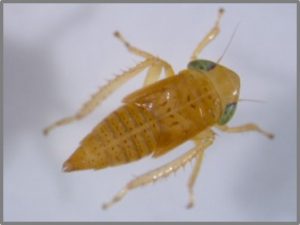
Blunt-nosed leafhoppers (BNLH) continue to be an increasing threat to cranberries in NJ. BNLH has one generation a year. It overwinters as

BNLH nymph

Picture 1. BNLH nymph. Photo by Elvira de Lange.

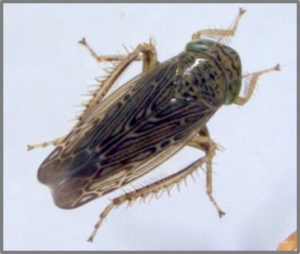
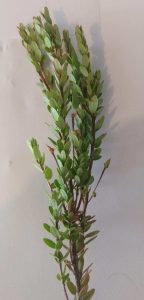
eggs, which begin to hatch in early May. The nymphs (Picture 1) will go through five instars in about a month. The adults (Picture 2) begin to appear by the end of June and are most abundant in mid-July. Numbers of this species start to diminish by the end of July. The adults have a characteristic blunt head and vary from light yellowish-gray to dark brown. Eggs are laid in June-July. Nymphs and adults get their food by sucking the juices of the cranberry vines with their piercing-sucking mouthparts. This direct injury is, however, not noticeable. They are most important as vectors of false blossom disease (Picture 3). Typical disease symptoms include distinctive branching of the upright shoots (witches’ broom) and malformed flowers where flowers stand erect and petals are redder than normal.

Here are some guidelines to consider when managing BNLH in cranberries:

  1. The most important point in BNLH control is locating the sites of infestation. Monitoring for this insect is accomplished best with an insect sweep net. Nymphs should be monitored before bloom using sweep nets (this time of year). Nymphs before bloom are small; thus, you may need to freeze the samples (to kill them), and then count the number of nymphs under a microscope or using a magnifying lens.
  2. To monitor, perform sweep sets of 25 sweeps each. The recommended number of sweep sets is: 1–3 sweep sets per 1–
    BNLH adult

    Picture 2. BNLH adult. Photo by Elvira de Lange.

    10 acres, at least 10 sweep sets per 10–20 acres, and 1 sweep set per 2 acres for more than 20 acres.

  3. A challenge for managing BNLH is the fact that they vector a phytoplasma that causes false blossom disease. For this reason, it is difficult to establish economic thresholds for this pest because we do not know the proportion of individuals that are infected in the population. Moreover, this proportion can vary depending on the variety. For instance, we have observed higher incidence of infection in the newer varieties even when populations of leafhoppers are low.
  4. Although they need to be tested, based on experience, I came up with the following tentative treatment thresholds: An average of 20 nymphs per sweep set if it is a new variety bed, bed with young plantings, and/or a bed that has a recent history of false blossom. Or, an average of 40 nymphs per sweep set if it is an older bed and older variety with no previous history of false blossom.
  5. If BNLH populations are increasing compared to previous years and the beds have not been treated for BNLH for 2-3 years, growers should consider treatment.
  6. If growers have treated for BNLH in the previous year and populations are low (average of less than 10–20 BNLH per sweep set), there is no need to treat again. Keep a record of the BNLH numbers and check those same beds again the following year to see if the numbers increase.

    False blossom-infected cranberry vine

    Picture 3. False blossom-infected cranberry vine.

  7. In most cases, there is no need to apply broad-spectrum insecticides (organophosphates, carbamates) to control BNLH for two or more consecutive years. These insecticides will disrupt the biological control of other pests such as Sparganothis fruitworm and therefore cause increases in insecticide use.
  8. If treatment is necessary, we have limited options to manage BNLH. The best timing for insecticide treatment is before bloom to target the young nymphs. We recommend the use of organophosphates such as Lorsban (chlorpyrifos) and Diazinon (diazinon), and carbamates like Sevin (carbaryl). The neonicotinoid Assail (acetamiprid) also works well against nymphs, but we do not recommend the use of neonicotinoids before bloom due to potential negative effects on bees-neonicotinoids are systemic insecticides that can accumulate in the pollen and nectar. A new registered insecticide, Closer (sulfoxaflor), is also effective against BNLH nymphs. Although Closer has a similar mode of action as the neonicotinoids, it belongs to a different class of insecticides. Closer use is prohibited during bloom (between 3 days prior to bloom and until after petal fall).
  9. Trials will be conducted this year at the Rutgers P.E. Marucci Center with existing and new insecticides against BNLH nymphs.