Needs Assessment Survey for RU Ready to Farm Beginner Farm Training Program

The Rutgers Cooperative Extension Training Program-RU Ready to Farm is looking for input from beginner farmers on what types of subjects they would like to see covered. The 2022 season of RU Ready to Farm will feature in person workshops that are open to the general beginner farmer community, and the focus and content of these workshops will be designed according to community need and interest. If you have been farming for fewer than 10 years and would like to contribute to the development of this workshop series, the survey can be found here: RU Ready to Farm Needs Assessment

For more information about the RU Ready to Farm program, visit: https://rubeginnerfarmer.rutgers.edu/


Lightning strike awareness for pasture producers

The intense lightening storm of May 26th that impacted most of New Jersey is a reminder that pastured livestock are also at risk from more than heat exhaustion as summer progresses.

Network for Lightning and Thunderstorms

Network for Lightning and Thunderstorms in Real Time map by Blitzortung.org for the storm system that moved across New Jersey on May 26th.

Measures to protect livestock from predators, sun exposure and dehydration should take lightening strikes into consideration. Lightening can kill animals by direct and indirect pathways and start fires in tinder dry grasses. A true act of nature, lightening deaths are random but producers can take steps to minimize losses from man-made structures, trees and water sources.

Tree shade: Lightening electricity seeks the path of least resistance. Different trees contain different amounts of sap and water making some a better conductor of lightening than others. “Among the most common tree species that get hit by lightning are oak, gum, maple, poplar, and pine trees.”  – https://www.americanarborists.net/tree-tips/2017/june/what-to-do-if-your-tree-is-struck-by-lightning-/

Cotton woods are a type of poplar. A single cottonwood can intake between 50 and 200 gallons of water every day, making them a potential risk to livestock during severe storms. In general, the more surface roots a tree has the more danger to livestock crowded around the tree. Rows of trees theoretically spread out the possibility of lightening strikes and less livestock are crowded under a single tree. Avoid having livestock in pastures on high ground with trees during these storms.

Poorly drained areas: Naturally occurring wet areas and wet areas associated with irrigation pumps and rigging increase the potential risk to livestock from lightening strikes. Grazing of livestock in and around these structures and others like solar panels should be restricted when severe storms are forecasted.

Fence and metal gate grounding: When lightening strikes the voltage will follow electric fence wires back to the charger and then into the ground rod. Grounding rods are recommended to be in the ground five feet to dissipate lightening safely. If livestock are crowded up against fence or have their heads through metal gates, they become the grounding rod. Woven electrified fence increases the surface area that animals may come in contact with.The charger itself may not survive a lightening strike. Fence chargers are expensive investments, turn off the charger and disconnect it prior to severe storms when feasible.

Metal water troughs: In crowded pens, metal and even rubber water troughs are a lightening injury risk to livestock. Again, this is due to the animal becoming the conduit to the water soaked ground. General guidelines suggest animals should be separated (not forced to congregate due to enclosure size) at least 50 feet from water troughs during lightning storms.

Temporary shelters: Temporary shelters to limit sun exposure and prevent heat exhaustion should be properly grounded and made of materials that limit electrical conductivity. Emergency shelters made of hay bale rings and metal panel gates with plywood or tarp roofs during high heat warnings should be temporary; and removed when lightning storms are forecasted.

Roosts: Chickens will roost where they are when dusk arrives. Evaluate pasture poultry locations for areas that chickens are using to roost and take measures to limit their roosting on objects that conduct electricity.

Buried commercial utility lines. I lost a first calf heifer to a lightening strike a few years back. A tree in a cemetary nearly a mile away along the same path as the phone line took a direct hit as did another tree on the opposite end of the pasture. The cow was standing directly over the buried unmaintained line and died instantly. Note the copper line was installed more than fifty years ago and through heave and thaw presumably had a crack in the insulation at that location. As farm usage and ownership changes over the decades, be familiar with what is buried on your farm in utility right of ways that may no longer be maintained.

Lightening insurance. Farmers can cover their losses by adding lightening protection to their policy. USDA also covers eligible lightening losses under their Livestock Indemnity Program. For general information see this 2009 article  https://www.fsa.usda.gov/Internet/FSA_File/29229200909.pdf and contact your local FSA office for current program requirements.

For more information on insulating your farm against lightening, see ‘Lightning Protection for Farms’ by National Ag Safety Database. https://nasdonline.org/1882/d001825/lightning-protection-for-farms.html

Management of italian ryegrass

Below is a pdf on ‘Italian Ryegrass Management in Soybeans’ by Take Action Partners on herbicide resistance management.

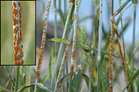
Italian rye grass and its hybrids are a common grass in head right now along field edges and in fall planted grains or as a weed of pure stands of hay crops. Ryegrass is difficult to control in most crops due to its emergence biology, tillering and resistance to herbicides.

“Technical editing for this publication was led by Larry Steckel, Ph.D., University of Tennessee, Knoxville; and Jason Bond, Ph.D., Mississippi State University, in partnership with other universities in the soybean-growing regions of the United States. Take Action is supported by BASF, Bayer, DuPont, Dow, FMC, Monsanto, Syngenta, Valent and corn, cotton, sorghum, soy and wheat organizations.” For more information and links to additional resources, visit www.IWillTakeAction.com.™

https://iwilltakeaction.com/uploads/files/57229-7-ta-hrm-factsheet-italianryegrass-r2-final.pdf

For management in forage hay crops, see the Oregon State publication “MANAGEMENT OF ANNUAL RYEGRASS CONTAMINATION IN TALL FESCUE AND ORCHARDGRASS GROWN FOR SEED” https://cropandsoil.oregonstate.edu/system/files/curtis_annual_ryegrass.pdf


NJ Secretary of Ag Fisher Addresses Governor’s Executive Order #243

NJ Governor Murphy signed Executive Order #243 rescinding EO#107 which requires employers to accommodate tele-work options for employees, and also lifts indoor mask mandates and 6ft social distancing requirements for vaccinated employees working indoors in businesses not open to public. Secretary of Agriculture Douglas Fisher has provided a summary of the changes that may impact agriculture operations. The full text of his letter is attached here.

Monitor field edge and in-field large seeded weed emergence pattern

Ivy-leaf morning glory seedlings with one set of true leaves seemingly sprang up over night with the storms that tracked across Southern NJ Wednesday night. This large seeded annual twining vine can significantly reduce yields in soybeans. Where in the field these seedlings are located should be monitored closely over the next few days. Don’t assume preemergence herbicides that have activity on seedlings up to four-inch morning glories are still going to do the job. It all depends on how many days (or weeks) went by since herbicides were applied and if this was the first activating rainfall since application.

Morning glory seeds can germinate at multiple depths in the soil profile escaping what soil residual activity was present before the rains came. Scouting cues of suppressive herbicidal activity from products like Valor, Canopy, Classic, Authority, Flexstar, Firstrate are: Noticeably larger plants along field edges that did not receive spray coverage, and more of them; but few plants further into field interiors where herbicides were applied. Look also for signs of herbicide activity over the next few days.

Preemergence products with some activity on morning glories have group 2, 5 and 14 modes of action and have somewhat similar symptoms of weed injury. “Seedling weeds will then either turn brown and die shortly after being exposed to light, or will cease growing, turn yellow and then turn brown from the growing point out.” – page 4, 2010 Valor XLT Soybean Label, Valent Product EPA Reg. No. 59639-117).

Even one morning glory left unchecked in a foot of row can reduce soybean yield in that row by 50%. If flushes of morning glories are emerging throughout the soybean crop, consider lightly cultivating if at all possible if row spacing permits before that early (full season) flush of morning glories have a chance to entwine. However, keep in mind that cultivation will incorporate surface applied herbicides. Too deep and this could reduce effectiveness against small-seeded broadleaf weed seeds brought up closer to the soil surface.

In beans, post-emergence herbicides applied to emerged morning glories generally only provide suppression and may not prevent seed production. This is generally true for all large-seeded annuals.

Don’t let those roadside edge plants outside the field go to seed. Other plants seen along with ivy morning glory yesterday are emerging jimsonweed and cocklebur seedlings, both large-seeded annuals. If you see a hand sized goose foot shaped plant it could be giant ragweed, also a large seeded annual.

Be careful of that Mama cow

A Missouri woman died recently after she was killed by a protective mother cow.  She was 76 years old.

CowsA Missouri woman named Jane Heisey died on her family farm recently.  (Click for Info).  She was ear tagging  a calf when the mother cow knocked her to the ground and stepped on her head.

Most farmers take precautions when working with bulls.  Interactions with aggressive bulls is a source of injuries and occasional fatalities on livestock farms.

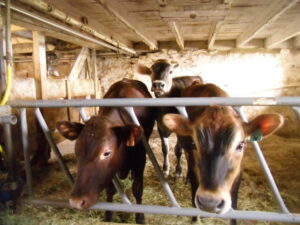
It is important to remember that mother cows can also be a source of injuries.  This usually happens when a protective mother views her calf to be threatened and becomes aggressive.  This is usually precipitated by a regular management practice such as ear tagging or castration.  These kinds of injuries can be avoided by taking precautions.  1. Do not get between the mother and her calf.  2. Bring another person along to stand guard if there is a concern.  3. Some animals are more aggressive than others.  Identify these and separate for special work.  4. Cull problem animals.  5. Select cattle known to be less aggressive.  Most bull studs have docility scores for the bull semen that they market.  Select those known to produce less aggressive offspring.

For more information, please see the fact sheet link:    North Dakota State Factsheet about Ornery Cows

Attitude is a heritable trait