Resources for New Jersey Licensed Private Pesticide Applicators & Growers – 2022 Meetings Tools for Regulatory Compliance
Crop progress and sicklebarring palmer greenstalks
Salem County: Two plus inches of June precipitation on the 9th and 12th carried non-irrigated corn and soybean through the month with only trace amounts of precipitation until the 24th when some areas received another half inch.
In exceptionally wet fields, climbing humidity levels on the 13th, 14th, and 15th were high enough to allow for foliar disease development in beans.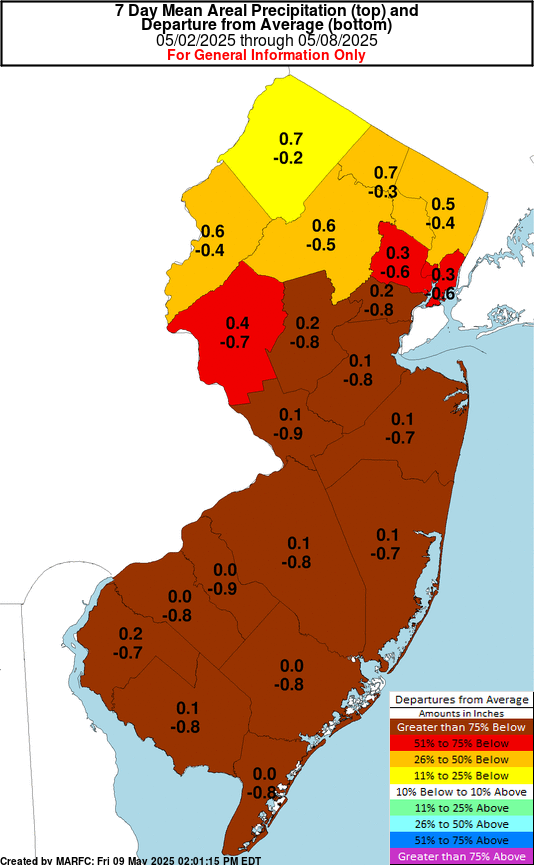 But the following week of low humidity was less than conducive for disease proliferation until the 22nd through the 25th when humidity levels briefly rose and remained in the high 80’s and 90’s for three days, before dropping nicely to the mid 60’s the last two days of June. However, wind speeds of 15 to 25 mph from June 13th to June 19th wicked moisture out of corn and soybeans leaving the crops in a moisture deficit.
This is confirmed in ‘The Evaporative Demand Drought Index’ (EDDI) monitoring tool for South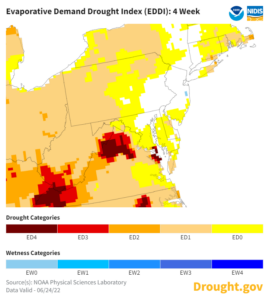 -Jersey. This tool created by the NOAA Physical Science Laboratory is an indicator of both rapidly evolving “flash” droughts and sustained droughts. “EDDI can offer early warning of agricultural drought, hydrologic drought, and fire-weather risk.”
Pest pressure: Producers should monitor beans for Japanese beetle, green stink bug and grasshopper feeding going into July and be alert to excessive damage from flea beetles on crops stressed from wind evaporation. Palmer amaranth is exceptionally tolerant to droughty conditions and thrives under stresses that wilt other pigweed species. Shattercane and johnsongrass are both warm-season grasses that also thrive under these weather conditions.
Mechanical options: In addition to chemical control options, if droughty evaporative weather persists, producers should consider manually removing seedhead stalks to protect maximum yield projections in soybeans. The ideal mechanical tool to do this would be a front mounted sickle bar mower. Do-it-yourself fabricators maybe interested in this attachment created specifically to deal with palmer amaranth by a Kansas farmer. (A cooperative build, purchase, may be a good investment for combine and spray rig operators in the County). https://www.rowshaver.com/
Forecast: Going into this weekend, the 24-hour precipitation forecast for
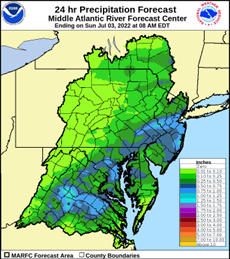 New Jersey anticipates a tenth of an inch to half inch of rainfall for most of Salem County through July 3 and much-needed swath probable for the northern counties where drought conditions the last seven days are 51% to 75% below normal.
USDA June Acreage Report for Corn, Soybean and Wheat
The USDA released its June Acreage Report
Here are the numbers:
2022 Corn Intended Acres: 89.9 million acres compared to the USDA March 31 report of 89.5 million acres and 93.3 million acres in 2021. This would be down 400,00 acres from the March report and down 3.4 million acres from last year.
2022 Soybean Planted Acres: 88.3 million acres vs. the USDA March 31 at 90.9 million acres and 87.2 million acres in 2021. This would be down 2.6 million acres from the March 31 report and up 1.2 million acres from last year.
2022 Wheat Planted Acres: 47.1 million acres this compares to the USDA March 31 report at 47.351 million acres and 46.703 million acres in 2021.
Initial thoughts after reviewing the survey numbers:
The numbers are neutral to corn and wheat and bullish short term and long term for soybeans. The total corn and soybean acreage is just 178.2 million acres. It looks like my early projection of 3 million acres of prevent plant may be 2 million acres too low.
The soybean market will be very weather sensitive, with 2.6 million acres less acres than the March 30 Prospective Planting report, this could create 134 million less soybean bushels than earlier estimates.
Shared from: https://www.agriculture.com/markets/analysis/actual-acres-planted-to-corn-rise-while-soybeans-drop-in-2022-usda-says?did=802009-20220630&utm_campaign=todays-news_newsletter&utm_source=agriculture.com&utm_medium=email&utm_content=063022&cid=802009&mid=91029761676&lctg=123588474
Sign Up By June 30 to Receive the 2022 Census of Agriculture

Agricultural producers who did not receive the 2017 Census of Agriculture and do not receive other USDA surveys or censuses have until June 30 to sign up to receive the 2022 Census of Agriculture. USDA’s National Agricultural Statistics Service (NASS) will mail ag census survey codes for responding securely online to every known U.S. producer this November. Hard copy questionnaires will follow in December.
The ag census, conducted for over 180 years, remains the only source of comprehensive and impartial agricultural data for every state and county in the nation. It includes every operation – large or small, urban or rural – from which $1,000 or more of agricultural products are produced and sold, or would normally be produced and sold, in the ag census year.
“The Census of Agriculture is a complete count of U.S. farms and ranches and the people who operate them,” said Bruce Eklund, state statistician of the USDA’s National Agricultural Statistics Service (NASS), New Jersey Field Office. “Every response is important. The Census of Agriculture is only taken once every five years and documents the value of America’s rural and urban farmers and ranchers. When it comes to Agriculture, people seek information about the local level. Help us document the importance of agriculture in your area.”
On the NASS webpage, producers can also access frequently asked questions, explore past and current ag census data, access tools to help spread the word about the upcoming ag census, learn about ag census special studies, and more.
NASS builds its distribution list for every Census of Agriculture between and during ag census through the official sign-up webpage and multiple National Agricultural Classification Surveys. To learn more about the 2022 Census of Agriculture, visit their website or call the NASS New Jersey Field Office at 503-308-0404.
###
NASS is the federal statistical agency responsible for producing official data about U.S. agriculture and is committed to providing timely, accurate and useful statistics in service to U.S. agriculture. USDA is an equal opportunity provider, employer and lender.
Upcoming Parasite Management Webinar for Sheep and Goat Producers
For more information and how to register visit:
https://www.ndsu.edu/agriculture/ag-hub/events/animal-antibiotics-and-parasite-management-webinar
Crop Progress and Hessian Fly Sightings
June 8, 2022 Salem County, NJ
Salem County has experienced nearly two weeks of ideal temperatures in the mid 80’s to low 90’s allowing for a considerable amount of soybean acreage to be planted, and hay acreage harvested. Rye for grain harvest is nearly complete and barley will soon follow. With a 72-hour forecast of one inch to one and a half inch expected, many producers have switched back to planting as the window to make dry hay closes.
Corn: Early planted corn is near canopy and in very good condition. Surface moisture is adequate but at this stage of rapid stem elongation, rain is needed to replenish the two inches of rain received at the end of May but less than a tenth of an inch in the last week. Overall, most of Salem County received in excess of 12 inches of rain in the last 90 days ending June 6, which is over an inch and a half more than the average for this period of the growing season and substantially more than the drought stressed crops in Cape May County that are experiencing a 75% deficit in moisture for the last seven days. Corn planted into standing rye and other late terminated cover crops is lagging behind tilled fields due to moisture competition and carbon sink, but overall flushes of seedling broadleaves are not present indicating preemergence programs are working effectively.
Soybeans: Full season soybean planting is nearly complete. Emerged beans are ahead of seedling flushes of pigweeds but behind giant ragweed in areas where ragweed is present. Expect amaranth species weed pressure to increase significantly after this weekend’s forecasted rain.
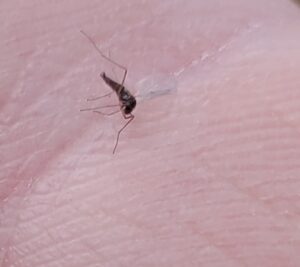
Wheat: Wheat is drying down rapidly and in overall good to excellent condition. In areas where irrigated wheat is already yellow and evidence of wind damage is visible, Hessian Fly is the most likely culprit as seen in this photograph taken in a dough stage field. Flowering canada thistle seen in wheat that will be double cropped with soybeans should be de-headed to prevent seed dispersal prior to harvesting. In enlarging patches, consider a spot-treatment (sacrificing soybean) of a growth regulator herbicide if prior treatments of glyphosate products have not limited spread.
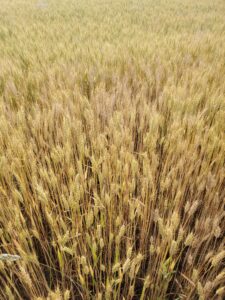
About Hessian Fly: Mayetiola destructor (Say) is a grain pest in the Cecidomyiidae family. It is a major cause of wheat yield reduction around the world. The fly forms galls on the underside of wheat leaves that protect the feeding larva from efficacious applications of insecticides. In addition to wheat, Hessian fly can be found in rye, barley and in brome grasses (and reedscanary). Bromes are a major composition of the grasses in this area. Egg hatched occurred when temperatures were above 50 degrees earlier this season.
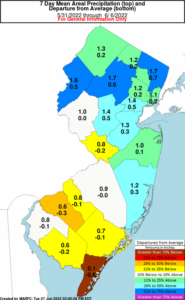
https://www.weather.gov/marfc/Precipitation_Departures
If producer’s noticed patches of dark green areas of wheat (barley) in the same fields now infested with flies or where lodging is increasingly evident, these are an indicator of where the larva were pupating.
Larval feeding after stem elongation causes lodging. Feeding damage can also cause failure to produce a seed head, and a reduce seeds per spike and light test weight. – Journal of Integrated Pest Management, September 2018 article.
The adult swarm seen today are emerging after fourteen days of ideal weather above 70 degrees Fahrenheit. Now that flies are present, they will lay eggs over the course of the next week.
Due to climate change, it is possible that there could be three emergences of Hessian Fly this year. Southern states see as many as six generations. Generally, in northern states past recommendations have suggested the fly has an emergence in the spring and again in the fall. But in southern states emergences occur in multiples of one, two three in spring, and again in fall. Which is where management strategies come into play. Knowing the number of emergences in our area can help producers calculate if delayed planting will assist with controlling a two brood a year emergence or if it is unlikely to help with multiples of brood emergences. Wind plays a major role in dispersal from infected fields to non-infected fields. Due to cover crop program planting dates for small grains, producers with Hessian Fly issues should talk to their local NRCS office to make sure program planting dates take into account the local Hessian Fly Free dates for fall of 2022.
What to do now: Producers can identify Hessian Fly by looking for swirling clouds of insects that look like white smoke coming out of the wheat canopy. Swatting the swarm will trap flies on the palm of the hand for easier identification. The female fly has a distinctive orange striping to her abdomen. Hessian flies are orange and black banded compared to the overall all orange appearance of wheat midges. At this stage, the flies have already pupated through the larval stage, which already damaged the wheat crop by tunneling into the stems. Most likely lodging is evident nearby.
What producers can do to plan for next year: Hessian fly was most likely introduced to North America in infected straw bedding. Straw from infested fields may still contain larva. The fly and larva are not considered a pest of stored grain. The larva pupate in the axis of the leaf stem. Cutting straw stubble below the leaf nodes and removing it from the field may help in management as the Hessian Fly larva overwinter inside a flax-seed like cocoon (puparia) at the base of infected plants. Plant resistant cultivars, delay planting dates if this year’s infestation is associated with an earlier planting date, destroy volunteer wheat, and manage brome grasses in field edges and within field when possible.
Hessian Fly Free Planting Dates in Southern New Jersey: “In Maryland, plant wheat following the Hessian fly-free date for your area. This date is approximately September 30 for the Hagerstown area and becomes progressively later as you move from the south and east in the state. The fly-free date is October 13 on the Lower Eastern Shore.” – Read more in 10 STEPS TO PROFITABLE WHEAT PRODUCTION in the Maryland Agronomy News.
Additional considerations for producers planting winter wheat – double crop soybeans-winterwheat: “Growers should avoid planting wheat into last season’s wheat stubble. Continuous no-tillage, wheat-double-cropped-soybeans may result in severe problems and should be avoided in Hessian fly problem areas.” – https://www.farmprogress.com/grains/hessian-fly-resistance-threat-southeast-wheat
Source information. For a detailed publication on Hessian Fly (Diptera: Cecidomyiidae) Biology and Management in Wheat visit Journal of Integrated Pest Management, (2018) 9(1): 14; 1–12 issue.
Salem County Producers, if you are seeing signs of Hessian Fly lodging, contact Melissa Bravo at the Salem County Extension Office so fields can be monitored in the fall to determine the Hessian Fly Free dates for this area.
