On-Farm Food Safety Section

Keep up with the latest news on this dynamic topic that impacts growers on multiple levels. Developing a farm food safety plan is a good idea for all growers, and may be required as part of food safety audits if you sell to certain buyers.

View NJAES On-Farm Food Safety Essentials

Subscriptions are available via EMAIL and RSS.

Are Disinfectant Wipes Working for You?

Disinfectant wipes can seem like an easy Disinfecting wipesoption to disinfect surfaces during the COVID-19 pandemic. Label instructions for disinfectant wipes include a “allow to remain wet” statement for efficacy. In many cases, the surface needs to stay wet for at least 4 minutes in order to be effective. Check your product label to verify the time for your specific wipes.
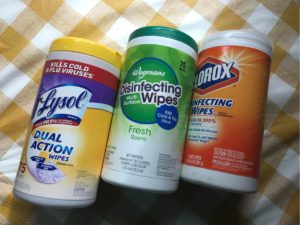
How wet your wipe is to start, how large of a surface you use the wipe on, the surface type and environmental conditions will all impact how long the surface stays wet. In a simple test to evaluate the ability to maintain the required wet time, three disinfectant wipe products were tested on fours surfaces. In an indoor setting at 70 degrees and 60% relative humidity without much air movement these wipes were used on a finished wood surface, a solid countertop, a plastic folding table, and a plastic table cloth. In all cases one wipe on a 4 [Read more…]

Hand Sanitizers for Use in the Field

Under the “Interim COVID-19 Guidance for Migrant and Seasonal Farmworkers, Their Employers, and Housing Providers”, employers are required to provide hand sanitizers with at least 60-95% alcohol in various locations and employers are to schedule handwashing breaks every hour.  If soap and water are not available, an alcohol-based sanitizer that contains 60-95% alcohol may be used.  Hand sanitizers may be difficult to find, but a grower can make their own.  Visit the onfarmfoodsafety.rutgers.edu website for a factsheet entitled “Home-made Hand Sanitizer”.  This walks you through how to make a cheap effective sanitizer.

The next question is, what is the proper method to apply and use the sanitizer?  Research has shown that a two-step sanitizer method is the best method for alcohol-based sanitizers.

  1. Step 1: Apply three pumps of sanitizer from the dispenser.
  2. Step 2: Rub hands for 20 seconds making sure to cover the palms, backs of hands, and between fingers up to the wrists.
  3. Step 3: Wipe the hands on a disposable paper towel.
  4. Step 4: Apply one pump of the sanitizer from the dispenser.
  5. Step 5: Rub hands until dry.

Hand sanitizers do not take the place of handwashing before starting or returning to work; after using the toilet; before and after eating and smoking; before putting on gloves; after touching animals or animal waste or any other time hands may become contaminated under the Food Safety Modernization Act or for most audits.

FDA Provides Flexibility to Farms Regarding Eligibility for the Qualified Exemption Under the Produce Safety Rule

The U.S. Food and Drug Administration announced that it will provide flexibility regarding eligibility criteria for the qualified exemption under the Produce Safety Rule during the COVID-19 public health emergency.


Under the FDA Food Safety Modernization Act (FSMA) Produce Safety Rule, farms are eligible for a qualified exemption and associated modified requirements if they meet certain criteria:

  • The farm’s food sales averaged less than $500,000 (adjusted for inflation) per year during the previous three years; and
  • The average value of the farm’s sales to qualified end-users exceeded the average value of the farm’s sales to all others during the previous three years. A qualified end-user is either (a) the consumer of the food or (b) a restaurant or retail food establishment that is located in the same state or the same Indian reservation as the farm or not more than 275 miles away.

Because of COVID-19, state and local governments across the United States have instituted public health orders that have resulted in many restaurants and retail food establishments either closing or significantly limiting their operations, leaving many farmers without their usual buyers. The guidance intends to allow affected farmers to shift their sales away from qualified end-users while still being considered eligible for the qualified exemption. Specifically, under the temporary policy announced in the guidance, farms that are currently eligible for the qualified exemption and associated modified requirements will still be considered eligible, even if they shift sales away from qualified end-users, so long as they continue to meet the requirement that their average food sales during the previous three years total less than $500,000 (adjusted for inflation).


FDA recognizes that providing flexibility to farms to allow them to shift food sales to available buyers during the COVID-19 public health emergency can help reduce food waste and food shortages. This temporary policy is intended to remain in effect only for the duration of the public health emergency, after which the FDA intends to issue additional guidance.


Qualified exempt farms must comply with modified requirements under the Produce Safety Rule, which include establishing and keeping certain records and prominently displaying their name and business address on food packaging or at the point of sale. Farms are responsible for ensuring that the food they produce is not adulterated under the Federal Food, Drug, and Cosmetic Act (FD&C Act) and they should use good agricultural practices to ensure the safety of their produce.

On-Farm Direct Marketing Webinar Series Now Online

The four-part On-Farm Direct Marketing webinar series recordings are now available online and linked below.
Social Distancing and Safe Food Handling Guidance for Farm Markets, Wes Kline
Sales and Distribution Strategies, Bill Bamka and Steve Komar
U-Pick Guidance for Compliance with Executive Orders, Meredith Melendez
Farmer Panel Discussion, Featuring Tracy Duffield, Jessica Neiderer, and David Specca

For more production agriculture resources on COVID-19, including printable signage for customers and farmworkers visit the Rutgers On-Farm Food Safety COVID-19 webpage.

Webinar Scheduled – Liability for Transmission of COVID-19 to Customers of Farm & Food Businesses

The Northeast Center for Advancement of Food Safety at the University of Vermont announced an upcoming webinar hosted by Farm Commons that might be of interest.

Liability for Transmission of COVID-19 to Customers of Farm & Food Businesses
Friday, May 29th at 4pm Eastern

If your actions lead to a customer contracting COVID-19, are you legally liable? Join us for a webinar discussing whether, when, and how, this legal risk could befall a farm or food business, including farmers markets and food hubs. Essential steps to minimize the legal risk to the business will also be covered. Insurance always plays a role when it comes to injury, so the role of insurance and important questions to ask one’s insurance provider will be discussed. The legal landscape develops by the day with state and federal government changes also on the agenda. This clear, focused webinar will emphasize what you can do to protect your business.

Register at this link.

Cloth Face Covering Requirements for Customers and Employees

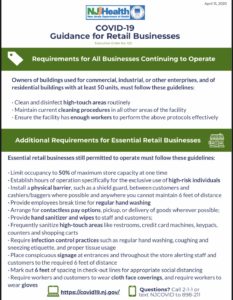
Covid guidelines for small buisnessesAs farms start-up their pick-your-own seasons we are becoming more aware of negative customer feedback on social media sites.  Comments have mostly been specific to the requirement of customers wearing face coverings while outside at a farm retail business.  Your farm is deemed an “essential retail business” allowing you to be open, but requiring you to follow state guidelines.  Customers are required to wear cloth face coverings at all times while at any essential retail business, including farm markets, farm stands, and pick-your-own locations.  Those with health conditions where a face covering would cause a negative impact on their health and children under the age of two are exempted from this requirement.   This season will be unlike any other you have had at the farm, and your customers experience will be different than what they are used to.  This season your farm has the opportunity to provide a safe place to obtain local, healthy food, and hopefully they will make a few good memories while practicing social distancing and using face coverings appropriately.

We have gathered resources to help convey the Governors Executive Orders, and their impacts to your farm operation, below.  The second link is the newly released NJDH printable poster outlining the requirements of all businesses allowed to operate during this time, including the mandate all operating businesses require customers and employees to wear face coverings.

NJ Executive Order 122 – Full length (see page 6, letter K for specifics)
“Require workers and customers to wear cloth face coverings while on the premises, except where doing so would inhibit that individuals health or where the individual is under two years of age.”

NJDH Guidance for Retail Businesses – Requirements for all Businesses Continuing to Operate (printable poster)
“Require workers and customers to wear cloth face coverings, and require workers to wear gloves.”

NJDH/NJDA/DOL Guidance for Migrant and Seasonal Farmworkers, Their Employers, and Housing Providers
“Workers must wear face coverings at all times, including during transportation, while working, and while in the presence of others.”
