On-Farm Food Safety Section

Keep up with the latest news on this dynamic topic that impacts growers on multiple levels. Developing a farm food safety plan is a good idea for all growers, and may be required as part of food safety audits if you sell to certain buyers.

View NJAES On-Farm Food Safety Essentials

Subscriptions are available via EMAIL and RSS.

Gleaning: Produce Safety Best Practices

Allowing gleaners on your farm is a wonderful way to provide nutritious high-quality food to food insecure communities. Gleaners can unknowingly contaminate produce, a thirteen minute training video has been developed for volunteer gleaners focusing on produce safety.  This video is available on the Rutgers NJAES YouTube site and soon on the Rutgers On-Farm Food Safety site. A companion quiz was created for use to take after watching the video to test the knowledge of the gleaner on best practices.  A certificate of completion is displayed once the questions have been answered correctly.  We encourage farmers and gleaning organizations to stress the importance of produce safety during the gleaning process through education and support the health and hygiene practices of gleaners.  Best practices covered in the video are discussed in the Q&A below.

How should a farm support gleaner health and hygiene?
The gleaning organization should be aware of what you expect to supply gleaners while they are at your farm and know what they need to provide themselves.

  • Restrooms and hand washing stations should be available in the location that gleaning will take place
  • Restrooms and handwashing stations should be stocked and ready to use
  • First aid supplies should be provided at a central location

What information should you supply the gleaning organization?
Clear communication channels before and during the gleaning process are important!

  • The contact information of the person at the farm who is responsible in case there is an emergency, or if something goes wrong
  • Location/s at the farm where gleaners are permitted to harvest
  • Location of restrooms and handwashing stations
  • Crops that will be harvested and any needed tools or containers that the gleaning organization should provide
  • Information specific to animal activities in the field that could result in feces in the field or feeding damage from wildlife
  • Any areas of the farm that gleaners must not enter

What information should the gleaning organization communicate to gleaners before they arrive at a gleaning event?
While many gleaning events happen last minute, and gleaner participation may be tentative, it is important that this information is shared with them prior to the event to help facilitate good practices.

  • Signs and symptoms of illness that would prevent them from gleaning
  • Appropriate clothing to wear while gleaning
  • Hand jewelry should not be worn while gleaning
  • Tools and gloves from home should not be used, gleaners should only use items supplied by the farm or the gleaning organization
  • Snacks and non-water beverages are not permitted in the field
  • The training video should be viewed prior to all gleaning participation

What information should gleaners understand about identifying produce that is safe to glean?
Gleaners should understand what produce can and cannot be harvested.

  • Do not harvest produce that has fallen off of the plant and is on the ground
  • Do not harvest produce that was dropped on the ground during harvest or transportation
  • Do not harvest produce that is visibly contaminated with fecal matter
  • Do not harvest produce that may be contaminated with fecal matter

What information should the farmer share with the gleaning coordinator and gleaners once they have arrived at the farm?
Information should be provided to gleaners at the start of the event to remind them of your expectations while gleaning. Volunteers showing up late must be informed of this same information and should know to check in with the gleaning coordinator.

  • Restroom and handwashing station locations
  • Importance of washing hands including when to wash them
  • First aid kit and injury handling procedures
  • Harvesting procedures and how to use tools if needed
  • The process to avoid placing harvest containers on the ground, such as using a bottom bin to stack on top of with other bins, with the bottom bin not harvested into
  • Gleaners should not use tools or gloves from home

What behaviors should I expect to see gleaners doing while gleaning to ensure produce safety?

  • Not eating or drinking non-water beverages in the field
  • Not eating produce while they are gleaning
  • Washing hands at appropriate times:
    • Prior to the start of gleaning
    • After using the restroom
    • After eating, drinking, smoking
    • Anytime their hands may become contaminated
  • Awareness of and staying away from fecal material in the field
  • Communicating with the gleaning coordinator when:
    • Fecal material found in the field
    • An injury occurs
    • Someone begins to feel ill
    • Restroom or handwashing facility issues

For more information on produce safety, and details on why the above best practices were targeted for the harvesting of produce visit the Rutgers On-Farm Food Safety Essentials webpage.  To access the gleaner produce safety training visit the Rutgers NJAES YouTube channel: https://www.youtube.com/watch?v=grIGTneupd8 
FSMA PRODUCE SAFETY RULE GROWER TRAINING

February 6, 2025 9:00 AM – 4:30 PM
Pre-Registration Required Deadline to register online is Monday February 3

 New Jersey Vegetable Growers Convention at Harrah’s Waterfront, 777 Harrah’s Blvd., Atlantic City, NJ

 This training fulfills the requirements of the Food and Drug Administration (FDA) that at least one person from each farm needs to receive a standardized curriculum recognized by the FDA.

Topics Include:

  • Introduction to Produce Safety
  • Worker Health, Hygiene & Training
  • Soil Amendments
  • Wildlife, Domesticated Animals & Land Use
  • Agricultural Water – Production Water
  • Agricultural Water – Postharvest Water
  • Postharvest Handling & Sanitation
  • How to Develop a Farm Food Safety Plan

Each attendee will receive a grower manual and be eligible for a certificate from the Association of Food & Drug Officials of the United States (AFDO). Note: Each participant must stay the entire training to be eligible for the certificate of training.

The cost is $50/per person,

Registration is separate from the registration fee to the Vegetable Growers Convention.

*Participants must be registered with VGANJ for the convention to attend this workshop.

For more information, email Jennifer at jmatthews@njaes.rutgers.edu

(Lunch is on your own)

Register at:  https://onfarmfoodsafety.rutgers.edu/fsmaac/

This training is partly funded through grants from the United States Department of Agriculture & the Food & Drug Administration.

Note:

Financial Assistance for Food Safety Certification and Training is available from the USDA Farm Service Agency. This is the chance for eligible fresh fruit and vegetable growers to recover some of their expenses for implementing food safety practices on the farm. For more information on this program please go to: Food Safety Certification for Specialty Crops for Program Years 2024 and 2025

REGISTER TODAY – NJ Ag Convention Coming Soon

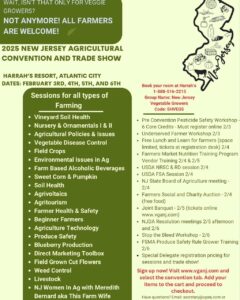
We are only days away from the start of the 2025 NJ Agricultural Convention and Trade Show at Harrah’s in Atlantic City starting on February 3rd to February 6th. The convention has evolved over the years to include much more than vegetable topics. See the graphic below or the VGANJ website convention program for a list of expanded topics.

Nursery growers – we have a full day for you. Do you raise livestock? We have a new session for you. Want to learn about agricultural policies? Come to the session on Tuesday morning hosted by Rutgers Cooperative Extension Director, Brian Schilling and colleagues from the State Agricultural Development Committee. Need to learn about Food Safety Regulations, we have both a session and a workshop for you. USDA will be hosting sessions on Tuesday to promote programs for farmers. There are too many more topics to put into text so please check out the program on the VGANJ website

Need pesticide recertification credits? This year the workshops and sessions will help you fulfill the obligation to obtain those credits. Monday afternoon hosts a 6-CORE credit workshop that requires a separate special registration. Check out the program and how to register on the VGANJ website.

Have you registered for your hotel rooms yet? If not please use the room block and register online at https://book.passkey.com/GO/SHVEG5 or call to make Room Reservations on the phone at 1-888-516-2215 (8:00am-2:00am EST, 7 days a week), Group Name: New Jersey Vegetable Growers. Group Code: SHVEG5. There are plenty of rooms left in the room block, but the pre-registration ends soon, so reserve your rooms today. Please reserve your rooms through the group block to help us meet our obligations for the convention contract. 

Don’t miss the great Tuesday events. There is a FREE “Lunch and Learn” on Tuesday (sign up for tickets at registration on Tuesday, limited to 100 participants) in the back area of the trade show hall with time to meet with vendors and also discussion with the new NJ Secretary of Agriculture, Ed Wengryn. Tuesday night hosts a charity auction and if you attended last year, you know how great this event is with food, drink, and time to catch up with old friends and make new friends in farming. Thanks to VGANJ Secretary, Darcy Perehinys the Tuesday events will once again have amazing food! Lots of prizes from our sponsors will be available for bid at the Charity Auction. If you haven’t attended this event in the past, don’t miss it this year as it is much improved from years past. Tuesday is a big day and with the Lunch and Learn and Charity Auction Happy Hour – if you attend both these events you can eat for free!!!!

One more event you won’t want to miss is the annual awards banquet on Wednesday night. Tickets can now be purchased online on the VGANJ website. This year’s NJ Vegetable Grower of the Year award goes to Brian Porch, of Porch Farms in Salem County, NJ. The award will be presented by VGANJ President, Jim Abma. Come help us celebrate Brian and all the other award winners who will be honored by the NJ Department of Agriculture. 


Central Jersey Vegetable Growers Meeting

February 14th, 2025

8:30 am – 2:30 pm

at the Monmouth County Agricultural Building

4000 Kozloski Road

Freehold, NJ  07728

Registration: $40 (includes morning refreshments and lunch)

CJVGM Brochure 2025

For registration questions, contact Cathy VanBenschoten at 732-431-7260

or email to Catherine.VanBenschoten@co.monmouth.nj.us

DEP Pesticide Credits Applied For:

CORE – TBD

1A – TBD

PP2 – TBD

10 – TBD


Agenda  

8:30 am to 9:00 am: Registration

9:00 am to 10:00 am (1 hour): Pesticide Safety for Applicators and Handlers

George Hamilton, Ph.D. – Specialist in Pest Management, Rutgers, NJAES, RCE

Safe and effective use of pesticides is essential for controlling pests of vegetables, while protecting human health and the environment. This presentation will focus on the proper storage and use of pesticides and the requirements for training and record keeping applicable to commercial vegetable growers. Dr. Hamilton is an extension specialist and chair of the department of entomology at Rutgers University. He has been involved with the initial certification and recertification of New Jersey’s pesticide applicators since 1986.


10:00 am to 11:00 am (1 hour): Updates on Vegetable Disease Control

Andy Wyenandt, Ph.D. – Specialist in Vegetable Pathology, Rutgers, NJAES

Crop losses due to vegetable diseases impact commercial growers every season. As new research findings emerge, our controls are becoming more efficient and effective for addressing these persistent challenges. This presentation fill focus on updates for controlling important diseases in vegetable production as well as new information in the 2023-2024 Commercial Vegetable Production Recommendations.


11:00 am to 11:15 am (15 minutes): BREAK


11:15 am to 11:45 am (30 minutes): Updates from the Vegetable IPM Program (Pre-recorded presentation)

Amanda Quadrel – Senior IPM Program Coordinator, Rutgers NJAES

Managing insect pests continues to be a major problem for commercial vegetable growers in New Jersey. This talk will discuss important updates to the Rutgers Vegetable IPM program, such as new personnel, new trapping protocols, techniques or products to consider for the upcoming season, and updates on pests and pesticide resistance.


11:45 – 12:15 (30 minutes): Industry and Service Provider Updates


12:15 pm to 1:00 pm (45 minutes): LUNCH


1:00 – 1:30 pm (30 minutes): Food Safety Update for NJ Farms

Meredith Melendez – County Agent, Mercer, Rutgers NJAES, RCE

This talk will provide an Update of the FSMA Produce Safety Rule agricultural water regulations for the 2025 growing season, clarification on NJ Cottage Food Law ingredient allowances, and how gleaning activities can impact your FSMA PSR inspection.


1:30 pm to 2:00 pm (30 minutes): Laser Scarecrows for Bird Damage Control

Kate Brown – County Agent, Somerset, Rutgers NJAES, RCE

This presentation will introduce growers to lasers, how they work, and their role in the bird damage control toolbox. The primary goals of this presentation are to describe results from local and regional efficacy trials, highlight laser safety practices, and provide an overview of how lasers are currently being utilized on four NJ farms.


2:00 pm to 2:30 pm (30 minutes): Beginner Farmer Program Update

Bill Hlubik – County Agent, Middlesex, Rutgers NJAES, RCE

Matt Milburn – Program Associate, Middlesex, RCE

This presentation will provide an update on the Rutgers RU Ready to Farm Beginner Farmer Training Program and ask the group for input on practical applied research and programs the farmers would like to see in 2025 and beyond.


This Annual Event is brought to you by Rutgers Cooperative Extension


Register Before December 31 for Bonuses at the 2025 NJ Ag Convention

Have you signed up for the 2025 New Jersey Agricultural Convention and Trade Show yet?
Visit the VGANJ Convention Website and register today!

It’s incredibly simple! Here’s a pro tip: Become a member of the Vegetable Growers Association to enjoy all the benefits, even if you don’t grow vegetables, and save on convention registration fees by becoming a member. Everyone must register to enter the trade show and participate in educational sessions and other events sponsored by the VGANJ. 

Make sure to register by December 31st to receive two complimentary drink tickets (per registered individual) for use at the trade show bars after 2 PM on Tuesday and Wednesday. Plus, you’ll be entered to win a $100 gift card for meals during your time in Atlantic City!

Don’t forget to check the VGANJ website for the exciting new educational sessions for 2025.

Also, on Tuesday there will be a special free “Lunch and Learn” program to engage with vendors and participate in a Q&A session with the new Secretary of Agriculture, Ed Wengryn.
*FREE lunch tickets only for the first 100 farmers Tuesday who sign up for the “Lunch and Learn” at the registration desk on Tuesday morning. Lunch starts at 12:00.

On Wednesday, February 5th the VGANJ will be honoring the NJ Vegetable Grower of the Year. For 2025 the honoree is Brian Porch from Salem County, NJ. Come help us celebrate our awardee and the NJDA awardees at the banquet. Tickets are now available online through VGANJ. See the VGANJ Convention Website to sign up for the banquet and other special events.

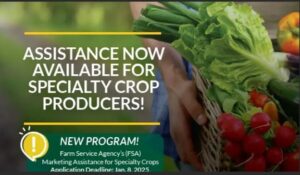
Hurry – Apply for the Marketing Assistance for Specialty Crops (MASC) Program– Applications Due January 8, 2025 – Contact Your Local FSA Office Now

The MASC program, administered by the Farm Service Agency (FSA) using Commodity Credit Corporation (CCC) funds, provides eligible specialty crop producers with marketing assistance payments to help them engage in activities that aid in expanding domestic specialty crop markets or in developing new markets for their specialty crops in 2025.

SPECIALTY CROPS ELIGIBLE – Fruits (fresh, dried) Nursery crops, Christmas trees, and floriculture, Vegetables (including dry edible beans and peas, mushrooms, and vegetable seed) Culinary and medicinal herbs and spices, Tree nuts, Honey, hops, maple sap, tea, turfgrass, and grass seed. Payments are capped at $125,000 per producer, and if demand exceeds the allocated $2 billion, payments may be prorated. Final payment factors will be determined after the application period closes.

To be eligible for payments, persons or legal entities must:
• Be in the business of producing a specialty crop at the time of application and be entitled to an ownership share and share in the risk of producing a specialty crop that will be sold in calendar year 2025;
• Be a U.S. citizen, resident alien, partnership, corporation, limited liability company, or other organizational structure organized under State law, Indian Tribe or Tribal Organization, or a foreign person or foreign entity who meets certain eligibility requirements;
• Comply with the provisions of the “Highly Erodible Land and Wetland Conservation” regulations, often called the conservation compliance provisions;
• Not have a controlled substance violation;
• Submit a complete MASC application form (FSA-1140) and provide all required documentation as specified in the documents section below.
To be eligible for payments, a person or legal entity must have an average adjusted gross income (AGI) of less than $900,000 for tax years 2021, 2022, and 2023, unless the person or legal entity’s average adjusted gross farm income is at least 75 percent of their average AGI.

Eligible producers can apply by completing the FSA-1140, Marketing Assistance for Specialty Crops (MASC) Application, and submitting it to any FSA county office by January 8, 2025.

FSA-1141, Marketing Assistance For Specialty Crops (MASC) New Producer Expected Sales Worksheet (New producers only)
New producers must complete and sign the new producer expected sales worksheet and provide along with their FSA-1140 to any Farm Service Agency county office nationwide.

See link for more information: https://www.fsa.usda.gov/tools/informational/fact-sheets/marketing-assistance-specialty-crops-program