Commercial Ag Updates + Farm Food Safety

Rutgers Cooperative Extension Ag Agents provide updates on what they see in the field, upcoming events, and other important news that affects your operation, such as developments in on-farm Food Safety. Subscribe if you wish to be notified about workshops, meetings, and upcoming commercial ag events.
 
Subscriptions are available via EMAIL and RSS.

This Week’s Changes and Updates to Relief Programs that Impact Farmers

This past week brought several changes and updates to relief programs that impact farmers. This blog from the University of Minnesota is a good summary of changes and announcements by USDA on relief programs that impact farmers and includes links to websites with more information: https://blog-abm-news.extension.umn.edu/2021/03/paycheck-protection-program-extended.html.

The American Rescue Plan Act uses the 2501 definition of “socially disadvantaged”, which includes Black/African American, American Indian or Alaskan native, Hispanic or Latino, and Asian American or Pacific Islander. Gender is not a criteria in and of itself, but of course women are included in these categories.

For the latest CFAP details, visit farmers.gov/cfap.

To find your local service center and learn more about how to access their services during the pandemic, visit farmers.gov/service-center-locator.

Attention Tree Fruit Growers!

Ask the Expert Series Orchard Edition

Please Join us for an Interactive Discussion on Tree Fruit Thinning

QR code

April 7: 9AM-10:15 AM

Zoom Link: https://go.rutgers.edu/tdi8pllm

Meeting ID: 974 2422 2622Password: 808726

Join by Phone: 1 646 558 8656


Expert Panelists
Win Cowgill, Professor Emeritus, Rutgers University and owner Win Enterprises International, LLC a Pomology and Horticultural Consulting firm
and
Jon Clements, Commercial Tree Fruit Extension Educator at The University of Massachusetts

Topics will include Apple fruit thinning with plant growth regulators, crop load management, return bloom, fruit growth model and Cornell Carbohydrate Models as tools for thinning and update on PGR’s Available for 2021

This will be part presentation followed by an INTERACTIVE discussion.

Prior to Wednesday April 7, Please E-mail ALL of your Tree Fruit Thinning Questions to:
Megan Muehlbauer muehlbauer@njaes.rutgers.edu
or
Hemant Gohil gohil@njaes.rutgers.edu
Prepare to have a lively interactive discussion between the experts and your fellow New Jersey tree fruit growers!

On Farm Readiness Reviews (OFRR) Available to Produce Growers

As part of the Food Safety Modernization Act (FSMA) the New Jersey Department of Agriculture in coordination with Rutgers Cooperative Extension are again offering an OFRR to any operation that has taken the Produce Safety Alliance (PSA) Training.  The PSA training is required for fresh produce operations to comply with FSMA with sales over $25,000.  We have been doing OFRRs over the last two years (approximately 100) and want to continue this service during 2021.  So, what is the OFRR?  It is a walkthrough of the farm operation to assess where it may need for make changes to comply with FSMA prior to an inspection.  Generally, two individuals will be on the assessment team one from Extension and one from the New Jersey Department of Agriculture.  These reviews take approximately 2 hours and is scheduled to fit into the grower’s time.  To schedule a review email Charlotte Muetter at charlotte.muetter@ag.nj.gov.  She will then contact the farm operation to schedule the review.

On-Farm Food Safety Talks for the Busy Grower

The Rutgers On-Farm Food Safety Team has developed three video presentations.  Clip on  Three On The Go Webinars For the Busy Grower  to view the three videos listed below.

 Introduction to Food Safety Modernization Act (FSMA) and USDA Audits.  Find out the differences between FSMA inspections and USDA audits. Who do they apply to and who does the inspection or audits?

Building Your One-Way Street: Backflow Prevention and Your Farm.  Learn what backflow is, how to evaluate your operations and how to prevent problems with backflow to protect your packed produce.

How to Use Best Practices for On-Farm Recordkeeping.  Tried and true strategies for organized record keeping that complies with FSMA and will prepare you for USDA audits.

What water test do you need and how often do you need to do it?

FSMA Produce Safety Rule compliance, third party audit standards, and general best practices all include the need for irrigation, harvest, cleaning, sanitation, handwashing, pesticide application, drinking and postharvest water testing.  Not all tests are the same, but all cost money, so make sure what your paying for meets your needs.  
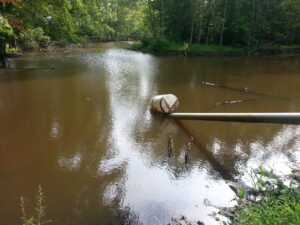
Pond

Here are the questions we commonly get from produce growers and answers that we hope you find helpful:

What water test do I need for a water source that is used only for irrigation of crops and/or pesticide applications?
– This water should be tested for generic E. coli, acceptable results give you a number answer of 126 CFU (colony forming units) or MPN (most probable number) or less. You do not want a presence/absence (P/A) test.  A P/A test would not be sufficient for a third-party audit requirement or the FSMA PSR.
-Most water testing labs on the NJ Water Testing Lab Map (link below) offer the EPA 1603 analysis, which satisfies both the FSMA PSR anticipated requirements and third-party audit requirements.
-Other acceptable analysis methods are described on the
Produce Safety Alliance Water Analysis Method Requirement fact sheet.
-Well water sources used for irrigation should be tested once a year.
-Surface water sources should be tested at least three times during their period of use, ideally when starting irrigation, mid-season, and close to harvest.  Surface water sources include irrigation ponds (spring fed, well fed, or other ponds), streams, rivers, and other bodies of water that are exposed to the surface.
-Municipal water sources used for irrigation should have a copy of the water testing record on file.  These testing records are often found online or are available upon request.  Made sure that generic E. coli is listed on the report.

What water test do I need for a water source that is used during the harvest process? Handwashing water? Cleaning and sanitizing use? Postharvest washing and cooling water? 
[Read more…]

What Farmers Need to Know about the Latest Relief Bills

Recent COVID-19 relief programs have impacts for farmers.

  • The Treasury Department and Internal Revenue Service (IRS) announced that the federal income tax filing due date for individuals for the 2020 tax year will be automatically extended from April 15, 2021, to May 17, 2021. The New Jersey Department of the Treasury has also extended income tax payments from April 15, 2021, to May 17, 2021. This relief does not apply to estimated tax payments that are due on April 15, 2021. These payments are still due on April 15. Source: Internal Revenue Service (irs.gov) and New Jersey Department of the Treasury (https://www.state.nj.us/treasury/taxation)
  • The American Rescue Plan Act ($1.9 trillion) – March 11, 2021
    • Assistance for Socially Disadvantaged Farmers –
      • Requires USDA to make payments of 120% of outstanding loans as of January 1, 2021 to socially disadvantaged farmers.
      • $1.01 billion in outreach, training, education, technical assistance, grants and loans, and funding to educational institutions to help land access to socially disadvantaged farmers.
    • Nutrition assistance to millions through additional funding for nutrition assistance programs (SNAP, WIC, school lunch programs, senior nutrition, nutrition assistance for the territories).
    • Supporting farmers and strengthening the food supply chain.
      • Increases food available for distribution through food banks, nonprofits, or restaurants to help feed families in need and at the same time supports farmers by purchasing their products.
      • Provides grants and loans to reimburse or purchase personal protective equipment, test kits, and other measures to keep essential food workers safe.
      • Invests in infrastructure and retooling support for food processors, farmers markets, food banks, local food systems, and producers to build resiliency in the food supply for the long term.
      • Funds the monitoring of COVID-19 in animals and reduces overtime inspection fees paid by small meat and poultry processors, supporting livestock and animal health.
    • Strengthening infrastructure, housing, and health care in rural America.
      • $500 million in Community Facility Program funds to help rural hospitals and local communities broaden access to COVID-19 vaccines & food assistance.
      • $100 million through September 2022 in rental assistance for low-income and elderly borrowers.
      • $39 million through September 2023 to help refinance direct loans under the Single-Family Housing Loan Program and the Single-Family Housing Repair Loans & Grants.
      • Investments into rural communities by expanding internet connectivity and establishing a homeowner assistance fund to assist struggling homeowners with mortgage payments, property taxes, property insurance, utilities, and other housing related costs.
    • PPP Extension Act of 2021
      • Passed the House March 18, 2021. Still needs to go through Senate and to the President before it becomes law.
      • This bill extends by 60 days the Paycheck Protection Program, established to support small businesses in response to COVID-19 (i.e., coronavirus disease 2019), through June 30, 2021. Currently, the program is set to expire on March 31, 2021.
      • For the final 30 days of the program (i.e., from June 1 until June 30), the Small Business Administration may only process applications submitted prior to June 1, and it may not accept any new loan applications.
      • The revised formula, introduced in an interim final rule March 3, allows Schedule C filers to use gross income instead of net profit in calculating the maximum amount they can receive in a PPP loan. Because many Schedule C filers report little, if any, net profit, they can qualify for significantly larger PPP loans using gross income in the formula.
      • The formula change does not make the change retroactive and allow Schedule C filers who received PPP loans based on the old formula to apply for the difference between what they received and what they could have received using gross income instead of net profit.
      • If I file a 1040 using Schedule F, can I get a PPP loan?
      • Yes, if your farm or ranch meets the size standards set by the SBA:
      • Farmers who fill a Schedule F were eligible for a PPP loan if:
        • Their business meets SBA’s “alternative size standard.” The “alternative size standard” is currently: (1) maximum net worth of the business is not more than $15 million, and (2) the average net income after Federal income taxes (excluding any carry-over losses) of the business for the two full fiscal years before the date of the application is not more than $5 million. For all of these criteria, the applicant must include its affiliates in its calculations.

The PPP Extension Act of 2021 is not yet law but can be very beneficial for farmers.  My suggestion is to consult with your professional tax advisor, pay taxes that are due, but do not file until we see if the PPP Extension Act of 2021 becomes law.

The United States Small Business Administration (SBA https://www.sba.gov) has FAQs that are constantly being updated to explain these programs and can be very useful for you and your tax advisor.