Commercial Ag Updates + Farm Food Safety

Rutgers Cooperative Extension Ag Agents provide updates on what they see in the field, upcoming events, and other important news that affects your operation, such as developments in on-farm Food Safety. Subscribe if you wish to be notified about workshops, meetings, and upcoming commercial ag events.
 
Subscriptions are available via EMAIL and RSS.

Be Proactive, Keep Youth Safe on the Farm

How often do you say this: “do as I say, not as I do”?

The farm can be a fun, engaging, and nostalgic place to raise children; however, life on the farm comes with inherent risks that require certain precautions to make the farm a safe place for kids. The curious nature of children makes this especially difficult, as they often exhibit a lack of fear or a clear understanding of danger. According to the Children’s Safety Network, 42% of fatal injuries to youth on U.S. farms involve machinery and motor vehicles (e.g. tractors, ATVs, etc.) while another 16% of fatal injuries are due to drowning. As the school year comes to a close and your own children and grandchildren spend more time on the farm, use your actions and attitude to establish safety as a priority.

In addition to being a positive role model, make time to identify hazards around the farm and implement changes to improve safety. We have included some of these hazardous “hot spots” in the table below, along with recommendations for injury prevention.

Hazards for Children Recommendations to Prevent Injury
Workshops, chemical and grain storage areas Install gates, doors, or other locking systems to keep children out

Explain the meaning of warning signs around the farm

Clean and dispose of empty chemical containers

Establish designated safe play areas

Machinery and equipment Equipment should be turned off, disengaged, and inaccessible

Leave front end loaders and similar equipment in the down position

Lock vehicle cabs after use

Keep vehicle keys out of reach of children

Never allow children to play around machinery

Never allow children (or anyone) to be an extra rider on a tractor

Livestock Pens Only allow children to work with livestock under adult supervision

Secure livestock pens so children cannot wander into the area


If you’re looking for fun ways to talk with children about farm safety, check out this farm safety activity book created by the National Child Safety Council. The book includes games, puzzles, crafts, and more on a wide array of topics from livestock and tractor safety to first aid.

For more details on age-specific hazards, protective measures, and appropriate tasks for youth check out our NJAES factsheet titled “Farm Safety Tips for Children”.

Source: Brennan, M.F. and Brumfield, R.B. “FS937: Farm Safety Tips for Children.” Rutgers University, March 1999. https://njaes.rutgers.edu/pubs/publication.php?pid=FS937. Accessed on 10 June 2021.
Needs Assessment Survey for RU Ready to Farm Beginner Farm Training Program

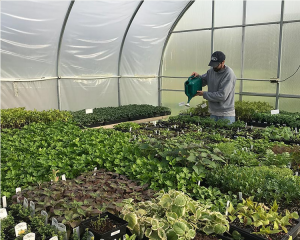
The Rutgers Cooperative Extension Training Program-RU Ready to Farm is looking for input from beginner farmers on what types of subjects they would like to see covered. The 2022 season of RU Ready to Farm will feature in person workshops that are open to the general beginner farmer community, and the focus and content of these workshops will be designed according to community need and interest. If you have been farming for fewer than 10 years and would like to contribute to the development of this workshop series, the survey can be found here: RU Ready to Farm Needs Assessment

For more information about the RU Ready to Farm program, visit: https://rubeginnerfarmer.rutgers.edu/


Rutgers Resources to Help Your Customers Safely Preserve Your Farm Fresh Produce

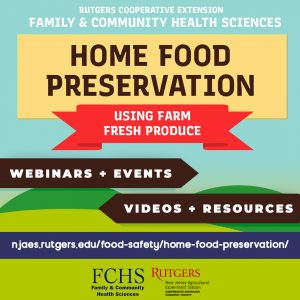
Home Food PreservationOur Ag & Natural Resources (ANR) Chair Nick Polanin shared that our Rutgers Cooperative Extension Family & Community Health Science Department (FCHS) has developed social media posts (below) and the attached mini posters for use by on-farm & community farm markets to promote safe home food preservation. These direct users to the NJAES home food preservation webpage. The posters are provided in full color and less color versions for websites or printing.

Face Book:  Please share this Facebook  post:  https://www.facebook.com/SCNJFCHS/posts/2008602745963285

Instagram text to copy & paste the jpg photo attached  and the following text:

Preserve Your Farm Fresh Produce

With the help of @fchs.rutgers, you can now access a harvest of free information for preserving your farm fresh produce!

Filled with webinars, events, videos, and all kinds of other resources, the home food preservation website is great for making everything easy to understand and digest, all while helping you learn through tutorial, expert publications, and more.

You can access the full site here:  njaes.rutgers.edu/food-safety/home-food-preservation/

This is also a valuable way of finding specific classes or speakers, as well as learning more about your county’s local FCHS office, their programs and events.

Management of italian ryegrass

Below is a pdf on ‘Italian Ryegrass Management in Soybeans’ by Take Action Partners on herbicide resistance management.

Italian rye grass and its hybrids are a common grass in head right now along field edges and in fall planted grains or as a weed of pure stands of hay crops. Ryegrass is difficult to control in most crops due to its emergence biology, tillering and resistance to herbicides.

“Technical editing for this publication was led by Larry Steckel, Ph.D., University of Tennessee, Knoxville; and Jason Bond, Ph.D., Mississippi State University, in partnership with other universities in the soybean-growing regions of the United States. Take Action is supported by BASF, Bayer, DuPont, Dow, FMC, Monsanto, Syngenta, Valent and corn, cotton, sorghum, soy and wheat organizations.” For more information and links to additional resources, visit www.IWillTakeAction.com.™

https://iwilltakeaction.com/uploads/files/57229-7-ta-hrm-factsheet-italianryegrass-r2-final.pdf

For management in forage hay crops, see the Oregon State publication “MANAGEMENT OF ANNUAL RYEGRASS CONTAMINATION IN TALL FESCUE AND ORCHARDGRASS GROWN FOR SEED” https://cropandsoil.oregonstate.edu/system/files/curtis_annual_ryegrass.pdf


USDA to Begin Loan Payments to Socially Disadvantaged Borrowers under American Rescue Plan Act

WASHINGTON, May 21, 2021 — The U.S. Department of Agriculture Farm Service Agency (FSA) today published the first notice of funding availability (NOFA) (PDF, 242 KB) announcing loan payments for eligible borrowers with qualifying direct farm loans under the American Rescue Plan Act Section 1005. The official NOFA will be published in the Federal Register early next week and USDA expects payments to begin in early June and continue on a rolling basis. A subsequent notice addressing guaranteed loan balances and direct loans that no longer have collateral and have been previously referred to the Department of Treasury for debt collection for offset, will be published within 120 days.

“The American Rescue Plan has made it possible for USDA to deliver historic debt relief to socially disadvantaged farmers and ranchers beginning in June,” said Agriculture Secretary Tom Vilsack. “USDA is recommitting itself to gaining the trust and confidence of America’s farmers and ranchers using a new set of tools provided in the American Rescue Plan to increase opportunity, advance equity and address systemic discrimination in USDA programs.”

Section 1005 of the American Rescue Plan Act of 2021 (ARPA) provides funding and authorization for USDA FSA to pay up to 120 percent of direct and guaranteed loan outstanding balances as of January 1, 2021, for socially disadvantaged farmers and ranchers as defined in Section 2501(a) of the Food, Agriculture Conservation, and Trade Act of 1990 (7 U.S.C. 2279(a)). Section 2501(a) defines a socially disadvantaged farmer or rancher as a farmer or rancher who is a member of a socially disadvantaged group, which is further defined as a group whose members have been subjected to racial or ethnic prejudice because of their identity as members of a group without regard to their individual qualities. Qualifying loans as part of today’s announcement are certain direct loans under the Farm Loan Programs (FLP) and Farm Storage Facility Loan Program (FSFL).

For much of the history of the USDA, socially disadvantaged farmers and ranchers have faced discrimination—sometimes overt and sometimes through deeply embedded rules and policies—that have prevented them from achieving as much as their counterparts who do not face these documented acts of discrimination. Over the past 30 years, several major civil rights lawsuits have compensated farmers for specific acts of discrimination—including Pigford I and Pigford II, Keepseagle, and the Garcia cases. However, those settlements and other related actions did not address the systemic and cumulative impacts of discrimination over a number of decades that the American Rescue Plan now begins to address.

Sections 1005 and 1006 of ARPA provide USDA with new tools to address longstanding inequities for socially disadvantaged borrowers. Section 1006 of ARPA provides additional funding to begin long-term racial equity work within USDA, including to address heirs property claims and to stand up an Equity Commission to identify barriers to access USDA programming.

To learn more about the loan payments to socially disadvantaged farmers and ranchers, visit www.farmers.gov/americanrescueplan.

USDA touches the lives of all Americans each day in so many positive ways. In the Biden-Harris Administration, USDA is transforming America’s food system with a greater focus on more resilient local and regional food production, fairer markets for all producers, ensuring access to safe, healthy and nutritious food in all communities, building new markets and streams of income for farmers and producers using climate smart food and forestry practices, making historic investments in infrastructure and clean energy capabilities in rural America, and committing to equity across the Department by removing systemic barriers and building a workforce more representative of America. To learn more, visit www.usda.gov.

#

USDA is an equal opportunity provider, employer, and lender.


USDA Press Release No. 0109.21

Contact Email: press@usda.gov

2020/2021 Mid-Atlantic Commercial Vegetable Production Recommendations available on-line

The 2020/2021 Mid-Atlantic Commercial Vegetable Production Recommendations guide is still available for FREE on-line. The complete 2020/2021 Vegetable Production Recommendations guide or specific sections can be downloaded depending on your production needs.