On-Farm Food Safety Section

Keep up with the latest news on this dynamic topic that impacts growers on multiple levels. Developing a farm food safety plan is a good idea for all growers, and may be required as part of food safety audits if you sell to certain buyers.

View NJAES On-Farm Food Safety Essentials

Subscriptions are available via EMAIL and RSS.

Covid-19 and Wholesale Grower Questions

The CDC, FDA and USDA have no reports at this time of human illnesses that suggest coronavirus can be transmitted by food or food packaging.

What should an operation do to protect their workers and themselves? Growers should inform employees concerning the importance of following recommended guidelines for their own health, the protection of co-workers and to keep the farm running.  Anyone getting sick with COVID–19 will have a significant impact on continued operation of the farm!
Transportation
1. Do not pack too many workers in a vehicle. Ideally there should just be two individuals in a pickup. If using buses have one individual per seat.
2. If bringing workers in from another country or another part of the United States, consider quarantining them for up to 14 days. It is especially important if one in the group is showing symptoms.
Labor Housing
1. Social distancing inside labor housing with a common bunk room may be a challenge. Consider installing temporary/permanent screens/walls between bunks, separating bunks as far as space allows, or divide bunks into individual beds if practical/possible.
2. Plan for what would happen if someone contracted Covid-19. There should be a separate area set aside for that individual, whether it is a separate room or in another house. The original camp should be cleaned and sanitized following CDC guidelines before any workers return. [Read more…]
“Ask the Ag Agent” 7:00PM Weekly – Every Wednesday – Farmer Video Conference/Call-In Forum

By, William Bamka, Stephen Komar, Michelle Infante-Casella and Meredith Melendez

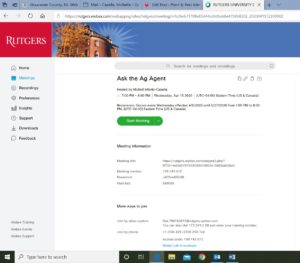
“Ask the Ag Agent” weekly 1-hour sessions for farmers will be hosted by Rutgers Agricultural Agents working with commercial farmers, on Wednesday April 15th and continue each Wednesday. The online conferencing/call in events will begin at 7:00PM with an open forum to discuss ag-related questions about production, marketing, regulations and any other topics farmers wish to discuss. All are welcome.

To access via WebEx on a computer go to https://go.rutgers.edu/rc9n3kxt

Join by phone
+1-650-429-3300 USA Toll
Access code: 799 743 872

Marketing Tip: Consider Pre-Bagging Produce at Farm Markets

By, Michelle Infante-Casella and Meredith Melendez, Agricultural Agents

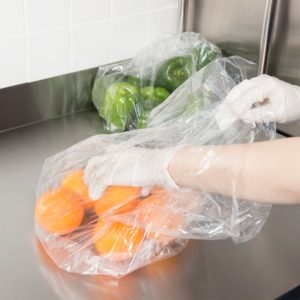
Farm marketers can learn from recent behaviors observed in supermarkets and other food outlets as we start the produce season in New Jersey. Besides facilitating social distancing and having employees and customers wear masks and other protective gear, farm owners and workers can help ease shopping anxiety by pre-bagging items.Person grabbing an orange from a bag with a glove

To date there is no scientific evidence to support the transmission of COVID-19 through food, but customer buying patterns have shown that packaged produce is selling better than loose produce. Customers are fearful of virus transmission from many different sources regardless of the science. Most people are very suspicious when touching every object around them whether it be door handles, shopping carts, checkout counters, credit card machines and also on the list – loose fruits and vegetables on shelves that may have been handled by other people. These fears are certainly understandable.

Some food stores are reporting bagged items are selling faster than loose items. The public sentiment is wrapped produce has a barrier that acts as a safety measure against contamination. Produce items in pre-packaged containers, such as bagged lettuces, bagged broccoli, bagged cucumbers, bagged peppers, packaged tomatoes and other items wrapped in plastic have increased in sales over their unpackaged counterparts. In addition, items in highest demand tend to be more shelf-stable produce like potatoes, apples, onions, unpeeled carrots, winter squashes and cabbage.

The media has been publicizing milk dumping from tanker trucks, in-season produce fields being plowed, and issues with food distribution across the country due to issues from COVID-19. Consumers are questioning many issues right now. Is the U.S. food supply safe? Will there be enough food to go around? Will the food stores be closing? Is it safe to buy fresh produce? Should I worry when I see empty store shelves?

To ensure a domestic food supply in the future, it is more important than ever for customers to buy local and US farm products. This is a message the entire agriculture industry can share with the public.

Some questions about food and COVID-19 can be answered by reading the U.S. Food & Drug Administration’s website https://www.fda.gov/food. This is also a good site to send your customers to help answer their questions. Resources specific for the agricultural community are listed on the Rutgers On-Farm Food Safety COVID-19 website.

In summary, farm market proprietors may want to keep produce displays well stocked with plenty of bagged and packaged produce items. This will also help facilitate having customers in the market for shorter periods. Customers can just pick up bags and go rather than pick through a pile and taking extra time to bag their own items. In addition, pricing bags ahead of time, that don’t need to be weighed, can also quicken check out times. Shoppers are in a hurry to get in and out of stores to ease fears of potential virus transmission. Making it as easy as possible to help facilitate shopping and check out may go a long way to lessen customer anxiety in current times. Keep engaged with customers for suggestions on what they may need from your market.

Farmers and farm markets will be playing a major role in food distribution and food security in the near future and beyond. Thank you to all farmers, farm workers, and other essential workers in this time of crisis.

Cloth Face Coverings for Retail Employees: Executive Order No. 122

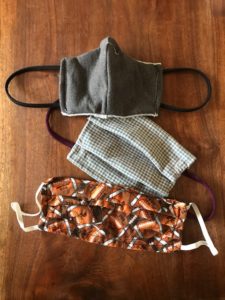
Cloth face masksThe Governor signed Executive Order No. 122 into law on Wednesday, April 8th.  This rule impacts retail sales locations that fall under the Executive Order No. 107 “essential retail business” category.  While many of the items would not be considered new, the requirement of cloth face coverings and gloves for employees is.

Face coverings for employees:
Workers are required to wear face coverings while at the retail location unless the covering would inhibit the individuals health.  Businesses are required to supply face coverings to workers.  The Executive Order does not acknowledge the fact that purchasing facemasks is currently very difficult.  The Executive Order does state that workers can supply their own face covering when preferred by the employee. Guidelines on how to make, wear, and handle face coverings can be found on the Rutgers On-Farm Food Safety COVID-19 webpage.   Printable signage is also available on the website.  Some community organizations are making cloth face coverings. These may be a resource for your workers who are not inclined to make their own if you are unable to provide them. Be sure to train your employees on proper use.  This face covering is not to be worn as a replacement for other personal protective equipment, such as those worn for pesticide applications.

Gloves for employees:
Businesses are required to provide gloves to employees who are interacting with customers and/or handling saleable goods.

Face coverings for customers:
Customers are required to wear cloth face coverings when they enter the retail area. When an individual refuses to wear a face covering for non-medical reasons the business should find an alternative method of shopping for the customer. Options could include pre or outside ordering with pick-up or delivery to the customer outside of the establishment.  Businesses may not ask for proof of a customers medical reason for not wearing a mask.

Visit the Rutgers On-Farm Food Safety COVID-19 webpage for updated resources relevant to your farm operation and COVID-19

Language specific to cloth face coverings and glove use from Executive Order No. 122 is below:

Essential retail businesses that are still permitted to operate under Executive Order No. 107 (2020) must adopt the following policies:
Require workers and customers to wear cloth face coverings while on the premises, except where doing so would inhibit that individual’s health or where the individual is under two years of age, and require workers to wear gloves when in contact with customers or goods. Businesses must provide, at their expense, such face coverings and gloves for their employees. If a customer refuses to wear a cloth face covering for non-medical reasons and if such covering cannot be provided to the individual by the business at the point of entry, then the business must decline entry to the individual, unless if the business is providing medication, medical supplies, or food, in which case the business policy should provide alternate methods of pickup and/or delivery of such goods. Nothing in the stated policy should prevent workers or customers from wearing a surgical-grade mask or other more protective face covering if the individual is already in possession of such equipment, or if the business is otherwise required to provide such worker with more protective equipment due to the nature of the work involved. Where an individual declines to wear a face covering on store premises due to a medical condition that inhibits such usage, neither the essential retail business nor its staff shall require the individual to produce medical documentation verifying the stated condition.

USDA Audits Expiration Dates Extended

Please see the press release below with regards to USDA Audit Program Certifications. Also, the Rutgers On-Farm Food Safety Website is being updated with the latest Covid-19 information as it relates to agriculture. We encourage you to check it frequently. Please reach out if you need us, we are not in the office but we are still working.

USDA Temporarily Extends Expiration Dates for Some Good Agricultural Practices, Domestic Origin Verification, Plant Systems Audit Program Certifications
The U.S. Department of Agriculture (USDA) Agricultural Marketing Service (AMS) is committed to delivering the timely services needed to support the movement of America’s food supply and will continue to take steps to meet challenges due to the COVID-19 national emergency.
To aid the movement of fresh specialty crops into marketing channels, AMS is extending the expiration date of USDA audit certifications scheduled to expire on or before May 31, 2020, by 60 days. USDA audit certifications are normally valid for 12 months. The certification extension applies to 400 current auditees certified under the USDA Good Agricultural Practices (GAP), Domestic Origin Verification and Plant Systems Audit programs.
AMS is advising affected auditees of their 60-day extension and is updating information under “Find a USDA Gap-Certified Company” on the Good Agricultural Practices (GAP) & Good Handling Practices (GHP) webpage to reflect the extended audit expiration dates.
Extending the expiration date for auditees with current certifications will allow AMS to concentrate resources on providing food safety verification audits for entities new to USDA audit programs who require certification to move product into commerce.
The extension is in alignment with the International Accreditation Forum’s Informative Document for Management of Extraordinary Events or Circumstances Affecting Accreditation Bodies and Certifying Organizations, Issue 1, which establishes guidelines for extending food safety audit certifications. The Global Food Safety Initiative (GFSI) also has communicated that, based on risk, certification bodies may be able to extend certifications under extraordinary circumstances for up to six months.
AMS recognizes that USDA specialty crops inspections and audits are critical to the nation’s food supply chain, and we are committed to ensuring the continuity of our audit operations.

NJAES COVID-19 Resource Website

Rutgers NJAES launches website dedicated to COVID-19 resources for commercial agriculture, the food industry, youth, and families.